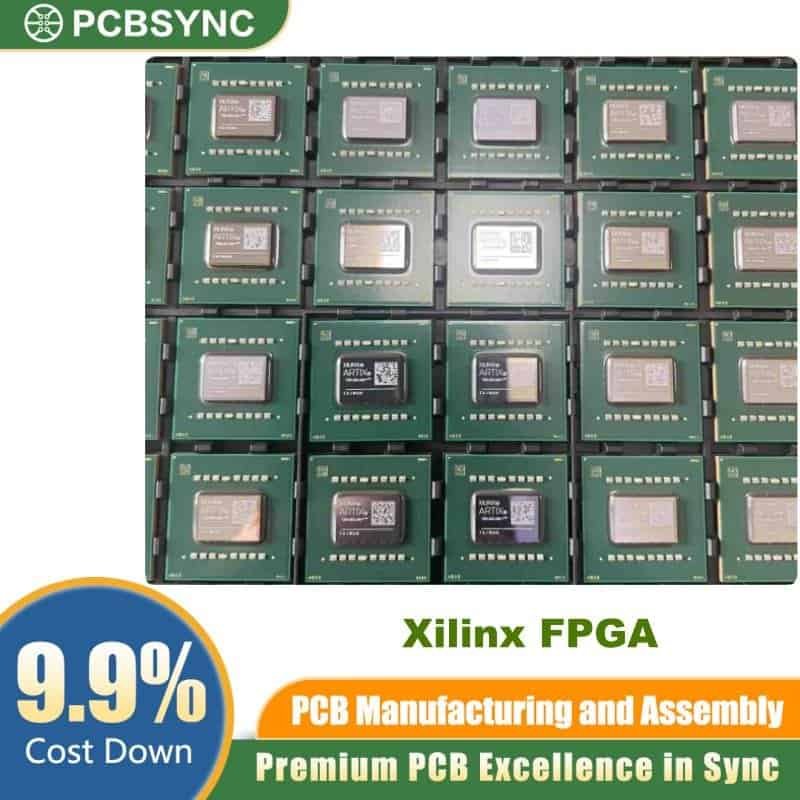
The XC3S1500-4FGG676C is a high-density, cost-optimized Xilinx FPGA from the Spartan-3 family, manufactured by AMD (formerly Xilinx). With 1.5 million system gates, 676-pin Fine-pitch Ball Grid Array (FBGA) packaging, and a -4 speed grade, this device delivers exceptional logic capacity and I/O flexibility for embedded systems, communications, and industrial applications.
XC3S1500-4FGG676C – Key Product Overview
The XC3S1500-4FGG676C is part of Xilinx’s Spartan-3 generation — a family engineered for high-volume, cost-sensitive designs without sacrificing programmable logic performance. It bridges the gap between low-cost CPLDs and high-end FPGAs, making it a preferred choice for engineers targeting mainstream production deployments.
| Attribute |
Value |
| Manufacturer |
AMD (Xilinx) |
| Part Number |
XC3S1500-4FGG676C |
| Family |
Spartan-3 |
| System Gates |
1,500,000 |
| Logic Cells |
29,952 |
| Speed Grade |
-4 |
| Package Type |
FGG676 (FBGA, 676-pin) |
| Package Body Size |
27 × 27 mm |
| Operating Temperature |
0°C to +85°C (Commercial) |
| Core Supply Voltage (VCCINT) |
1.2V |
| I/O Supply Voltage (VCCO) |
1.2V – 3.3V |
| Distributor Reference |
DigiKey #826940 |
XC3S1500-4FGG676C Technical Specifications
Logic and Memory Resources
The Spartan-3 XC3S1500 is built on a 90nm process technology, offering a rich set of on-chip resources suitable for complex digital designs.
| Resource |
Specification |
| System Gates |
1,500,000 |
| Logic Cells |
29,952 |
| Slices |
13,312 |
| Flip-Flops |
26,624 |
| 4-input LUTs |
26,624 |
| Block RAM (BRAM) |
712 Kbits (32 blocks × 18Kbit) |
| Distributed RAM |
208 Kbits |
| Dedicated Multipliers (18×18) |
32 |
| Digital Clock Managers (DCMs) |
4 |
I/O and Connectivity
| I/O Feature |
Specification |
| Maximum User I/O Pins |
487 |
| I/O Standards Supported |
LVTTL, LVCMOS, SSTL, HSTL, LVDS, LVPECL, PCI, GTL+ |
| Differential I/O Pairs |
221 |
| Single-Ended I/O |
45 |
| I/O Banks |
8 |
Clock and Timing
| Parameter |
Value |
| Speed Grade |
-4 (Commercial) |
| DCMs |
4 |
| Max Clock Frequency |
Up to 280 MHz (internal) |
| Clock Input Pins |
8 global |
Package Information: FGG676
FGG676 Package Details
The “FGG676” suffix denotes a Fine-pitch Ball Grid Array package with 676 solder balls arranged in a 26×26 matrix on a 27 mm × 27 mm body. This compact BGA footprint is ideal for high-density PCB designs where board space is a premium.
| Package Parameter |
Value |
| Package Code |
FGG676 |
| Package Type |
Fine-Pitch Ball Grid Array (FBGA) |
| Total Ball Count |
676 |
| Ball Array |
26 × 26 |
| Body Size |
27 × 27 mm |
| Ball Pitch |
1.0 mm |
| Height (max) |
3.0 mm |
| Mounting Type |
Surface Mount (SMD) |
Part Number Breakdown
| Segment |
Meaning |
| XC |
Xilinx (now AMD) product family prefix |
| 3S |
Spartan-3 series |
| 1500 |
1.5 million system gates |
| -4 |
Speed grade (-4 is slowest/most economical in this family) |
| FGG |
Fine-pitch Ball Grid Array package |
| 676 |
676 total pins/balls |
| C |
Commercial temperature grade (0°C to +85°C) |
Electrical Characteristics
Power Supply Requirements
| Supply Rail |
Voltage Range |
Purpose |
| VCCINT |
1.14V – 1.26V (nominal 1.2V) |
Core logic power |
| VCCO |
1.14V – 3.465V |
I/O output drivers |
| VCCAUX |
2.375V – 2.625V (nominal 2.5V) |
Auxiliary circuits, DCI, config |
| VREF |
Varies by I/O standard |
Reference for terminated standards |
Absolute Maximum Ratings
| Parameter |
Maximum |
| VCCINT |
1.32V |
| VCCO |
4.0V |
| VCCAUX |
3.0V |
| Junction Temperature (Tj) |
+125°C |
| Storage Temperature |
-65°C to +150°C |
Functional Features of the XC3S1500-4FGG676C
Digital Clock Managers (DCMs)
The XC3S1500 includes 4 on-chip Digital Clock Managers, each capable of clock multiplication, division, phase shifting, and duty cycle correction. DCMs eliminate the need for external clock conditioning circuitry, simplifying PCB design and improving system timing closure.
Block RAM Architecture
The 32 embedded 18-Kbit dual-port Block RAMs can be configured as true dual-port or single-port memory blocks. They support various aspect ratios (×1, ×2, ×4, ×9, ×18) and can be cascaded for larger memory arrays, making them well-suited for FIFOs, data buffers, and look-up tables in DSP designs.
Dedicated Multipliers
Thirty-two 18×18-bit hardware multipliers provide efficient arithmetic performance for digital signal processing, FIR/IIR filters, and other math-intensive operations without consuming fabric logic resources.
SelectIO Technology
Spartan-3’s SelectIO interface technology supports a wide range of single-ended and differential I/O standards, enabling direct connection to various memories, buses, and high-speed interfaces. On-chip DCI (Digitally Controlled Impedance) reduces the need for external termination resistors.
Configuration and Programming
The XC3S1500-4FGG676C supports multiple configuration modes, providing flexibility for diverse system architectures.
| Configuration Mode |
Description |
| Master Serial |
SPI Flash device drives configuration |
| Slave Serial |
External source (e.g., processor) drives configuration |
| Master Parallel (SelectMAP) |
8-bit or 16-bit parallel from flash |
| Slave Parallel (SelectMAP) |
Processor-driven parallel configuration |
| JTAG |
Boundary scan and in-circuit programming (IEEE 1149.1) |
| Master SPI |
Direct connection to standard SPI flash |
Configuration data is stored externally (e.g., Xilinx Platform Flash XCF series or standard SPI NOR flash), and the FPGA loads its bitstream at power-up or on demand via JTAG for debugging.
Applications for XC3S1500-4FGG676C
The XC3S1500-4FGG676C’s combination of logic density, memory, and I/O capability makes it a versatile fit across multiple application domains.
| Industry |
Typical Use Cases |
| Industrial Automation |
Motor control, PLCs, industrial protocol bridges |
| Communications |
Protocol converters, line cards, DSL equipment |
| Consumer Electronics |
Set-top boxes, digital video, audio processing |
| Automotive |
Sensor fusion, ADAS data aggregation |
| Test & Measurement |
Data acquisition, signal generation |
| Medical Devices |
Imaging pre-processing, patient monitoring |
| Military / Defense |
Ruggedized (with extended-grade variants) signal processing |
| Embedded Computing |
Co-processor acceleration, custom peripheral interfaces |
XC3S1500-4FGG676C vs. Other Spartan-3 Devices
Engineers selecting within the Spartan-3 family should compare device sizes to match design requirements and cost targets.
| Part Number |
System Gates |
Logic Cells |
Block RAM |
Multipliers |
Max I/O |
Package Options |
| XC3S200 |
200K |
4,320 |
216 Kbits |
12 |
173 |
TQ144, PQ208, FT256 |
| XC3S400 |
400K |
8,064 |
288 Kbits |
16 |
264 |
TQ144, PQ208, FT256, FG320 |
| XC3S1000 |
1,000K |
17,280 |
432 Kbits |
24 |
391 |
FT256, FG320, FG456 |
| XC3S1500 |
1,500K |
29,952 |
712 Kbits |
32 |
487 |
FG320, FG456, FG676 |
| XC3S2000 |
2,000K |
46,080 |
1,152 Kbits |
40 |
565 |
FG456, FG676 |
| XC3S4000 |
4,000K |
62,208 |
1,872 Kbits |
96 |
712 |
FG676, FG900 |
Ordering Information
Available Grade and Package Variants for XC3S1500
| Part Number |
Speed Grade |
Package |
Temperature |
Status |
| XC3S1500-4FGG676C |
-4 |
FGG676 |
Commercial (0°C – 85°C) |
Active |
| XC3S1500-5FGG676C |
-5 (faster) |
FGG676 |
Commercial |
Active |
| XC3S1500-4FGG676I |
-4 |
FGG676 |
Industrial (-40°C – 100°C) |
Active |
| XC3S1500-4FG320C |
-4 |
FG320 |
Commercial |
Active |
| XC3S1500-4FG456C |
-4 |
FG456 |
Commercial |
Active |
Note: The suffix “C” indicates a Commercial temperature range (0°C to +85°C ambient). For Industrial-grade operation (-40°C to +100°C), select the “I” suffix variant.
PCB Design Considerations
Decoupling and Power Integrity
- Place 100nF ceramic decoupling capacitors at every VCCINT, VCCO, and VCCAUX pin, as close to the ball as possible.
- Use 1µF bulk capacitors per power bank for low-frequency decoupling.
- Separate VCCINT and VCCO planes to avoid noise coupling into I/O logic.
BGA Fanout Strategy
With a 1.0mm ball pitch on the FGG676 package, standard PCB design rules apply. A minimum of 4–6 routing layers is recommended for efficient BGA escape routing, with a via-in-pad or dog-bone via approach.
Signal Integrity
- Use source-series termination (33–68Ω) on high-speed signal lines.
- Enable DCI on I/O banks connected to terminated buses (DDR, SSTL) to eliminate external termination resistors.
- Differential pairs (LVDS, LVPECL) should be routed as tightly coupled pairs with matched length.
Compliance and Certifications
| Standard |
Compliance |
| RoHS |
RoHS Compliant (Pb-free, Halogen-free) |
| REACH |
Compliant |
| JEDEC |
BGA package per JEDEC MO-205 |
| IEEE |
JTAG per IEEE 1149.1 boundary scan |
| MSL |
MSL 3 (per IPC/JEDEC J-STD-020) |
Frequently Asked Questions (FAQ)
Q: What is the difference between XC3S1500-4FGG676C and XC3S1500-5FGG676C? The only difference is the speed grade. The -5 variant offers higher maximum frequency and lower propagation delays, but at a higher cost. For timing-relaxed designs, the -4 is the more economical choice.
Q: Is the XC3S1500-4FGG676C still in production? Yes, the Spartan-3 family remains in active production as of this writing, with AMD (Xilinx) committed to long-term supply for industrial and embedded customers.
Q: What tools are used to design with the XC3S1500-4FGG676C? AMD’s Xilinx ISE Design Suite (version 14.x) is the primary design toolchain. It supports HDL entry (VHDL/Verilog), synthesis, implementation, timing analysis, and bitstream generation. For new designs, migration to the Vivado toolchain with a newer device may be considered.
Q: Can the XC3S1500-4FGG676C interface with DDR SDRAM? Yes. Using the SSTL2 I/O standard on the appropriate I/O banks, the XC3S1500 can interface with DDR SDRAM at speeds compatible with the -4 speed grade timing parameters. Xilinx provides MIG (Memory Interface Generator) cores for automated DDR controller instantiation.
Q: What is the configuration file size for XC3S1500? The configuration bitstream for the XC3S1500 is approximately 3.7 Mbit (about 470 KB), which determines the minimum required capacity of an external configuration flash device.
All specifications are referenced from AMD/Xilinx official datasheet DS099 for the Spartan-3 FPGA Family. Always verify against the latest revision of the official documentation before production design.