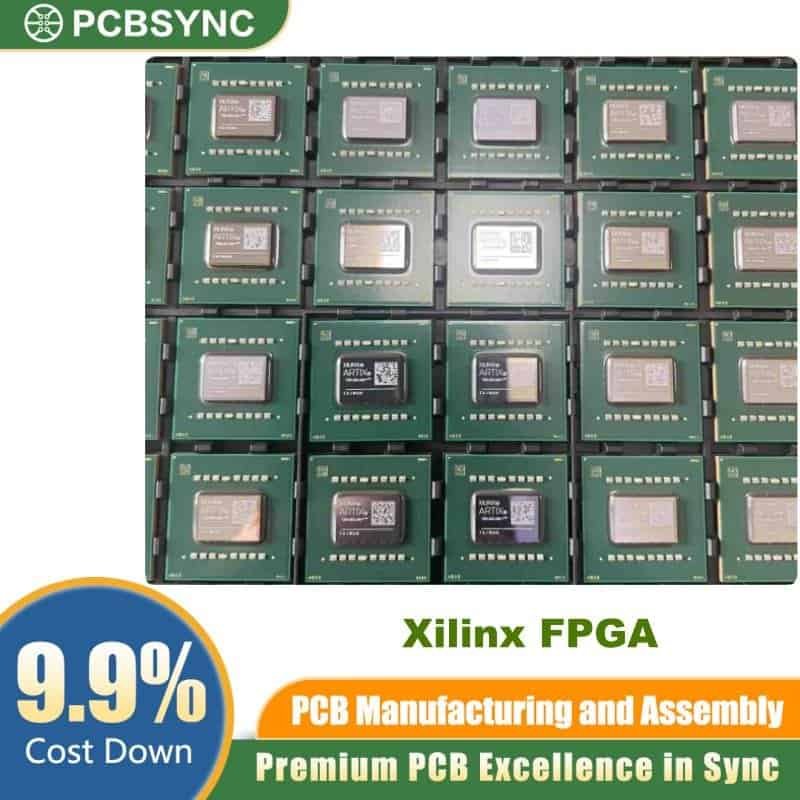
The XC3S1000E-4TQG144C is a high-performance, cost-optimized field-programmable gate array (FPGA) from Xilinx’s Spartan-3E family, now under AMD. Designed for high-volume, cost-sensitive embedded applications, this device delivers 1,000,000 system gates, advanced I/O capabilities, and robust on-chip memory — all in a compact 144-pin Thin Quad Flat Package (TQFP). Whether you are developing consumer electronics, industrial controllers, or communications systems, the XC3S1000E-4TQG144C offers the perfect balance of density, speed, and affordability.
If you are searching for a reliable, programmable logic solution, explore our full range of Xilinx FPGA products for pricing and availability.
What Is the XC3S1000E-4TQG144C?
The XC3S1000E-4TQG144C belongs to Xilinx’s Spartan-3E product line — a family engineered to extend the cost-performance advantages of the original Spartan-3 series. The “E” designation reflects a number of architectural enhancements, including increased logic density, expanded block RAM, and a higher ratio of I/O pins per logic cell compared to earlier Spartan generations.
The part number breaks down as follows:
| Part Number Segment |
Meaning |
| XC3S1000E |
Spartan-3E family, 1,000K system gates |
| -4 |
Speed grade –4 (slowest/most economical) |
| TQ |
Thin Quad Flat Package (TQFP) |
| G144 |
144-pin package |
| C |
Commercial temperature range (0°C to +85°C) |
Key Specifications at a Glance
Core Logic and Performance
| Parameter |
Value |
| System Gates |
1,000,000 |
| Logic Cells |
10,476 |
| CLB Slices |
4,656 |
| CLB Flip-Flops |
9,312 |
| Distributed RAM |
73 Kb |
| Max Frequency |
Up to ~200 MHz (speed-grade dependent) |
| Speed Grade |
-4 |
Memory Resources
| Memory Type |
Capacity |
| Block RAM (BRAM) |
432 Kb (24 × 18 Kb blocks) |
| Distributed RAM |
73 Kb |
| Total On-Chip RAM |
504 Kb |
I/O and Connectivity
| Parameter |
Value |
| Package |
144-pin TQFP (TQG144) |
| User I/O Pins |
92 |
| Differential I/O Pairs |
40 |
| I/O Standards Supported |
LVCMOS, LVTTL, SSTL, HSTL, LVDS, RSDS, PCI, and more |
| Digital Clock Managers (DCMs) |
4 |
Power and Operating Conditions
| Parameter |
Value |
| Core Supply Voltage (VCCINT) |
1.2V |
| I/O Supply Voltage (VCCO) |
1.2V – 3.3V |
| Operating Temperature (Commercial) |
0°C to +85°C |
| Package Type |
TQFP (Thin Quad Flat Package) |
| Moisture Sensitivity Level |
MSL 3 |
Ordering Information
| Attribute |
Detail |
| Manufacturer |
AMD (Xilinx) |
| Manufacturer Part Number |
XC3S1000E-4TQG144C |
| Series |
Spartan-3E |
| Package |
144-TQFP |
| RoHS Compliance |
Yes |
| Product Category |
Embedded – Complex Logic (FPGA) |
XC3S1000E-4TQG144C Detailed Description
H3: Spartan-3E Architecture Overview
The Spartan-3E architecture is built around five fundamental programmable elements:
- Configurable Logic Blocks (CLBs) — The primary logic resource. Each CLB contains two slices, and each slice contains two 4-input Look-Up Tables (LUTs), two storage elements (flip-flops or latches), carry logic, and dedicated multiplexers.
- Block RAM (BRAM) — Dual-port synchronous RAM modules, each 18 Kb deep. The XC3S1000E includes 24 BRAM blocks totaling 432 Kb, ideal for FIFOs, frame buffers, and lookup tables.
- Dedicated Multipliers — Twenty 18×18 dedicated hardware multipliers built alongside the BRAM blocks, enabling efficient DSP and signal processing without consuming CLB resources.
- Digital Clock Managers (DCMs) — Four fully digital, DLL-based clock managers that provide clock skew elimination, frequency synthesis, and phase shifting for precise timing control.
- Input/Output Blocks (IOBs) — Programmable I/O cells supporting a wide range of single-ended and differential signaling standards, with built-in pull-up/pull-down resistors and optional slew-rate control.
H3: On-Chip Multipliers for DSP Applications
One often-overlooked advantage of the Spartan-3E architecture is its dedicated 18×18-bit multiplier blocks. The XC3S1000E includes 20 multipliers, tightly coupled to the BRAM columns. This integration allows engineers to implement:
- Digital filters (FIR, IIR)
- Fast Fourier Transforms (FFTs)
- PID controllers
- Motor control algorithms
- Image processing pipelines
These hardware multipliers deliver significantly better performance and efficiency than equivalent logic built in CLBs alone.
H3: Digital Clock Manager (DCM) Capabilities
The four DCMs in the XC3S1000E-4TQG144C offer:
| DCM Feature |
Description |
| Clock Frequency Synthesis |
Multiply/divide input clock by integers |
| Phase Shifting |
Fixed or variable phase adjustment |
| Duty-Cycle Correction |
Restores 50% duty cycle on output |
| Clock Deskew |
Eliminates delay between input and output clocks |
| Spread-Spectrum Support |
Reduces EMI in sensitive applications |
This makes the XC3S1000E-4TQG144C well-suited for multi-clock-domain designs and systems requiring tight timing margins.
H3: I/O Flexibility and Supported Standards
The 92 user I/O pins of the XC3S1000E-4TQG144C support a broad array of interface standards:
| Standard |
Type |
Typical Voltage |
| LVCMOS 3.3 / 2.5 / 1.8 / 1.5 / 1.2 |
Single-ended |
1.2V – 3.3V |
| LVTTL |
Single-ended |
3.3V |
| SSTL2 / SSTL18 |
Single-ended/Diff |
2.5V / 1.8V |
| HSTL |
Single-ended/Diff |
1.5V / 1.8V |
| LVDS |
Differential |
2.5V |
| RSDS |
Differential |
2.5V |
| PCI 3.3V |
Single-ended |
3.3V |
This broad standard support means the XC3S1000E-4TQG144C can interface directly with processors, memories, sensors, and communication ICs from virtually any vendor.
Package Details: 144-Pin TQFP (TQG144)
The TQFP (Thin Quad Flat Package) is a surface-mount package popular for PCB designs requiring a balance between pin count, footprint size, and solderability. Key package attributes:
| Package Attribute |
Value |
| Package Type |
TQFP |
| Pin Count |
144 |
| Body Size |
20mm × 20mm |
| Lead Pitch |
0.5mm |
| Height (max) |
1.0mm |
| Lead Style |
Gull-wing |
| PCB Mounting |
Surface Mount (SMT) |
The 0.5mm pitch requires standard PCB fabrication capabilities and moderate reflow soldering experience. The flat, low-profile form factor makes it ideal for space-constrained designs.
Configuration and Programming
The XC3S1000E-4TQG144C supports several configuration modes:
| Configuration Mode |
Description |
| Master Serial |
Uses an external serial Flash (e.g., Xilinx Platform Flash) |
| Slave Serial |
Controlled by an external processor or CPLD |
| Master SPI |
Direct connection to SPI Flash memory |
| Master BPI (Byte-Wide) |
Parallel NOR Flash interface |
| JTAG |
In-system programming and boundary scan |
For most production designs, Master SPI configuration using a low-cost SPI NOR Flash (such as the Micron M25P series or Winbond W25Q series) is the most common choice. JTAG is universally used during development and debug.
Typical Applications of the XC3S1000E-4TQG144C
The XC3S1000E-4TQG144C is a versatile device used across a wide range of industries and applications:
| Application Area |
Use Cases |
| Industrial Automation |
Motor control, PLC logic replacement, sensor interfaces |
| Consumer Electronics |
Set-top boxes, displays, audio/video processing |
| Communications |
Protocol bridging, UART/SPI/I2C controllers, Ethernet MACs |
| Embedded Processing |
MicroBlaze soft-core processor hosting |
| Test & Measurement |
Data acquisition, pattern generation, logic analysis |
| Medical Devices |
Signal processing, patient monitoring, imaging front-ends |
| Automotive |
ADAS development, CAN/LIN interface logic |
| Education |
FPGA development kits, digital design coursework |
Comparison: XC3S1000E vs. Other Spartan-3E Variants
| Device |
System Gates |
CLB Slices |
Block RAM |
Multipliers |
User I/O (TQ144) |
| XC3S100E |
100K |
960 |
72 Kb |
4 |
83 |
| XC3S250E |
250K |
2,448 |
216 Kb |
12 |
92 |
| XC3S500E |
500K |
4,656 |
360 Kb |
20 |
92 |
| XC3S1000E |
1,000K |
9,312 |
432 Kb |
20 |
92 |
| XC3S1600E |
1,600K |
14,752 |
648 Kb |
36 |
92 |
The XC3S1000E sits in the sweet spot of the Spartan-3E family — offering substantially more logic than the XC3S500E while staying within the 144-pin package footprint.
Design Tools and IP Support
Xilinx (now AMD) provides a comprehensive ecosystem for designing with the XC3S1000E-4TQG144C:
| Tool / Resource |
Description |
| Xilinx ISE Design Suite |
Primary synthesis, P&R, and simulation toolchain for Spartan-3E |
| CORE Generator |
IP core generation (FIFOs, memory controllers, DSP blocks) |
| ChipScope Pro |
On-chip logic analyzer for hardware debug |
| MicroBlaze Soft Processor |
32-bit RISC processor for embedded applications |
| PicoBlaze |
8-bit soft-core processor for lightweight tasks |
| XPower Analyzer |
Power estimation and analysis |
| ModelSim / ISIM |
HDL simulation for Verilog and VHDL designs |
Note: Xilinx ISE Design Suite 14.7 is the final supported version for Spartan-3E devices. It is available as a free WebPACK edition that fully supports the XC3S1000E-4TQG144C without a license fee.
Power Consumption Estimates
| Operating Condition |
Typical Power |
| Standby (quiescent) |
~50 mW |
| Active (50% toggle rate, typical design) |
150–350 mW |
| Maximum (high utilization, high frequency) |
~500 mW |
Actual power consumption varies based on design utilization, clock frequency, I/O activity, and supply voltage. Use Xilinx XPower Analyzer with your specific design for accurate estimates.
Why Choose the XC3S1000E-4TQG144C?
- Cost-effective: Part of Xilinx’s value-focused Spartan line, designed for high-volume production without sacrificing capability.
- Proven technology: Spartan-3E FPGAs have been deployed in millions of end products worldwide.
- Large ecosystem: Extensive reference designs, application notes, and community support.
- Compact footprint: 144-pin TQFP is easy to source PCB assembly services for globally.
- Flexible I/O: Multi-standard I/O banks allow connection to virtually any peripheral or processor.
- Adequate for MicroBlaze: Sufficient LUTs and BRAM to host a functional MicroBlaze processor core with peripherals.
Frequently Asked Questions (FAQ)
Q: What is the difference between XC3S1000E-4TQG144C and XC3S1000E-5TQG144C? A: The only difference is the speed grade. The “-4” is the slower, more economical grade while “-5” offers higher maximum operating frequency. For most designs operating below 100 MHz, the -4 grade is fully sufficient.
Q: Is the XC3S1000E-4TQG144C RoHS compliant? A: Yes. The “C” suffix denotes the commercial temperature grade, and all current production versions are RoHS compliant (lead-free).
Q: Can I use Vivado to design for the XC3S1000E-4TQG144C? A: No. The Spartan-3E family is only supported by Xilinx ISE Design Suite (version 14.7). Vivado supports only 7-Series and newer devices.
Q: What Flash memory is compatible for configuration? A: Common choices include the Xilinx XCF platform flash series, Micron M25P40/80, and Winbond W25Q series SPI Flash devices.
Q: What is the configuration bitstream size for the XC3S1000E? A: The configuration bitstream for the XC3S1000E is approximately 2.8 Mb (megabits), requiring a minimum of a 4 Mb (512 KB) Flash device.