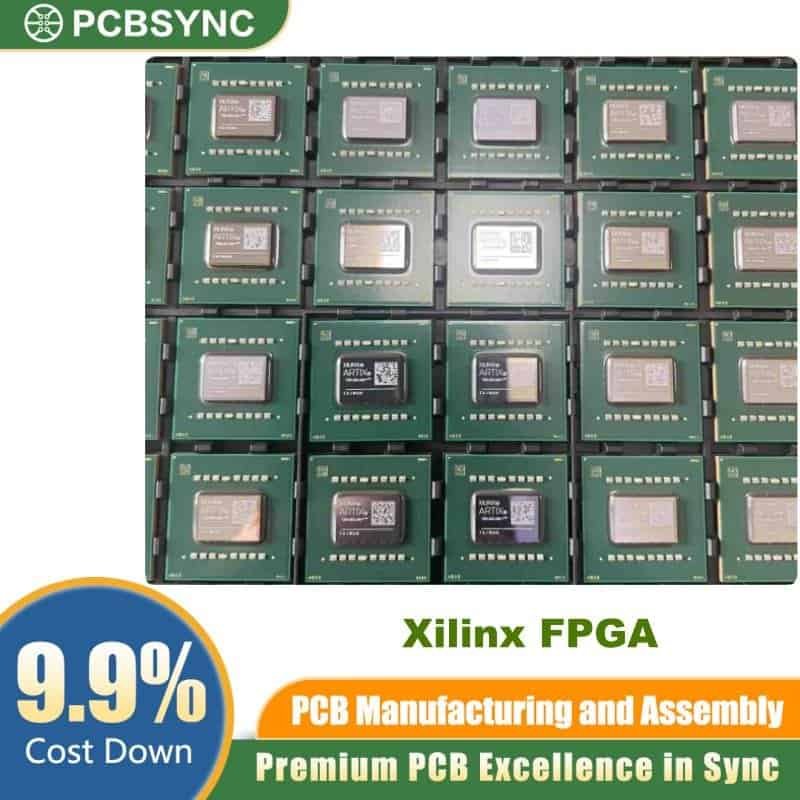
The XC3S1000-6FG456C is a high-performance, cost-optimized field-programmable gate array (FPGA) from AMD Xilinx’s Spartan-3 family. Designed for high-volume, price-sensitive applications, it offers 1,000,000 system gates with flexible I/O resources and robust logic capacity — making it one of the most widely adopted devices in embedded systems, communications, and industrial designs. Whether you’re prototyping a new product or scaling to full production, the XC3S1000-6FG456C delivers the programmable logic density and speed performance engineers depend on.
What Is the XC3S1000-6FG456C?
The XC3S1000-6FG456C is part of AMD Xilinx’s Spartan-3 FPGA series, engineered to provide low-cost programmable logic without compromising on performance. The “-6” speed grade designation indicates standard commercial timing performance, while the “FG456” refers to the 456-pin Fine-pitch Ball Grid Array (FBGA) package. The “C” suffix denotes a commercial temperature range of 0°C to +85°C.
This device is an ideal choice for engineers who need high gate counts with generous I/O flexibility. It fits naturally into Xilinx FPGA design ecosystems and is fully supported by the Xilinx ISE design suite.
XC3S1000-6FG456C Key Specifications at a Glance
| Parameter |
Value |
| Manufacturer |
AMD Xilinx |
| Part Number |
XC3S1000-6FG456C |
| FPGA Family |
Spartan-3 |
| System Gates |
1,000,000 |
| Logic Cells |
17,280 |
| CLB Slices |
7,680 |
| Distributed RAM |
120 Kb |
| Block RAM |
432 Kb |
| Multipliers (18×18) |
24 |
| DCM (Digital Clock Manager) |
4 |
| Maximum User I/O |
391 |
| Package |
FG456 (FBGA, 456-Pin) |
| Speed Grade |
-6 (Commercial) |
| Operating Temperature |
0°C to +85°C |
| Core Voltage (VCCINT) |
1.2V |
| I/O Voltage (VCCO) |
1.2V – 3.3V |
| RoHS Compliant |
Yes |
XC3S1000-6FG456C Package and Pinout Information
The FG456 package is a Fine-pitch Ball Grid Array with a 456-ball configuration on a 1.0mm pitch grid. This compact surface-mount package makes it well-suited for space-constrained PCB designs while still providing up to 391 user I/O pins — one of the most generous I/O counts available in the Spartan-3 1M gate tier.
| Package Attribute |
Detail |
| Package Type |
FBGA (Fine-pitch BGA) |
| Total Ball Count |
456 |
| Ball Pitch |
1.0 mm |
| Package Body Size |
23 mm × 23 mm |
| PCB Mount Type |
Surface Mount |
| Maximum User I/O |
391 |
| I/O Standards Supported |
LVTTL, LVCMOS, SSTL, HSTL, LVDS, BLVDS, and more |
Logic Architecture: CLBs, Slices, and LUTs
The XC3S1000-6FG456C uses Xilinx’s Configurable Logic Block (CLB) architecture as its core programmable fabric. Each CLB contains four slices, and each slice includes two 4-input Look-Up Tables (LUTs), two storage elements (flip-flops or latches), and dedicated carry and control logic.
CLB and Slice Breakdown
| Resource |
Count |
| CLBs (Configurable Logic Blocks) |
1,920 |
| Slices per CLB |
4 |
| Total Slices |
7,680 |
| LUTs (4-input) |
15,360 |
| Flip-Flops / Latches |
15,360 |
| Distributed RAM (max) |
120 Kb |
| Shift Register LUTs |
Supported |
This architecture enables highly efficient pipelining, finite state machine (FSM) implementation, and parallel data processing — all essential for demanding digital design tasks.
Memory Resources: Block RAM and Distributed RAM
The XC3S1000-6FG456C provides two types of on-chip memory to support a wide range of data buffering and storage needs.
Block RAM
- 18 dedicated Block RAM tiles, each 18 Kb in size
- Total Block RAM: 432 Kb
- Each block can be configured as single-port or true dual-port RAM
- Supports aspect ratios from 16K×1 up to 512×36
- Enables FIFO buffers, frame buffers, lookup tables, and more
Distributed RAM
- Implemented within CLB LUTs
- Up to 120 Kb of distributed RAM available
- Ideal for small, fast, synchronous memory structures embedded in the logic fabric
Digital Clock Management (DCM)
The XC3S1000-6FG456C includes 4 Digital Clock Managers (DCMs), which provide advanced clock control features critical for synchronous system design:
- Clock synthesis: multiply or divide input clocks
- Phase shifting (coarse and fine resolution)
- Duty cycle correction (DCC)
- Clock deskewing and distribution across the device
- Support for differential clock inputs
DCMs eliminate clock skew across large designs and allow multiple clock domains to operate reliably within a single FPGA.
Dedicated Multipliers for DSP Applications
One of the standout features of the Spartan-3 family is the inclusion of 24 dedicated 18×18-bit hardware multipliers. These fixed-function blocks offload multiplication operations from the general logic fabric, delivering:
- Higher throughput for DSP algorithms
- Lower latency compared to LUT-based multiplier implementations
- Efficient implementation of FIR filters, FFTs, and convolution engines
- Reduced resource utilization, freeing LUTs for other logic
This makes the XC3S1000-6FG456C suitable for signal processing applications including audio processing, motor control, and communications baseband.
I/O Standards and SelectIO Technology
The XC3S1000-6FG456C supports Xilinx’s SelectIO technology, enabling each I/O bank to be independently configured to different voltage standards. This provides maximum compatibility with other devices on the board.
Supported I/O Standards
| Standard |
Type |
Voltage |
| LVTTL |
Single-ended |
3.3V |
| LVCMOS33 / LVCMOS25 / LVCMOS18 / LVCMOS15 / LVCMOS12 |
Single-ended |
Various |
| SSTL2 / SSTL3 |
Stub Series Terminated |
2.5V / 3.3V |
| HSTL |
High-Speed Transceiver Logic |
1.5V |
| LVDS / LVDS_25 |
Differential |
2.5V |
| BLVDS |
Bus LVDS Differential |
2.5V |
| GTL / GTLP |
Gunning Transceiver Logic |
Variable |
The device features 8 I/O banks, each supporting independent VCCO settings, enabling seamless interfacing to mixed-voltage bus architectures.
Power Supply Requirements
Proper power sequencing and decoupling are critical for reliable FPGA operation. Below is the power profile for the XC3S1000-6FG456C:
| Supply |
Voltage |
Purpose |
| VCCINT |
1.2V |
Core logic supply |
| VCCO |
1.2V – 3.3V |
I/O bank supply (per bank) |
| VCCAUX |
2.5V |
Auxiliary circuits (DCMs, DCI) |
The VCCINT 1.2V core supply is the most sensitive rail and should be well-regulated with low-noise decoupling capacitors placed close to the BGA pads on the PCB.
Speed Grade Explained: What Does “-6” Mean?
The -6 speed grade is the standard commercial performance tier for the Spartan-3 series. Compared to faster grades (-5, -4), it offers a balance between cost efficiency and timing performance. Key timing characteristics include:
| Timing Parameter |
-6 Grade (Typical) |
| tPD (LUT propagation delay) |
~0.61 ns |
| tCO (CLK to output) |
~0.67 ns |
| tSU (setup time) |
~0.15 ns |
| Maximum system frequency |
~200 MHz (design-dependent) |
| DCM input frequency range |
24 MHz – 350 MHz |
Actual maximum operating frequency depends on the design’s critical path length and routing complexity.
XC3S1000-6FG456C vs. Related Spartan-3 Variants
Understanding how this device fits within the broader XC3S1000 product line helps engineers select the right part for their PCB layout and I/O requirements.
| Part Number |
Package |
Pins |
Max User I/O |
Speed Grade |
Temp |
| XC3S1000-4FG456C |
FG456 |
456 |
391 |
-4 (Fastest) |
Commercial |
| XC3S1000-6FG456C |
FG456 |
456 |
391 |
-6 (Standard) |
Commercial |
| XC3S1000-4FGG456C |
FGG456 |
456 |
391 |
-4 |
Commercial |
| XC3S1000-5FGG456C |
FGG456 |
456 |
391 |
-5 |
Commercial |
| XC3S1000-4FGG456I |
FGG456 |
456 |
391 |
-4 |
Industrial (-40°C to +100°C) |
The -6 speed grade is typically the most cost-effective option when the design’s timing closure requirements do not mandate the faster -4 or -5 grades.
Typical Applications for the XC3S1000-6FG456C
Thanks to its combination of gate density, memory, DSP resources, and I/O flexibility, the XC3S1000-6FG456C is deployed across a broad range of industries:
Embedded Systems and SoC Designs
- Soft-core processor implementations (MicroBlaze, PicoBlaze)
- Peripheral expansion for microcontrollers
- Custom bus interfaces and bridge logic
Communications and Networking
- Line protocol bridging (UART, SPI, I2C, CAN)
- Parallel-to-serial and serial-to-parallel conversion
- Network packet filtering and switching
Industrial Automation
- Motor drive control and PWM generation
- Encoder decoding and feedback processing
- Machine vision pre-processing
Consumer and AV Electronics
- Video frame buffering and scaling
- Audio DSP pipelines
- Display controller logic
Test and Measurement Equipment
- High-speed data capture
- Trigger logic and event detection
- Pattern generation
Design and Development Tools
The XC3S1000-6FG456C is fully supported by the Xilinx ISE Design Suite (the primary legacy toolchain for Spartan-3). Engineers can take advantage of:
- ISE Project Navigator – HDL design entry, synthesis, and implementation
- PlanAhead – Floorplanning and constraint management
- ChipScope Pro – On-chip debug and logic analysis
- CORE Generator – IP core instantiation (FIFOs, MACs, memory controllers, etc.)
- ISim – RTL and gate-level simulation
Third-party tools from Mentor Graphics (ModelSim), Cadence (Incisive), and Synopsys (VCS) are also compatible with this device.
Ordering Information
| Attribute |
Detail |
| Full Part Number |
XC3S1000-6FG456C |
| Manufacturer |
AMD Xilinx |
| Series |
Spartan-3 |
| Package |
FG456 (FBGA 456-ball, 1.0mm pitch) |
| Speed Grade |
-6 |
| Temperature Grade |
Commercial (0°C to +85°C) |
| RoHS Status |
RoHS Compliant |
| Moisture Sensitivity Level (MSL) |
MSL 3 – 168 Hours |
Frequently Asked Questions
Is the XC3S1000-6FG456C still in production?
The Spartan-3 family is in mature/sustained production. While no longer the newest generation, it remains available from authorized distributors and is supported for existing designs.
What is the difference between XC3S1000-6FG456C and XC3S1000-4FGG456C?
Both are 1M gate Spartan-3 FPGAs in a 456-pin BGA package. The -4FGG variant uses a faster speed grade (-4 vs -6) and the “GG” in the package code can indicate a slight package variant. The -6FG456C is the standard-speed commercial version.
What programming interface does this FPGA use?
The XC3S1000-6FG456C supports JTAG-based configuration via a Xilinx Platform Cable USB or similar download cable. It also supports Master Serial, Slave Serial, SelectMAP, and SPI/BPI Flash configuration modes.
Can I replace an XC3S1000-6FG456C with an XC3S1000-4FG456C?
Yes. The -4 and -6 variants are pin-compatible. The -4 grade is faster and may be used as a drop-in replacement. The reverse substitution (replacing a -4 with a -6) is only valid if your design meets -6 timing requirements.
Conclusion
The XC3S1000-6FG456C remains a reliable, cost-effective FPGA choice for engineers building high-volume digital systems. Its 1M gate capacity, 391 user I/Os, 432 Kb Block RAM, 24 hardware multipliers, and 4 DCMs offer a well-balanced feature set for a wide range of applications — from embedded processors and motor control to DSP pipelines and communications. With commercial temperature rating and standard -6 speed grade, it provides an excellent cost-performance point for designs that don’t require the fastest timing margins.