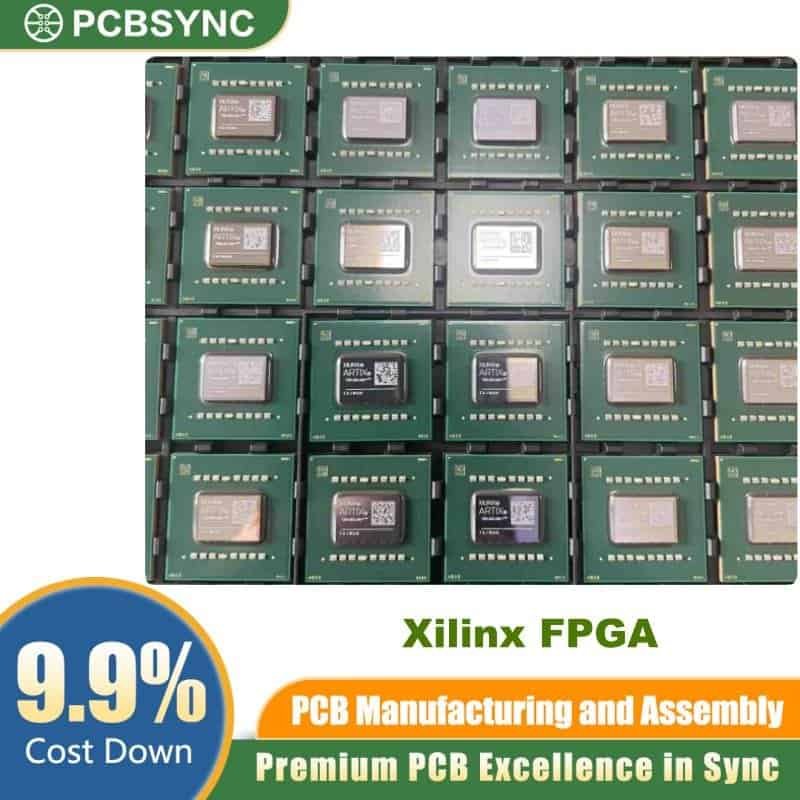
The XC3S1000-5FGG320C is a high-performance, cost-optimized field-programmable gate array (FPGA) from AMD Xilinx’s Spartan-3 family. Designed for high-volume, cost-sensitive applications, this device delivers 1,000,000 system gates in a compact 320-pin Fine-Pitch Ball Grid Array (FBGA) package, making it a popular choice for embedded systems, communications, and consumer electronics design.
Whether you are an FPGA engineer sourcing components or a procurement specialist evaluating Xilinx FPGA solutions, this guide covers everything you need to know — from pin count and logic capacity to power requirements and typical applications.
What Is the XC3S1000-5FGG320C?
The XC3S1000-5FGG320C belongs to AMD Xilinx’s Spartan-3 series, a family specifically engineered to offer the lowest cost per logic cell in programmable logic history at the time of its release. The “5” in the part number designates the speed grade — indicating a -5 speed variant, which is the slowest (and most power-efficient) speed grade available in this family. The “FGG320C” suffix specifies the commercial-temperature-range Fine-Pitch Ball Grid Array package with 320 balls.
This FPGA is manufactured on a 90nm process technology and uses a look-up table (LUT)-based architecture optimized for both logic density and embedded memory.
XC3S1000-5FGG320C Key Specifications
The table below summarizes the most important electrical and physical parameters for the XC3S1000-5FGG320C.
Table 1: General Specifications
| Parameter |
Value |
| Manufacturer |
AMD (Xilinx) |
| Part Number |
XC3S1000-5FGG320C |
| Series |
Spartan-3 |
| Logic Cells |
17,280 |
| System Gates |
1,000,000 |
| CLB Slices |
7,680 |
| Distributed RAM |
120 Kb |
| Block RAM |
432 Kb |
| DSP / Multiplier Blocks |
24 × 18×18 Multipliers |
| Speed Grade |
-5 (slowest, most power-efficient) |
| Package |
FGG320 (Fine-Pitch BGA) |
| Pin Count |
320 |
| I/O Standards Supported |
LVTTL, LVCMOS, SSTL, HSTL, PCI, GTL, and more |
| Maximum User I/Os |
221 |
| Temperature Range |
0°C to +85°C (Commercial) |
| Process Technology |
90nm |
| Supply Voltage (VCC_INT) |
1.2V |
| Supply Voltage (VCC_AUX) |
2.5V |
XC3S1000-5FGG320C Package and Pinout Details
Table 2: Package Information
| Attribute |
Detail |
| Package Type |
FBGA (Fine-Pitch Ball Grid Array) |
| Package Code |
FGG320 |
| Total Ball Count |
320 |
| Max User I/O Pins |
221 |
| Package Dimensions |
19mm × 19mm |
| Ball Pitch |
1.00mm |
| Height (max) |
2.23mm |
| Lead Finish |
Lead-Free (RoHS Compliant) — see suffix “C” |
| Mounting Type |
Surface Mount Technology (SMT) |
The FGG320 package provides a good balance between board area and available I/O count, making it suitable for medium-complexity PCB designs where board space is at a premium but a large number of I/O connections is still required.
Logic Architecture and Internal Resources
## CLB and Slice Architecture
The XC3S1000 organizes its programmable logic into Configurable Logic Blocks (CLBs). Each CLB contains four slices, and each slice contains two 4-input LUTs, two flip-flops, and dedicated carry and control logic. This architecture enables efficient implementation of both combinational logic and registered sequential logic.
Table 3: Logic Resource Breakdown
| Resource |
Quantity |
| CLBs |
1,920 |
| Slices |
7,680 |
| 4-Input LUTs |
15,360 |
| Flip-Flops |
15,360 |
| Maximum Distributed RAM (bits) |
122,880 |
| Block RAM (18Kb blocks) |
24 |
| Total Block RAM (bits) |
432,000 |
| Dedicated Multipliers (18×18) |
24 |
| Digital Clock Managers (DCMs) |
4 |
#### Digital Clock Managers (DCMs)
The four on-chip DCMs provide clock multiplication, division, phase shifting, and deskewing capabilities. This makes the XC3S1000-5FGG320C highly versatile for multi-clock-domain designs without requiring external clock distribution circuitry.
#### Embedded Block RAM
With 24 blocks of 18Kb dual-port synchronous SRAM, the device supports up to 432Kb of on-chip block RAM. Each block can be configured as single-port or dual-port with programmable width/depth ratios, enabling flexible data buffering, FIFO queues, and lookup tables.
#### Dedicated Multipliers
The 24 dedicated 18×18-bit multipliers accelerate DSP functions such as FIR filters, FFT computation, and matrix operations — tasks that would otherwise consume significant LUT resources.
I/O Bank Structure and Supported Standards
Table 4: I/O Voltage and Standard Compatibility
| I/O Standard |
Voltage Level |
Use Case |
| LVTTL |
3.3V |
General-purpose logic |
| LVCMOS 3.3 / 2.5 / 1.8 / 1.5 |
3.3V–1.5V |
Low-voltage interfaces |
| SSTL 2 / SSTL 18 |
2.5V / 1.8V |
DDR/DDR2 memory interfaces |
| HSTL I / II |
1.5V |
High-speed memory buses |
| PCI / PCI-X |
3.3V / 5V |
PCI bus compatibility |
| GTL / GTL+ |
Terminated |
Bus interfaces |
| LVDS / LVPECL |
Differential |
High-speed differential links |
The I/O pins are organized into four banks, each independently powered, enabling mixed-voltage designs on a single device.
Power Supply Requirements
Table 5: Power Supply Summary
| Supply Rail |
Voltage |
Function |
| VCCINT |
1.2V |
Core logic power |
| VCCAUX |
2.5V |
Auxiliary circuits, DCM, config |
| VCCO (per bank) |
1.5V – 3.3V |
I/O bank output voltage |
| VREF (optional) |
Varies |
Reference for SSTL/HSTL I/Os |
Proper power sequencing is recommended: VCCINT and VCCAUX should be applied before or simultaneously with VCCO to avoid latch-up conditions.
Configuration Options
The XC3S1000-5FGG320C supports multiple configuration modes, allowing designers to choose the most appropriate boot method for their system.
Table 6: Configuration Mode Overview
| Mode |
Interface |
Typical Storage Medium |
| Master Serial |
SPI-like |
Serial Flash (e.g., Xilinx Platform Flash) |
| Slave Serial |
Serial |
External controller or CPLD |
| Master Parallel (SelectMAP) |
8-bit parallel |
Parallel Flash, Processor-driven |
| Slave Parallel (SelectMAP) |
8-bit parallel |
Microprocessor boot |
| JTAG |
4-wire JTAG |
In-system programming and debugging |
| Master SPI |
SPI |
Standard SPI Flash devices |
Configuration data is stored externally and loaded into the FPGA’s SRAM-based configuration cells at power-up. The device also supports full in-system reconfigurability via JTAG.
Ordering Information and Part Number Decoder
Understanding the part number helps procurement teams quickly identify the correct variant.
Table 7: XC3S1000-5FGG320C Part Number Breakdown
| Field |
Code |
Meaning |
| Family |
XC3S |
Spartan-3 |
| Device |
1000 |
~1,000,000 system gates |
| Speed Grade |
-5 |
Slowest / most power-efficient grade |
| Package |
FGG |
Fine-Pitch Ball Grid Array |
| Pin Count |
320 |
320 total balls |
| Temperature |
C |
Commercial (0°C to +85°C) |
Alternative speed grades available: -4 (faster), -5 (standard entry). Industrial-temperature variants (suffix “I”, –40°C to +85°C) exist in the broader XC3S1000 product line but carry different part numbers.
Typical Applications for the XC3S1000-5FGG320C
The Spartan-3 XC3S1000 is widely used across a broad range of industries due to its combination of logic density, embedded memory, and competitive cost.
Table 8: Common Application Areas
| Industry |
Application Example |
| Communications |
Ethernet MAC, protocol bridging, SERDES framing |
| Consumer Electronics |
Video processing, image scaling, display control |
| Industrial Automation |
Motor control, real-time data acquisition |
| Defense & Aerospace |
Ruggedized interface controllers (commercial-grade) |
| Embedded Computing |
Custom processor cores (MicroBlaze), hardware accelerators |
| Automotive Electronics |
ADAS sensor interfaces, CAN/FlexRay bridging |
| Test & Measurement |
Signal generation, waveform capture, protocol analyzers |
| Medical Devices |
Data logging, sensor fusion, imaging pipelines |
XC3S1000-5FGG320C vs. Other Spartan-3 Variants
When selecting the right FPGA, comparing the XC3S1000 against nearby family members helps ensure the correct resource fit.
Table 9: Spartan-3 Family Comparison
| Part Number |
System Gates |
CLB Slices |
Block RAM |
Multipliers |
Max I/O |
| XC3S200 |
200K |
1,920 |
56Kb |
12 |
141 |
| XC3S400 |
400K |
3,840 |
72Kb |
16 |
141 |
| XC3S1000 |
1,000K |
7,680 |
432Kb |
24 |
391 |
| XC3S1500 |
1,500K |
13,312 |
432Kb |
32 |
487 |
| XC3S2000 |
2,000K |
17,280 |
720Kb |
40 |
565 |
The XC3S1000 offers a significant jump in logic resources over the XC3S400 while remaining substantially more affordable than the XC3S1500, making it a popular mid-range choice.
Design Tools and Software Support
The XC3S1000-5FGG320C is supported by AMD’s Xilinx ISE Design Suite (the primary legacy toolchain for Spartan-3 devices). Key tools include:
- ISE Project Navigator — RTL entry, synthesis (XST), place-and-route
- PlanAhead — Floorplanning and constraint-driven implementation
- iMPACT — Device configuration via JTAG and indirect programming
- ChipScope Pro — On-chip logic analyzer for real-time debugging
- EDK (Embedded Development Kit) — For soft processor (MicroBlaze) designs
- CORE Generator — Parameterized IP core library (FIFOs, memories, DSP)
HDL support includes VHDL and Verilog. Third-party synthesis tools such as Synopsys Synplify and Mentor Precision are also fully supported.
Compliance and Environmental Certifications
Table 10: Compliance Summary
| Standard |
Status |
| RoHS |
Compliant (suffix “C” = Lead-Free) |
| REACH |
Compliant |
| Halogen-Free |
Contact manufacturer for specific lot |
| MSL (Moisture Sensitivity) |
MSL 3 per J-STD-020 |
| ESD Sensitivity |
Class 1C (HBM per JEDEC JESD22-A114) |
Frequently Asked Questions (FAQ)
Q: What is the maximum operating frequency of the XC3S1000-5FGG320C? A: The maximum internal logic frequency depends on the design complexity, but register-to-register paths in typical designs can achieve 200 MHz or above for simple pipelines. The “-5” speed grade is the slowest in the Spartan-3 family; “-4” provides higher performance if clock speed is critical.
Q: Is the XC3S1000-5FGG320C still in production? A: The Spartan-3 family is in end-of-life (EOL) status from AMD Xilinx. Design engineers beginning new projects should evaluate migration to Spartan-7 or Artix-7 FPGAs. However, XC3S1000-5FGG320C devices remain available from authorized distributors and component brokers for legacy system support and replacement.
Q: Can I use Vivado with the XC3S1000-5FGG320C? A: No. Vivado only supports 7-Series and newer Xilinx devices. The XC3S1000-5FGG320C must be developed using ISE Design Suite 14.7, which is the final release supporting Spartan-3.
Q: What external components are required for configuration? A: A minimum configuration requires an external non-volatile memory device (such as a Xilinx Platform Flash XCF04S/XCF08P or standard SPI Flash) and decoupling capacitors on each power rail. A 1–33 MHz oscillator is required to clock the configuration process.
Q: What is the difference between XC3S1000-4FGG320C and XC3S1000-5FGG320C? A: Only the speed grade differs. The “-4” grade supports higher clock frequencies (lower propagation delays), while the “-5” grade is more conservative in timing but may offer marginal power savings. For most cost-sensitive designs, the -5 grade is adequate.
Summary
The XC3S1000-5FGG320C remains a solid, proven FPGA for legacy embedded designs, replacement procurement, and cost-sensitive development projects. With 1 million system gates, 432Kb of block RAM, 24 dedicated multipliers, and 221 user I/Os in a compact 320-ball BGA package, it balances logic density and affordability effectively.
For new projects, engineers are encouraged to evaluate the AMD Xilinx Spartan-7 or Artix-7 families, which offer dramatically improved performance-per-watt, more on-chip resources, and active tool support. For existing designs and legacy maintenance, the XC3S1000-5FGG320C continues to serve as a reliable solution available through authorized electronics distributors worldwide.