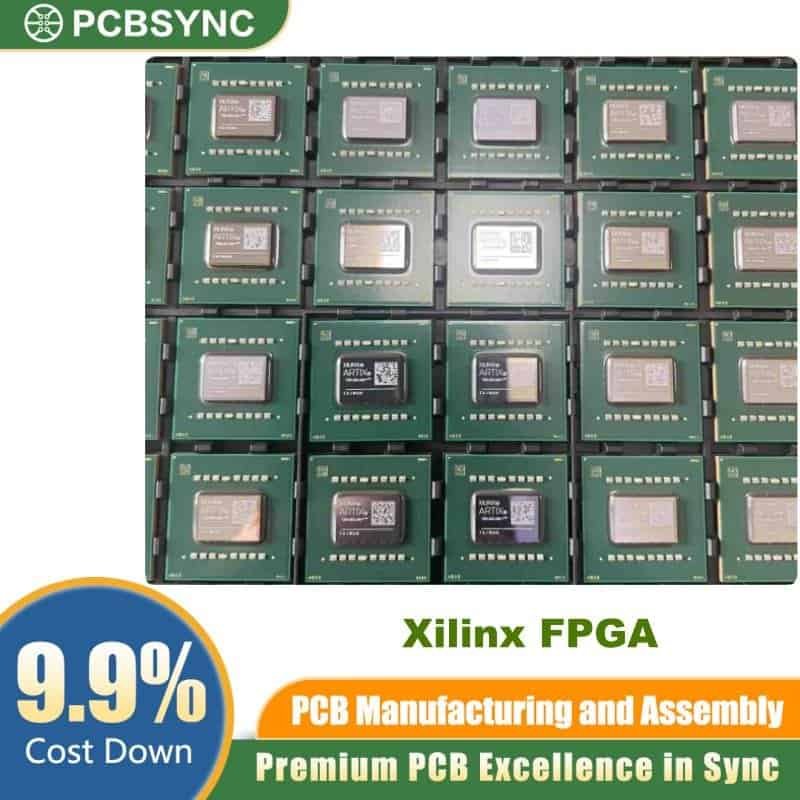
The XC3S1000-5FG456C is a high-performance, cost-optimized Field Programmable Gate Array (FPGA) from AMD Xilinx’s Spartan-3 family. Designed for volume-sensitive applications that require significant logic density, this device delivers 1,000,000 system gates in a compact 456-pin Fine-pitch Ball Grid Array (FBGA) package. Whether you’re building consumer electronics, communications equipment, or embedded control systems, the XC3S1000-5FG456C is a versatile and proven solution. Explore the full range of Xilinx FPGA devices to find the right fit for your design.
What Is the XC3S1000-5FG456C?
The XC3S1000-5FG456C belongs to AMD Xilinx’s Spartan-3 series — a family of FPGAs engineered specifically to meet the price and performance demands of high-volume production. The “5” in the part number denotes a -5 speed grade (the fastest available in this family), and “FG456C” identifies the 456-ball FBGA package with commercial temperature range (0°C to +85°C).
This device was introduced as part of Xilinx’s 90nm process technology generation and has since become a workhorse component across industrial, automotive, and consumer design segments.
XC3S1000-5FG456C Key Specifications
General Device Information
| Parameter |
Value |
| Manufacturer |
AMD (Xilinx) |
| Part Number |
XC3S1000-5FG456C |
| Series |
Spartan-3 |
| Technology |
FPGA (Field Programmable Gate Array) |
| Process Node |
90nm |
| Temperature Range |
0°C ~ +85°C (Commercial) |
| Voltage Supply (VCC) |
1.2V |
Logic Resources
| Resource |
Quantity |
| System Gates |
1,000,000 |
| Logic Cells |
17,280 |
| CLB Slices |
7,680 |
| CLB Flip-Flops |
15,360 |
| Maximum Distributed RAM |
120 Kb |
| Block RAM |
432 Kb (24 × 18 Kb blocks) |
| DSP/Multiplier Blocks |
24 × 18×18 Multipliers |
| DCM (Digital Clock Manager) |
4 |
I/O and Packaging
| Parameter |
Value |
| Package Type |
FBGA (Fine-pitch Ball Grid Array) |
| Package Code |
FG456 |
| Pin Count |
456 |
| Maximum User I/Os |
391 |
| I/O Standards Supported |
LVCMOS, LVTTL, HSTL, SSTL, LVDS, RSDS, PCI, GTL+ |
| Differential I/O Pairs |
Up to 173 |
Performance
| Parameter |
Value |
| Speed Grade |
-5 (Fastest) |
| Maximum System Clock |
~200 MHz (typical, design-dependent) |
| fMAX (internal) |
Up to 326 MHz (simple register-to-register paths) |
| Configuration Interfaces |
Master Serial, Slave Serial, SelectMAP (x8), JTAG |
XC3S1000-5FG456C Pin Configuration and Package Details
Package Diagram Overview
The FG456 package uses a 22 × 22 ball grid array with 1.0mm ball pitch. This compact footprint allows high-density PCB layouts while supporting nearly 400 user-accessible I/O pins.
| Package Attribute |
Detail |
| Body Size |
23mm × 23mm |
| Ball Pitch |
1.0mm |
| Ball Diameter |
0.60mm (nominal) |
| Ball Count |
456 |
| User I/O Pins |
391 |
| Height (max) |
2.07mm |
| PCB Land Pattern |
NSMD (Non-Solder Mask Defined) recommended |
Spartan-3 Architecture Deep Dive
Configurable Logic Blocks (CLBs)
The XC3S1000-5FG456C is organized around an array of CLBs, each containing four slices. Each slice includes two 4-input Look-Up Tables (LUTs), two flip-flops, carry logic, and multiplexers. This structure provides fine-grained, flexible logic implementation suitable for both combinational and sequential designs.
Block RAM (BRAM)
The device contains 24 dual-port block RAM tiles, each 18 Kb in size, totaling 432 Kb of on-chip memory. Each BRAM can be configured in various aspect ratios (from ×1 to ×18 width) and supports simultaneous read and write operations at independent clock frequencies — ideal for FIFOs, lookup tables, and embedded processor memory.
Dedicated Multipliers
The 24 dedicated 18×18 multipliers support signed and unsigned multiplication with pipeline support, enabling efficient DSP operations such as filtering, correlation, and modulation without consuming CLB resources.
Digital Clock Managers (DCMs)
Four fully digital DCMs allow precise clock synthesis, multiplication, division, and phase shifting. Applications benefit from jitter reduction, duty-cycle correction, and clock deskewing for multi-board synchronization.
Supported I/O Standards
The XC3S1000-5FG456C supports an extensive list of single-ended and differential I/O standards, making it compatible with a wide range of peripheral interfaces and bus standards.
Single-Ended Standards
| Standard |
VCCO (V) |
Max Speed |
| LVCMOS33 |
3.3 |
Fast |
| LVCMOS25 |
2.5 |
Fast |
| LVCMOS18 |
1.8 |
Fast |
| LVCMOS15 |
1.5 |
Fast |
| LVTTL |
3.3 |
Fast |
| PCI / PCI-X |
3.3 / 3.3 |
Supported |
| GTL / GTL+ |
VREF-based |
Fast |
| HSTL Class I/II |
1.5 |
Fast |
| SSTL2 / SSTL3 |
2.5 / 3.3 |
Supported |
Differential Standards
| Standard |
Description |
| LVDS |
Low-Voltage Differential Signaling |
| RSDS |
Reduced Swing Differential Signaling |
| LVPECL |
Low-Voltage Positive ECL |
| BLVDS |
Bus LVDS |
| Mini-LVDS |
Compact LVDS variant |
Configuration Modes
The XC3S1000-5FG456C supports multiple configuration methods to suit different system architectures:
| Mode |
Description |
Typical Use Case |
| Master Serial |
FPGA drives serial PROM clock |
Simple standalone configuration |
| Slave Serial |
External controller drives configuration |
Daisy-chain multi-device systems |
| SelectMAP (x8) |
8-bit parallel configuration bus |
Fast configuration, processor-driven |
| JTAG |
IEEE 1149.1-compliant boundary scan |
Debug, in-system programming |
| Master SPI |
From SPI Flash (via PROM bridge) |
Cost-optimized BOM |
Absolute Maximum Ratings
| Parameter |
Rating |
| Supply Voltage (VCCINT) |
-0.5V to +1.32V |
| I/O Supply Voltage (VCCO) |
-0.5V to +4.0V |
| Storage Temperature |
-65°C to +150°C |
| Junction Temperature (TJ max) |
+125°C |
| ESD Rating (HBM) |
Class 1C (per JEDEC JS-001) |
Note: Operation beyond the absolute maximum ratings may permanently damage the device. These are stress ratings only and do not imply functional operation at these conditions.
Power Consumption
Power consumption varies significantly based on design activity, clock frequency, and I/O loading. Below are typical estimates for the XC3S1000-5FG456C:
| Condition |
Estimated Power |
| Quiescent (no clocks, 25°C) |
~90 mW |
| Typical active design (50 MHz) |
~150–350 mW |
| High-utilization design (200 MHz) |
~500–800 mW |
| VCCINT current (1.2V typical) |
75–600 mA depending on activity |
For accurate power analysis, AMD Xilinx recommends using the XPower Analyzer tool included with ISE Design Suite.
XC3S1000-5FG456C vs. Other Spartan-3 Variants
| Part Number |
Gates |
CLB Slices |
Block RAM |
Multipliers |
Package |
Speed |
| XC3S200-5FT256C |
200K |
1,920 |
56 Kb |
12 |
FT256 |
-5 |
| XC3S400-5FT256C |
400K |
3,584 |
72 Kb |
16 |
FT256 |
-5 |
| XC3S1000-5FG456C |
1M |
7,680 |
432 Kb |
24 |
FG456 |
-5 |
| XC3S1500-5FG456C |
1.5M |
10,752 |
576 Kb |
32 |
FG456 |
-5 |
| XC3S2000-5FG456C |
2M |
14,752 |
720 Kb |
40 |
FG456 |
-5 |
| XC3S4000-5FG676C |
4M |
27,648 |
1,728 Kb |
96 |
FG676 |
-5 |
The XC3S1000-5FG456C sits at an attractive middle ground — offering generous logic density, substantial block RAM, and 24 hardware multipliers in the same FG456 footprint used by higher-density variants, simplifying PCB migration.
Typical Applications
The XC3S1000-5FG456C is deployed across a wide range of markets and applications:
Communications & Networking
- Line cards and protocol bridges
- 10/100/1000 Ethernet MACs
- T1/E1 framing and SONET/SDH interfaces
- Wireless baseband processing
Industrial & Embedded Control
- Motor drive controllers (FOC algorithms)
- PLC coprocessors and real-time I/O
- Machine vision pre-processing pipelines
- Safety and monitoring systems
Consumer Electronics
- Digital TV and set-top box glue logic
- Audio DSP and mixing systems
- Gaming and display controllers
Test & Measurement
- Logic analyzers and pattern generators
- Mixed-signal instrument interfaces
- Protocol analyzers (USB, SPI, I²C, CAN)
Aerospace & Defense (Extended-temperature variants)
- Signal intelligence
- Radar signal processing (with appropriate grade selection)
Development Tools & Ecosystem
Xilinx ISE Design Suite
The XC3S1000-5FG456C is supported by Xilinx ISE Design Suite (versions up to 14.7), which includes:
- ISE Project Navigator – HDL design entry and management
- XST (Xilinx Synthesis Technology) – RTL synthesis optimized for Spartan-3
- PlanAhead – Floorplanning and constraint management
- iMPACT – JTAG-based device programming
- ChipScope Pro – In-system logic analyzer via JTAG
Note: ISE 14.7 is the final release supporting Spartan-3 devices. It is available free of charge from AMD Xilinx for legacy design support.
Supported HDL Languages
| Language |
Support Level |
| VHDL |
Full synthesis and simulation |
| Verilog |
Full synthesis and simulation |
| SystemVerilog |
Partial (behavioral simulation) |
| EDIF Netlist |
Import and export supported |
| NGC/NGO |
Native Xilinx netlist formats |
Soft Processor Cores
| Core |
Description |
| MicroBlaze |
32-bit soft RISC processor (royalty-free with ISE license) |
| PicoBlaze |
8-bit ultra-compact soft processor |
| OpenRISC |
Community open-source 32-bit RISC core |
PCB Design Guidelines for XC3S1000-5FG456C
Decoupling Recommendations
Proper power supply decoupling is critical for FPGA performance and reliability:
| Supply Rail |
Recommended Decoupling |
| VCCINT (1.2V) |
100nF ceramic per power pin + 10µF bulk |
| VCCO banks |
100nF ceramic per I/O bank + 10µF bulk |
| VCCAUX (2.5V) |
100nF ceramic + 4.7µF bulk |
| VREF pins |
100nF ceramic per VREF pin |
PCB Stack-Up Recommendations
- Use at least a 4-layer PCB (signal–ground–power–signal)
- Dedicated ground plane beneath the FBGA footprint
- Route high-speed differential pairs with impedance control (100Ω differential, 50Ω single-ended)
- Keep configuration lines short and away from high-frequency clock traces
Ordering Information
| Parameter |
Detail |
| Full Part Number |
XC3S1000-5FG456C |
| DigiKey Part Number |
122-1522-ND |
| AMD/Xilinx Part Number |
XC3S1000-5FG456C |
| RoHS Compliance |
Yes (Pb-free, RoHS compliant) |
| Package |
456-FBGA (23mm × 23mm, 1.0mm pitch) |
| Temperature Grade |
Commercial (0°C to +85°C) |
| Lead-Free |
Yes |
| Moisture Sensitivity Level |
MSL 3 |
Frequently Asked Questions (FAQ)
What does “5” mean in XC3S1000-5FG456C?
The “-5” designates the speed grade of the device. In the Spartan-3 family, speed grades range from -4 (slowest) to -5 (fastest). The -5 grade offers the highest internal clock frequency and the tightest timing margins, making it ideal for designs that push the performance envelope.
Is the XC3S1000-5FG456C still in production?
As of 2024, AMD Xilinx has transitioned the Spartan-3 family to mature product status. While still available through authorized distributors and component brokers, designers starting new projects are encouraged to consider the Spartan-6 or Spartan-7 families for enhanced performance, lower power, and continued long-term support.
What is the difference between XC3S1000-5FG456C and XC3S1000-4FG456C?
Both devices share identical silicon resources and the same FG456 package. The only difference is the speed grade: the -5 variant meets tighter timing constraints and supports higher clock frequencies. The -4 variant is suitable for less speed-critical designs and may offer a cost advantage.
What configuration device should I use with the XC3S1000-5FG456C?
AMD Xilinx recommends the XCF04S or XCF08P Platform Flash PROMs for Master Serial configuration. For SPI-based approaches, the M25P16 or equivalent 16Mbit SPI Flash is a common choice. A 16Mbit (2 MB) Flash is sufficient for the XC3S1000 bitstream (~3.2 Mb).
Can the XC3S1000-5FG456C be used in automotive applications?
The “C” suffix denotes commercial temperature range (0°C to +85°C). For automotive or extended-temperature applications requiring operation up to +125°C, the XC3S1000-5FG456I (industrial grade) should be considered instead.
Summary
The XC3S1000-5FG456C remains a reliable and widely understood FPGA for engineers working with legacy systems or cost-sensitive designs where proven Spartan-3 technology is preferred. Its combination of 1 million system gates, 432 Kb block RAM, 24 hardware multipliers, 391 user I/Os, and -5 speed grade in a manageable 456-ball FBGA package makes it a flexible choice for a broad range of applications — from industrial control to communications infrastructure.
For engineers beginning new designs, evaluating the pin-compatible or functionally equivalent devices in the Spartan-6 family (e.g., XC6SLX45) may offer advantages in power efficiency, tooling support, and availability.