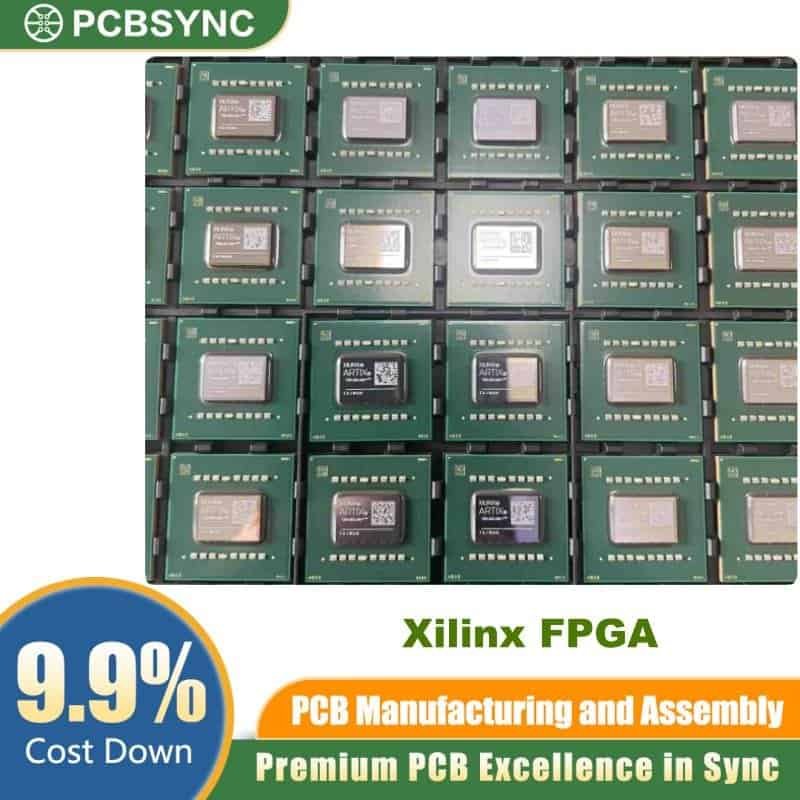
The XC3S1000-4FTG256I is a high-performance, industrial-grade field-programmable gate array (FPGA) from AMD Xilinx’s Spartan-3 family. Designed for cost-sensitive, high-volume applications that demand reliable logic density and robust I/O flexibility, this device delivers 1,000,000 system gates in a compact Fine-pitch Ball Grid Array (FTBGA) package. Whether you are designing embedded systems, digital signal processing pipelines, or industrial control hardware, the XC3S1000-4FTG256I offers the configurability and performance needed to accelerate your development cycle.
This product page provides complete technical specifications, pin configuration details, application use cases, ordering information, and design tips to help engineers make informed purchasing decisions.
What Is the XC3S1000-4FTG256I?
The XC3S1000-4FTG256I is part of Xilinx’s widely adopted Spartan-3 FPGA series — a family engineered specifically for cost-optimized designs without sacrificing programmable logic capability. The “4” in the part number denotes the speed grade (-4, the slowest in the Spartan-3 lineup, optimized for power and cost), while “FTG256” refers to the 256-ball Fine-pitch Thin Ball Grid Array (FTBGA) package, and “I” designates the industrial temperature range (-40°C to +85°C).
As part of the broader Xilinx FPGA product ecosystem, the Spartan-3 series has been a benchmark for affordable programmable logic since its introduction, and the XC3S1000 variant remains a popular choice for new and legacy designs alike.
Key Features of the XC3S1000-4FTG256I
- 1,000,000 system gates (equivalent logic capacity)
- 17,280 logic cells organized in a flexible CLB matrix
- 120 Kbits of distributed RAM
- 432 Kbits of block RAM (24 × 18 Kbit BRAM blocks)
- 24 hardware multipliers (18×18-bit)
- 4 digital clock managers (DCMs) for clock synthesis and de-skewing
- Up to 173 user I/O pins
- 3.3V LVTTL/LVCMOS I/O standards with multi-standard support
- Industrial temperature range: –40°C to +85°C
- 256-ball FTBGA package (17mm × 17mm, 1.0mm pitch)
- Speed grade -4 for power-optimized designs
- Compatible with Xilinx ISE Design Suite
XC3S1000-4FTG256I Technical Specifications
General Specifications
| Parameter |
Value |
| Manufacturer |
AMD (Xilinx) |
| Part Number |
XC3S1000-4FTG256I |
| FPGA Family |
Spartan-3 |
| Product Series |
Spartan-3 |
| System Gates |
1,000,000 |
| Logic Cells |
17,280 |
| Speed Grade |
-4 |
| Temperature Range |
–40°C to +85°C (Industrial) |
| Package Type |
FTBGA (Fine-pitch Thin BGA) |
| Package Marking |
XC3S1000-4FTG256I |
| Moisture Sensitivity Level |
MSL 3 |
| RoHS Status |
RoHS Compliant |
Memory & Logic Resources
| Resource |
Quantity / Capacity |
| Distributed RAM |
120 Kbits |
| Block RAM (BRAM) |
432 Kbits total |
| Number of BRAM Blocks |
24 (18 Kbits each) |
| Hardware Multipliers (18×18-bit) |
24 |
| CLBs (Configurable Logic Blocks) |
1,920 |
| Slices per CLB |
4 |
| Total Slices |
7,680 |
| Flip-Flops |
15,360 |
| LUTs (4-input) |
15,360 |
| Digital Clock Managers (DCMs) |
4 |
I/O & Package Specifications
| Parameter |
Value |
| Package |
256-Ball FTBGA |
| Package Dimensions |
17mm × 17mm |
| Ball Pitch |
1.0mm |
| Maximum User I/O Pins |
173 |
| Number of I/O Banks |
4 |
| I/O Voltage |
1.2V – 3.3V (bank-selectable) |
| Supported I/O Standards |
LVTTL, LVCMOS, SSTL, HSTL, GTL, GTL+, PCI, LVDS, BLVDS, LVPECL |
| On-chip Termination |
Yes (configurable) |
| Differential I/O Pairs |
Up to 20 |
Power & Electrical Characteristics
| Parameter |
Value |
| Core Supply Voltage (VCCINT) |
1.2V |
| I/O Supply Voltage (VCCO) |
1.2V – 3.3V |
| Auxiliary Voltage (VCCAUX) |
2.5V |
| Static Current (typical) |
~30 mA |
| Configuration Modes |
Master Serial, Slave Serial, Master Parallel, JTAG |
| Configuration Data Retention |
Volatile (SRAM-based, requires re-loading on power-up) |
Package Diagram & Pin Count Summary
The XC3S1000-4FTG256I is housed in the FTG256 package — a 16×16 ball grid array layout with 256 total balls. Of these, 173 are available as user I/O pins, while the remainder are dedicated to power, ground, and configuration signals.
| Ball Grid |
16 × 16 (256 total balls) |
| User I/O Balls |
173 |
| Power/Ground Balls |
75 |
| Configuration Pins |
8 (dedicated JTAG + config) |
The 1.0mm ball pitch and 17mm × 17mm footprint make this package compatible with standard FR4 PCB manufacturing processes and suitable for moderate-density PCB designs.
Ordering Information
| Attribute |
Detail |
| Manufacturer |
AMD (Xilinx) |
| Manufacturer Part Number |
XC3S1000-4FTG256I |
| DigiKey Part Number |
122-1579-ND |
| Category |
Embedded – FPGAs (Field Programmable Gate Array) |
| Series |
Spartan-3 |
| Product Status |
Active |
| Minimum Order Quantity |
1 |
| Packaging |
Tray |
| Lead-Free / RoHS |
Yes |
XC3S1000-4FTG256I vs. Other Spartan-3 Variants
Understanding how the XC3S1000-4FTG256I compares to nearby devices in the Spartan-3 family helps engineers choose the right part for their logic density, I/O, and cost requirements.
| Part Number |
System Gates |
Logic Cells |
Block RAM |
Multipliers |
Max I/O |
Package Options |
| XC3S200-4FTG256I |
200,000 |
4,320 |
72 Kbits |
12 |
173 |
FT256, FG256 |
| XC3S400-4FTG256I |
400,000 |
8,064 |
288 Kbits |
16 |
173 |
FT256, FG320 |
| XC3S1000-4FTG256I |
1,000,000 |
17,280 |
432 Kbits |
24 |
173 |
FT256, FG320 |
| XC3S1500-4FG320I |
1,500,000 |
29,952 |
576 Kbits |
32 |
221 |
FG320, FG456 |
| XC3S2000-4FG456I |
2,000,000 |
46,080 |
720 Kbits |
40 |
270 |
FG456, FG676 |
The XC3S1000 sits in the mid-range of the Spartan-3 lineup, offering a strong balance between logic capacity, on-chip memory, and cost — making it ideal when a 200K or 400K gate device falls short but a 1.5M+ device would be over-specified.
Supported I/O Standards
The XC3S1000-4FTG256I supports a broad range of single-ended and differential I/O standards, giving designers maximum flexibility in interfacing with external components.
| Standard |
Type |
Voltage |
| LVTTL |
Single-ended |
3.3V |
| LVCMOS33 / 25 / 18 / 15 / 12 |
Single-ended |
1.2V – 3.3V |
| SSTL2 Class I/II |
Single-ended |
2.5V |
| HSTL Class I/III/IV |
Single-ended |
1.5V |
| GTL / GTL+ |
Single-ended |
Open drain |
| PCI 33/66 MHz |
Single-ended |
3.3V |
| LVDS |
Differential |
2.5V |
| BLVDS |
Differential |
2.5V |
| LVPECL |
Differential |
3.3V |
Digital Clock Manager (DCM) Capabilities
The XC3S1000-4FTG256I includes 4 Digital Clock Managers (DCMs), providing advanced clock management features essential for synchronous designs:
- Clock multiplication and division – Synthesize frequencies from a reference clock without external PLLs
- Phase shifting – Shift clock phase in fine-grained steps (1/256 of clock period in variable mode)
- Clock deskewing – Eliminate board-level clock distribution delay
- Frequency synthesis – Generate arbitrary output frequencies using M/D multiplication/division ratios
- Status output – LOCKED signal indicates when DCM has achieved phase lock
These DCM capabilities reduce the need for external clock generation ICs and simplify PCB design for timing-critical applications.
Configuration Modes
Being an SRAM-based FPGA, the XC3S1000-4FTG256I must be configured on every power-up. It supports multiple configuration modes to suit different system architectures:
| Mode |
Description |
Typical Use Case |
| Master Serial |
FPGA drives serial flash (SPI or standard serial) |
Single-board systems with dedicated flash |
| Slave Serial |
External controller clocks bitstream in |
Multi-FPGA daisy-chain |
| Master SelectMAP |
Parallel byte-wide bus to flash |
High-speed configuration |
| Slave SelectMAP |
Processor-driven parallel configuration |
Processor-managed boot |
| JTAG |
IEEE 1149.1 boundary scan + configuration |
Debug and in-system programming |
Typical production designs use Master Serial mode with an external SPI flash (e.g., Xilinx Platform Flash or standard SPI NOR) to store the bitstream.
Typical Application Areas
The XC3S1000-4FTG256I is well-suited for a wide range of embedded and industrial applications:
#### Digital Signal Processing (DSP)
With 24 hardware 18×18-bit multipliers and substantial block RAM, the XC3S1000 can implement FIR/IIR filters, FFT pipelines, and signal conditioning algorithms without relying on soft multipliers that consume LUT resources.
#### Industrial Motor Control
The device’s robust I/O standards (including LVDS and HSTL) and wide industrial temperature range make it appropriate for PWM generation, encoder interfaces, and real-time feedback control loops in servo and stepper motor applications.
#### Embedded System Acceleration
Designers can implement MicroBlaze soft processor cores or interface co-processors alongside custom IP blocks for tasks like compression, encryption, or custom bus bridges.
#### Communications & Protocol Bridging
The FPGA’s multi-standard I/O makes it ideal for bridging between different bus protocols — such as translating between SPI, I2C, UART, and parallel interfaces in a single device.
#### Automotive & Transportation Electronics
The industrial-grade temperature tolerance (–40°C to +85°C) and reliable logic density make the XC3S1000-4FTG256I suitable for automotive infotainment, telematics, and diagnostic systems.
#### Test & Measurement Instruments
High logic capacity combined with fast I/O allows real-time data capture, pattern generation, and protocol analysis in portable or benchtop test equipment.
Design Tools & Software Support
The XC3S1000-4FTG256I is fully supported by the Xilinx ISE Design Suite (the primary tool for Spartan-3 development). Key tools include:
| Tool |
Purpose |
| ISE Project Navigator |
RTL design entry, synthesis, implementation |
| XST (Xilinx Synthesis Technology) |
HDL synthesis to Spartan-3 netlists |
| iMPACT |
Device programming and JTAG debugging |
| ChipScope Pro |
In-system logic analysis and debugging |
| PlanAhead |
Floorplanning and constraints management |
| CORE Generator |
IP core instantiation (FIFOs, memories, DSP blocks) |
Note: Xilinx ISE is no longer actively developed (superseded by Vivado for newer 7-series and UltraScale devices), but it remains fully functional and available for download to support Spartan-3 designs.
PCB Design Guidelines
When designing a PCB for the XC3S1000-4FTG256I in the FTG256 package, consider the following best practices:
- Decoupling capacitors: Place 100nF ceramic capacitors as close as possible to each VCCINT and VCCO power ball. Add bulk 10µF capacitors per power plane.
- Power planes: Dedicate a continuous copper plane to VCCINT (1.2V) and separate VCCO planes per I/O bank for clean power distribution.
- Ball pitch: The 1.0mm pitch requires at minimum via-in-pad or dog-bone routing strategies for inner balls; plan for 4–6 routing layers.
- JTAG header: Always include a 2×7 or 2×5 JTAG header (TDI, TDO, TCK, TMS, GND, VCC) for in-system programming and debug.
- Configuration flash: Use Xilinx-compatible SPI or Platform Flash for reliable power-on configuration.
- Ground stitching: Ensure generous ground via stitching around the BGA footprint to minimize EMI and signal return path impedance.
Frequently Asked Questions (FAQ)
Q: What is the difference between XC3S1000-4FTG256I and XC3S1000-4FG320I?
The primary difference is the package. The FTG256 package has 256 balls in a 17×17mm footprint with 1.0mm pitch, while the FG320 (FBGA) has 320 balls in a larger body with different I/O availability. For most designs, the FTG256 is more PCB-space-efficient.
Q: Is the XC3S1000-4FTG256I obsolete?
As of 2024, the XC3S1000-4FTG256I is still listed as active by AMD Xilinx, though engineers starting new designs are often recommended to consider the Artix-7 or Spartan-7 families for long-term support and improved performance-per-watt.
Q: Can this FPGA run a soft processor?
Yes. The XC3S1000 has sufficient logic capacity to implement a Xilinx MicroBlaze soft processor core along with peripheral IP (UART, SPI, I2C, etc.) for embedded applications.
Q: Does it support LVDS I/O?
Yes. The XC3S1000-4FTG256I supports LVDS, BLVDS, and LVPECL differential I/O standards on dedicated differential-capable I/O pairs.
Q: What bitstream format does the XC3S1000 use?
It uses Xilinx’s proprietary .bit bitstream format generated by ISE. For SPI flash storage, this is typically converted to an .mcs or .bin file using iMPACT.
Summary
The XC3S1000-4FTG256I is a proven, industrial-grade FPGA offering 1 million system gates, 432 Kbits of block RAM, 24 hardware multipliers, and 173 user I/O pins in a compact 256-ball BGA package. Its –40°C to +85°C industrial temperature rating, broad I/O standard support, and compatibility with Xilinx ISE make it a reliable choice for embedded control, DSP, communications, and test applications where cost efficiency and design flexibility are equally important.
For engineers evaluating programmable logic solutions across the Xilinx portfolio, the XC3S1000-4FTG256I remains one of the most capable and accessible mid-range Spartan-3 devices available on the market today.