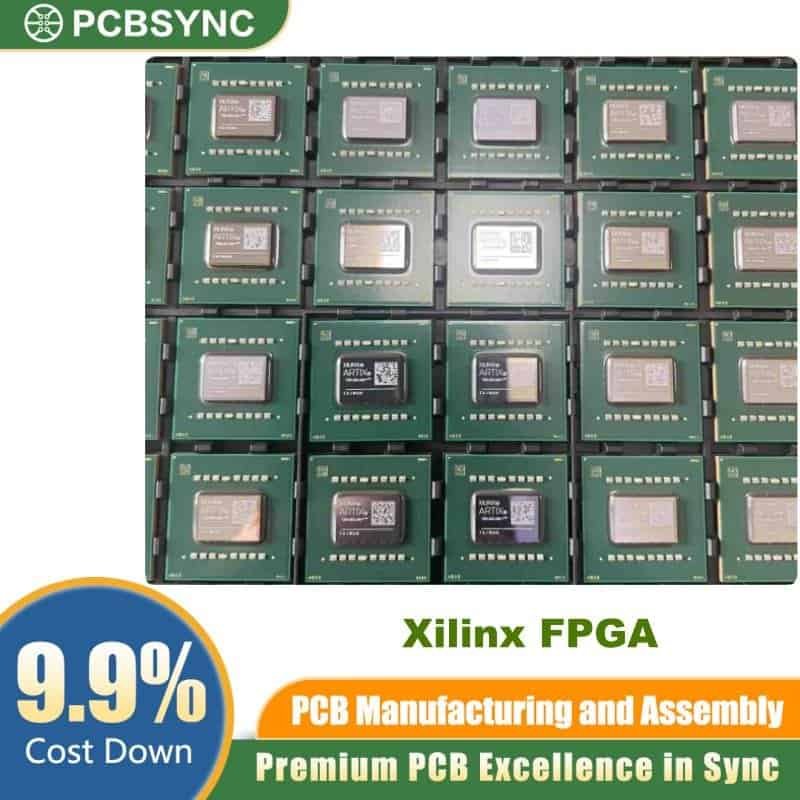
The XC3S1000-4FT256C is a high-performance, cost-optimized field-programmable gate array (FPGA) from AMD Xilinx’s Spartan-3 family. Designed for high-volume production applications, this device delivers 1,000,000 system gates, 256-pin FTBGA package, and a –4 speed grade — making it an ideal choice for engineers seeking reliable, scalable logic solutions in consumer electronics, communications, industrial control, and embedded systems.
If you are sourcing Xilinx FPGA components for your next design, the XC3S1000-4FT256C offers an excellent balance of logic density, I/O flexibility, and economic efficiency.
What Is the XC3S1000-4FT256C?
The XC3S1000-4FT256C belongs to Xilinx’s Spartan-3 generation — a family engineered specifically to reduce system cost while maintaining the programmable flexibility that FPGAs are known for. The “4” in the part number denotes the –4 speed grade (the fastest standard option for Spartan-3), “FT256” refers to the 256-ball Fine-Pitch Thin Ball Grid Array (FTBGA) package, and the trailing “C” indicates commercial temperature range (0°C to +85°C).
XC3S1000-4FT256C Key Specifications
General Specifications
| Parameter |
Value |
| Manufacturer |
AMD (Xilinx) |
| Series |
Spartan-3 |
| Part Number |
XC3S1000-4FT256C |
| Package Type |
FTBGA (Fine-Pitch Thin Ball Grid Array) |
| Number of Pins |
256 |
| Speed Grade |
-4 (Fastest) |
| Temperature Range |
Commercial: 0°C to +85°C |
| Operating Voltage (VCCINT) |
1.2V |
| RoHS Compliant |
Yes |
Logic & Memory Resources
| Resource |
Specification |
| System Gates |
1,000,000 |
| Logic Cells (LCs) |
17,280 |
| CLB Array |
120 × 72 |
| CLB Flip-Flops |
15,360 |
| Maximum Distributed RAM |
120 Kb |
| Block RAM |
432 Kb (24 × 18 Kb blocks) |
| Dedicated Multipliers (18×18) |
24 |
| DCM (Digital Clock Manager) Blocks |
4 |
I/O Specifications
| Parameter |
Value |
| Total Package Pins |
256 |
| Maximum User I/O Pins |
173 |
| I/O Standards Supported |
LVTTL, LVCMOS, SSTL, HSTL, PCI, GTL, LVPECL, LVDS, BLVDS |
| Maximum Single-Ended I/O |
173 |
| Maximum Differential I/O Pairs |
68 |
Performance & Power
| Parameter |
Value |
| Speed Grade |
-4 |
| Maximum Frequency (Internal) |
Up to ~630 MHz (DCM output) |
| Static Current (ICCINTQ) |
~15 mA (typical) |
| Configuration Interfaces |
Master/Slave Serial, SelectMAP (Parallel), JTAG, SPI Flash |
XC3S1000-4FT256C Package Dimensions
FTBGA-256 Package Details
| Parameter |
Dimension |
| Package Body Size |
17 mm × 17 mm |
| Ball Pitch |
1.00 mm |
| Ball Diameter |
0.50 mm (nominal) |
| Package Height |
1.55 mm (max) |
| Ball Grid Array |
16 × 16 (256 total) |
The compact FTBGA-256 footprint makes this device well-suited for space-constrained PCB designs while still offering 173 usable I/O pins.
XC3S1000-4FT256C vs. Other Spartan-3 Devices
| Part Number |
System Gates |
Logic Cells |
Block RAM |
User I/O |
Package Options |
| XC3S200-4FT256C |
200,000 |
4,320 |
216 Kb |
173 |
FTBGA-256 |
| XC3S400-4FT256C |
400,000 |
8,064 |
288 Kb |
173 |
FTBGA-256 |
| XC3S1000-4FT256C |
1,000,000 |
17,280 |
432 Kb |
173 |
FTBGA-256 |
| XC3S1500-4FG320C |
1,500,000 |
29,952 |
576 Kb |
221 |
FBGA-320 |
| XC3S2000-4FG456C |
2,000,000 |
46,080 |
720 Kb |
270 |
FBGA-456 |
The XC3S1000-4FT256C sits in the sweet spot of the Spartan-3 lineup — offering significantly more logic than smaller devices while retaining the compact, cost-efficient 256-ball package that works on two-layer and four-layer PCBs.
Supported I/O Standards
The XC3S1000-4FT256C supports a wide range of single-ended and differential I/O standards, allowing seamless interfacing with modern memory, processors, and peripherals.
Single-Ended I/O Standards
| Standard |
VCCO |
Description |
| LVTTL |
3.3V |
Low Voltage TTL |
| LVCMOS33 |
3.3V |
Low Voltage CMOS |
| LVCMOS25 |
2.5V |
Low Voltage CMOS |
| LVCMOS18 |
1.8V |
Low Voltage CMOS |
| LVCMOS15 |
1.5V |
Low Voltage CMOS |
| PCI / PCI-X |
3.3V |
PCI compliant |
| SSTL2 / SSTL3 |
2.5V / 3.3V |
For DDR/SDRAM interfaces |
| HSTL |
1.5V |
High-Speed Transceiver Logic |
Differential I/O Standards
| Standard |
Description |
| LVDS |
Low Voltage Differential Signaling |
| BLVDS |
Bus LVDS |
| LVPECL |
Low Voltage Positive ECL |
| RSDS |
Reduced Swing Differential Signaling |
Configuration Modes
The XC3S1000-4FT256C supports multiple configuration modes, providing design flexibility for production and prototyping environments.
| Mode |
Description |
| Master Serial |
Uses an external SPI Flash (e.g., Xilinx Platform Flash) |
| Slave Serial |
Controlled by an external processor or CPLD |
| Master SelectMAP |
Parallel configuration up to 8/16 bits wide |
| Slave SelectMAP |
Parallel, externally driven |
| JTAG (Boundary Scan) |
IEEE 1149.1 compliant, ideal for in-system debugging |
| SPI Flash |
Direct connection to standard SPI serial Flash memory |
Ordering Information
| Parameter |
Detail |
| Full Part Number |
XC3S1000-4FT256C |
| Manufacturer |
AMD (Xilinx) |
| Manufacturer Part Number |
XC3S1000-4FTG256C |
| Packaging |
Tray |
| RoHS Status |
RoHS Compliant |
| ECCN |
EAR99 |
| HTS Code |
8542.39.0001 |
Note: The suffix “C” denotes Commercial temperature range (0°C to +85°C). For industrial-grade operation (–40°C to +85°C), the equivalent industrial part is the XC3S1000-4FTG256I.
Typical Applications of XC3S1000-4FT256C
The XC3S1000-4FT256C is a versatile device used across a broad range of industries and applications:
Communications & Networking
- Protocol bridges (UART, SPI, I²C, CAN)
- Ethernet MAC controllers
- Line-card logic and framing
- Serial-to-parallel conversion
Consumer Electronics
- Display timing controllers
- Audio DSP and signal routing
- Set-top box control logic
- Remote I/O expansion
Industrial Control & Automation
- Motion control state machines
- PLC (Programmable Logic Controller) co-processing
- Sensor data aggregation
- Custom industrial protocol support
Embedded & Computing
- Processor peripheral expansion
- Memory controllers for SDRAM / DDR
- Co-processor acceleration
- Custom bus interfaces
Test & Measurement
- Pattern generators
- Logic analyzers
- Waveform capture and processing
- ATE (Automated Test Equipment) logic
Design Resources & Tools
AMD Xilinx provides a comprehensive suite of tools to support the XC3S1000-4FT256C throughout the design cycle.
| Resource |
Description |
| Xilinx ISE Design Suite |
Primary synthesis, implementation, and bitstream generation tool for Spartan-3 |
| ChipScope Pro |
In-system logic analyzer and debugging tool |
| Platform Flash / XCF Series |
Recommended non-volatile configuration storage device |
| UCF (User Constraints File) |
Pin assignment and timing constraint methodology |
| IBIS Models |
Available for signal integrity simulation |
| BSDL Files |
IEEE 1149.1 boundary scan description language files |
Spartan-3 devices are supported by Xilinx ISE 14.7 (the final ISE release). Migration to Vivado is not supported for this family; ISE remains the recommended toolchain.
Why Choose the XC3S1000-4FT256C?
✅ Cost-Optimized for High-Volume Production
The Spartan-3 architecture was specifically designed to hit aggressive pricing targets for production volumes, making it one of the most cost-efficient FPGAs available per logic cell.
✅ High Logic Density in a Compact Package
With 17,280 logic cells in a 17×17 mm FTBGA-256 footprint, the XC3S1000-4FT256C enables dense, complex designs without requiring a large PCB area.
✅ Abundant On-Chip Memory
432 Kb of dedicated block RAM plus 120 Kb of distributed RAM supports demanding data buffering, FIFO, and lookup table requirements.
✅ Dedicated DSP Resources
24 dedicated 18×18 hardware multipliers accelerate arithmetic-intensive tasks without consuming CLB resources.
✅ Fastest Spartan-3 Speed Grade
The –4 speed grade delivers maximum performance within the Spartan-3 family, supporting timing-sensitive designs.
✅ Broad I/O Standard Support
With 173 user I/Os supporting standards from LVCMOS to LVDS, this device interfaces natively with virtually any peripheral, memory, or processor in your system.
Frequently Asked Questions (FAQ)
Q: What is the difference between XC3S1000-4FT256C and XC3S1000-4FTG256C? A: These are the same device. “FT256” and “FTG256” both refer to the 256-ball FTBGA package. Distributor listings may use either suffix; the underlying silicon and package are identical.
Q: Is the XC3S1000-4FT256C RoHS compliant? A: Yes. The device is fully RoHS compliant and uses lead-free ball grid array solder balls.
Q: What configuration device is recommended for the XC3S1000? A: AMD Xilinx recommends the Platform Flash XCF series (e.g., XCF04S or XCF08P) for persistent configuration storage via Master Serial mode.
Q: Can I use Vivado to program the XC3S1000-4FT256C? A: No. Spartan-3 devices are supported exclusively by Xilinx ISE 14.7. Vivado does not support the Spartan-3 family.
Q: What is the VCCINT supply voltage for this device? A: The XC3S1000-4FT256C requires a 1.2V VCCINT supply. VCCO can vary from 1.2V to 3.3V depending on the I/O standard used.
Q: What is the industrial-grade equivalent? A: The XC3S1000-4FTG256I is the industrial-grade equivalent, rated for –40°C to +85°C operation.
Summary
The XC3S1000-4FT256C is a proven, production-ready FPGA delivering 1 million system gates, 17,280 logic cells, 432 Kb of block RAM, 24 hardware multipliers, and 173 user I/Os — all within a compact 256-ball FTBGA package at commercial temperature grade. Its –4 speed grade, broad I/O standard support, and multiple configuration options make it a flexible, reliable foundation for a wide range of embedded, communications, and industrial designs.
For engineers and procurement teams building Xilinx FPGA solutions, the XC3S1000-4FT256C represents an outstanding combination of logic capacity, design flexibility, and cost efficiency within the Spartan-3 platform.