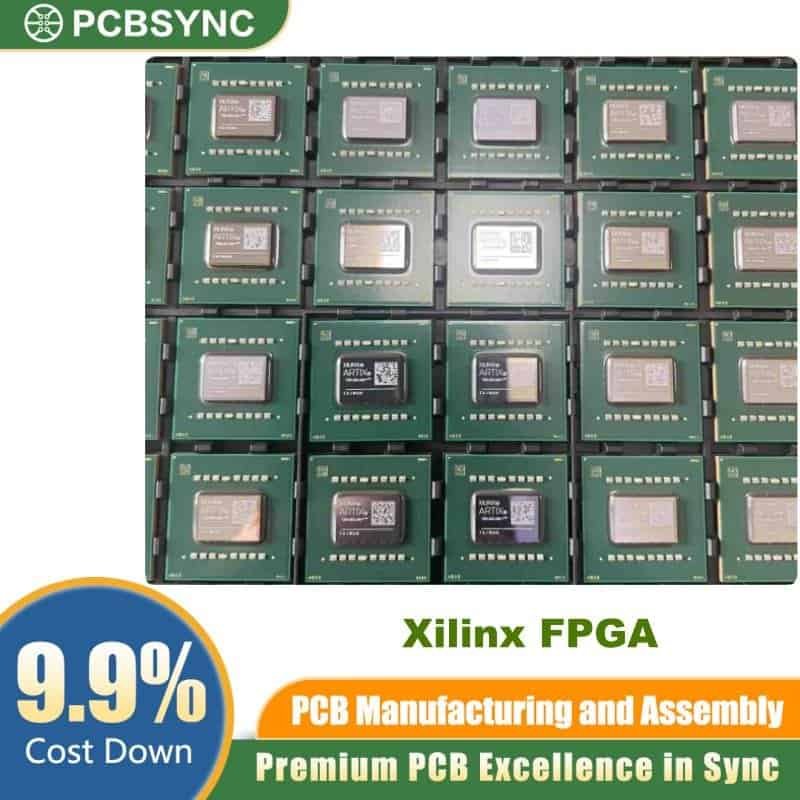
The XC3S1000-4FGG676C is a high-performance, cost-effective Field Programmable Gate Array (FPGA) from Xilinx’s Spartan-3 family, now part of the AMD product portfolio. Designed for high-volume, cost-sensitive applications, this device delivers 1 million system gates, 391 user I/Os, and a robust set of programmable resources — all in a compact 676-ball Fine-Pitch BGA package. Whether you are building embedded systems, communications equipment, or industrial control solutions, the XC3S1000-4FGG676C offers the flexibility and performance that modern designs demand.
What Is the XC3S1000-4FGG676C?
The XC3S1000-4FGG676C is a member of the Xilinx Spartan-3 FPGA family — one of the most successful low-cost FPGA platforms ever introduced. The device targets applications where programmability, logic density, and price efficiency must all be balanced. It operates at a core voltage of 1.2V and is manufactured using advanced 90nm CMOS process technology, enabling a maximum performance of up to 630 MHz system clock.
The “4” in the part number refers to the commercial speed grade, “FGG676” designates the 676-ball Fine-Pitch Ball Grid Array (FBGA) Pb-free package, and “C” indicates the commercial temperature range (0°C to +85°C).
Explore more options in the Xilinx FPGA product lineup to find the right device for your design.
XC3S1000-4FGG676C Key Specifications
| Parameter |
Value |
| Manufacturer |
Xilinx (AMD) |
| Part Number |
XC3S1000-4FGG676C |
| Family |
Spartan-3 |
| System Gates |
1,000,000 (1M) |
| Equivalent Logic Cells |
17,280 |
| CLB Array |
48 Rows × 40 Columns |
| Total CLBs |
1,920 |
| Distributed RAM |
120K bits |
| Block RAM |
432K bits (24 blocks) |
| Dedicated Multipliers |
24 |
| DCMs (Digital Clock Managers) |
4 |
| Max User I/O |
391 |
| Max Differential I/O Pairs |
175 |
| Core Voltage (VCCINT) |
1.2V |
| Speed Grade |
-4 (Commercial) |
| Process Technology |
90nm |
| Max System Clock |
630 MHz |
| Package |
676-ball FBGA (FGG676) |
| Package Type |
Fine-Pitch Ball Grid Array, Pb-Free |
| Temperature Range |
0°C to +85°C (Commercial) |
| RoHS |
Not Compliant (Standard version) |
| Tray Packaging |
Yes |
XC3S1000-4FGG676C Part Number Decoder
Understanding the ordering code helps engineers quickly identify key device attributes:
| Code Segment |
Meaning |
| XC |
Xilinx Commercial Product |
| 3S |
Spartan-3 Family |
| 1000 |
1,000,000 System Gates |
| -4 |
Speed Grade (-4 = Commercial, Slowest) |
| FGG |
Fine-Pitch BGA, Pb-Free Package |
| 676 |
676 Balls / Pins |
| C |
Commercial Temperature Range (0°C to +85°C) |
Architecture and Functional Elements
Configurable Logic Blocks (CLBs)
The XC3S1000-4FGG676C contains 1,920 CLBs, each comprising four slices. Each slice includes RAM-based Look-Up Tables (LUTs) for logic implementation, flip-flops or latches for storage, carry logic for fast arithmetic operations, and wide-function multiplexers. The CLBs give designers the flexibility to implement virtually any combinational or sequential digital logic function.
Block RAM (BRAM)
The device provides 432K bits of block RAM organized across 24 dedicated RAM blocks. Block RAM supports true dual-port operation, selectable data width configurations, and can serve as FIFOs, shift registers, ROM, or general-purpose data storage — without consuming CLB resources.
Distributed RAM
In addition to block RAM, the device offers 120K bits of distributed RAM embedded within the LUT structures of the CLBs. Distributed RAM is ideal for small, high-speed memories and shift register implementations.
Dedicated Multipliers
The XC3S1000-4FGG676C includes 24 dedicated 18×18-bit hardware multipliers. These multipliers execute at full device speed and are optimized for DSP functions, digital filtering, and signal processing pipelines — tasks that would otherwise consume significant CLB resources.
Digital Clock Managers (DCMs)
Four Digital Clock Managers (DCMs) provide advanced clock management including clock multiplication and division, phase shifting, clock deskewing, and duty-cycle correction. DCMs ensure clean, low-jitter clocking across the entire device.
Input/Output Blocks (IOBs)
The 391 user I/O pins are controlled by flexible Input/Output Blocks (IOBs) that support:
- 26 single-ended I/O standards (LVCMOS, LVTTL, PCI, etc.)
- 8 high-performance differential I/O standards (LVDS, BLVDS, RSDS, HSTL, SSTL, etc.)
- Double Data-Rate (DDR) registers
- Digitally Controlled Impedance (DCI) for on-chip termination
Routing Architecture
The five functional elements (CLBs, BRAMs, Multipliers, DCMs, IOBs) are interconnected through a rich, hierarchical routing network. Each functional element has an associated switch matrix providing flexible signal routing throughout the device.
Configuration Modes
The XC3S1000-4FGG676C supports five configuration modes, giving designers multiple options for loading bitstream data at power-up:
| Mode |
Description |
| Master Parallel |
8-bit SelectMAP, FPGA controls clock |
| Slave Parallel |
8-bit SelectMAP, external controller provides clock |
| Master Serial |
Serial configuration, FPGA controls clock |
| Slave Serial |
Serial configuration, externally clocked |
| Boundary Scan (JTAG) |
IEEE 1149.1-compliant JTAG interface |
Configuration data is stored externally (typically in a Xilinx Platform Flash PROM) and loaded into static CMOS configuration latches (CCLs) at power-on. The device can also be reconfigured in the field without hardware replacement — a major advantage over mask-programmed ASICs.
I/O Standards Supported
Single-Ended Standards
| Standard |
Description |
| LVCMOS 3.3V / 2.5V / 1.8V / 1.5V |
Low-Voltage CMOS |
| LVTTL |
Low-Voltage TTL |
| PCI 3.3V / 5V |
PCI Bus Standard |
| GTL / GTL+ |
Gunning Transceiver Logic |
| HSTL (Class I, II, III, IV) |
High-Speed Transceiver Logic |
| SSTL 2 / 3 (Class I, II) |
Stub Series Terminated Logic |
Differential Standards
| Standard |
Description |
| LVDS |
Low-Voltage Differential Signaling |
| BLVDS |
Bus LVDS |
| RSDS |
Reduced Swing Differential Signaling |
| LVPECL |
Low-Voltage Positive Emitter-Coupled Logic |
| HSTL Differential |
High-Speed Differential |
| SSTL Differential |
Series Stub Differential |
Package Information: FGG676
| Parameter |
Detail |
| Package Designation |
FGG676 |
| Package Type |
Fine-Pitch Ball Grid Array (FBGA) |
| Ball Count |
676 |
| Lead Finish |
Pb-Free (RoHS-compliant packaging) |
| Body Size |
27mm × 27mm |
| Ball Pitch |
1.0mm |
| User I/O Available |
391 |
The “G” in FGG676 indicates the Pb-free (lead-free) package variant, suitable for designs targeting RoHS compliance at the PCB assembly level.
XC3S1000-4FGG676C vs Other Spartan-3 Devices
| Device |
System Gates |
Logic Cells |
Block RAM |
Multipliers |
Max I/O |
| XC3S200 |
200K |
4,320 |
216K bits |
12 |
173 |
| XC3S400 |
400K |
8,064 |
288K bits |
16 |
264 |
| XC3S1000 |
1M |
17,280 |
432K bits |
24 |
391 |
| XC3S1500 |
1.5M |
29,952 |
576K bits |
32 |
487 |
| XC3S2000 |
2M |
46,080 |
720K bits |
40 |
565 |
| XC3S4000 |
4M |
62,208 |
1,728K bits |
96 |
712 |
| XC3S5000 |
5M |
74,480 |
1,872K bits |
104 |
784 |
Typical Applications
The XC3S1000-4FGG676C is well suited for a wide range of applications:
- Consumer Electronics — Set-top boxes, digital displays, home networking
- Embedded Processing — Soft processor cores (MicroBlaze), co-processing
- Communications — Protocol bridges, line cards, serial interfaces
- Industrial Control — Motor control, PLC replacement, sensor interfacing
- Automotive Electronics — Body control, infotainment interface logic
- Test & Measurement — Data acquisition, pattern generation
- Image & Video Processing — Pipeline logic, frame buffering, pixel processing
- Networking — Packet processing, traffic management, switch fabric
Advantages Over ASICs
The XC3S1000-4FGG676C offers compelling advantages versus mask-programmed ASICs:
| Factor |
ASIC |
XC3S1000-4FGG676C FPGA |
| NRE Cost |
Very High (millions) |
None |
| Time to Market |
Months to years |
Days to weeks |
| Design Flexibility |
Fixed after tape-out |
Reprogrammable in field |
| Minimum Order Quantity |
High |
Single unit |
| Prototype Risk |
High |
Minimal |
| Field Upgrades |
Impossible |
Full bitstream update |
Design Tools and Support
Xilinx Spartan-3 devices are supported by the following development tools:
- Xilinx ISE Design Suite — Full RTL synthesis, place & route, simulation, and bitstream generation (recommended for legacy Spartan-3 designs)
- ModelSim / Vivado Simulator — Functional and timing simulation
- ChipScope Pro — In-circuit debug and logic analysis
- Platform Cable USB II — JTAG programming and debug interface
- Xilinx Platform Flash (XCFxxP/XCFxxS) — Recommended non-volatile configuration storage
The Xilinx ISE Design Suite is the primary recommended tool for Spartan-3 series device programming and implementation.
Ordering Information
| Part Number |
Package |
Speed Grade |
Temperature |
Pb-Free |
| XC3S1000-4FGG676C |
676-ball FBGA |
-4 |
Commercial (0–85°C) |
Yes |
| XC3S1000-4FGG676I |
676-ball FBGA |
-4 |
Industrial (−40–100°C) |
Yes |
| XC3S1000-4FG676C |
676-ball FBGA |
-4 |
Commercial (0–85°C) |
No |
| XC3S1000-5FGG676C |
676-ball FBGA |
-5 |
Commercial (0–85°C) |
Yes |
Frequently Asked Questions (FAQ)
Q: What is the difference between XC3S1000-4FGG676C and XC3S1000-4FG676C? The “G” in FGG676 indicates a Pb-free (lead-free) package with RoHS-compatible solder balls. The FG676 variant uses standard tin-lead solder. Both devices are functionally identical.
Q: Is the XC3S1000-4FGG676C still in production? The Spartan-3 family is in the mature/end-of-life phase. It is still available through authorized distributors and the secondary market. Engineers beginning new designs should evaluate the newer Spartan-6 or Artix-7 families for long-term supply assurance.
Q: What configuration PROM is recommended for the XC3S1000? Xilinx recommends the XCF04S Platform Flash PROM (3.2M bits), which provides sufficient capacity to store the XC3S1000 configuration bitstream.
Q: Can I use Vivado to program the XC3S1000-4FGG676C? Vivado does not support Spartan-3 devices. Use Xilinx ISE Design Suite (version 14.7 is the final release) for all XC3S1000 design and programming tasks.
Q: What is the maximum operating frequency? The device is rated up to 630 MHz system clock under optimal conditions. Achievable frequency depends on the design’s critical path, temperature, and voltage.
Summary
The XC3S1000-4FGG676C remains a capable and cost-effective FPGA choice for mid-density logic requirements. With 1 million system gates, 391 user I/Os, 24 block RAMs, 24 hardware multipliers, and 4 DCMs — all in a compact 676-ball Pb-free BGA package — it continues to serve a wide range of industrial, communications, and embedded applications. Its field-programmability, broad I/O standard support, and proven Xilinx architecture make it a reliable choice for both legacy system maintenance and new low-cost designs.