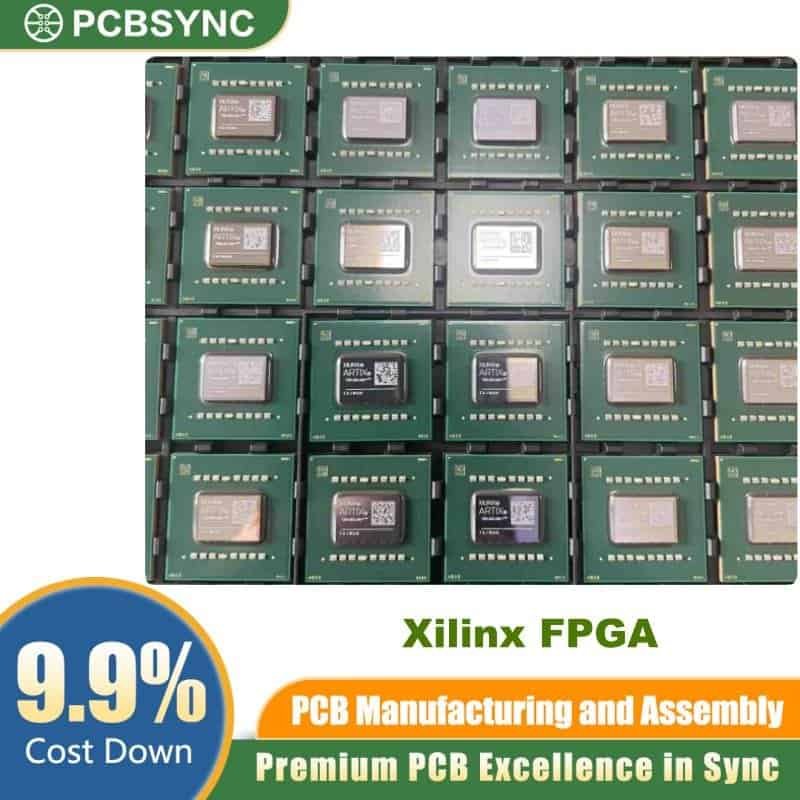
The XC3S1000-4FGG456C is a high-performance, cost-optimized field-programmable gate array (FPGA) from the Xilinx Spartan-3 family. Manufactured under AMD Xilinx, this device delivers 1 million system gates in a compact 456-pin Fine-pitch Ball Grid Array (FBGA) package, making it one of the most popular Xilinx FPGA solutions for volume production designs. Whether you are building embedded systems, digital signal processing pipelines, or industrial control applications, the XC3S1000-4FGG456C offers the logic density, I/O flexibility, and power efficiency to meet demanding design requirements.
What Is the XC3S1000-4FGG456C?
The XC3S1000-4FGG456C is a member of the eight-device Spartan-3 FPGA family, built on 90nm process technology with a 1.2V core supply. It is designed as a cost-effective, high-volume alternative to mask-programmed ASICs — offering full in-field programmability with no non-recurring engineering (NRE) costs. The “-4” in the part number denotes the speed grade, and “FGG456C” identifies the 456-pin FBGA package in commercial temperature range.
XC3S1000-4FGG456C Key Specifications
Core Device Parameters
| Parameter |
Value |
| Manufacturer |
AMD Xilinx (formerly Xilinx Inc.) |
| Part Number |
XC3S1000-4FGG456C |
| Series |
Spartan-3 |
| Device Type |
FPGA – Field Programmable Gate Array |
| System Gates |
1,000,000 (1M) |
| Logic Cells |
17,280 |
| CLBs (Configurable Logic Blocks) |
1,920 |
| Process Technology |
90nm CMOS |
| Core Supply Voltage |
1.2V (1.14V – 1.26V) |
| Speed Grade |
-4 |
| Maximum Clock Frequency |
630 MHz |
I/O and Memory Resources
| Resource |
Value |
| Number of User I/Os |
333 |
| Total I/O Pins (Package) |
456 |
| Total RAM Bits |
442,368 bits |
| Embedded RAM |
54 kB |
| Dedicated Block RAMs |
24 × 18Kb |
| 18×18 Multipliers |
24 |
| Digital Clock Managers (DCMs) |
4 |
Package and Mechanical Specifications
| Parameter |
Value |
| Package Type |
FBGA (Fine-pitch Ball Grid Array) |
| Package Code |
FGG456 |
| Pin Count |
456 |
| Body Size |
23mm × 23mm |
| Mounting Type |
Surface Mount Technology (SMT) |
| Packaging / Shipping Form |
Tray |
| RoHS Compliant |
Yes |
| Temperature Range |
Commercial (0°C to +85°C) |
XC3S1000-4FGG456C Part Number Decode
Understanding the part number helps you quickly confirm you have the right device:
| Field |
Value |
Meaning |
| XC |
XC |
Xilinx Commercial product |
| 3S |
3S |
Spartan-3 family |
| 1000 |
1000 |
~1,000,000 system gates |
| -4 |
-4 |
Speed grade 4 (slowest commercial) |
| FGG |
FGG |
Fine-pitch Ball Grid Array package |
| 456 |
456 |
456 pins |
| C |
C |
Commercial temperature grade (0°C to +85°C) |
Functional Overview: Spartan-3 Architecture
Configurable Logic Blocks (CLBs)
The XC3S1000-4FGG456C contains 1,920 CLBs, each comprising four slices. Every slice includes two 4-input look-up tables (LUTs), storage elements (flip-flops), and carry/arithmetic logic. This enables efficient implementation of combinational and sequential logic, shift registers, and distributed RAM.
Block RAM
With 24 dedicated 18Kb block RAMs totaling 54 kB, the device supports dual-port synchronous memory access, making it suitable for FIFO buffers, lookup tables, and on-chip data storage in communications and DSP applications.
18×18 Multipliers
The XC3S1000-4FGG456C provides 24 dedicated 18×18-bit hardware multipliers. These hardwired multiply blocks accelerate DSP tasks such as filtering, Fourier transforms, and matrix operations without consuming general logic resources.
Digital Clock Managers (DCMs)
Four integrated DCMs provide clock synthesis, deskewing, phase shifting, and frequency division/multiplication. DCMs allow designers to meet precise timing constraints across the device and generate multiple clock domains from a single reference.
I/O Interface Standards
The 333 user I/Os support a wide range of single-ended and differential I/O standards, including LVTTL, LVCMOS (3.3V/2.5V/1.8V/1.5V), LVDS, SSTL, and HSTL. This flexibility makes the device compatible with a broad ecosystem of memory devices, processors, and communication interfaces.
Configuration Modes
The XC3S1000-4FGG456C supports several configuration modes to suit different system designs:
| Mode |
Description |
| Master Serial |
Loads bitstream from an external serial PROM |
| Slave Serial |
Receives bitstream from an external controller |
| Master Parallel (SelectMAP) |
High-speed byte-wide configuration from Flash/SRAM |
| Slave Parallel (SelectMAP) |
Byte-wide loading controlled by external processor |
| JTAG (Boundary Scan) |
IEEE 1149.1 compliant in-circuit programming and test |
The device retains configuration in an external SPI or parallel Flash memory and re-loads on power-up, enabling non-volatile operation.
Applications of the XC3S1000-4FGG456C
The combination of 1M gates, 54 kB embedded RAM, and 333 I/Os makes the XC3S1000-4FGG456C an excellent fit for a wide variety of applications:
Digital Signal Processing (DSP)
The dedicated 18×18 multipliers and large CLB array support FIR/IIR filters, FFT engines, and custom DSP accelerators for audio, video, and radar signal chains.
Embedded System Control
With its large I/O count and high logic density, the FPGA can implement soft processor cores (such as MicroBlaze or PicoBlaze), peripheral interfaces, and real-time controllers within a single chip.
Communications and Networking
The XC3S1000-4FGG456C supports high-speed serial and parallel interfaces for applications in broadband access equipment, network switches, protocol converters, and wireless base stations.
Industrial Automation
The device excels in motor control, sensor fusion, machine vision pre-processing, and PLC-like control functions that require deterministic timing and flexible I/O configuration.
Consumer Electronics
Thanks to its low unit cost and 90nm technology efficiency, this FPGA is well suited for high-volume consumer electronics including display controllers, set-top boxes, and home networking equipment.
Test and Measurement
Its reprogrammable nature makes the XC3S1000-4FGG456C ideal for instrument front-ends, pattern generators, logic analyzers, and protocol test equipment that require frequent firmware updates.
Advantages Over Traditional ASICs
| Feature |
XC3S1000-4FGG456C (FPGA) |
Mask-Programmed ASIC |
| Non-Recurring Engineering Cost |
None |
High (hundreds of thousands USD) |
| Time to Market |
Days to weeks |
6–18 months |
| Design Changes |
In-field reprogrammable |
Requires new masks |
| Small-Volume Feasibility |
Yes |
Not cost-effective |
| IP Protection |
Bitstream encryption available |
Fixed in silicon |
Ordering and Availability Information
| Attribute |
Detail |
| DigiKey Part Number |
122-1572-ND |
| Manufacturer Part Number |
XC3S1000-4FGG456C |
| Manufacturer |
AMD Xilinx |
| Series |
Spartan-3 |
| Packaging |
Tray |
| Status |
Active / Legacy |
| Minimum Order Quantity |
1 unit (varies by distributor) |
The XC3S1000-4FGG456C is available through authorized distributors including DigiKey, Mouser, Avnet, and Arrow Electronics. It is also available from independent component distributors for legacy and end-of-life supply chain support.
Related Spartan-3 Family Devices
| Part Number |
System Gates |
I/Os |
Package |
| XC3S50-4TQG144C |
50,000 |
97 |
144-TQFP |
| XC3S200-4FT256C |
200,000 |
141 |
256-FTBGA |
| XC3S400-4FG456C |
400,000 |
264 |
456-FBGA |
| XC3S1000-4FGG456C |
1,000,000 |
333 |
456-FBGA |
| XC3S1500-4FG676C |
1,500,000 |
391 |
676-FBGA |
| XC3S4000-4FG676C |
4,000,000 |
489 |
676-FBGA |
Design Tools and Support
Xilinx supports the XC3S1000-4FGG456C through the ISE Design Suite (versions 10.1 through 14.7), which includes:
- XST (Xilinx Synthesis Technology) for RTL synthesis
- ISE Simulator (ISim) for functional and timing simulation
- IMPACT for device configuration and JTAG programming
- ChipScope Pro for in-system logic analysis
- PlanAhead for floorplanning and placement guidance
Third-party tools including Mentor Graphics ModelSim, Synopsys Synplify Pro, and Aldec Active-HDL are also fully supported.
Summary
The XC3S1000-4FGG456C is a reliable, cost-effective FPGA solution ideal for engineers who need substantial logic capacity (1M gates, 17,280 cells), flexible I/O (333 pins), and embedded memory (54 kB) in a proven 456-pin FBGA footprint. Built on mature 90nm process technology from Xilinx, it remains a popular choice for new designs and legacy system maintenance alike. Its in-field reprogrammability, broad tool support, and competitive unit cost make it a strong alternative to fixed-function ASICs across industrial, communications, consumer, and embedded computing markets.