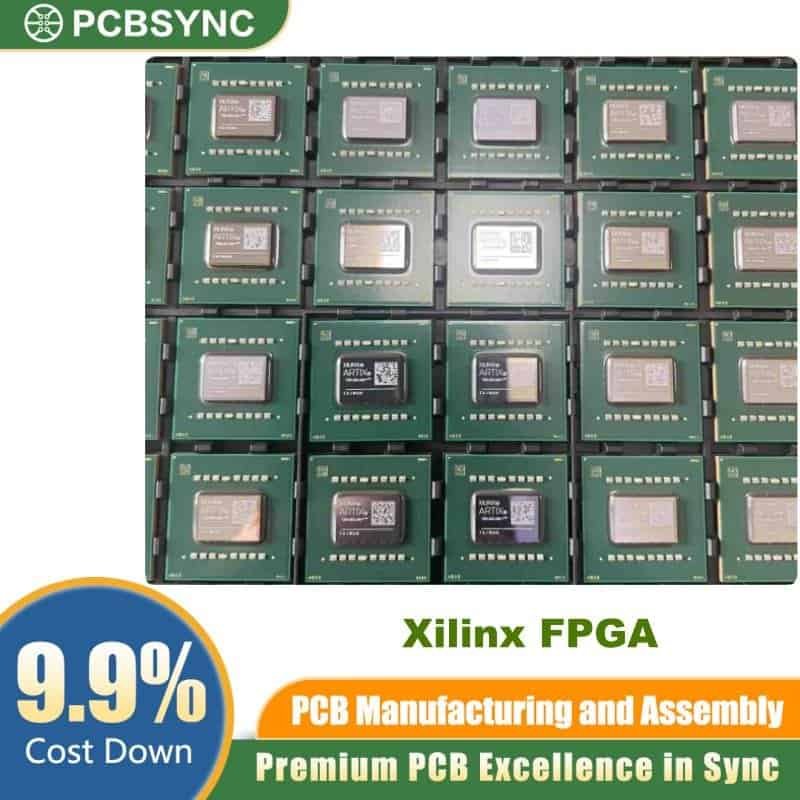
The XC3S1000-4FGG320C is a high-performance Xilinx FPGA from the Spartan-3 family, manufactured by AMD (formerly Xilinx). Designed for cost-sensitive, high-volume applications, this device delivers 1,000,000 system gates in a compact Fine-Pitch Ball Grid Array (FBGA) package with 320 balls. Whether you are designing embedded systems, digital signal processing pipelines, or communications hardware, the XC3S1000-4FGG320C provides the logic density, I/O flexibility, and power efficiency your project demands.
What Is the XC3S1000-4FGG320C?
The XC3S1000-4FGG320C belongs to Xilinx’s Spartan-3 FPGA series — a product line specifically optimized to deliver maximum logic resources at the lowest possible cost per gate. The part number breaks down as follows:
| Part Number Segment |
Meaning |
| XC3S |
Xilinx Spartan-3 Family |
| 1000 |
1,000,000 System Gates |
| -4 |
Speed Grade -4 (slowest/most power-efficient in S3 line) |
| FGG |
Fine-Pitch Ball Grid Array (FBGA) Package |
| 320 |
320 Total Ball Count |
| C |
Commercial Temperature Range (0°C to +85°C) |
XC3S1000-4FGG320C Key Specifications
Core Logic & Architecture
| Parameter |
Value |
| Family |
Spartan-3 |
| Manufacturer |
AMD / Xilinx |
| System Gates |
1,000,000 |
| Logic Cells |
17,280 |
| Slices |
7,680 |
| CLB Array (Rows × Columns) |
96 × 80 |
| Flip-Flops |
15,360 |
| Maximum Distributed RAM |
120 Kb |
| Block RAM |
432 Kb (24 × 18 Kb blocks) |
| DSP/Multiplier Blocks |
24 × 18×18 Dedicated Multipliers |
I/O & Packaging
| Parameter |
Value |
| Package Type |
FBGA (Fine-Pitch Ball Grid Array) |
| Package Code |
FGG320 |
| Total Ball Count |
320 |
| User I/O Pins |
391 (max across package options) |
| I/O Standards Supported |
LVTTL, LVCMOS, SSTL, HSTL, GTL, PCI, LVDS, BLVDS, LVPECL, ULVDS, and more |
| Differential I/O Pairs |
Up to 40 |
Speed & Power
| Parameter |
Value |
| Speed Grade |
-4 |
| Core Supply Voltage (VCCINT) |
1.2 V |
| I/O Supply Voltage (VCCO) |
1.2 V – 3.3 V (bank-selectable) |
| Operating Temperature (Commercial) |
0°C to +85°C |
| Configuration Modes |
Master Serial, Slave Serial, Master Parallel, Slave Parallel, JTAG (IEEE 1149.1) |
Ordering & Compliance Information
| Parameter |
Value |
| Full Part Number |
XC3S1000-4FGG320C |
| Manufacturer |
AMD (Xilinx) |
| DigiKey Part Number |
122-1480-ND |
| RoHS Status |
RoHS Compliant |
| Moisture Sensitivity Level (MSL) |
MSL 3 – 168 Hours |
| Series |
Spartan-3 |
| Status |
Active |
XC3S1000-4FGG320C Detailed Features
#### High-Density Logic Fabric
At its core, the XC3S1000-4FGG320C is built around Xilinx’s proven 4-input Look-Up Table (LUT) architecture. Each Configurable Logic Block (CLB) contains four slices, and each slice contains two LUTs and two flip-flops. This gives designers an efficient, fine-grained logic structure capable of implementing both combinational and sequential logic across a wide range of applications.
#### Dedicated Block RAM
The device features 24 block RAM modules, each 18 Kb in size, for a total of 432 Kb of on-chip block memory. These true dual-port RAMs can be configured as single-port or dual-port with independent read/write widths, making them ideal for FIFOs, look-up tables, data buffering, and embedded processor memory maps.
#### Dedicated Hardware Multipliers
The XC3S1000-4FGG320C includes 24 dedicated 18×18-bit hardware multipliers, enabling high-speed fixed-point arithmetic for DSP workloads, signal processing, image processing, and data compression — without consuming any general logic fabric.
#### Flexible I/O Architecture
The I/O architecture supports a broad range of single-ended and differential signaling standards. Each I/O bank can be independently powered, allowing mixed-voltage board interfaces within a single device. The FGG320 package provides a practical number of user I/O pins in a small 19×19 mm footprint, suitable for high-density PCB designs.
#### JTAG Boundary Scan and Configuration
Full IEEE 1149.1 JTAG boundary scan is supported, enabling in-circuit testing and programming. The device can be configured via SelectMAP (parallel), Serial (master/slave), or JTAG modes, and is compatible with Xilinx’s iMPACT programming software and Platform Cable USB.
XC3S1000-4FGG320C vs Other Spartan-3 Devices
The table below compares the XC3S1000-4FGG320C against similar devices in the Spartan-3 family to help you choose the right logic density for your design.
| Part Number |
System Gates |
Logic Cells |
Block RAM |
Multipliers |
Package Options |
| XC3S200-4FTG256C |
200K |
4,320 |
216 Kb |
12 |
FTG256 |
| XC3S400-4FTG256C |
400K |
8,064 |
288 Kb |
16 |
FTG256 |
| XC3S1000-4FGG320C |
1,000K |
17,280 |
432 Kb |
24 |
FGG320 |
| XC3S1500-4FGG456C |
1,500K |
29,952 |
576 Kb |
32 |
FGG456 |
| XC3S2000-4FGG456C |
2,000K |
46,080 |
720 Kb |
40 |
FGG456 |
Typical Applications for the XC3S1000-4FGG320C
The Spartan-3 1000K gate device is widely used in designs that require more logic than entry-level FPGAs but where cost constraints make higher-end Virtex or Kintex devices impractical. Common applications include:
| Application Area |
Example Use Cases |
| Embedded Processing |
Soft-core CPU implementations (MicroBlaze, PicoBlaze) |
| Digital Signal Processing |
FIR/IIR filters, FFT engines, motor control |
| Communications |
UART, SPI, I2C, Ethernet MAC interfaces |
| Industrial Control |
PLC logic replacement, motion control, sensor fusion |
| Consumer Electronics |
Set-top boxes, display controllers, IoT hardware |
| Prototyping & Emulation |
ASIC prototyping, hardware emulation, development boards |
| Image & Video Processing |
Line buffering, pixel processing, video scaling |
PCB Design Considerations for the FGG320 Package
The XC3S1000-4FGG320C comes in a 320-ball FBGA package with a 1.0 mm ball pitch and a 19 mm × 19 mm body size. PCB designers should note the following:
| Design Parameter |
Recommendation |
| Ball Pitch |
1.0 mm |
| Package Body Size |
19 mm × 19 mm |
| PCB Layer Count |
6–8 layers recommended for full signal routing |
| Via Strategy |
Via-in-pad or dogbone fanout for inner-ball breakout |
| Decoupling Capacitors |
100 nF per VCCINT/VCCO pin, placed as close as possible |
| Thermal Pad / Heatsink |
Not required at commercial temps for most designs |
| JTAG Access |
Expose TCK, TMS, TDI, TDO, GND for in-circuit programming |
Configuration & Programming Guide
#### Supported Configuration Modes
The XC3S1000-4FGG320C supports five configuration modes selectable via the M0, M1, and M2 mode pins:
| Mode |
Description |
Typical Use |
| Master Serial |
FPGA drives clock to serial PROM |
Standalone SPI-based PROM boot |
| Slave Serial |
External source drives configuration |
Microcontroller-assisted boot |
| Master Parallel (SelectMAP) |
Parallel data bus, FPGA drives clock |
Fast configuration |
| Slave Parallel (SelectMAP) |
Parallel data bus, external clock |
Host-driven configuration |
| JTAG |
IEEE 1149.1 TAP controller |
In-system programming and debug |
#### Recommended Configuration Devices
| Configuration PROM |
Interface |
Capacity |
| XCF04S |
Serial |
4 Mb |
| XCF08P |
Serial |
8 Mb |
| XCF16P |
Serial |
16 Mb |
| M25P80 (third-party SPI) |
SPI Master Serial |
8 Mb |
Power Supply Requirements
| Supply Rail |
Voltage |
Function |
| VCCINT |
1.2 V |
Core logic supply |
| VCCO (per bank) |
1.2 V – 3.3 V |
I/O output driver supply |
| VCCAUX |
2.5 V |
Auxiliary supply (DCI, DCM) |
| GND |
0 V |
Ground reference |
Design Tip: Use separate, low-noise LDO or switching regulators for VCCINT and VCCO. Decouple every power pin with a 100 nF ceramic capacitor within 1 mm and add bulk decoupling of 10 µF per power rail.
Development Tools & Software Support
The XC3S1000-4FGG320C is fully supported by Xilinx/AMD design tools:
| Tool |
Version |
Notes |
| Xilinx ISE Design Suite |
14.7 (final) |
Full synthesis, P&R, bitstream generation |
| ChipScope Pro |
14.7 |
In-system logic analysis via JTAG |
| iMPACT |
14.7 |
Device programming via JTAG/USB cable |
| CORE Generator |
14.7 |
IP core generation (FIFOs, MACs, etc.) |
| ModelSim / XSIM |
Any version |
RTL and post-place simulation |
Note: ISE 14.7 is the last version to support the Spartan-3 family. Vivado does not support Spartan-3 devices.
Frequently Asked Questions (FAQ)
Q: What is the difference between XC3S1000-4FGG320C and XC3S1000-4FGG320I?
A: The “C” suffix denotes Commercial temperature range (0°C to +85°C), while “I” denotes Industrial temperature range (−40°C to +100°C). Choose the Industrial grade for harsh environment or extended-temperature designs.
Q: Is the XC3S1000-4FGG320C RoHS compliant?
A: Yes. This part is fully RoHS compliant and lead-free.
Q: Can I use Vivado with this device?
A: No. Vivado does not support the Spartan-3 family. Use Xilinx ISE 14.7, which is available as a free WebPACK edition for devices up to a certain gate count.
Q: What is the maximum user I/O for this package?
A: The FGG320 package supports up to 221 user I/O pins for the XC3S1000 device specifically. Other XC3S1000 packages (e.g., FT256) offer fewer I/Os.
Q: What soft-core processors can I implement on this device?
A: The XC3S1000 is large enough to support Xilinx’s MicroBlaze (32-bit RISC) or PicoBlaze (8-bit) soft-core processors, with plenty of remaining logic for peripherals.
Summary
The XC3S1000-4FGG320C is a proven, cost-effective FPGA solution for medium-complexity digital designs. With 1 million system gates, 432 Kb of block RAM, 24 hardware multipliers, and flexible multi-voltage I/O support — all in a compact 320-ball FBGA package — it remains a popular choice for industrial, communications, and embedded system applications. Its Commercial-grade temperature rating and full RoHS compliance make it suitable for most modern product developments.
For a broader selection of programmable logic devices and technical support resources, explore the full range of Xilinx FPGA solutions available through authorized distributors.