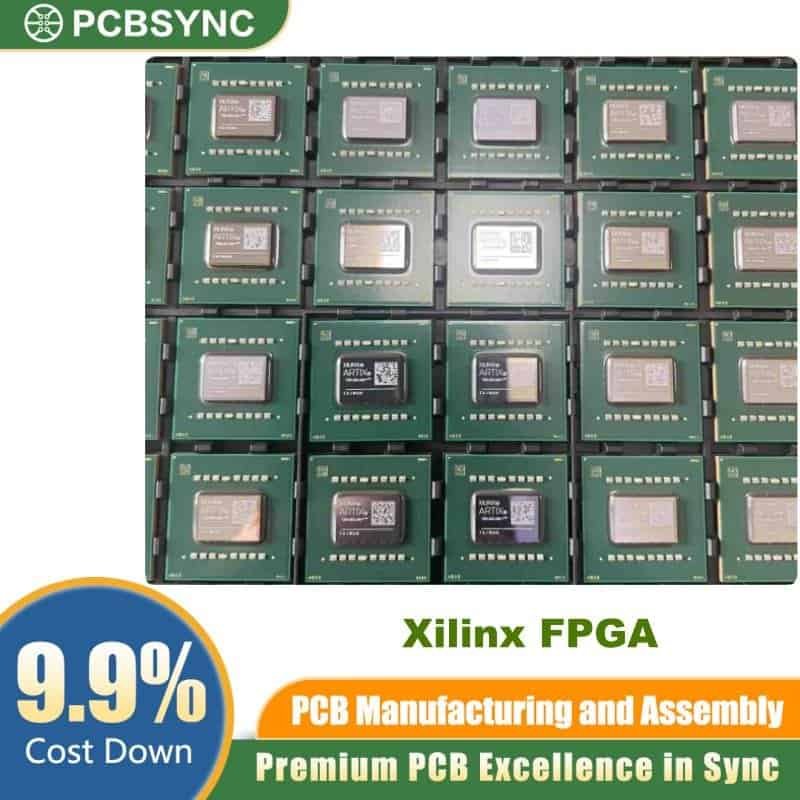
The XC3S1000-4FG676C is a high-performance, cost-optimized field-programmable gate array (FPGA) from AMD Xilinx’s Spartan-3 family. Designed for high-volume, cost-sensitive applications, this device delivers 1,000,000 system gates, a fine-pitch BGA package, and versatile I/O capabilities that make it a go-to choice for engineers worldwide. Whether you are designing consumer electronics, industrial control systems, or communications equipment, the XC3S1000-4FG676C offers the right balance of logic density, speed, and affordability.
What Is the XC3S1000-4FG676C?
The XC3S1000-4FG676C is part of the Xilinx FPGA Spartan-3 generation — a family engineered from the ground up to deliver maximum logic per dollar. The “XC3S1000” in the part number designates the Spartan-3 series with 1 million gate equivalents, while “4” indicates the speed grade (-4, the slowest/most cost-effective speed grade in this family), and “FG676C” describes the 676-ball Fine-pitch Ball Grid Array (FBGA) package in commercial temperature range.
This FPGA is manufactured on a 90nm process technology, which optimizes power consumption while maintaining competitive switching speeds suitable for most embedded and communications designs.
XC3S1000-4FG676C Key Specifications
Core Logic Parameters
| Parameter |
Value |
| Part Number |
XC3S1000-4FG676C |
| Manufacturer |
AMD (formerly Xilinx) |
| FPGA Family |
Spartan-3 |
| System Gates |
1,000,000 |
| Logic Cells |
17,280 |
| CLB Array |
96 × 72 |
| CLB Flip-Flops |
15,360 |
| Distributed RAM |
120 Kb |
| Block RAM |
432 Kb |
| Dedicated Multipliers (18×18) |
24 |
| DCM (Digital Clock Manager) |
4 |
Packaging & Physical Specifications
| Parameter |
Value |
| Package Type |
FBGA (Fine-pitch Ball Grid Array) |
| Package Code |
FG676 |
| Total Ball Count |
676 |
| Package Body Size |
27 mm × 27 mm |
| Ball Pitch |
1.0 mm |
| Height (max) |
2.6 mm |
| Operating Temperature (Commercial) |
0°C to +85°C |
Electrical Characteristics
| Parameter |
Value |
| Core Supply Voltage (VCCINT) |
1.2V |
| I/O Supply Voltage (VCCO) |
1.2V – 3.3V |
| Speed Grade |
-4 |
| Max User I/O Pins |
487 |
| I/O Standards Supported |
LVTTL, LVCMOS (1.2V–3.3V), SSTL, HSTL, LVDS, BLVD, GTL, and more |
XC3S1000-4FG676C I/O Bank Configuration
The XC3S1000-4FG676C features multiple independent I/O banks, each supporting separate VCCO voltages. This enables designers to interface with multiple logic families within a single device.
| I/O Bank |
Max Pins per Bank |
Voltage Support |
| Bank 0 |
~50 |
1.2V – 3.3V |
| Bank 1 |
~80 |
1.2V – 3.3V |
| Bank 2 |
~80 |
1.2V – 3.3V |
| Bank 3 |
~80 |
1.2V – 3.3V |
| Bank 4 |
~80 |
1.2V – 3.3V |
| Bank 5 |
~80 |
1.2V – 3.3V |
| Bank 6 |
~80 |
1.2V – 3.3V |
| Bank 7 |
~80 |
1.2V – 3.3V |
Note: Exact bank assignments vary by pin configuration. Refer to the official AMD Xilinx XC3S1000 datasheet for precise bank-level pinout.
XC3S1000-4FG676C Block RAM Organization
One of the most valued features of the XC3S1000-4FG676C is its 432 Kb of block RAM, organized into 18 Kb dual-port RAM blocks. These memory blocks enable high-throughput, low-latency on-chip data storage, making the device ideal for buffering, FIFO queues, and data path operations.
| Block RAM Feature |
Specification |
| Total Block RAM |
432 Kb |
| Number of 18 Kb Blocks |
24 |
| Port Width (configurable) |
×1, ×2, ×4, ×9, ×18 |
| Dual-Port Support |
Yes |
| ECC Support |
No |
XC3S1000-4FG676C Digital Clock Management (DCM)
The four integrated Digital Clock Managers (DCMs) provide clock synthesis, multiplication, division, and phase shifting — eliminating the need for external PLLs or clock buffers in most applications.
| DCM Feature |
Value |
| Number of DCMs |
4 |
| Frequency Synthesis |
Yes (DFS) |
| Clock Multiplication |
Integer (×2 to ×32) |
| Clock Division |
Integer (÷2 to ÷32) |
| Phase Shift |
Fixed, Variable, Direct |
| Input Frequency Range |
24 MHz – 350 MHz |
XC3S1000-4FG676C vs. Other Spartan-3 Variants
Choosing the right device for your design often involves comparing gate counts, I/O, memory, and packaging. Here is how the XC3S1000-4FG676C compares to nearby devices in the Spartan-3 family:
| Feature |
XC3S200 |
XC3S400 |
XC3S1000 |
XC3S2000 |
XC3S4000 |
| System Gates |
200K |
400K |
1,000K |
2,000K |
4,000K |
| Logic Cells |
4,320 |
8,064 |
17,280 |
33,280 |
62,208 |
| Block RAM |
72 Kb |
288 Kb |
432 Kb |
720 Kb |
1,728 Kb |
| Multipliers |
12 |
16 |
24 |
40 |
96 |
| DCMs |
4 |
4 |
4 |
4 |
4 |
| Max User I/O |
141 |
264 |
487 |
565 |
633 |
The XC3S1000-4FG676C occupies the mid-tier of the Spartan-3 family — offering significantly more logic density than the XC3S400 while remaining more cost-effective than the XC3S2000.
XC3S1000-4FG676C Ordering Information & Part Number Decoder
Understanding the part number structure helps engineers quickly identify the exact variant needed:
| Position |
Code |
Meaning |
| XC |
XC |
Xilinx Commercial Product |
| Family |
3S |
Spartan-3 Family |
| Gates |
1000 |
1,000,000 System Gates |
| Speed Grade |
-4 |
Speed Grade -4 (slowest/most economical) |
| Package |
FG |
Fine-pitch Ball Grid Array (FBGA) |
| Ball Count |
676 |
676 Total Solder Balls |
| Temp Range |
C |
Commercial (0°C to +85°C) |
For industrial temperature range (-40°C to +85°C), look for the XC3S1000-4FG676I variant.
XC3S1000-4FG676C Supported I/O Standards
The XC3S1000-4FG676C supports a wide array of industry-standard single-ended and differential I/O standards, making it highly compatible with legacy and modern interface requirements:
| Standard Category |
Supported Standards |
| Single-Ended (3.3V) |
LVTTL, LVCMOS33 |
| Single-Ended (2.5V) |
LVCMOS25 |
| Single-Ended (1.8V/1.5V/1.2V) |
LVCMOS18, LVCMOS15, LVCMOS12 |
| Memory Interface |
SSTL2 (Class I & II), SSTL3 (Class I & II), HSTL (Class I & III) |
| Differential |
LVDS, Mini-LVDS, BLVD-25, RSDS |
| Open Drain |
GTL, GTL+ |
| PCI |
PCI (3.3V, 66 MHz) |
XC3S1000-4FG676C Typical Applications
The XC3S1000-4FG676C is widely adopted across multiple industries due to its combination of logic density, I/O flexibility, and competitive cost:
#### Industrial Automation
Real-time motor control, PLC co-processors, encoder interfaces, and sensor fusion applications benefit from the FPGA’s deterministic timing and configurable I/O.
#### Communications & Networking
The 24 dedicated 18×18 multipliers and distributed RAM enable DSP-intensive tasks like FIR/IIR filtering, FFT processing, and protocol bridging in networking cards and modems.
#### Consumer Electronics
Set-top boxes, digital cameras, and multimedia processors leverage the low core voltage (1.2V) and broad I/O voltage support for battery-optimized, multi-interface designs.
#### Embedded Systems & SoC Prototyping
Engineers use the XC3S1000-4FG676C as a prototyping platform for soft-core processors (such as MicroBlaze or PicoBlaze), memory controllers, and custom peripheral interfaces.
#### Test & Measurement Equipment
The four DCMs, deep block RAM, and high I/O count make this FPGA suitable for logic analyzers, signal generators, and automated test equipment.
XC3S1000-4FG676C Design Considerations
#### PCB Layout Best Practices
- Decoupling Capacitors: Place 100nF decoupling capacitors on every VCCO and VCCINT pin, as close to the BGA ball as possible, to minimize power rail noise.
- Ground Planes: Use a solid, continuous ground plane beneath the FPGA footprint for signal integrity and EMI reduction.
- Ball Escape Routing: The 1.0 mm ball pitch allows for standard via-in-pad or dog-bone escape routing on 4–6 layer PCBs.
- Thermal Management: At typical operating conditions, the XC3S1000 dissipates moderate power; a copper pour or small heatsink may be required at maximum utilization.
#### Configuration Modes
The XC3S1000-4FG676C supports multiple configuration modes:
| Configuration Mode |
Description |
| Master Serial (SPI) |
Fastest single-device configuration via SPI Flash |
| Slave Serial |
Daisy-chain multi-FPGA configurations |
| Master SelectMAP |
8-bit parallel configuration for fast boot |
| Slave SelectMAP |
External microcontroller-driven configuration |
| JTAG |
Boundary scan and in-system programming |
#### Power Supply Requirements
The device requires two main supply rails:
| Supply |
Voltage |
Purpose |
| VCCINT |
1.2V |
Core logic supply |
| VCCO |
1.2V – 3.3V |
I/O bank supply (per bank) |
| VCCAUX |
2.5V |
Auxiliary supply (DCM, config) |
XC3S1000-4FG676C vs. XC3S1000-4FG676I: Commercial vs. Industrial Grade
| Specification |
XC3S1000-4FG676C |
XC3S1000-4FG676I |
| Temperature Range |
0°C to +85°C |
-40°C to +85°C |
| Use Case |
Consumer, benign environments |
Industrial, outdoor, automotive |
| Typical Cost |
Lower |
Higher |
| Availability |
Broad |
May require longer lead times |
Choose the C (commercial) grade for standard office or consumer designs; select the I (industrial) grade for equipment exposed to temperature extremes.
XC3S1000-4FG676C: Frequently Asked Questions (FAQ)
Q: What is the maximum operating frequency of the XC3S1000-4FG676C? A: The -4 speed grade supports internal logic operation up to approximately 200–250 MHz depending on the logic path depth and synthesis optimization. The DCMs accept input clock frequencies between 24 MHz and 350 MHz.
Q: Can the XC3S1000-4FG676C replace an XC3S1000-5FG676C? A: Yes, for designs where the -4 speed grade meets timing requirements. The -5 speed grade is faster and pin-compatible in the same FG676 package, so a -4 can replace a -5 if timing closure is achievable.
Q: Is the XC3S1000-4FG676C still in production? A: The Spartan-3 family has been in the market for many years. While AMD Xilinx has shifted focus to newer families (Spartan-6, Spartan-7, Artix-7), the XC3S1000-4FG676C remains available through authorized distributors and may be sourced as new or surplus inventory.
Q: What programming software is required? A: AMD Xilinx ISE Design Suite (version 14.7 is the final and recommended version for Spartan-3 devices). Vivado does not support the Spartan-3 family.
Q: Does this FPGA support partial reconfiguration? A: The Spartan-3 family does not support partial reconfiguration. Full device reconfiguration via JTAG, SPI, or SelectMAP is required for any design updates.
XC3S1000-4FG676C Summary Table
| Specification |
Value |
| Manufacturer |
AMD Xilinx |
| Series |
Spartan-3 |
| Part Number |
XC3S1000-4FG676C |
| System Gates |
1,000,000 |
| Logic Cells |
17,280 |
| Block RAM |
432 Kb |
| Distributed RAM |
120 Kb |
| Multipliers (18×18) |
24 |
| DCMs |
4 |
| Max User I/O |
487 |
| Package |
676-ball FBGA |
| Package Size |
27 mm × 27 mm |
| Ball Pitch |
1.0 mm |
| Core Voltage |
1.2V |
| Temperature Grade |
Commercial (0°C to +85°C) |
| Speed Grade |
-4 |
| Configuration Modes |
JTAG, SPI, SelectMAP, Serial |
| EDA Tool |
Xilinx ISE 14.7 |
For more detailed pinout, timing characteristics, and application notes, refer to the official AMD Xilinx Spartan-3 FPGA Family Datasheet (DS099) available on the AMD Xilinx website.