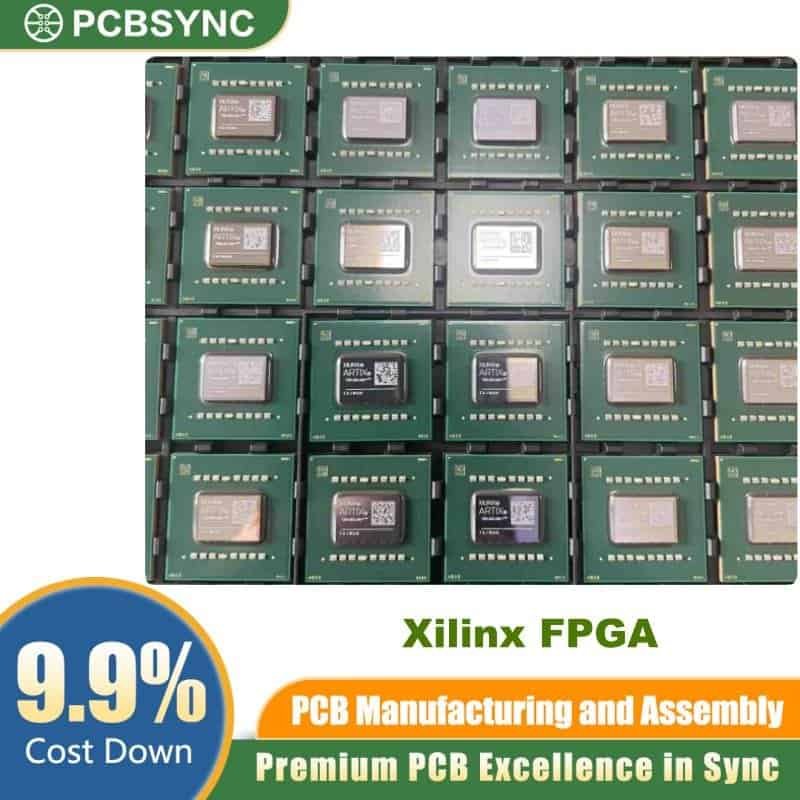
The XC3S1000-4FG456I is a high-performance, cost-optimized Field Programmable Gate Array (FPGA) from the Xilinx Spartan-3 family, now under the AMD portfolio. Featuring 1 million system gates, a 456-pin Fine-pitch Ball Grid Array (FBGA) package, and a –4 speed grade, this device is purpose-built for high-volume production designs demanding reliability in industrial temperature environments. Whether you are designing for embedded processing, digital signal processing, or communications applications, the XC3S1000-4FG456I delivers the logic capacity and I/O flexibility required for complex programmable logic tasks.
What Is the XC3S1000-4FG456I?
The XC3S1000-4FG456I belongs to Xilinx FPGA Spartan-3 series — one of the most widely adopted FPGA families for cost-sensitive, production-volume applications. The “XC3S1000” designates 1 million system gates within the Spartan-3 architecture. The “4” suffix indicates the –4 speed grade (the fastest in the Spartan-3 lineup), “FG456” specifies the 456-ball Fine-pitch BGA package, and the trailing “I” denotes the industrial temperature range (–40°C to +100°C), making it suitable for harsh operating environments.
Key Specifications at a Glance
| Parameter |
Value |
| Manufacturer |
AMD (Xilinx) |
| Part Number |
XC3S1000-4FG456I |
| FPGA Family |
Spartan-3 |
| System Gates |
1,000,000 |
| Logic Cells |
17,280 |
| CLB Slices |
7,680 |
| Distributed RAM |
120 Kb |
| Block RAM |
432 Kb |
| Multipliers (18×18) |
24 |
| DCMs (Digital Clock Managers) |
4 |
| Maximum User I/O |
391 |
| Package |
FG456 (Fine-pitch BGA, 456 balls) |
| Speed Grade |
–4 (Fastest) |
| Operating Voltage (VCCINT) |
1.2V |
| I/O Voltage |
1.2V – 3.3V |
| Temperature Range |
–40°C to +100°C (Industrial) |
| RoHS Status |
Non-RoHS (legacy device) |
| Moisture Sensitivity Level |
MSL 3 / 168 Hours |
XC3S1000-4FG456I Architecture Overview
Configurable Logic Blocks (CLBs) and Slices
The XC3S1000-4FG456I contains 7,680 CLB slices, each consisting of two 4-input Look-Up Tables (LUTs) and two flip-flops. This architecture provides substantial combinational and sequential logic resources, enabling complex state machines, data path operations, and control logic all within a single device.
Dedicated Block RAM
With 432 Kb of embedded Block RAM organized in 18 Kb dual-port blocks, the XC3S1000-4FG456I supports on-chip data buffering, FIFO implementations, and small embedded memory systems. Block RAMs can be configured as single-port or dual-port memories at widths of 1 to 36 bits.
Distributed RAM
Beyond Block RAM, the device offers 120 Kb of distributed RAM implemented within CLB LUTs. This is ideal for small lookup tables and shift registers that demand very low-latency access directly alongside logic.
Dedicated Multipliers
The device includes 24 dedicated 18×18-bit hardware multipliers, enabling efficient DSP operations including filtering, correlation, and arithmetic-intensive signal processing without consuming LUT resources.
Digital Clock Managers (DCMs)
Four on-chip Digital Clock Managers provide clock synthesis, phase shifting, deskewing, and frequency division/multiplication. DCMs help designers meet strict timing requirements across multiple clock domains and eliminate board-level clock distribution challenges.
Package and Pinout Details
FG456 Fine-Pitch BGA Package
| Package Attribute |
Detail |
| Package Type |
Fine-pitch BGA (FBGA) |
| Ball Count |
456 |
| Body Size |
23 mm × 23 mm |
| Ball Pitch |
1.0 mm |
| Maximum User I/O Pins |
391 |
| I/O Banks |
8 |
The FG456 package offers a compact footprint suitable for space-constrained PCB designs while providing access to all 391 user I/O pins. The 1.0 mm ball pitch is compatible with standard PCB manufacturing processes, simplifying board layout and assembly.
I/O Capabilities and Supported Standards
The XC3S1000-4FG456I supports a rich set of I/O standards across its 8 independent I/O banks, allowing each bank to operate at a different voltage and standard.
| I/O Standard |
Description |
| LVTTL |
Low Voltage TTL, 3.3V |
| LVCMOS 3.3V / 2.5V / 1.8V / 1.5V |
Low Voltage CMOS |
| SSTL2 Class I & II |
Stub Series Terminated Logic for DDR SDRAM |
| SSTL3 Class I & II |
Stub Series Terminated Logic, 3.3V |
| HSTL Class I, II, III, IV |
High-Speed Transceiver Logic |
| PCI 3.3V |
Peripheral Component Interconnect |
| GTL / GTL+ |
Gunning Transceiver Logic |
| LVDS |
Low Voltage Differential Signaling |
| BLVDS |
Bus Low Voltage Differential Signaling |
| ULVDS |
Ultra Low Voltage Differential Signaling |
Speed Grade –4: Performance Characteristics
The –4 speed grade is the fastest available in the Spartan-3 1000K gate family, offering the lowest propagation delays and highest clock frequencies. This makes the XC3S1000-4FG456I the preferred choice for timing-critical designs.
| Performance Metric |
Value (–4 Grade) |
| Maximum System Clock (Fmax) |
~200 MHz (design-dependent) |
| DCM Max Input Frequency |
280 MHz |
| Block RAM Read Access Time |
~2.5 ns |
| Distributed RAM Read Access |
~1.0 ns |
Note: Actual Fmax depends on design complexity, placement, and routing.
Industrial Temperature Range (“I” Suffix)
The “I” suffix indicates the device is rated for industrial temperature operation (–40°C to +100°C junction temperature). This is a critical distinction from the commercial “C” grade (0°C to +85°C), enabling deployment in:
- Industrial automation and control systems
- Outdoor telecommunications equipment
- Transportation electronics
- Military and aerospace support equipment
- Test and measurement instruments
Configuration Options
The XC3S1000-4FG456I supports multiple configuration modes, allowing designers to choose the best fit for their system architecture:
| Configuration Mode |
Description |
| Master Serial |
SPI Flash configuration, single-bit interface |
| Slave Serial |
Externally clocked serial configuration |
| Master SelectMAP |
Parallel byte-wide configuration interface |
| Slave SelectMAP |
External controller drives byte-wide interface |
| JTAG (IEEE 1149.1) |
Boundary scan and in-system programming |
| Platform Flash |
Xilinx Platform Flash PROM interface |
Typical Application Areas
The combination of 1 million gates, dedicated multipliers, high I/O count, and industrial temperature rating makes the XC3S1000-4FG456I well suited for a broad range of applications:
| Application Domain |
Use Case Examples |
| Industrial Control |
Motor controllers, PLC replacement, process automation |
| Communications |
Protocol bridging, line cards, packet processing |
| Digital Signal Processing |
FIR/IIR filters, FFT engines, audio processing |
| Image & Video Processing |
Frame buffering, pixel pipeline, display controllers |
| Embedded Systems |
Soft processor cores (MicroBlaze, PicoBlaze), bus interfaces |
| Test & Measurement |
Logic analyzers, pattern generators, data acquisition |
| Automotive Electronics |
Engine control assist, sensor processing |
Design Tools and Software Support
The XC3S1000-4FG456I is fully supported by Xilinx ISE Design Suite (the primary EDA environment for the Spartan-3 generation). Key tools include:
- ISE Project Navigator – RTL to bitstream flow
- PlanAhead – Floorplanning and timing analysis
- ChipScope Pro – On-chip debug and logic analysis
- Core Generator – IP core generation (FIFOs, memory controllers, DSP blocks)
- ModelSim / ISim – RTL and gate-level simulation
Third-party synthesis tools including Synopsys Synplify and Mentor Precision also support this device family.
Ordering Information
| Part Number |
Speed Grade |
Package |
Temperature |
Tray/Tube |
| XC3S1000-4FG456I |
–4 (Fastest) |
FG456 FBGA |
Industrial (–40°C to +100°C) |
Tray |
| XC3S1000-5FG456I |
–5 (Standard) |
FG456 FBGA |
Industrial |
Tray |
| XC3S1000-4FG456C |
–4 (Fastest) |
FG456 FBGA |
Commercial (0°C to +85°C) |
Tray |
Comparison: XC3S1000 vs. Adjacent Spartan-3 Devices
| Feature |
XC3S500E |
XC3S1000 |
XC3S1500 |
XC3S2000 |
| System Gates |
500K |
1,000K |
1,500K |
2,000K |
| CLB Slices |
4,656 |
7,680 |
13,312 |
19,512 |
| Block RAM |
360 Kb |
432 Kb |
576 Kb |
720 Kb |
| Multipliers |
20 |
24 |
32 |
40 |
| Max User I/O |
232 |
391 |
487 |
565 |
The XC3S1000 sits at the mid-range of the Spartan-3 family, offering a balanced trade-off between logic resources, I/O count, and unit cost — making it the most popular choice for medium-complexity production designs.
Why Choose the XC3S1000-4FG456I?
The XC3S1000-4FG456I stands out for several reasons:
High Logic Density at Low Cost — The Spartan-3 architecture was designed from the ground up for cost-sensitive, high-volume production. At 1 million system gates, this device handles substantial design complexity without the premium price of higher-end FPGA families.
Maximum Speed Performance — The –4 speed grade ensures the fastest propagation delays available in the XC3S1000 device, making it the right choice when system clock frequency is a design constraint.
Industrial Reliability — The “I” temperature grade and MSL 3 moisture sensitivity level confirm this device is engineered for long-term reliability in industrial and harsh environments.
Proven Ecosystem — With millions of units deployed worldwide, the Spartan-3 family benefits from a vast library of reference designs, IP cores, application notes, and community support, significantly reducing development risk and time-to-market.
Frequently Asked Questions
Q: What is the difference between XC3S1000-4FG456I and XC3S1000-4FG456C? The only difference is the temperature rating. The “I” suffix device is rated for industrial temperatures (–40°C to +100°C), while the “C” suffix is commercial grade (0°C to +85°C).
Q: Is the XC3S1000-4FG456I still in production? The Spartan-3 family is in a mature/end-of-life phase. AMD/Xilinx continues to supply the device for existing production needs, but new designs are encouraged to migrate to Spartan-7 or Artix-7 for longer product longevity.
Q: What configuration PROM is compatible with the XC3S1000-4FG456I? Xilinx Platform Flash devices such as the XCF04S, XCF08P, and XCF16P are commonly used. SPI Flash memories from vendors like Micron, Spansion, and Winbond are also supported in Master Serial mode.
Q: Can I run a soft processor on the XC3S1000-4FG456I? Yes. Both the MicroBlaze 32-bit soft processor and the lightweight PicoBlaze 8-bit processor are fully supported and are commonly implemented in this device.