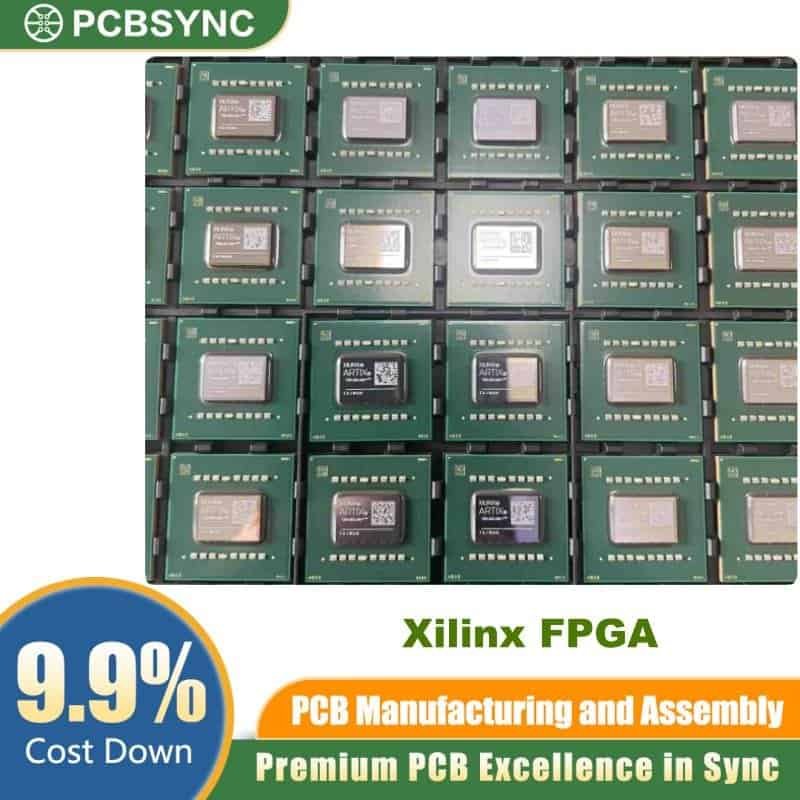
The XC3S1000-4FG456C is a high-performance, cost-optimized field-programmable gate array (FPGA) from the Xilinx FPGA Spartan-3 family, now distributed under AMD. Designed for high-volume production and logic-intensive applications, the XC3S1000-4FG456C delivers 1,000,000 system gates in a compact 456-pin Fine-pitch Ball Grid Array (FBGA) package. With its -4 speed grade and commercial temperature range, this device strikes the ideal balance between performance, power efficiency, and cost — making it one of the most widely adopted Spartan-3 FPGAs in embedded and consumer electronics design.
What Is the XC3S1000-4FG456C? Key Features Overview
The XC3S1000-4FG456C belongs to the Xilinx Spartan-3 FPGA family, a series purpose-built to meet the demands of high-volume, price-sensitive designs. The device integrates programmable logic fabric, block RAM, dedicated multipliers, and Digital Clock Managers (DCMs) all within a single chip — enabling designers to implement complex digital systems without external components.
Core Specifications at a Glance
| Parameter |
Value |
| Manufacturer / Brand |
AMD (Xilinx) |
| Part Number |
XC3S1000-4FG456C |
| FPGA Family |
Spartan-3 |
| System Gates |
1,000,000 |
| Logic Cells |
17,280 |
| CLB Slices |
7,680 |
| Flip-Flops |
15,360 |
| Distributed RAM |
120 Kb |
| Block RAM |
432 Kb (24 blocks × 18 Kb) |
| Dedicated Multipliers |
24 (18×18 bit) |
| Digital Clock Managers (DCMs) |
4 |
| Max User I/O Pins |
391 |
| Package Type |
FG456 (FBGA, 456-ball) |
| Package Dimensions |
23 mm × 23 mm |
| Speed Grade |
-4 |
| Operating Temperature |
0°C to +85°C (Commercial) |
| Core Voltage (VCCINT) |
1.2 V |
| I/O Voltage (VCCO) |
1.2 V – 3.3 V |
| RoHS Status |
Lead-free / RoHS Compliant |
| Mounting Type |
Surface Mount |
| Series |
Spartan-3 |
XC3S1000-4FG456C Part Number Breakdown
Understanding the Xilinx part numbering system helps engineers quickly verify they are ordering the correct device.
| Segment |
Code |
Meaning |
| Family |
XC3S |
Xilinx Spartan-3 |
| Gate Count |
1000 |
1,000,000 system gates |
| Speed Grade |
-4 |
Standard commercial speed (faster = lower number) |
| Package Code |
FG |
Fine-pitch BGA (FBGA) |
| Pin Count |
456 |
456-ball array |
| Temperature Grade |
C |
Commercial (0°C to +85°C) |
Detailed Technical Specifications
Logic Resources
The XC3S1000-4FG456C provides a rich logic fabric built around Configurable Logic Blocks (CLBs). Each CLB contains four slices, and each slice contains two 4-input Look-Up Tables (LUTs), two flip-flops, and dedicated carry logic. This architecture enables efficient implementation of both combinational and sequential logic.
| Logic Resource |
Quantity |
| CLBs (Configurable Logic Blocks) |
1,920 |
| Slices |
7,680 |
| 4-Input LUTs |
15,360 |
| Flip-Flops / Registers |
15,360 |
| Maximum Distributed RAM |
120 Kb |
Memory Resources
| Memory Type |
Quantity |
Total Capacity |
| Block RAM (18 Kb each) |
24 blocks |
432 Kb |
| Distributed RAM (via LUTs) |
— |
120 Kb |
| Total On-Chip RAM |
— |
552 Kb |
Block RAM in the XC3S1000-4FG456C supports true dual-port operation, configurable data widths, and optional pipelining — making it well-suited for FIFOs, look-up tables, and data buffering.
DSP and Arithmetic Resources
The device integrates 24 dedicated 18×18-bit hardware multipliers, which can be cascaded or combined with block RAM to form efficient MAC (Multiply-Accumulate) pipelines — critical for DSP, image processing, and filtering applications.
Clock Management
| Clock Feature |
Specification |
| Digital Clock Managers (DCMs) |
4 |
| Global Clock Networks |
8 |
| DCM Functions |
Frequency synthesis, phase shifting, duty-cycle correction, clock multiplication/division |
DCMs enable the XC3S1000-4FG456C to generate multiple derived clocks from a single input, synchronize clocks between domains, and eliminate clock skew across large designs.
I/O Capabilities
| I/O Parameter |
Value |
| Maximum User I/O |
391 |
| I/O Banks |
8 |
| Supported I/O Standards |
LVTTL, LVCMOS (1.8V, 2.5V, 3.3V), SSTL, HSTL, LVDS, BLVDS, LVPECL, PCI, GTL+ |
| Output Drive Strength |
2 mA – 24 mA (programmable) |
| Slew Rate Control |
Fast / Slow |
| Internal Pull-Up/Pull-Down |
Yes |
| Differential I/O Pairs |
Up to 40 pairs |
Package and Thermal Data
| Parameter |
Value |
| Package |
FG456 (FBGA) |
| Body Size |
23 mm × 23 mm |
| Ball Pitch |
1.0 mm |
| Ball Count |
456 |
| θJA (Junction-to-Ambient) |
~14°C/W (still air) |
| Maximum Junction Temperature |
125°C |
XC3S1000-4FG456C Pin Configuration
The FG456 package arranges 456 solder balls in a 27×17 grid layout on the underside of the device. The balls are organized into eight I/O banks plus dedicated power and ground supply pins. Below is a summary of the pin allocation:
| Pin Group |
Count |
Description |
| User I/O |
391 |
Programmable I/O, supports multiple voltage standards |
| VCCINT |
Multiple |
1.2 V core power supply |
| VCCO (per bank) |
Multiple |
I/O bank supply (1.2–3.3 V per bank) |
| VCCAUX |
Multiple |
2.5 V auxiliary supply |
| GND |
Multiple |
Ground |
| Dedicated Config Pins |
~10 |
DONE, PROG_B, CCLK, M[2:0], etc. |
| JTAG Pins |
4 |
TDI, TDO, TCK, TMS |
Configuration Modes Supported
The XC3S1000-4FG456C supports multiple configuration modes selected by the M[2:0] mode pins:
| Mode |
Description |
| Master Serial |
FPGA drives CCLK; reads configuration from a serial Flash |
| Slave Serial |
External device drives CCLK and data |
| Master SPI |
Reads configuration from a standard SPI Flash |
| Master BPI (Parallel) |
Reads from parallel NOR Flash |
| JTAG |
In-system programming via IEEE 1149.1 boundary scan |
| Slave SelectMAP |
High-speed parallel configuration from a processor |
Bitstream capacity for the XC3S1000 is approximately 2.77 Mb (uncompressed).
Electrical Characteristics
Absolute Maximum Ratings
| Parameter |
Value |
| VCCINT Supply Voltage |
–0.5 V to +1.5 V |
| VCCO Supply Voltage |
–0.5 V to +4.0 V |
| VCCAUX Supply Voltage |
–0.5 V to +3.0 V |
| Input Voltage on I/O Pin |
–0.5 V to VCCO + 0.5 V |
| Storage Temperature |
–65°C to +150°C |
| Maximum Junction Temperature |
125°C |
Recommended Operating Conditions
| Parameter |
Min |
Typical |
Max |
| VCCINT (Core) |
1.14 V |
1.20 V |
1.26 V |
| VCCAUX |
2.375 V |
2.5 V |
2.625 V |
| VCCO (3.3V bank) |
3.135 V |
3.3 V |
3.465 V |
| VCCO (2.5V bank) |
2.375 V |
2.5 V |
2.625 V |
| Operating Temperature |
0°C |
25°C |
85°C |
Speed Grade -4: What Does It Mean?
In Xilinx Spartan-3 nomenclature, the speed grade (following the dash) indicates the device’s performance tier. The -4 speed grade is the standard commercial speed for the Spartan-3 family.
| Speed Grade |
Relative Performance |
Typical Use Case |
| -5 |
Fastest |
Timing-critical, high-frequency designs |
| -4 |
Standard |
General-purpose commercial applications |
| -4C |
Slowest (low-power) |
Cost-optimized, lower frequency designs |
For most commercial designs operating below 100 MHz, the -4 speed grade provides ample timing margin while maintaining cost efficiency.
Typical Applications for the XC3S1000-4FG456C
The XC3S1000-4FG456C is a versatile, general-purpose FPGA well-suited for a broad range of applications:
Embedded Systems and Microprocessor Implementation
- Soft-core processor implementations (MicroBlaze, PicoBlaze)
- Co-processing and hardware acceleration
- Custom peripheral IP integration
Communications and Networking
- Protocol bridging (SPI, I2C, UART, CAN, Ethernet)
- Serializer/Deserializer (SerDes) interfacing
- Custom network processing pipelines
Industrial and Control Systems
- Motor control and servo drives
- Real-time data acquisition and processing
- Industrial Ethernet (EtherCAT, PROFINET interface logic)
Video and Image Processing
- Line buffering and pixel pipeline processing
- Display interface controllers (VGA, DVI)
- Basic image filtering and transformations
Test and Measurement Equipment
- Digital pattern generators
- Logic analyzers
- Protocol analyzers
Consumer Electronics
- Set-top box control logic
- Storage controller interfaces
- Custom ASIC prototyping
XC3S1000-4FG456C vs. Other Spartan-3 Devices
| Parameter |
XC3S500E |
XC3S1000 |
XC3S2000 |
XC3S4000 |
| System Gates |
500K |
1,000K |
2,000K |
4,000K |
| Logic Cells |
10,476 |
17,280 |
29,504 |
55,270 |
| CLB Slices |
4,656 |
7,680 |
13,312 |
24,576 |
| Block RAM |
360 Kb |
432 Kb |
720 Kb |
1,728 Kb |
| Multipliers |
20 |
24 |
40 |
96 |
| DCMs |
4 |
4 |
4 |
4 |
| Max I/O (FG456) |
232 |
391 |
391 |
391 |
The XC3S1000 occupies the mid-range of the Spartan-3 family, offering a significant logic capacity step up from the XC3S500E while sharing the same FG456 footprint as larger devices — enabling pin-compatible board designs that can scale up to the XC3S2000 or XC3S4000.
Design and Development Tools
Designs for the XC3S1000-4FG456C are developed using Xilinx ISE Design Suite (the legacy Xilinx tool for Spartan-3). Key tools and resources include:
| Tool / Resource |
Description |
| Xilinx ISE Design Suite |
RTL synthesis, implementation, bitstream generation |
| CORE Generator |
Pre-built IP cores (FIFOs, RAMs, DSP blocks, interfaces) |
| ChipScope Pro |
In-system logic analyzer and debug |
| iMPACT |
JTAG configuration and Flash programming |
| PlanAhead |
Floorplanning and physical constraints |
| ModelSim / ISim |
RTL and gate-level simulation |
| MicroBlaze |
32-bit soft-core processor for embedded designs |
| PicoBlaze |
Ultra-compact 8-bit soft-core controller |
Note: Xilinx ISE is a legacy tool (no longer actively developed). For new designs, AMD recommends migrating to Vivado, though Vivado does not natively support Spartan-3. ISE 14.7 remains the final supported version for Spartan-3.
PCB Layout and Design Considerations
Power Supply Decoupling
- Place 100 nF ceramic capacitors at every VCCINT, VCCO, and VCCAUX pin
- Add bulk capacitance (10–47 µF) near each power plane
- Keep decoupling capacitors as close to the BGA package as possible
PCB Stack-Up Recommendations
- Use at least a 4-layer PCB (signal, GND, power, signal) for optimal power integrity
- Dedicated VCCINT and VCCO planes minimize switching noise coupling
- Controlled-impedance routing recommended for LVDS and high-speed I/O
BGA Soldering
- 1.0 mm ball pitch requires IPC Class 2 or Class 3 assembly processes
- X-ray inspection recommended for solder joint verification
- Underfill may be required in high-vibration environments
Ordering Information
| Part Number |
Package |
Speed Grade |
Temperature |
Status |
| XC3S1000-4FG456C |
FG456 (FBGA) |
-4 |
Commercial (0–85°C) |
Active |
| XC3S1000-5FG456C |
FG456 (FBGA) |
-5 |
Commercial (0–85°C) |
Active |
| XC3S1000-4FG456I |
FG456 (FBGA) |
-4 |
Industrial (–40–100°C) |
Active |
| XC3S1000-4FT256C |
FT256 (FTBGA) |
-4 |
Commercial (0–85°C) |
Active |
Compliance and Certifications
| Standard |
Status |
| RoHS (Restriction of Hazardous Substances) |
Compliant |
| REACH |
Compliant |
| MSL (Moisture Sensitivity Level) |
MSL 3 |
| JEDEC |
J-STD-020 compliant |
| JTAG |
IEEE 1149.1 (Full boundary scan) |
Frequently Asked Questions (FAQ)
Q: Is the XC3S1000-4FG456C in production? A: Yes. As of the current date, Xilinx (AMD) continues to supply the XC3S1000-4FG456C as an active part. It is available from authorized distributors including DigiKey, Mouser, and Arrow.
Q: What is the difference between XC3S1000-4FG456C and XC3S1000-5FG456C? A: The only difference is the speed grade. The -5 grade is faster (lower propagation delays), allowing higher clock frequencies. The -4 grade is sufficient for most commercial designs up to ~150 MHz depending on logic depth.
Q: Can I replace XC3S1000-4FG456C with XC3S2000-4FG456C on the same PCB? A: Yes. The FG456 package is pin-compatible across the Spartan-3 XC3S1000, XC3S2000, and XC3S4000. No PCB changes are needed; simply update the bitstream for the larger device.
Q: What programming software supports the XC3S1000-4FG456C? A: Xilinx ISE Design Suite 14.7 is the primary development tool. The device can be programmed via Xilinx iMPACT using a JTAG cable (such as the Xilinx Platform Cable USB II).
Q: Is the XC3S1000-4FG456C suitable for automotive designs? A: No. The “C” suffix indicates a Commercial temperature grade (0°C to +85°C). For automotive or extended-range applications, the “I” suffix (Industrial: –40°C to +100°C) variant such as the XC3S1000-4FG456I should be used.
Summary
The XC3S1000-4FG456C is a proven, production-ready FPGA offering 1 million system gates, 432 Kb of block RAM, 24 hardware multipliers, and 4 Digital Clock Managers in a standard FG456 BGA package. Its -4 commercial speed grade, broad I/O standard support, and rich IP ecosystem make it an ideal choice for engineers designing embedded systems, communications interfaces, industrial controllers, and digital signal processing applications. Combined with the Xilinx ISE toolchain and a vast library of soft-core processors and IP cores, the XC3S1000-4FG456C continues to be a reliable, cost-effective solution for FPGA-based product development.