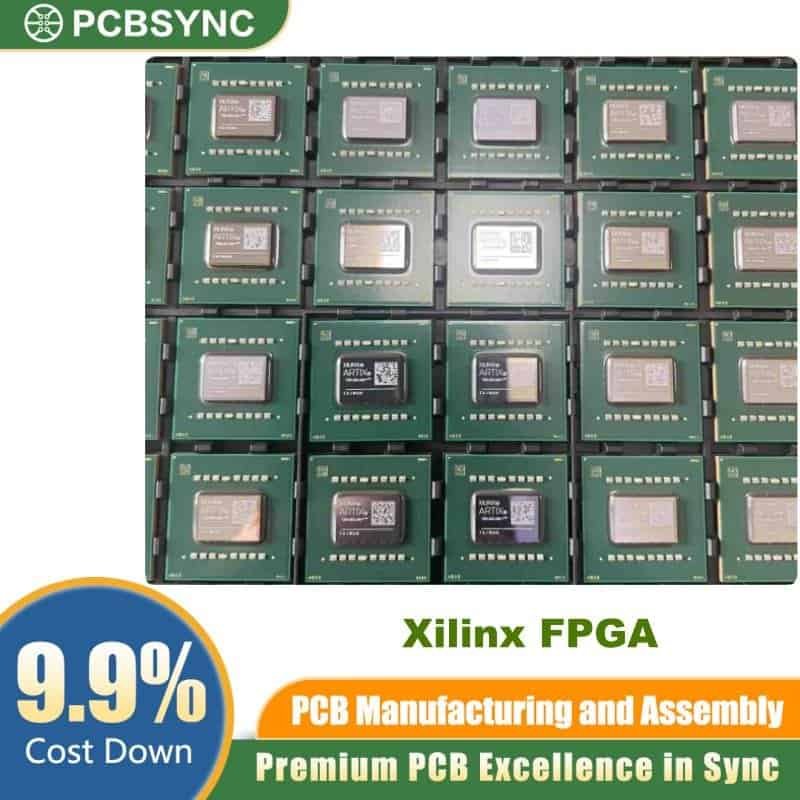
Overview of XC2S600E-7FGG456C FPGA
The XC2S600E-7FGG456C is a high-performance field-programmable gate array (FPGA) from AMD Xilinx’s Spartan-IIE family, designed for cost-effective yet powerful digital logic applications. This versatile FPGA delivers 600,000 system gates with enhanced speed capabilities, making it an ideal choice for telecommunications, industrial automation, embedded systems, and consumer electronics applications.
Manufactured using advanced 0.15-micron CMOS technology, the XC2S600E-7FGG456C combines high logic density with low power consumption in a compact 456-pin fine-pitch ball grid array (FBGA) package. The “-7” speed grade provides maximum operational frequency of 400MHz, delivering superior performance for timing-critical applications.
Key Features and Specifications
Core Architecture and Logic Resources
The XC2S600E-7FGG456C belongs to AMD Xilinx’s second-generation ASIC replacement technology, built on the proven Virtex-E FPGA architecture. This Xilinx FPGA solution provides exceptional flexibility and performance for modern digital designs.
| Specification |
Value |
| System Gates |
600,000 gates |
| Logic Cells |
15,552 cells |
| Configurable Logic Blocks (CLBs) |
3,456 CLBs |
| Maximum Frequency |
400 MHz |
| Speed Grade |
-7 (fastest) |
| Technology Node |
0.15 micron CMOS |
Memory Configuration
| Memory Type |
Capacity |
Configuration |
| Block RAM |
288 Kbits total |
4K-bit true dual-port blocks |
| Distributed RAM |
221,184 bits |
16 bits per LUT |
| Total RAM Bits |
294,912 bits |
Hierarchical SelectRAM |
Package and I/O Specifications
| Parameter |
Specification |
| Package Type |
456-pin FBGA (Fine-Pitch Ball Grid Array) |
| Package Dimensions |
23mm × 23mm |
| Mounting Type |
Surface Mount Technology (SMT) |
| User I/O Pins |
329 configurable I/Os |
| I/O Standards Supported |
19 selectable standards |
Electrical Characteristics
| Parameter |
Value |
| Core Voltage (VCCINT) |
1.8V (1.71V – 1.89V) |
| I/O Voltage (VCCO) |
1.5V to 3.3V |
| Operating Temperature |
Commercial: 0°C to +85°C (TJ) |
| Power Consumption |
Low power optimized |
Advanced Technical Capabilities
Programmable Logic Architecture
The XC2S600E-7FGG456C features a hierarchical programmable interconnect system that ensures fast, predictable routing for complex designs. Each Configurable Logic Block (CLB) contains four Logic Cells (LCs) organized in two slices, providing maximum design flexibility.
Key architectural elements include:
- Four-input Look-Up Tables (LUTs) for implementing any Boolean function
- Dedicated fast carry logic for arithmetic operations
- Embedded multiplexers supporting wide function implementation
- D-type flip-flops or latches with individual clock enables
- Fast local routing resources for optimal performance
Memory Hierarchy
The device implements SelectRAM hierarchical memory architecture combining distributed and block RAM:
Distributed RAM capabilities:
- 16 bits per LUT available as distributed memory
- Ideal for small FIFO buffers, register files, and lookup tables
- Seamlessly integrated within logic fabric
Block RAM features:
- True dual-port configuration supporting simultaneous read/write operations
- Configurable data widths from 1 to 18 bits
- Independent clocking for each port
- Optional pipelining registers for enhanced performance
Clock Management System
The XC2S600E-7FGG456C includes four Delay-Locked Loops (DLLs) providing comprehensive clock management:
- Digital clock synthesis and distribution
- Clock de-skewing and phase shifting
- Frequency synthesis through clock multiplication/division
- Support for multiple independent clock domains
- Low-jitter performance for high-speed interfaces
Application Areas
Telecommunications and Networking
The XC2S600E-7FGG456C excels in telecommunications infrastructure applications requiring high-speed data processing:
- Protocol converters and bridges
- Network packet processing engines
- Digital signal processing (DSP) applications
- Interface controllers for multiple communication standards
- Software-defined radio (SDR) implementations
Industrial Control Systems
Industrial automation benefits from the FPGA’s reliability and flexibility:
- Programmable logic controllers (PLCs)
- Motion control systems
- Machine vision processing
- Real-time monitoring and control
- Sensor interface and data acquisition systems
Consumer Electronics
The device’s cost-effectiveness makes it suitable for consumer applications:
- Display controllers and video processing
- Audio signal processing and effects
- Gaming console peripherals
- Set-top box functionality
- Smart home automation controllers
Embedded Computing
Embedded system designers leverage the FPGA for:
- Custom microcontroller implementations
- Hardware acceleration engines
- Peripheral interface expansion
- Real-time operating system (RTOS) support
- Prototype development and validation
Configuration and Programming
Configuration Modes
The XC2S600E-7FGG456C supports multiple configuration methods for maximum flexibility:
| Configuration Mode |
Description |
Use Case |
| Master Serial Mode |
FPGA reads from external PROM |
Standalone operation |
| Slave Serial Mode |
External controller programs device |
Processor-based systems |
| Slave Parallel Mode |
Fast parallel configuration |
Quick reconfiguration needs |
| JTAG/Boundary Scan |
IEEE 1149.1 compliant |
Development and debugging |
Unlimited Reprogrammability
The device stores configuration data in SRAM-based memory cells, enabling:
- Unlimited reconfiguration cycles without device degradation
- In-system programming (ISP) capabilities
- Remote field updates without hardware replacement
- Dynamic partial reconfiguration for adaptive systems
- Non-volatile configuration using external flash memory
Design Tools and Software Support
Xilinx provides comprehensive development tools:
- ISE Design Suite for synthesis and implementation
- Vivado Design Suite compatibility for advanced features
- ChipScope for embedded logic analysis
- IP Core libraries for rapid development
- Simulation tools integration (ModelSim, Questa, VCS)
Advantages Over Traditional ASICs
Cost-Effectiveness
The XC2S600E-7FGG456C delivers significant economic benefits compared to mask-programmed ASICs:
- Zero NRE costs: Eliminate expensive mask set and fabrication setup fees
- Lower minimum order quantities: Suitable for low to medium volume production
- Reduced time-to-market: Design iterations in hours versus months
- Risk mitigation: Avoid costly silicon respins
Design Flexibility
FPGA programmability provides unmatched adaptability:
- Post-deployment updates: Fix bugs or add features in deployed systems
- Rapid prototyping: Validate designs quickly before committing to ASIC
- Feature differentiation: Enable multiple product variants from single hardware
- Future-proofing: Adapt to evolving standards and requirements
Fast Predictable Interconnect
The hierarchical routing architecture ensures:
- Consistent timing across design iterations
- Meeting timing closure requirements reliably
- Reduced design cycle time
- Predictable performance scaling
Package Information
FBGA-456 Package Details
The XC2S600E-7FGG456C utilizes a 456-pin Fine-Pitch Ball Grid Array package offering:
Physical characteristics:
- Compact 23mm × 23mm footprint
- 1.0mm ball pitch for high-density routing
- RoHS compliant lead-free construction
- Excellent thermal characteristics
- MSL (Moisture Sensitivity Level) rated for reliability
PCB Design considerations:
- Requires controlled impedance routing for high-speed signals
- BGA-specific land pattern requirements
- Thermal via placement for heat dissipation
- Power plane distribution for clean power delivery
- Signal integrity considerations for I/O standards
Ordering Information and Part Number Breakdown
Part Number Decoding: XC2S600E-7FGG456C
| Segment |
Code |
Meaning |
| Device Family |
XC2S |
Spartan-II family |
| Logic Density |
600E |
600,000 system gates, enhanced |
| Speed Grade |
-7 |
Fastest speed option (400 MHz) |
| Package Type |
FGG |
Fine-pitch Ball Grid Array |
| Pin Count |
456 |
Total package pins |
| Temperature Grade |
C |
Commercial (0°C to +85°C) |
Related Part Numbers
Alternative speed grades and packages in the XC2S600E series:
- XC2S600E-6FGG456C: Speed grade -6 (357 MHz), same package
- XC2S600E-7FG676C: Speed grade -7, larger 676-pin package
- XC2S600E-6FGG456I: Industrial temperature range (-40°C to +100°C)
- XC2S600E-7FT256C: Speed grade -7, smaller 256-pin FTBGA package
Quality and Reliability
Manufacturing Standards
AMD Xilinx maintains rigorous quality control:
- ISO 9001 certified manufacturing facilities
- Automotive-grade quality options (AEC-Q100)
- JEDEC standard compliance
- RoHS and REACH compliant materials
- Comprehensive environmental testing
Reliability Testing
Every device undergoes extensive qualification:
- High-temperature operating life (HTOL) testing
- Temperature cycling stress tests
- Moisture sensitivity level characterization
- Electromagnetic compatibility (EMC) validation
- Latch-up immunity verification
Warranty and Support
Standard manufacturer warranty includes:
- Defect-free materials and workmanship guarantee
- Technical support through authorized distributors
- Comprehensive documentation and application notes
- Regular design advisory updates
- Long-term product availability commitments
Development Resources
Documentation
Complete technical resources available:
- Detailed product datasheet (DS077)
- User guide with application examples
- PCB layout guidelines
- Thermal management guidelines
- SelectIO standards reference
- Configuration user guide
Reference Designs
Xilinx provides starter designs for common applications:
- Communication interface examples
- DSP algorithm implementations
- Memory controller templates
- High-speed I/O reference designs
- Power-on and configuration examples
Technical Support
Access to comprehensive support ecosystem:
- Xilinx support forums and community
- Application engineers for design assistance
- Design services partnerships
- Training and certification programs
- Webinars and technical seminars
Competitive Advantages
Performance Leadership
The XC2S600E-7FGG456C speed grade -7 option delivers:
- Up to 400 MHz system clock frequency
- Industry-leading logic density for cost
- Optimized architecture for specific applications
- Superior power-to-performance ratio
Ecosystem Maturity
Spartan-IIE FPGAs benefit from:
- Decades of proven field deployment
- Extensive third-party IP core availability
- Mature design tools and methodology
- Comprehensive training resources
- Large designer community worldwide
Supply Chain Stability
AMD Xilinx ensures product availability through:
- Multiple fabrication sources
- Authorized global distributor network
- Long product lifecycle commitments
- Strategic inventory management
- Component obsolescence management programs
Thermal Management Considerations
Heat Dissipation Requirements
Effective thermal management ensures reliable operation:
Thermal parameters:
- Junction-to-ambient thermal resistance (θJA)
- Junction-to-case thermal resistance (θJC)
- Maximum junction temperature (TJ max): 125°C
- Recommended operating junction temperature
Cooling solutions:
- Natural convection for low-power applications
- Heat sinks for moderate power dissipation
- Forced air cooling for maximum performance
- Thermal vias in PCB for heat spreading
Migration Path and Design Scalability
Family Compatibility
The Spartan-IIE family offers scalability options:
Lower density alternatives:
- XC2S50E: 50,000 gates for simple applications
- XC2S100E: 100,000 gates entry-level
- XC2S150E: 150,000 gates moderate complexity
- XC2S200E: 200,000 gates mid-range
- XC2S300E: 300,000 gates expanded capability
- XC2S400E: 400,000 gates high-integration
Higher density option:
- XC2S800E: 800,000 gates for maximum capacity
Upgrade Path Considerations
Design migration benefits include:
- Pin-compatible packages across density range
- Common design tools and methodology
- Reusable IP cores and design blocks
- Consistent I/O standard support
- Similar clock management resources
Frequently Asked Questions
What makes the XC2S600E-7FGG456C suitable for my application?
This FPGA provides an optimal balance of logic capacity, performance, and cost-effectiveness. With 600,000 system gates and 400 MHz operation, it handles moderate to complex digital designs efficiently while maintaining economic viability for production volumes.
How does the speed grade -7 differ from speed grade -6?
The -7 speed grade offers faster maximum clock frequencies (400 MHz versus 357 MHz) and reduced propagation delays, enabling higher performance but at slightly increased cost. Choose -7 for timing-critical applications requiring maximum speed.
What I/O voltage standards are supported?
The XC2S600E-7FGG456C supports 19 different I/O standards including LVTTL, LVCMOS (3.3V, 2.5V, 1.8V, 1.5V), SSTL, HSTL, GTL, and differential standards like LVDS, enabling direct interface to various devices without external level shifters.
Is this device recommended for new designs?
While the Spartan-IIE family is mature and reliable, AMD Xilinx marks it as “not recommended for new designs” as newer families offer improved performance and features. However, it remains excellent for cost-sensitive applications, legacy design support, and applications requiring proven long-term availability.
What configuration memory is required?
For Master Serial mode, the XC2S600E requires approximately 2.6 Mbit configuration memory. Xilinx Platform Flash XCFxxP PROMs or equivalent serial flash devices provide suitable configuration storage.
Can I perform partial reconfiguration?
The Spartan-IIE family supports full device reconfiguration but not dynamic partial reconfiguration. For applications requiring partial reconfiguration, consider newer Xilinx FPGA families like 7-Series or UltraScale.
What development boards are available?
While Xilinx doesn’t produce official development kits for Spartan-IIE, many third-party vendors offer evaluation boards featuring XC2S600E devices. Common options include general-purpose FPGA development boards with expansion headers, communication interfaces, and reference designs.
How do I get started with FPGA design?
Begin with Xilinx ISE Design Suite (available free as WebPACK edition), review the Getting Started guide, examine reference designs, and utilize online tutorials. The Xilinx support forums and community provide excellent learning resources for beginners.
Conclusion
The XC2S600E-7FGG456C represents a mature, cost-effective FPGA solution delivering 600,000 system gates in a high-performance package. Its combination of proven architecture, comprehensive I/O support, flexible configuration options, and strong ecosystem support makes it an excellent choice for industrial, telecommunications, consumer, and embedded applications where reliability and cost-effectiveness are paramount.
Whether you’re implementing digital signal processing, control systems, communication protocols, or custom computing architectures, this Xilinx FPGA provides the resources and performance needed for successful deployment. The unlimited reprogrammability, extensive documentation, and mature development tools ensure design success from concept through production.
For applications requiring maximum flexibility, proven reliability, and excellent price-performance ratio, the XC2S600E-7FGG456C delivers exceptional value in today’s competitive electronics market.