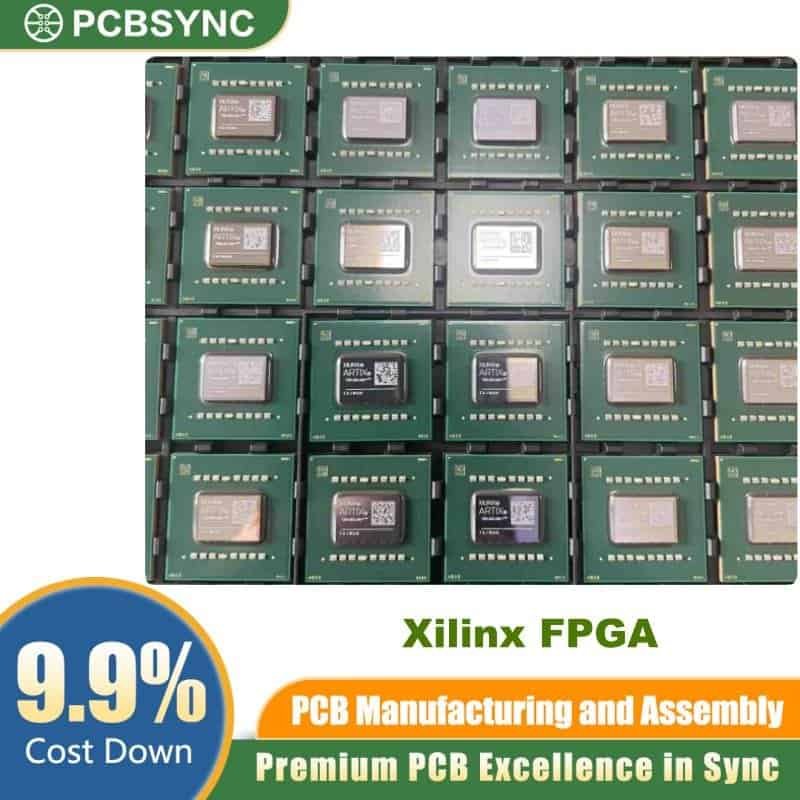
Overview of XC2S600E-6FGG676C FPGA
The XC2S600E-6FGG676C is a powerful field-programmable gate array from the Spartan-IIE family, manufactured by Xilinx (now part of AMD). This FPGA delivers exceptional programmable logic capabilities with 600,000 system gates and 15,552 logic cells, making it an ideal solution for high-volume digital design applications. Built on advanced 0.15-micron technology, the XC2S600E-6FGG676C offers engineers and designers a cost-effective alternative to traditional ASICs while maintaining superior performance and flexibility.
This Xilinx FPGA features a commercial-grade temperature range and comes packaged in a 676-pin Fine-Pitch Ball Grid Array (FBGA) configuration, providing extensive I/O capabilities for complex system integration. The device operates at 1.8V, ensuring low power consumption without compromising processing speed or functionality.
Key Technical Specifications
Core Architecture Features
| Specification |
Value |
| Logic Cells |
15,552 cells |
| System Gates |
600,000 gates |
| Maximum Operating Frequency |
357 MHz |
| Process Technology |
0.15 µm |
| Supply Voltage |
1.8V |
| Package Type |
676-Pin FBGA (FGG676) |
| Speed Grade |
-6 (Commercial) |
Memory Architecture
| Memory Type |
Capacity |
| Block RAM |
Up to 288 Kbits |
| Distributed RAM |
Up to 221,184 bits |
| Total RAM Size |
36 KB |
I/O and Configuration
| Feature |
Specification |
| Total Pins |
676 pins |
| User I/O Pins |
514 programmable I/Os |
| I/O Standards Supported |
19 selectable standards |
| DLL (Delay-Locked Loops) |
4 DLLs |
| Configuration Modes |
Master Serial, Slave Serial, Slave Parallel, JTAG |
Temperature and Environmental Ratings
| Parameter |
Rating |
| Operating Temperature Range |
0°C to +85°C (Commercial) |
| Temperature Grade |
Commercial |
| RoHS Compliance |
RoHS Compliant |
| Lead-Free Status |
Lead-Free Available |
| Radiation Hardening |
No |
Advanced Features and Benefits
Programmable Logic Capabilities
The XC2S600E-6FGG676C FPGA leverages the proven Spartan-IIE architecture, derived from the industry-leading Virtex-E technology. This design inheritance provides designers with robust programmable logic resources organized in configurable logic blocks (CLBs). Each CLB contains four logic cells arranged in two slices, enabling efficient implementation of complex digital functions.
SelectRAM Hierarchical Memory System
One of the standout features of this FPGA is its SelectRAM memory architecture, which provides flexibility for various memory requirements. The device includes both distributed RAM (16 bits per lookup table) and configurable 4K-bit true dual-port block RAM. With six columns of block RAM, the XC2S600E offers designers substantial on-chip memory resources for data buffering, FIFO implementations, and embedded processing applications.
I/O Flexibility and Standards Compliance
The XC2S600E-6FGG676C supports 19 different I/O standards, making it highly versatile for interfacing with various external components and systems. This multi-standard I/O capability allows designers to integrate the FPGA seamlessly into mixed-voltage environments and communicate with peripherals using different signaling protocols.
Delay-Locked Loop (DLL) Technology
Four integrated DLLs provide advanced clock management capabilities, enabling precise control over clock distribution and timing. These DLLs help designers achieve optimal timing closure and support sophisticated clocking architectures required in high-performance digital systems.
Application Areas
Telecommunications and Networking
The high logic density and fast operating frequency make the XC2S600E-6FGG676C suitable for telecommunications equipment, including protocol converters, packet processors, and interface controllers. The abundant I/O resources support multiple communication channels simultaneously.
Industrial Control Systems
Industrial automation applications benefit from the FPGA’s reliability, reprogrammability, and real-time processing capabilities. The device can implement custom control algorithms, sensor interfaces, and motor control functions.
Consumer Electronics
Cost-sensitive consumer applications leverage the Spartan-IIE’s competitive pricing while maintaining high performance. Examples include digital set-top boxes, gaming peripherals, and audio/video processing equipment.
Embedded Systems
The combination of logic resources, embedded memory, and flexible I/O makes this FPGA ideal for embedded system prototypes and production designs requiring custom processing capabilities.
Configuration and Programming
Multiple Configuration Options
The XC2S600E-6FGG676C supports several configuration methods to accommodate different system requirements:
- Master Serial Mode: The FPGA loads configuration data from an external serial PROM, ideal for standalone applications
- Slave Serial Mode: External controller writes configuration data serially
- Slave Parallel Mode: Parallel configuration for faster startup times
- JTAG Boundary Scan: In-system programming and debugging through standard JTAG interface
Platform Flash Integration
Xilinx Platform Flash in-system programmable configuration PROMs provide reliable, non-volatile storage for FPGA bitstreams. This integration simplifies board design and enables field updates without specialized programming equipment.
Unlimited Reprogrammability
Unlike mask-programmed ASICs, the XC2S600E-6FGG676C can be reprogrammed an unlimited number of times. This capability facilitates iterative design refinement, field upgrades, and feature modifications without hardware replacement.
Design Development Tools
ISE Design Suite Support
The XC2S600E-6FGG676C is fully supported by Xilinx ISE Design Suite, providing comprehensive tools for synthesis, implementation, and timing analysis. Designers can leverage industry-standard HDL languages including VHDL and Verilog for design entry.
Simulation and Verification
Extensive simulation libraries enable thorough pre-silicon verification, reducing development time and increasing confidence in design functionality before hardware implementation.
Package Information
FBGA Package Characteristics
The 676-pin Fine-Pitch Ball Grid Array package offers several advantages:
- High pin density for maximum I/O utilization
- Excellent thermal performance for reliable operation
- Low inductance connections for high-speed signals
- Standard PCB assembly compatibility
Physical Dimensions
The FGG676 package provides a compact footprint while delivering extensive connectivity options, making it suitable for space-constrained applications without sacrificing functionality.
Comparison with Alternative Solutions
Advantages Over ASICs
| Feature |
XC2S600E-6FGG676C |
Traditional ASIC |
| Development Time |
Weeks to months |
6-12 months |
| Initial Cost |
Low (no NRE) |
High NRE costs |
| Design Flexibility |
Unlimited changes |
Fixed after fabrication |
| Time to Market |
Fast |
Slow |
| Field Updates |
Supported |
Impossible |
FPGA vs. Microcontroller
While microcontrollers excel at sequential processing, the XC2S600E-6FGG676C provides true parallel processing capabilities with customizable hardware acceleration. This makes it superior for applications requiring simultaneous multi-channel processing or high-throughput data manipulation.
Power Considerations
Low-Voltage Operation
Operating at 1.8V, the XC2S600E-6FGG676C maintains low power consumption, which is critical for battery-operated devices and systems with thermal constraints. The reduced voltage also contributes to improved reliability and longer component lifespan.
Power Management Features
Designers can implement various power-saving techniques, including clock gating and selective resource utilization, to further optimize power consumption for specific application requirements.
Quality and Reliability
Manufacturing Standards
Manufactured using proven 0.15-micron CMOS technology, the XC2S600E-6FGG676C meets stringent quality standards. Each device undergoes comprehensive testing to ensure reliability across the full commercial temperature range.
Pb-Free and RoHS Compliance
The FPGA is available in lead-free packaging options, ensuring compliance with environmental regulations and making it suitable for worldwide distribution and sale.
Design Considerations
PCB Layout Requirements
When designing circuit boards for the XC2S600E-6FGG676C, engineers should consider:
- Power supply decoupling requirements for stable 1.8V operation
- Thermal management for sustained high-frequency operation
- Signal integrity for high-speed I/O connections
- JTAG programming interface accessibility
Configuration Strategy
Selecting the appropriate configuration mode depends on system requirements. Master serial mode offers simplicity for standalone operation, while JTAG provides flexibility during development and field maintenance.
Procurement and Support
Availability and Lifecycle
While the XC2S600E series represents mature FPGA technology, components remain available through authorized distributors and electronic component suppliers. For new designs, engineers should verify current availability and consider migration paths to newer FPGA families.
Technical Documentation
Comprehensive datasheets, application notes, and reference designs are available from Xilinx to support development efforts. These resources provide detailed timing specifications, programming guidelines, and best practices for successful implementation.
Frequently Asked Questions
What is the main difference between speed grades?
The -6 speed grade indicates the device’s timing performance characteristics. Lower numbers (like -7) offer faster operation, while higher numbers prioritize cost optimization. The -6 grade provides an excellent balance of performance and cost for commercial applications.
Can the XC2S600E-6FGG676C be used in industrial applications?
While the commercial temperature range (0°C to 85°C) suits many applications, designers should verify that operating conditions remain within specification. Industrial-grade versions may be available for extended temperature requirements.
How does this FPGA handle hot-swap capability?
The Spartan-IIE family includes hot-swap support features, allowing the device to be inserted into live systems without damage. Proper board design with appropriate current limiting and voltage sequencing is essential for reliable hot-swap operation.
What development boards are compatible?
Various development boards and starter kits support the Spartan-IIE family, though specific boards for the FGG676 package may be limited. Engineers often use evaluation boards with similar devices for algorithm development before transitioning to custom hardware.
Conclusion
The XC2S600E-6FGG676C represents a mature, proven FPGA solution delivering substantial programmable logic resources in a cost-effective package. Its combination of 600,000 system gates, extensive I/O capabilities, and flexible memory architecture makes it suitable for diverse applications across telecommunications, industrial control, and embedded systems.
With unlimited reprogrammability, multiple configuration options, and comprehensive design tool support, this FPGA enables rapid development cycles and field-upgradable products. While newer FPGA families offer enhanced features and performance, the XC2S600E-6FGG676C remains a viable choice for cost-sensitive applications requiring proven technology with established design flows.
Engineers seeking reliable programmable logic solutions with substantial resources will find the XC2S600E-6FGG676C delivers excellent value, combining the flexibility of programmable logic with the integration density approaching traditional ASIC implementations.