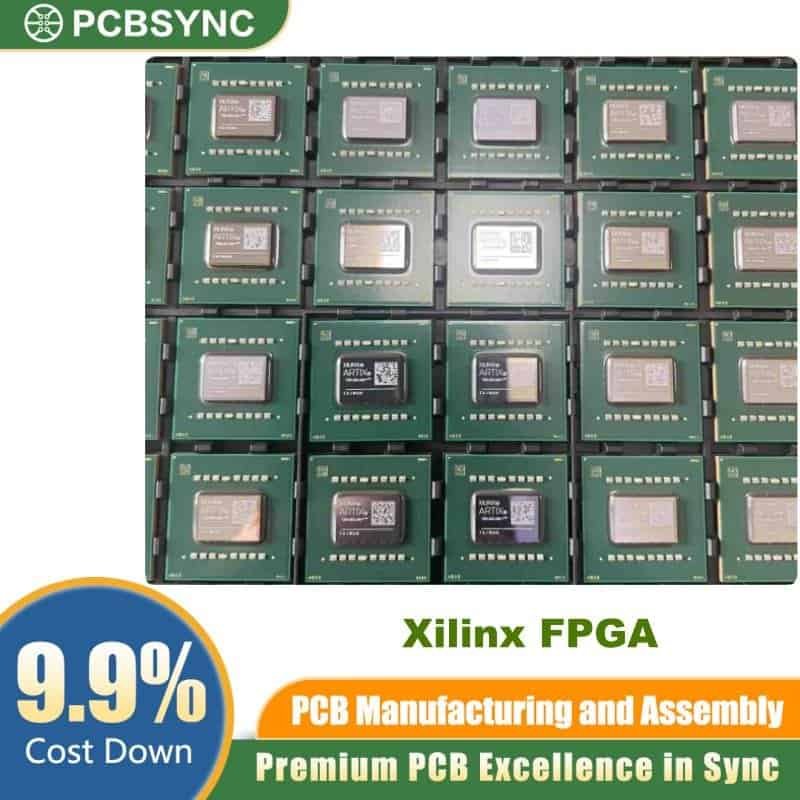
Overview of XC2S50E-7TQ144C Field Programmable Gate Array
The XC2S50E-7TQ144C is a powerful field-programmable gate array (FPGA) from Xilinx’s renowned Spartan-IIE family. This versatile programmable logic device delivers exceptional performance with 50,000 system gates, making it an ideal solution for cost-sensitive digital design applications. Built on proven 0.15-micron CMOS technology, this FPGA provides engineers with the flexibility and reliability needed for modern embedded systems.
As part of the second-generation ASIC replacement technology, the XC2S50E-7TQ144C offers unlimited in-system reprogrammability, eliminating the lengthy development cycles and high initial costs associated with traditional ASICs. Whether you’re developing telecommunications equipment, industrial automation systems, or consumer electronics, this Xilinx FPGA delivers the performance and features you need.
Key Technical Specifications
Core Performance Characteristics
| Specification |
Value |
| System Gates |
50,000 gates |
| Logic Cells |
1,728 cells |
| Configurable Logic Blocks (CLBs) |
384 CLBs |
| Maximum Frequency |
357 MHz |
| Process Technology |
0.15μm (0.15 micron) CMOS |
| Speed Grade |
-7 (7ns) |
| Core Voltage |
1.8V (1.71V – 1.89V) |
| Operating Temperature |
Commercial (0°C to +85°C) |
Memory Architecture
| Memory Type |
Capacity |
| Total RAM Bits |
32,768 bits |
| Block RAM |
Up to 64K bits |
| Distributed RAM |
16 bits per LUT |
| Flip-Flops |
1,728 flip-flops |
Input/Output Capabilities
| I/O Feature |
Specification |
| User I/O Pins |
102 pins |
| Package Type |
144-TQFP (Thin Quad Flat Pack) |
| Package Dimensions |
20mm x 20mm |
| I/O Standards Supported |
19 selectable standards |
| Mounting Type |
Surface Mount Technology (SMT) |
Advanced Features of XC2S50E-7TQ144C FPGA
SelectRAM Hierarchical Memory System
The XC2S50E-7TQ144C incorporates Xilinx’s innovative SelectRAM technology, providing designers with flexible memory options. The distributed RAM architecture allows each Look-Up Table (LUT) to function as a 16-bit RAM, while the configurable 4K-bit true dual-port block RAM enables efficient data storage and retrieval for complex applications.
Delay-Locked Loops (DLLs)
This Spartan-IIE FPGA features four on-chip Delay-Locked Loops that provide precise clock management capabilities. The DLLs enable clock multiplication, division, phase shifting, and duty cycle correction, ensuring optimal timing performance across your entire design.
Versatile I/O Standards Support
With support for 19 different I/O standards, the XC2S50E-7TQ144C offers exceptional interface flexibility. Compatible standards include:
- LVTTL (Low Voltage TTL)
- LVCMOS (Low Voltage CMOS)
- SSTL (Stub Series Terminated Logic)
- HSTL (High Speed Transceiver Logic)
- LVDS (Low Voltage Differential Signaling)
- PCI-compliant interfaces
This wide range of I/O support enables seamless integration with various system components and peripherals.
Design Architecture and Capabilities
Configurable Logic Blocks Structure
Each CLB in the XC2S50E-7TQ144C contains four Logic Cells (LCs) organized in two slices, providing maximum design flexibility. The LCs can be configured as:
- D-type flip-flops for sequential logic
- Level-sensitive latches for timing-critical paths
- Combinatorial logic functions through LUT configuration
- Distributed RAM or shift registers
Fast and Predictable Interconnect
The Spartan-IIE architecture features a streamlined interconnect network based on the proven Virtex-E platform. This predictable routing structure ensures that successive design iterations continue to meet timing requirements, reducing development time and improving project predictability.
Applications and Use Cases
Industrial Automation Systems
The XC2S50E-7TQ144C excels in industrial control applications, including:
- Motor control systems
- Process automation controllers
- Sensor interface modules
- Industrial communication protocols (CANbus, Profibus, Modbus)
Telecommunications Equipment
Telecommunications designers leverage this FPGA for:
- Digital signal processing (DSP) applications
- Protocol converters
- Communication interface modules
- Network switching components
Consumer Electronics
The device’s cost-effectiveness makes it ideal for:
- Digital video/audio processing
- Gaming peripherals
- Smart home devices
- LED display controllers
Embedded Systems Development
Engineers utilize the XC2S50E-7TQ144C for:
- Prototype development
- Custom logic implementation
- System-on-Chip (SoC) glue logic
- Interface bridging solutions
Package Information: 144-TQFP Details
Physical Specifications
| Package Parameter |
Specification |
| Package Type |
TQFP (Thin Quad Flat Pack) |
| Pin Count |
144 pins |
| Body Size |
20mm x 20mm |
| Pin Pitch |
0.5mm |
| Package Height |
1.4mm (maximum) |
| Lead Finish |
Matte tin or NiPdAu |
The compact 144-pin TQFP package provides an excellent balance between I/O capability and board space efficiency, making it suitable for space-constrained applications.
Comparison with Related Spartan-IIE Devices
| Model |
System Gates |
Logic Cells |
Speed Grade |
Package |
| XC2S50E-6TQ144C |
50,000 |
1,728 |
-6 (slower) |
144-TQFP |
| XC2S50E-7TQ144C |
50,000 |
1,728 |
-7 (faster) |
144-TQFP |
| XC2S50E-7FT256C |
50,000 |
1,728 |
-7 |
256-FTBGA |
| XC2S100E-7TQ144C |
100,000 |
2,700 |
-7 |
144-TQFP |
The XC2S50E-7TQ144C represents the faster speed grade option in the 50K gate count category with the convenient 144-pin TQFP packaging.
Development Tools and Programming
Xilinx ISE Design Suite
The XC2S50E-7TQ144C is fully supported by Xilinx’s ISE (Integrated Software Environment) Design Suite, which provides:
- Comprehensive synthesis and implementation tools
- Timing analysis and constraint management
- Simulation capabilities with ModelSim integration
- ChipScope Pro for in-system debugging
- BitGen configuration file generation
Configuration Methods
The device supports multiple configuration modes:
Master Serial Mode – FPGA controls configuration using internal oscillator
Slave Serial Mode – External controller provides configuration data serially
Slave Parallel Mode – Byte-wide configuration for faster programming
JTAG Boundary Scan Mode – IEEE 1149.1 compliant for testing and programming
Power Consumption and Thermal Characteristics
Voltage Requirements
| Power Rail |
Voltage Range |
Function |
| VCCINT |
1.71V – 1.89V |
Core logic power |
| VCCO |
1.2V – 3.6V |
I/O bank power |
| VCCAUX |
2.375V – 2.625V |
DLL and auxiliary circuits |
Thermal Performance
The commercial temperature range (0°C to +85°C) makes the XC2S50E-7TQ144C suitable for most industrial and commercial applications. Proper thermal management through adequate PCB design and heat dissipation ensures reliable long-term operation.
Quality and Reliability Standards
RoHS Compliance
The XC2S50E-7TQ144C is available in RoHS-compliant versions, meeting environmental regulations for lead-free manufacturing. Lead-free packages use matte tin or NiPdAu (Nickel-Palladium-Gold) lead finishes.
Manufacturing Standards
- Built on proven 0.15-micron semiconductor process
- Comprehensive device testing and qualification
- ESD protection on all I/O pins
- Latch-up immunity exceeding 100mA
Advantages Over Traditional ASICs
Cost Benefits
Unlike custom ASICs, the XC2S50E-7TQ144C eliminates:
- High non-recurring engineering (NRE) costs
- Long manufacturing lead times
- Risk of design errors in silicon
- Inventory obsolescence concerns
Design Flexibility
The FPGA approach provides:
- Unlimited design iterations during development
- Field upgrades and bug fixes without hardware changes
- Multiple product variants from single hardware platform
- Rapid prototyping and time-to-market advantages
In-System Reprogrammability
The ability to reprogram the device in the field enables:
- Feature updates after deployment
- Bug fixes without hardware replacement
- Product customization for different markets
- Extended product lifecycle
Design Considerations and Best Practices
Power Supply Design
Ensure adequate power supply decoupling with:
- 0.1μF ceramic capacitors on each power pin
- 10μF bulk capacitors for each power rail
- Low-impedance power distribution network
- Separate analog and digital ground planes
Clock Distribution
Optimize clock performance by:
- Using dedicated clock input pins
- Leveraging on-chip DLLs for clock management
- Minimizing clock skew through proper routing
- Implementing appropriate clock domains for multi-clock designs
Signal Integrity
Maintain signal quality through:
- Controlled impedance traces for high-speed signals
- Proper termination of I/O signals
- Minimizing stub lengths on critical nets
- Following Xilinx PCB design guidelines
Procurement and Availability
Market Status
Please note that the Spartan-IIE family, including the XC2S50E-7TQ144C, has been classified as obsolete by AMD Xilinx. However, inventory is still available through:
- Authorized distributors (Digi-Key, Mouser, Arrow)
- Specialized obsolete component suppliers
- Electronic component brokers
- Excess inventory markets
Ordering Information
When ordering, specify:
- Full part number: XC2S50E-7TQ144C
- Required quantity
- Packaging preference (trays, tubes, or tape & reel)
- RoHS compliance requirements
Lead times vary based on available stock, typically ranging from immediate availability to 4-8 weeks for sourcing from excess inventory channels.
Alternative and Successor Devices
Spartan-3 Family
For new designs, consider newer Xilinx families:
- Spartan-3E series (improved performance and features)
- Spartan-6 family (enhanced DSP capabilities)
- Spartan-7 series (current generation with better power efficiency)
Migration Considerations
When migrating from XC2S50E-7TQ144C to newer devices:
- Review I/O standard compatibility
- Verify timing closure with new architecture
- Update design constraints for new speed grades
- Leverage migration tools in Vivado Design Suite
Technical Support and Documentation
Available Resources
- Spartan-IIE Family Datasheet (DS077)
- PCB Design Guidelines
- Configuration User Guide
- Application notes for specific implementations
- Online technical forums and community support
Design Assistance
For technical questions and design support:
- Xilinx support forums and community
- Authorized design service partners
- FAE (Field Application Engineer) support through distributors
- Third-party FPGA design consultants
Frequently Asked Questions
Q: What is the difference between the -6 and -7 speed grades?
The -7 speed grade offers faster maximum operating frequencies compared to -6, providing better performance for timing-critical applications.
Q: Can I use 3.3V I/O with this device?
Yes, the XC2S50E-7TQ144C supports 3.3V I/O through the VCCO power supply, along with numerous other voltage standards.
Q: Is this device suitable for new designs?
While classified as obsolete, it remains viable for legacy system maintenance, educational purposes, and applications where newer devices are not cost-justified.
Q: What programming cable do I need?
You’ll need a Xilinx Platform Cable USB or similar JTAG programmer compatible with the ISE Design Suite.
Q: Does it support partial reconfiguration?
The Spartan-IIE family does not support partial reconfiguration; the entire device must be reconfigured.
Conclusion
The XC2S50E-7TQ144C represents proven FPGA technology from Xilinx’s successful Spartan-IIE family. With 50,000 system gates, 1,728 logic cells, and comprehensive I/O support in a compact 144-pin TQFP package, this device continues to serve embedded system designers requiring reliable, cost-effective programmable logic solutions.
While newer FPGA families offer enhanced features and performance, the XC2S50E-7TQ144C remains relevant for legacy system support, educational applications, and projects where its capabilities perfectly match requirements without unnecessary complexity or cost.
For engineers maintaining existing designs or developing applications where the Spartan-IIE architecture is already qualified, the XC2S50E-7TQ144C delivers the proven performance and reliability that has made Xilinx the leader in programmable logic devices.