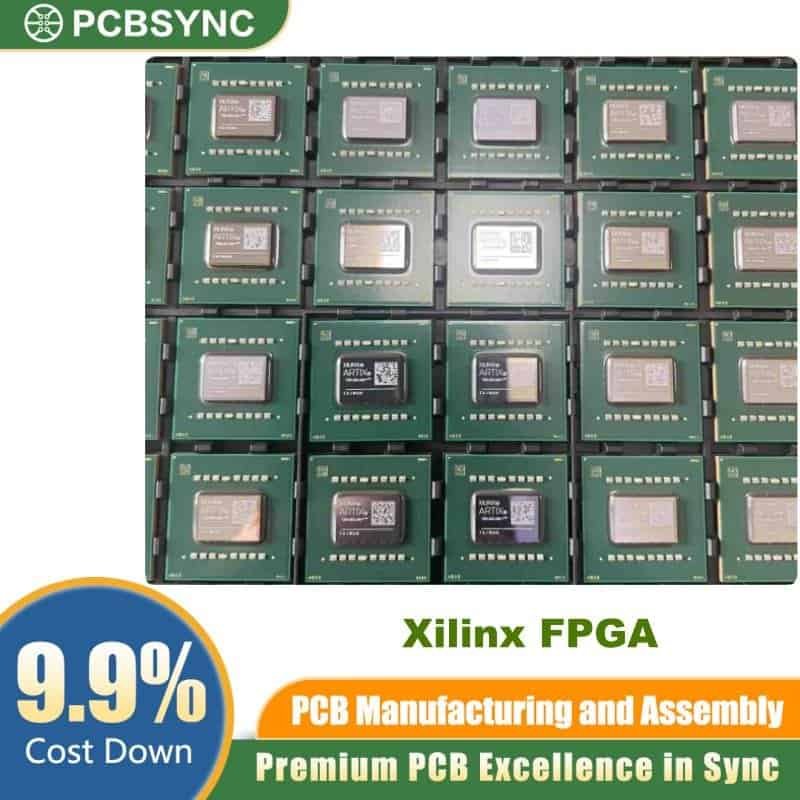
The XC2S50-5TQ144C is a high-performance field-programmable gate array from the Xilinx Spartan-II family. This cost-effective FPGA delivers 50,000 system gates and 1,728 logic cells in a compact 144-pin TQFP package. Engineers choose this device for embedded systems, telecommunications equipment, and industrial automation projects that require reliable programmable logic without excessive cost.
The Spartan-II architecture provides a proven foundation for digital design projects. With 263 MHz operating frequency and 2.5V core voltage, the XC2S50-5TQ144C balances performance and power efficiency. Its unlimited reprogrammability makes it an excellent alternative to application-specific integrated circuits for prototype development and medium-volume production.
XC2S50-5TQ144C Key Specifications
Understanding the technical parameters helps engineers determine if this FPGA meets their project requirements. The following specifications define the XC2S50-5TQ144C’s capabilities:
| Parameter |
Value |
| Manufacturer |
Xilinx (AMD) |
| Family |
Spartan-II |
| System Gates |
50,000 |
| Logic Cells |
1,728 |
| CLBs (Configurable Logic Blocks) |
384 |
| Maximum Frequency |
263 MHz |
| Process Technology |
0.18 µm |
| Core Voltage |
2.5V |
| Package Type |
144-Pin TQFP |
| Speed Grade |
-5 |
| Temperature Range |
Commercial (0°C to +85°C) |
| User I/O Pins |
92 |
Spartan-II FPGA Architecture Features
The XC2S50-5TQ144C inherits its architecture from the Virtex FPGA platform, bringing enterprise-grade features to cost-sensitive applications.
Configurable Logic Block Structure
Each CLB contains four logic cells organized into two slices. Every slice includes two 4-input look-up tables and two flip-flops for implementing combinational and sequential logic. The direct feedthrough paths within each CLB enable efficient signal routing without consuming additional logic resources.
SelectRAM Memory System
The XC2S50-5TQ144C features a hierarchical memory architecture combining distributed and block RAM options. Distributed RAM provides 16 bits per LUT for small, fast storage needs. Four dedicated 4K-bit block RAM modules offer synchronous dual-port memory with independent read and write clocks. This configuration delivers up to 32,768 bits of block RAM for data buffering and FIFO implementations.
Delay-Locked Loop Clock Management
Four delay-locked loops positioned at each die corner provide precise clock distribution across the device. The DLLs eliminate clock skew, multiply or divide clock frequencies, and enable phase shifting for timing-critical applications. Global clock networks ensure low-skew signal distribution to all logic elements and memory blocks.
XC2S50-5TQ144C I/O Capabilities
The input/output system supports multiple interface standards for connecting to diverse peripheral devices.
Supported I/O Standards
This FPGA accommodates various signaling protocols including LVTTL, LVCMOS (3.3V and 2.5V), PCI (3.3V at 33 MHz), GTL, GTL+, HSTL, SSTL, and CTT. Eight I/O banks allow independent voltage configuration, enabling mixed-voltage system designs without level-shifting circuitry.
Pin Configuration
The 144-pin TQFP package provides 92 user-configurable I/O pins plus four global clock inputs. The remaining pins handle power supply, ground, configuration, and JTAG boundary scan functions. All I/O pins support programmable drive strength and slew rate control.
Configuration Options for XC2S50-5TQ144C
Static memory cells store configuration data that defines the FPGA’s logic functions and routing. Multiple configuration modes accommodate different system architectures.
Master Serial Mode
The FPGA generates its own configuration clock and reads bitstream data from external serial PROMs. This autonomous operation suits standalone applications requiring power-on self-configuration.
Slave Serial and Parallel Modes
External processors or microcontrollers can load configuration data through serial or byte-wide parallel interfaces. Slave parallel mode supports high-speed configuration at rates exceeding 50 MHz when controlling the BUSY handshake signal.
Boundary Scan Configuration
IEEE 1149.1-compliant JTAG ports enable configuration through standard test access ports. This method integrates with existing board-level test infrastructure and supports in-system programming during production.
Development Tools and Software Support
Xilinx ISE Design Suite provides complete design entry, synthesis, implementation, and verification capabilities for Spartan-II devices. The software environment includes schematic capture, HDL synthesis, timing analysis, and power estimation tools.
Third-party synthesis tools from vendors like Synopsys and Mentor Graphics offer additional optimization options. IP core libraries provide pre-verified functional blocks for processors, memory controllers, communication interfaces, and signal processing algorithms.
XC2S50-5TQ144C Applications
The combination of performance, features, and price point makes this FPGA suitable for numerous embedded applications.
Industrial Automation
Programmable logic controllers, motor drive systems, and sensor interfaces benefit from the FPGA’s real-time processing capabilities. The unlimited reprogrammability allows field updates as control algorithms evolve.
Telecommunications Equipment
Protocol converters, multiplexers, and interface bridging applications utilize the parallel processing architecture for high-throughput data handling. Block RAM stores packet buffers and lookup tables efficiently.
Consumer Electronics
Video processing, display controllers, and audio systems leverage the FPGA’s signal processing resources. The low power consumption extends battery life in portable devices.
Prototyping and Education
Academic institutions and development teams use Spartan-II devices for teaching digital design concepts and validating ASIC implementations before committing to silicon.
Why Choose XC2S50-5TQ144C for Your Next Project
This Xilinx FPGA offers several advantages for engineering teams seeking cost-effective programmable logic solutions. The mature process technology ensures stable supply and predictable pricing. Comprehensive documentation and widespread community knowledge simplify the learning curve for new designers.
The 144-pin TQFP package balances I/O density with PCB assembly requirements. Standard surface-mount soldering processes accommodate this package without specialized equipment. Pin-compatible variants within the Spartan-II family enable density upgrades without board redesign.
Ordering Information
The part number XC2S50-5TQ144C decodes as follows:
| Code |
Meaning |
| XC2S |
Spartan-II Family |
| 50 |
50,000 System Gates |
| -5 |
Speed Grade |
| TQ |
144-Pin TQFP Package |
| 144 |
Pin Count |
| C |
Commercial Temperature Range |
Pb-free variants add a “G” suffix (XC2S50-5TQG144C) for RoHS-compliant applications. Industrial temperature range versions (-40°C to +100°C) substitute “I” for “C” in the ordering code.
Technical Documentation
Engineers should consult the DS001 Spartan-II FPGA Family Data Sheet for complete electrical specifications, timing parameters, and application guidelines. This four-module document covers introduction, functional description, DC/switching characteristics, and pinout tables.
Application notes address specific implementation topics including configuration methods, I/O interfacing, and clock management techniques. The Spartan-II User Guide provides architectural details and design recommendations for optimizing performance and resource utilization.