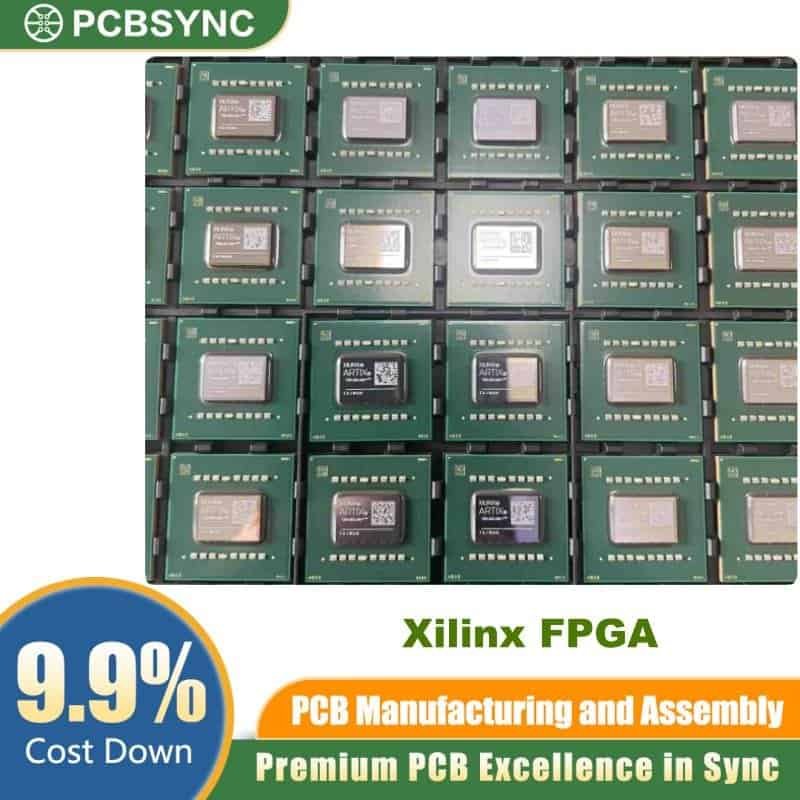
Overview of XC2S400E-6FT256I FPGA Technology
The XC2S400E-6FT256I represents a powerful solution in the AMD (formerly Xilinx) Spartan-IIE FPGA family, delivering exceptional performance for cost-sensitive embedded applications. This field-programmable gate array combines 400,000 system gates with advanced features, making it ideal for digital signal processing, control systems, and high-speed communication interfaces.
Key Technical Specifications XC2S400E-6FT256I
Core FPGA Parameters
| Specification |
Value |
| Part Number |
XC2S400E-6FT256I |
| Family |
Spartan-IIE |
| System Gates |
400,000 |
| Logic Cells |
10,240 |
| CLB Array |
40 x 64 |
| Total Block RAM |
56 Kbits |
| Distributed RAM |
40 Kbits |
| Package Type |
FT256 (17mm x 17mm FTBGA) |
| Speed Grade |
-6 (Industrial) |
| Temperature Range |
-40°C to +100°C |
| Operating Voltage |
1.8V Core, 3.3V I/O |
Advanced Performance Features
| Feature |
Description |
| Maximum User I/Os |
176 pins |
| Differential I/O Pairs |
Up to 88 pairs |
| DLL Resources |
4 Digital Clock Managers |
| Maximum Frequency |
Up to 200 MHz internal |
| Configuration Options |
Master Serial, Slave Serial, JTAG, SelectMAP |
| Power Consumption |
Low-power CMOS technology |
XC2S400E-6FT256I Applications and Use Cases
Industrial Control Systems
The XC2S400E-6FT256I excels in industrial automation applications where reliable operation across extended temperature ranges is critical. The industrial-grade -6 speed grade ensures consistent performance in harsh manufacturing environments, while the 400K system gates provide sufficient logic resources for complex control algorithms.
Digital Signal Processing Applications
With 56 Kbits of dedicated block RAM and 10,240 logic cells, this Xilinx FPGA delivers excellent DSP performance for audio processing, image filtering, and real-time data analysis applications. The four DLL resources enable precise clock management for synchronous data processing pipelines.
Communication Interface Implementation
| Application Area |
Implementation Capability |
| Protocol Conversion |
UART, SPI, I2C, CAN bus bridging |
| Network Processing |
Ethernet MAC, packet filtering |
| Display Controllers |
VGA, LVDS, LCD drivers |
| Motor Control |
PWM generation, encoder interfaces |
XC2S400E-6FT256I Package and Pin Configuration
FT256 FTBGA Package Details
The fine-pitch ball grid array (FTBGA) package offers several advantages for space-constrained designs:
- Compact Footprint: 17mm x 17mm body size
- Ball Pitch: 1.0mm for high-density routing
- Thermal Performance: Enhanced heat dissipation through bottom-side thermal pad
- Assembly Compatibility: Standard SMT reflow processes
Power Distribution Requirements
| Power Rail |
Nominal Voltage |
Typical Current |
Purpose |
| VCCINT |
1.8V ±5% |
150-500mA |
Core logic power |
| VCCO |
1.5V to 3.3V |
Bank-dependent |
I/O bank power |
| VCCAUX |
2.5V ±5% |
50-150mA |
Auxiliary circuits |
Programming and Configuration Options
Configuration Memory Interface
The XC2S400E-6FT256I supports multiple configuration methods to accommodate various system architectures:
- Master Serial Mode: FPGA controls external PROM or Flash memory
- Slave Serial Mode: External processor programs FPGA through serial interface
- Boundary Scan (JTAG): In-system programming and debugging via IEEE 1149.1
- SelectMAP Mode: High-speed parallel configuration interface
Configuration Bit Stream Size
| Parameter |
Value |
| Bit Stream Size |
1,669,920 bits (compressed) |
| Configuration Time |
<100ms (typical at 10 MHz CCLK) |
| Readback Support |
Full device readback capability |
Design Resources and Development Tools
Compatible Software Environments
The XC2S400E-6FT256I integrates seamlessly with industry-standard FPGA design tools:
- AMD Vivado Design Suite: Complete design flow from synthesis to bitstream generation
- ISE Design Suite: Legacy support for Spartan-IIE family targeting
- ModelSim/Questa: HDL simulation and verification
- Synplify Pro: Advanced synthesis optimization
IP Core Integration
| IP Core Category |
Available Cores |
| Math Functions |
Multipliers, dividers, CORDIC, FFT |
| Communication |
UART, SPI, I2C, PCIe |
| Memory Controllers |
SDRAM, DDR, SRAM interfaces |
| Video Processing |
Scaling, color space conversion |
Reliability and Quality Standards
Operating Environmental Specifications
The XC2S400E-6FT256I meets stringent industrial qualification standards:
- Temperature Grade: Industrial (-40°C to +100°C junction)
- Moisture Sensitivity Level: MSL 3 per JEDEC J-STD-020
- ESD Protection: Human Body Model (HBM) Class 1C
- Latch-up Immunity: >100mA per JEDEC standard
Comparing XC2S400E Variants
Speed Grade and Package Options
| Part Number |
Speed Grade |
Temperature |
Package |
Key Difference |
| XC2S400E-6FT256I |
-6 |
Industrial |
FT256 |
Extended temp range |
| XC2S400E-6FT256C |
-6 |
Commercial |
FT256 |
0°C to +85°C operation |
| XC2S400E-7FT256I |
-7 |
Industrial |
FT256 |
Faster performance grade |
| XC2S400E-6FG456I |
-6 |
Industrial |
FG456 |
More I/O pins available |
Power Management Strategies
Dynamic Power Optimization
Effective power management techniques for XC2S400E-6FT256I designs:
- Clock Gating: Disable unused logic regions to reduce dynamic power
- I/O Standard Selection: Choose lower-voltage I/O standards where possible
- DLL Power Down: Disable unused Digital Lock Loop circuits
- Activity-Based Optimization: Minimize toggle rates in high-fanout nets
Thermal Design Considerations
| Thermal Parameter |
Specification |
| θJA (Junction-Ambient) |
25°C/W (typical with thermal pad) |
| θJC (Junction-Case) |
8°C/W (typical) |
| Maximum Power Dissipation |
Design-dependent, typically 1-3W |
Getting Started with XC2S400E-6FT256I Development
Evaluation and Prototyping
For rapid prototyping and evaluation:
- Development Boards: Spartan-IIE evaluation kits provide immediate design start
- Reference Designs: Pre-built examples for common applications
- Design Constraints: UCF files for pin assignment and timing requirements
- Debugging Tools: ChipScope for in-system signal analysis
PCB Design Guidelines
Critical PCB layout recommendations for XC2S400E-6FT256I:
| Design Aspect |
Recommendation |
| Decoupling Capacitors |
0.1µF and 10µF per power pin pair |
| Power Plane Strategy |
Separate planes for VCCINT, VCCO banks |
| Signal Integrity |
Length matching for differential pairs |
| Ground Connection |
Solid thermal pad connection to ground plane |
Frequently Asked Questions about XC2S400E-6FT256I
What is the difference between -6 and -7 speed grades?
The -6 speed grade offers moderate performance suitable for most industrial applications, while -7 provides higher maximum frequencies for timing-critical designs. The -6 grade typically consumes less power and costs less than the -7 variant.
Can this FPGA replace XC2S300E in existing designs?
Yes, the XC2S400E-6FT256I is pin-compatible with XC2S300E in the same package, offering more logic resources as a drop-in upgrade. Review timing constraints as increased routing complexity may affect some timing paths.
What configuration PROM size is required?
A minimum 2Mbit serial PROM (such as XCF02S) is recommended to store the configuration bitstream with adequate margin for design updates.
Is this device RoHS compliant?
Yes, the XC2S400E-6FT256I is manufactured using lead-free processes and complies with RoHS directives for environmentally-conscious designs.
Conclusion: Why Choose XC2S400E-6FT256I
The XC2S400E-6FT256I delivers an optimal balance of performance, cost, and reliability for industrial embedded applications. With 400,000 system gates, industrial temperature range operation, and comprehensive development tool support, this FPGA provides a proven platform for deploying complex digital logic in demanding environments. Whether implementing custom control systems, signal processing algorithms, or communication interfaces, the XC2S400E-6FT256I offers the flexibility and robustness required for successful product deployment.