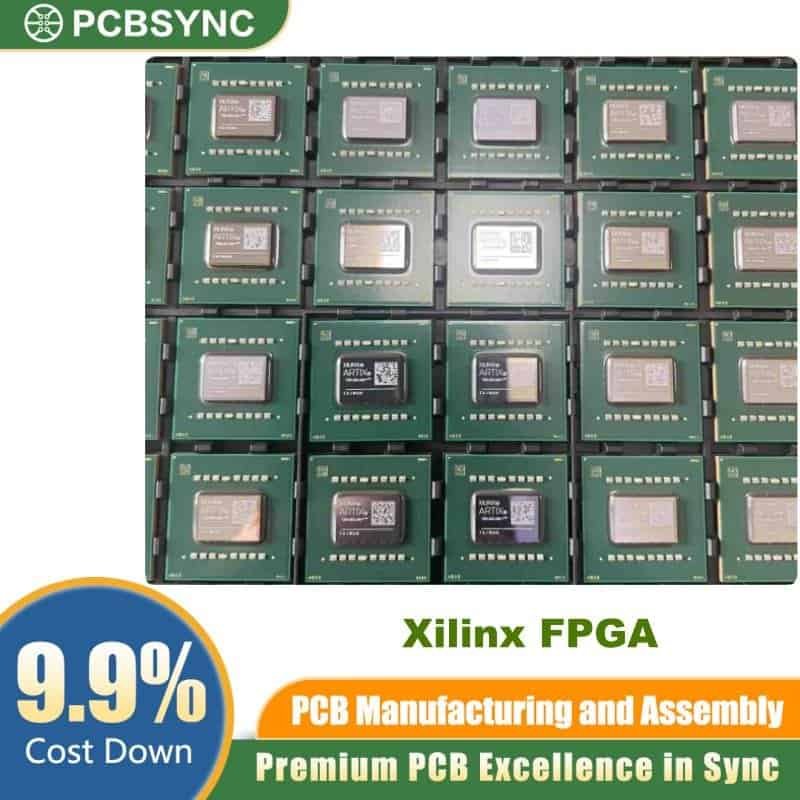
Overview of XC2S200-6FGG982C FPGA
The XC2S200-6FGG982C is a powerful Field Programmable Gate Array (FPGA) from AMD Xilinx’s renowned Spartan-II family. This high-performance programmable logic device delivers exceptional flexibility and processing capabilities with 200,000 system gates, making it an ideal solution for complex digital designs, embedded systems, and industrial applications. The XC2S200-6FGG982C combines cost-effectiveness with robust performance, offering engineers and developers a superior alternative to traditional ASICs.
Key Specifications of XC2S200-6FGG982C
Technical Specifications Table
| Specification |
Value |
| Device Family |
Spartan-II |
| Part Number |
XC2S200-6FGG982C |
| System Gates |
200,000 |
| Logic Cells |
5,292 |
| Configurable Logic Blocks (CLBs) |
1,176 (28 x 42 array) |
| Distributed RAM |
75,264 bits |
| Block RAM |
56K bits (56,000 bits) |
| Maximum User I/O |
284 pins |
| Speed Grade |
-6 (highest performance) |
| Operating Voltage |
2.5V core voltage |
| Technology Node |
0.18µm CMOS process |
| Package Type |
FGG982 (982-ball Fine-Pitch BGA) |
| Temperature Range |
Commercial (0°C to +85°C) |
XC2S200-6FGG982C Architecture and Features
Configurable Logic Block Architecture
The XC2S200-6FGG982C features a regular, flexible architecture centered around Configurable Logic Blocks (CLBs). With a 28 x 42 CLB array providing 1,176 total CLBs, this FPGA delivers extensive logic resources for implementing complex digital functions. Each CLB contains multiple logic slices with look-up tables (LUTs), flip-flops, and multiplexers, enabling efficient implementation of combinational and sequential logic.
Memory Resources
| Memory Type |
Capacity |
Key Features |
| Block RAM |
56,000 bits |
Dual-port structure, configurable width |
| Distributed RAM |
75,264 bits |
Integrated within CLBs for fast local storage |
| Total Memory |
131,264 bits |
Flexible memory configuration options |
Input/Output Capabilities
The XC2S200-6FGG982C provides up to 284 user I/O pins through its FGG982 package, supporting a wide range of digital interfacing requirements. The programmable I/O blocks (IOBs) surround the CLB array in a perimeter configuration, offering:
- Multiple I/O standards support (LVTTL, LVCMOS, SSTL, HSTL, GTL)
- Programmable drive strength and slew rate control
- Individual I/O configuration for maximum flexibility
- Differential signaling capabilities
- Built-in termination options
Performance Characteristics of Spartan-II XC2S200-6FGG982C
Speed Grade and Timing
The -6 speed grade represents the highest performance tier available for commercial temperature range Spartan-II devices. This designation ensures:
- Maximum operating frequency up to 263 MHz for system-level designs
- Optimized signal propagation delays
- Superior timing performance for high-speed applications
- Reduced setup and hold times for critical path optimization
Processing Technology
Built on advanced 0.18µm CMOS technology, the XC2S200-6FGG982C delivers:
- Low power consumption for energy-efficient designs
- High integration density
- Improved signal integrity
- Enhanced reliability and durability
XC2S200-6FGG982C Applications
Industrial Control and Automation
The XC2S200-6FGG982C excels in industrial environments where programmability and reliability are critical:
- Motor control systems
- Process automation controllers
- Industrial robotics interface
- Machine vision processing
- Sensor data acquisition systems
Communication Systems
With its high-speed capabilities and extensive I/O resources, this FPGA is ideal for:
- Network routing and switching
- Protocol conversion and implementation
- Data encryption and security processing
- Telecommunications infrastructure
- Wireless communication interfaces
Digital Signal Processing
| Application Area |
Implementation Benefits |
| Audio Processing |
Real-time filtering and effects processing |
| Image Processing |
Video format conversion, enhancement algorithms |
| Software-Defined Radio |
Modulation/demodulation, frequency synthesis |
| Measurement Instruments |
High-speed data acquisition and analysis |
Embedded System Development
The XC2S200-6FGG982C serves as an excellent coprocessor or standalone controller for:
- Custom peripheral interfaces
- System-on-Chip (SoC) prototyping
- Hardware acceleration for specific algorithms
- ASIC emulation and verification
- Rapid prototyping platforms
Advantages of XC2S200-6FGG982C Over ASICs
Cost-Effectiveness
Unlike traditional Application-Specific Integrated Circuits (ASICs), the XC2S200-6FGG982C eliminates:
- High initial NRE (Non-Recurring Engineering) costs
- Expensive mask sets and fabrication runs
- Long lead times for production
- Financial risk of design errors
Design Flexibility and Upgradability
The programmable nature of the XC2S200-6FGG982C provides unique advantages:
- In-field reprogrammability: Update designs without hardware replacement
- Iterative development: Rapid design modifications and testing
- Version control: Deploy different configurations for varying applications
- Future-proofing: Adapt to changing requirements and standards
Time-to-Market Benefits
| Development Phase |
FPGA Advantage |
| Initial Design |
Immediate implementation without fabrication wait |
| Prototyping |
Hardware testing with actual silicon |
| Debug and Verification |
Real-time design modifications |
| Production |
Flexible volume manufacturing |
| Updates |
Remote or on-site reconfiguration capability |
XC2S200-6FGG982C Package Information
FGG982 Package Details
The FGG982 package is a Fine-Pitch Ball Grid Array offering:
- 982-ball configuration for maximum I/O density
- Compact footprint for space-constrained applications
- Excellent thermal performance characteristics
- Industry-standard BGA mounting compatibility
- Lead-free (RoHS compliant) option available with “G” designation
Thermal and Power Considerations
Effective thermal management is crucial for optimal XC2S200-6FGG982C performance:
- Core voltage: 2.5V (VCCINT)
- I/O voltage: Configurable per bank (VCCO)
- Auxiliary voltage: 2.5V (VCCAUX)
- Power estimation tools available through Xilinx design software
- Thermal resistance specifications for package thermal analysis
Design Tools and Development Support
Xilinx ISE Design Suite Compatibility
The XC2S200-6FGG982C is fully supported by Xilinx ISE (Integrated Software Environment):
- Comprehensive design entry (schematic, HDL, IP cores)
- Advanced synthesis and implementation tools
- Timing analysis and optimization
- BitStream generation and configuration management
- In-system debugging capabilities
Programming and Configuration
Multiple configuration methods are supported:
- JTAG programming interface for development
- Serial and parallel configuration modes
- Master and slave configuration options
- Configuration PROM support
- Boundary-scan testing (IEEE 1149.1 compliant)
Comparing XC2S200-6FGG982C with Alternative Xilinx FPGA Solutions
Spartan-II Family Comparison
| Device |
System Gates |
Logic Cells |
Block RAM |
Max User I/O |
| XC2S50 |
50,000 |
1,728 |
32K bits |
176 |
| XC2S100 |
100,000 |
2,700 |
40K bits |
176 |
| XC2S200 |
200,000 |
5,292 |
56K bits |
284 |
| XC2S150 |
150,000 |
3,888 |
48K bits |
260 |
The XC2S200-6FGG982C represents the optimal balance between resources and cost within the mid-range Spartan-II family, offering substantial logic capacity and memory resources for demanding applications.
Migration Paths and Alternatives
For different project requirements, consider these alternatives:
For higher capacity needs:
- XC2S300E/400E/600E (Spartan-IIE family with enhanced features)
- Spartan-3 family for newer architecture and lower voltage operation
For lower cost/smaller designs:
- XC2S50/100 for simpler applications with reduced resource requirements
- Spartan-3A/3E for cost-optimized modern implementations
Quality and Reliability Features
Commercial Temperature Range
The “C” designation indicates commercial temperature range operation (0°C to +85°C), suitable for:
- Indoor industrial equipment
- Commercial electronics
- Consumer products
- Office and laboratory instrumentation
Manufacturing Quality Standards
AMD Xilinx maintains stringent quality standards:
- ISO 9001 certified manufacturing processes
- Comprehensive testing and screening
- Long-term reliability verification
- Automotive and industrial grade options available (contact for specifications)
Procurement and Availability
Ordering Information
When ordering the XC2S200-6FGG982C, ensure the complete part number is specified:
- XC2S200: Device type (200K system gates)
- -6: Speed grade (highest performance)
- FGG982: Package type (982-ball Fine-Pitch BGA)
- C: Commercial temperature range
For lead-free RoHS compliant packages, specify XC2S200-6FGGG982C (note the extra “G”).
Supply Chain Considerations
| Consideration |
Recommendation |
| Lead Time |
Verify current availability with authorized distributors |
| Minimum Order Quantity |
May vary by distributor; bulk pricing available |
| Package Options |
Confirm FGG982 package availability |
| Documentation |
Request latest datasheet and errata information |
Frequently Asked Questions About XC2S200-6FGG982C
What is the main difference between speed grades?
The -6 speed grade offers the fastest timing performance among Spartan-II commercial temperature devices, with lower propagation delays and higher maximum frequencies compared to -5 or -4 speed grades. This enables more aggressive timing constraints and higher system performance.
Can the XC2S200-6FGG982C be reprogrammed?
Yes, the XC2S200-6FGG982C uses SRAM-based configuration technology, allowing unlimited reprogramming cycles. Configuration data can be loaded from external memory (PROM, Flash) or through JTAG interface for development and field updates.
What development tools are required?
Xilinx ISE WebPACK (free version) or ISE Foundation/Advanced editions support the XC2S200-6FGG982C. Additional third-party synthesis tools (Synplify, Precision) are compatible. A JTAG programming cable (Platform Cable USB or compatible) is needed for device configuration.
Is the XC2S200-6FGG982C suitable for new designs?
While the Spartan-II family is considered mature technology, the XC2S200 remains viable for:
- Cost-sensitive applications with proven designs
- Replacements and legacy system maintenance
- Educational and prototyping purposes
- Applications where newer devices offer no significant advantage
For new high-volume production designs, consider newer Spartan-7 or Artix-7 families for improved features, lower power, and long-term availability.
What support resources are available?
AMD Xilinx provides comprehensive documentation:
- Complete datasheet (DS001) with electrical specifications
- User guides for CLB, IOB, and Block RAM architecture
- Application notes for design best practices
- Reference designs and IP cores
- Active technical support through AMD support portal
Conclusion: Why Choose XC2S200-6FGG982C
The XC2S200-6FGG982C represents a proven, reliable FPGA solution for engineers and developers requiring substantial logic resources, flexible I/O capabilities, and high-performance operation. With 200,000 system gates, 5,292 logic cells, and comprehensive memory resources, this Spartan-II device delivers exceptional value for:
- Industrial control applications demanding reliability and reconfigurability
- Communication systems requiring high-speed data processing
- Digital signal processing implementations with real-time constraints
- Embedded system development needing custom peripheral interfaces
The combination of cost-effectiveness, design flexibility, and mature development tool support makes the XC2S200-6FGG982C an excellent choice for projects where proven technology, availability, and FPGA programmability advantages align with project requirements.
Whether you’re developing new products, maintaining existing designs, or prototyping innovative solutions, the XC2S200-6FGG982C provides the resources and performance needed to bring your digital designs to life. Its superiority over traditional ASIC approaches—eliminating high initial costs, lengthy development cycles, and design risk—combined with field-upgradability, positions this FPGA as a smart choice for modern digital system implementation.