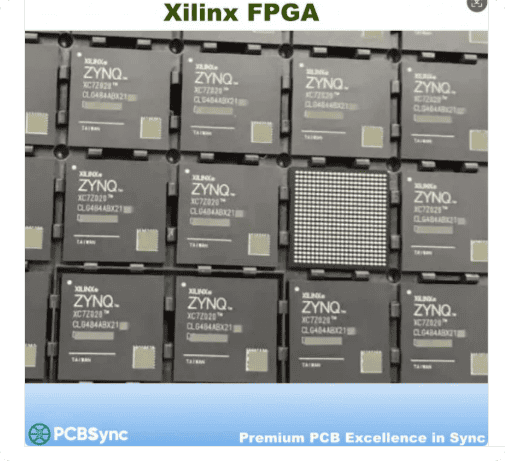
The XC2S200-6FGG949C is a powerful field-programmable gate array (FPGA) from the Xilinx Spartan-II family, designed to deliver cost-effective programmable logic solutions for demanding embedded applications. This FPGA combines 200,000 system gates with advanced features in a fine-pitch BGA package, making it an ideal choice for industrial control, communications, and digital signal processing applications.
Overview of XC2S200-6FGG949C FPGA
The XC2S200-6FGG949C represents a significant advancement in programmable logic technology, offering designers a flexible alternative to traditional ASICs. As part of the proven Spartan-II architecture, this device provides exceptional performance at commercial temperature ranges while maintaining the cost advantages that have made the Spartan series a popular choice for volume production.
Key Technical Specifications
Core Architecture Features
| Specification |
Value |
| Logic Cells |
5,292 cells |
| System Gates |
200,000 gates |
| CLB Array Configuration |
28 x 42 (1,176 CLBs total) |
| Distributed RAM |
75,264 bits |
| Block RAM |
56K bits |
| Maximum Clock Frequency |
263 MHz |
| Process Technology |
0.18μm |
| Core Voltage |
2.5V |
Package and Pin Configuration
| Feature |
Specification |
| Package Type |
949-ball Fine-Pitch BGA (FGG949) |
| Total I/O Pins |
Up to 408 user I/Os |
| Speed Grade |
-6 (Commercial Grade) |
| Operating Temperature |
0°C to +85°C (Commercial) |
| Package Dimensions |
Fine-pitch ball grid array |
| Lead-Free Option |
Available (indicated by ‘G’ in part number) |
Product Features and Benefits
Advanced FPGA Capabilities
The XC2S200-6FGG949C delivers several critical advantages for embedded system designers:
Flexible Logic Resources: With 5,292 logic cells organized in a 28 x 42 CLB array, this FPGA provides ample resources for complex digital designs. Each configurable logic block (CLB) contains four logic cells, offering efficient implementation of both combinatorial and sequential logic.
Abundant Memory Options: The device features dual-port block RAM totaling 56K bits, complemented by 75,264 bits of distributed RAM. This combination enables efficient implementation of FIFOs, buffers, and look-up tables without consuming logic resources.
High-Speed Performance: Operating at frequencies up to 263 MHz, the XC2S200-6FGG949C meets the timing requirements of high-throughput applications. The -6 speed grade ensures optimal performance for commercial temperature applications.
Comprehensive I/O Capabilities: Supporting up to 408 user I/O pins, this FPGA accommodates designs requiring extensive external connectivity. The device supports 16 different I/O standards, enabling seamless interfacing with various system components.
Delay-Locked Loop (DLL) Technology
The XC2S200-6FGG949C incorporates four DLL circuits strategically positioned at each corner of the die. These DLLs provide:
- Clock de-skew and distribution
- Programmable clock phase shifting
- Frequency synthesis and multiplication
- Reduced clock-to-output delays
Application Areas
Industrial Control Systems
The XC2S200-6FGG949C excels in industrial automation applications where reliability and flexibility are paramount. Its robust architecture supports:
- Motor control and drive systems
- PLC (Programmable Logic Controller) implementations
- Process monitoring and control
- Factory automation interfaces
Communications Infrastructure
For telecommunications and networking equipment, this FPGA offers:
- Protocol conversion and bridging
- Data packet processing
- Interface adaptation
- Signal conditioning and filtering
Digital Signal Processing
The combination of block RAM and high-speed logic makes the XC2S200-6FGG949C suitable for:
- Real-time filtering applications
- Image and video processing
- Audio codec implementations
- Algorithmic acceleration
Consumer Electronics
Cost-sensitive consumer applications benefit from:
- Display controllers and interfaces
- Embedded system controllers
- Data acquisition systems
- Custom peripheral implementations
Design and Development Support
Compatible Development Tools
The XC2S200-6FGG949C is fully supported by the Xilinx ISE (Integrated Software Environment) development system, providing:
- Automated Implementation: Complete place-and-route automation
- HDL Support: VHDL and Verilog synthesis
- Timing Analysis: Comprehensive static timing analysis tools
- Simulation Integration: Industry-standard simulator compatibility
- IP Core Library: Access to pre-verified design blocks
Configuration Options
This FPGA supports multiple configuration modes for flexible system integration:
| Configuration Mode |
Description |
| Master Serial |
FPGA controls configuration process |
| Slave Serial |
External controller provides configuration data |
| Master Parallel |
High-speed parallel configuration |
| Slave Parallel |
Byte-wide parallel interface |
| JTAG Boundary Scan |
In-system programming and testing |
Technical Advantages Over ASIC Solutions
Cost-Effective Development
Unlike mask-programmed ASICs, the XC2S200-6FGG949C eliminates:
- High non-recurring engineering (NRE) costs
- Lengthy fabrication cycles (typically 12-16 weeks)
- Financial risk of silicon errors
- Minimum order quantity requirements
Design Flexibility
The programmable nature of this Xilinx FPGA enables:
- Rapid Prototyping: Design verification in hours rather than months
- Field Updates: Logic modifications without hardware changes
- Design Reuse: Easy migration between projects
- Version Management: Multiple configuration files for different features
Time-to-Market Benefits
Development teams achieve faster product launches through:
- Immediate device availability
- Iterative design refinement
- Parallel hardware/software development
- Reduced qualification time
Power Consumption and Thermal Management
Power Supply Requirements
| Supply Rail |
Voltage |
Purpose |
| VCCINT |
2.5V |
Internal core logic |
| VCCO |
1.5V to 3.3V |
Output drivers (bank-dependent) |
| VCCAUX |
2.5V |
Auxiliary circuits and DLLs |
Power Management Features
The XC2S200-6FGG949C incorporates several power optimization techniques:
- Unused logic automatically disabled
- Clock gating capabilities
- Selective I/O bank power control
- Low-power configuration modes
Quality and Reliability
Manufacturing Standards
Xilinx manufactures the XC2S200-6FGG949C using advanced 0.18μm CMOS technology, ensuring:
- Consistent electrical characteristics
- High manufacturing yield
- Extended product lifetime
- Industry-standard quality certifications
Environmental Compliance
The device meets current environmental regulations:
- RoHS compliant options available (FGG949C designation)
- Lead-free ball grid array construction
- Halogen-free packages available
- REACH compliance
Package and Pinout Information
FGG949 Package Characteristics
The 949-ball fine-pitch BGA package offers several advantages:
High Pin Density: Maximum I/O utilization in a compact footprint enables complex system implementations with minimal board space.
Excellent Signal Integrity: Short bond wires and controlled impedance reduce signal integrity issues, supporting high-speed operation.
Thermal Performance: Efficient heat dissipation through the package bottom enables sustained high-performance operation.
PCB Design Considerations: Standard BGA routing techniques apply, with recommended via-in-pad construction for optimal signal routing.
Comparison with Alternative Devices
XC2S200 Package Options
| Package Code |
Ball Count |
Max User I/Os |
Typical Applications |
| PQ208 |
208 pins |
140 I/Os |
Cost-sensitive designs |
| FG256 |
256 balls |
172 I/Os |
Moderate I/O requirements |
| FG456 |
456 balls |
284 I/Os |
High I/O density |
| FGG949 |
949 balls |
408 I/Os |
Maximum connectivity |
Speed Grade Comparison
The -6 speed grade represents the fastest commercial-grade option for the XC2S200 family:
- -6 Grade: Maximum performance for commercial temperature (0°C to +85°C)
- -5 Grade: Standard performance with broader availability
- -4 Grade: Entry-level performance for cost-sensitive applications
Design Considerations and Best Practices
PCB Layout Guidelines
When designing with the XC2S200-6FGG949C, engineers should consider:
Power Distribution: Adequate decoupling capacitance (typically 0.1μF ceramic per power pin) placed close to the BGA package.
Signal Integrity: Matched impedance traces for high-speed signals, with particular attention to clock distribution networks.
Thermal Management: Sufficient PCB copper for heat dissipation, potentially including thermal vias under the package.
Manufacturing: Via-in-pad construction may be required for high-density routing, necessitating specialized PCB fabrication.
Configuration Strategy
Selecting the appropriate configuration mode depends on system requirements:
- Master Serial: Simplest implementation using standard serial PROM
- Slave Parallel: Fastest configuration for processor-controlled systems
- JTAG: Essential for development and field updates
Supply Chain and Availability
Ordering Information
The complete ordering code XC2S200-6FGG949C breaks down as follows:
- XC2S200: Device family and density (200K gates)
- 6: Speed grade (fastest commercial grade)
- FGG949: Package type (949-ball fine-pitch BGA)
- C: Commercial temperature range (0°C to +85°C)
Alternative Part Numbers
Related devices in the Spartan-II family include:
- XC2S200-5FGG949C: Same package, -5 speed grade
- XC2S200-6FG456C: Smaller 456-ball package option
- XC2S150-6FGG949C: Lower density alternative
- XC2S300-6FGG949C: Higher density option
Technical Support and Resources
Documentation and Design Files
Xilinx provides comprehensive support materials:
- Complete datasheet with electrical specifications
- Application notes for common design patterns
- Reference designs and IP cores
- PCB layout guidelines and footprints
- Thermal simulation models
Community and Expert Support
Developers working with the XC2S200-6FGG949C benefit from:
- Active user forums and communities
- Technical application engineers
- Training courses and webinars
- Third-party design services
Conclusion
The XC2S200-6FGG949C represents an excellent choice for embedded system designers requiring high logic density, abundant I/O resources, and maximum performance in the commercial temperature range. Its combination of 200,000 system gates, 408 user I/Os, and 263 MHz operation make it suitable for demanding applications across industrial, communications, and consumer markets.
By choosing this FPGA over traditional ASIC solutions, development teams gain significant advantages in time-to-market, design flexibility, and cost management while maintaining the performance necessary for modern embedded systems. The comprehensive development tool support and extensive documentation ensure successful project completion from concept through production.
Whether designing industrial control systems, communications infrastructure, or advanced digital signal processing applications, the XC2S200-6FGG949C provides the resources, performance, and reliability required for today’s competitive electronic products.
Frequently Asked Questions
Q: What is the difference between the -6 and -5 speed grades?
A: The -6 speed grade offers the fastest timing performance, with maximum internal clock frequencies up to 263 MHz. It is exclusively available in commercial temperature ranges and provides optimal performance for timing-critical designs.
Q: Can the XC2S200-6FGG949C be reprogrammed in the field?
A: Yes, this FPGA supports in-system programming through JTAG and other configuration modes, allowing design updates without hardware replacement.
Q: What development tools are required?
A: The Xilinx ISE development system provides complete design entry, synthesis, implementation, and programming support for this device.
Q: How does this compare to modern FPGA families?
A: While the Spartan-II family is a mature product line, it continues to offer excellent cost-performance for applications where the latest process technology is not required. For new designs requiring higher performance, consider current Xilinx FPGA families.
Q: What is the typical power consumption?
A: Power consumption varies with design complexity and operating frequency. Typical applications consume 0.5-2.0W depending on resource utilization and clock speeds.