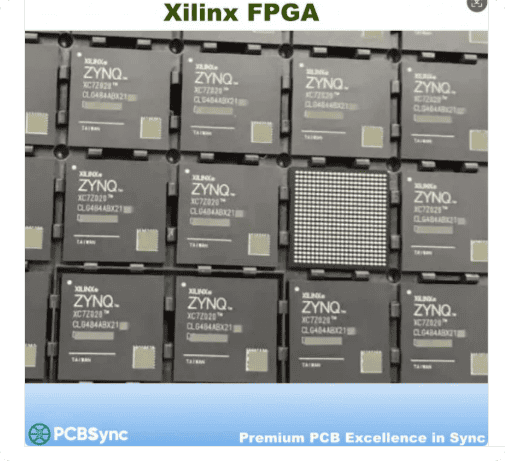
The XC2S200-6FGG918C is a premium field-programmable gate array (FPGA) from AMD Xilinx’s renowned Spartan-II family, engineered to deliver exceptional performance in demanding digital processing applications. This commercial-grade FPGA combines 200,000 system gates with 5,292 logic cells in an advanced 918-ball fine-pitch BGA package, making it an ideal solution for complex embedded systems, telecommunications infrastructure, and industrial automation projects.
As part of the Spartan-II series, the XC2S200-6FGG918C represents a superior alternative to traditional mask-programmed ASICs, offering unprecedented flexibility with field-upgradable capabilities while eliminating the lengthy development cycles and substantial upfront costs associated with custom silicon solutions.
Key Technical Specifications
Core Architecture Features
| Parameter |
Specification |
| Device Family |
Spartan-II FPGA |
| System Gates |
200,000 |
| Logic Cells |
5,292 |
| CLB Array Configuration |
28 x 42 (1,176 total CLBs) |
| Distributed RAM |
75,264 bits |
| Block RAM |
56 Kbits |
| Maximum User I/O |
284 pins |
| Speed Grade |
-6 (highest performance) |
| Operating Voltage |
2.5V |
Package and Pin Configuration
| Package Details |
Value |
| Package Type |
FGG918 (Fine-pitch Ball Grid Array) |
| Total Pin Count |
918 balls |
| Package Technology |
Lead-free compatible (G designation) |
| Temperature Range |
Commercial (0°C to +85°C) |
| Assembly Method |
Surface Mount Technology |
Performance Characteristics
| Performance Metric |
Specification |
| Maximum Operating Frequency |
Up to 263 MHz |
| Technology Node |
0.18μm CMOS process |
| Pin-to-Pin Delay |
Optimized for -6 speed grade |
| DLL Resources |
4 Delay-Locked Loops |
| Global Clock Networks |
Advanced clocking architecture |
Why Choose XC2S200-6FGG918C for Your Project?
Superior Design Flexibility
The XC2S200-6FGG918C FPGA delivers unmatched programmable logic capabilities, allowing engineers to implement custom digital circuits without the constraints of fixed-function devices. Its 1,176 configurable logic blocks (CLBs) arranged in a 28×42 array provide extensive routing resources and logic implementation options.
Cost-Effective Development
Unlike traditional ASIC development requiring significant non-recurring engineering (NRE) costs and lengthy fabrication timelines, the XC2S200-6FGG918C enables rapid prototyping and production deployment. Design modifications can be implemented through simple reconfiguration, eliminating expensive silicon respins.
Enhanced Memory Resources
With 75,264 bits of distributed RAM and 56 Kbits of dedicated block RAM, this FPGA provides ample on-chip memory for data buffering, lookup tables, and temporary storage operations. The dual-port block RAM architecture supports simultaneous read/write operations for high-throughput applications.
High-Speed I/O Capabilities
The FGG918 package delivers maximum connectivity with 284 user-configurable I/O pins, supporting various industry-standard interfaces including:
- LVTTL/LVCMOS logic levels
- Differential signaling standards
- Multi-voltage I/O banks
- Programmable drive strength and slew rate control
Technical Architecture Deep Dive
Configurable Logic Block (CLB) Structure
Each CLB in the XC2S200-6FGG918C contains multiple look-up tables (LUTs), flip-flops, and multiplexers that can implement any combinational or sequential logic function. The hierarchical routing architecture ensures efficient signal distribution across the device with minimal propagation delay.
Memory System Design
The XC2S200-6FGG918C incorporates a dual-memory architecture:
Distributed RAM: Implemented within CLB structures, distributed RAM offers fast, localized storage ideal for small FIFOs, shift registers, and content-addressable memory (CAM) applications.
Block RAM: Dedicated synchronous memory blocks provide high-density storage with configurable data widths and depths, supporting applications requiring substantial buffering capacity.
Clock Management System
Four strategically positioned Delay-Locked Loops (DLLs) provide advanced clock conditioning capabilities including:
- Clock deskewing and distribution
- Frequency multiplication and division
- Phase-shifted clock generation
- Duty cycle correction
Primary Application Domains
Telecommunications and Networking Equipment
The XC2S200-6FGG918C excels in communications infrastructure, implementing protocol converters, packet processors, and interface bridges for high-speed data transmission systems. Its abundant I/O resources support multiple concurrent communication channels.
Industrial Automation and Control Systems
For factory automation and process control applications, this FPGA provides deterministic real-time processing with programmable logic that can be customized for specific control algorithms, sensor interfaces, and actuator drivers.
Medical Instrumentation
Healthcare equipment manufacturers leverage the XC2S200-6FGG918C for diagnostic imaging systems, patient monitoring devices, and laboratory instruments requiring high-reliability signal processing with regulatory compliance flexibility.
Consumer Electronics and Multimedia
From video processing to audio codecs, the XC2S200-6FGG918C handles complex multimedia algorithms with dedicated hardware acceleration, enabling feature-rich consumer products at competitive price points.
Automotive Electronics Systems
Automotive applications benefit from the FPGA’s programmability for infotainment systems, driver assistance features, and vehicle network interfaces, allowing manufacturers to adapt functionality across vehicle platforms.
Design Implementation and Development Tools
Software Development Environment
The XC2S200-6FGG918C is fully supported by AMD Xilinx’s comprehensive development toolchain:
- ISE Design Suite: Complete implementation flow from HDL synthesis through bitstream generation
- VHDL/Verilog Support: Industry-standard hardware description language compatibility
- Simulation Integration: ModelSim, Questa, and other third-party simulator support
- Timing Closure Tools: Advanced static timing analysis and optimization
Programming and Configuration
Multiple configuration methods provide deployment flexibility:
- JTAG boundary scan programming
- Master/slave serial configuration
- Parallel configuration interfaces
- Remote field updates via microcontroller interfaces
Comparison with Alternative Package Options
| Package Type |
Pin Count |
I/O Pins |
Package Size |
Best Application |
| PQ208 |
208 |
~140 |
Quad Flat Pack |
Space-constrained designs |
| FG256 |
256 |
176 |
Fine-pitch BGA |
Mid-density I/O applications |
| FGG918 |
918 |
284 |
Fine-pitch BGA |
Maximum I/O connectivity |
The FGG918 package provides the highest I/O density among XC2S200 variants, making it the optimal choice for applications requiring extensive external connectivity while maintaining a manageable PCB footprint.
Power Management Considerations
Power Supply Requirements
| Supply Rail |
Voltage |
Purpose |
| VCCINT |
2.5V ± 5% |
Core logic power |
| VCCO |
1.8V – 3.3V |
I/O bank power (bank-selectable) |
| VCCAUX |
2.5V |
Auxiliary functions |
Power Consumption Optimization
The XC2S200-6FGG918C incorporates several power-saving features:
- Unused I/O tri-state capability
- Clock gating support
- Selective power-down of unused block RAM
- Dynamic power scaling based on logic utilization
Quality and Reliability Standards
Manufacturing Excellence
Manufactured using advanced 0.18-micron CMOS process technology, the XC2S200-6FGG918C meets stringent quality standards including:
- RoHS compliance (lead-free “G” package variant)
- JEDEC moisture sensitivity level ratings
- Extended operational temperature testing
- Comprehensive electrical characterization
Long-Term Availability
As part of AMD Xilinx’s established Spartan-II product line, the XC2S200-6FGG918C benefits from mature manufacturing processes and proven supply chain reliability, ensuring component availability for production continuity.
Integration Guidelines and Best Practices
PCB Design Recommendations
Successful implementation of the XC2S200-6FGG918C requires careful PCB layout:
- Dedicated power planes for VCCINT and ground
- Decoupling capacitors positioned close to BGA power pins
- Controlled impedance routing for high-speed signals
- Thermal management considerations for sustained operation
Signal Integrity Optimization
To maximize performance and reliability:
- Minimize stub lengths on critical signals
- Implement proper termination for high-speed interfaces
- Separate analog and digital ground planes where applicable
- Follow manufacturer-recommended trace impedance specifications
Where to Purchase XC2S200-6FGG918C
When sourcing the XC2S200-6FGG918C for your projects, selecting authorized distributors ensures genuine components with full manufacturer warranty and technical support. For comprehensive information about Xilinx FPGA products, pricing, and availability, consult established electronic component suppliers who maintain authenticated supply chains.
Frequently Asked Questions
What distinguishes the -6 speed grade from other variants?
The -6 speed grade represents the highest performance tier in the Spartan-II family, offering the fastest propagation delays and maximum operating frequencies. This speed grade is exclusively available in commercial temperature range devices.
Can the XC2S200-6FGG918C be used in industrial temperature applications?
The XC2S200-6FGG918C variant with the “C” suffix is specified for commercial temperature range (0°C to +85°C). For industrial temperature requirements (-40°C to +100°C), alternative package options with “I” temperature designations should be specified.
What development tools are required for programming?
The primary development environment is Xilinx ISE Design Suite, which provides complete design entry, synthesis, implementation, and programming capabilities. JTAG programming cables and compatible adapters are required for device configuration.
How does block RAM differ from distributed RAM?
Block RAM consists of dedicated synchronous memory arrays optimized for high-density storage with configurable port widths. Distributed RAM is implemented using CLB resources, offering faster access times but lower total capacity, ideal for small buffers and lookup tables.
What is the typical power consumption?
Power consumption varies significantly based on design utilization, clock frequencies, and I/O activity. Static power remains relatively low, while dynamic power scales with switching activity. Xilinx Power Estimator tools provide accurate consumption estimates for specific designs.
Conclusion: The XC2S200-6FGG918C Advantage
The XC2S200-6FGG918C FPGA represents an exceptional balance of performance, flexibility, and cost-effectiveness for sophisticated digital design projects. Its combination of 200,000 system gates, extensive I/O capabilities in the 918-ball package, and proven Spartan-II architecture makes it the preferred choice for engineers requiring maximum connectivity and design adaptability.
Whether developing next-generation telecommunications equipment, advanced industrial control systems, or innovative consumer electronics, the XC2S200-6FGG918C delivers the programmable logic resources and performance characteristics necessary for competitive product differentiation.
For design teams seeking to accelerate time-to-market while maintaining design flexibility for future enhancements, the XC2S200-6FGG918C provides a proven, reliable platform supported by comprehensive development tools and extensive documentation resources.