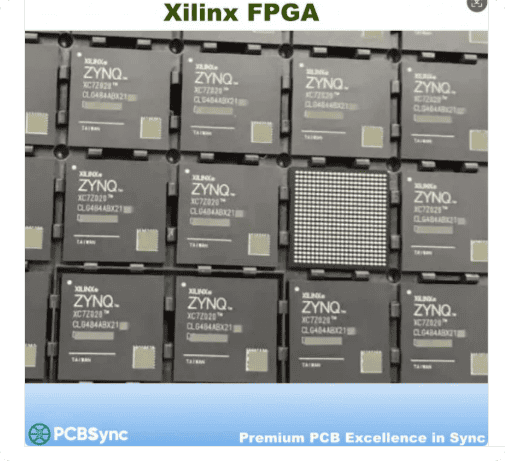
The XC2S200-6FGG912C is a powerful Field-Programmable Gate Array (FPGA) from AMD Xilinx’s renowned Spartan-II family. This high-performance programmable logic device delivers exceptional flexibility and cost-effectiveness for complex digital design applications. With 200,000 system gates and advanced 0.18µm CMOS technology, the XC2S200-6FGG912C represents a superior alternative to traditional mask-programmed ASICs, offering designers the ability to implement, modify, and upgrade digital circuits without the lengthy development cycles and high upfront costs associated with custom silicon.
Whether you’re developing telecommunications equipment, industrial automation systems, or consumer electronics, this FPGA provides the processing power, flexibility, and reliability needed for demanding applications.
Key Technical Specifications
Core Performance Parameters
| Specification |
Value |
| Device Family |
Spartan-II |
| System Gates |
200,000 |
| Logic Cells |
5,292 |
| CLB Array Configuration |
28 x 42 (1,176 total CLBs) |
| Speed Grade |
-6 (Commercial) |
| Operating Voltage |
2.5V Core |
| Process Technology |
0.18µm CMOS |
| Maximum Frequency |
263 MHz |
| Temperature Range |
Commercial (0°C to +85°C) |
Memory and I/O Resources
| Resource Type |
Capacity |
| Distributed RAM |
75,264 bits |
| Block RAM |
56 Kbits (57,344 bits) |
| Maximum User I/O Pins |
284 (package dependent) |
| Global Clock Inputs |
4 dedicated pins |
| Delay-Locked Loops (DLLs) |
4 (one per corner) |
XC2S200-6FGG912C Architecture and Features
Advanced Configurable Logic Blocks (CLBs)
The XC2S200-6FGG912C features 1,176 Configurable Logic Blocks arranged in a 28×42 array, providing extensive logic resources for implementing complex digital functions. Each CLB contains:
- Look-up tables (LUTs) for combinational logic
- Flip-flops for sequential logic implementation
- Multiplexers for efficient data routing
- Fast carry logic for arithmetic operations
Flexible Memory Architecture
This Spartan-II FPGA integrates dual memory architectures to maximize design flexibility:
Distributed RAM: With 75,264 bits of distributed RAM embedded throughout the CLB array, designers can implement small, fast memory structures directly adjacent to logic functions, minimizing routing delays and improving performance.
Block RAM: The 56 Kbits of dual-port block RAM organized in dedicated columns provides efficient storage for larger data buffers, lookup tables, and FIFO implementations essential for DSP and communication applications.
High-Speed I/O Capabilities
The XC2S200-6FGG912C supports up to 284 user-configurable I/O pins, enabling extensive connectivity with external devices. Key I/O features include:
- Multiple I/O standards support (LVTTL, LVCMOS, SSTL, HSTL)
- Programmable drive strength and slew rate control
- Individual I/O banking for mixed-voltage operation
- Input/Output delay elements for timing optimization
Clock Management with DLLs
Four Delay-Locked Loops positioned at each corner of the die provide sophisticated clock management capabilities including:
- Clock de-skewing for synchronous system design
- Clock frequency multiplication and division
- Phase shifting for timing optimization
- Clock mirroring for multi-FPGA synchronization
Application Areas for XC2S200-6FGG912C
Telecommunications and Networking
The XC2S200-6FGG912C excels in communication infrastructure applications where its 200K gates and high-speed I/O enable implementation of:
- Protocol converters and bridges
- Network packet processors
- Data encryption/decryption engines
- Baseband signal processing
- Line interface controllers
Industrial Automation and Control
Industrial applications benefit from the FPGA’s reliability and reconfigurability:
- Motor control systems with sophisticated PWM generation
- PLC (Programmable Logic Controller) implementations
- Machine vision preprocessing
- Sensor interface and data acquisition systems
- Process control algorithms
Consumer Electronics
The cost-effective Spartan-II architecture makes the XC2S200-6FGG912C ideal for high-volume consumer products:
- Digital video processing and display controllers
- Audio codec implementations
- Gaming console logic
- Set-top box functions
- IoT edge computing devices
Medical and Scientific Instrumentation
Medical device manufacturers leverage this FPGA for:
- Patient monitoring equipment signal processing
- Medical imaging preprocessing
- Diagnostic equipment control logic
- Laboratory instrument automation
- Data acquisition and analysis systems
XC2S200-6FGG912C vs Alternative FPGAs
Comparison with Other Spartan-II Family Members
| Device |
System Gates |
Logic Cells |
CLBs |
Block RAM |
Max I/O |
| XC2S50 |
50,000 |
1,728 |
384 |
32 Kbits |
176 |
| XC2S100 |
100,000 |
2,700 |
600 |
40 Kbits |
176 |
| XC2S150 |
150,000 |
3,888 |
864 |
48 Kbits |
260 |
| XC2S200 |
200,000 |
5,292 |
1,176 |
56 Kbits |
284 |
The XC2S200-6FGG912C represents the flagship device in the Spartan-II family, offering maximum logic density and I/O resources for the most demanding applications.
Design and Development Tools
ISE Design Suite Compatibility
The XC2S200-6FGG912C is fully supported by Xilinx ISE (Integrated Software Environment) Design Suite, providing comprehensive tools for:
- HDL synthesis (VHDL and Verilog)
- Constraint-driven implementation
- Timing analysis and optimization
- In-system programming and debugging
- Power analysis and optimization
Configuration Options
This FPGA supports multiple configuration modes for maximum flexibility:
- Master Serial Mode: FPGA controls configuration from external PROM
- Slave Serial Mode: External controller provides serial bitstream
- Slave Parallel Mode: Fast 8-bit parallel configuration
- JTAG Mode: Industry-standard boundary scan configuration
Power Consumption and Thermal Considerations
Voltage Requirements
| Supply Rail |
Voltage |
Purpose |
| VCCINT |
2.5V ± 5% |
Core logic power |
| VCCO |
1.5V to 3.3V |
I/O bank power (configurable per bank) |
| VCCAUX |
2.5V or 3.3V |
Auxiliary circuits (DLLs, configuration) |
Power Optimization Features
The XC2S200-6FGG912C incorporates several power-saving features:
- Low static power consumption due to advanced 0.18µm process
- Programmable I/O standards for power-optimized signaling
- Partial reconfiguration capability for dynamic power management
- Clock gating options to reduce dynamic power
Package Information and PCB Design Considerations
Note: The FGG912 package designation is non-standard for Spartan-II devices. Standard XC2S200 packages include FGG456 (456-ball Fine-Pitch BGA), FGG256 (256-ball FBGA), and PQG208 (208-pin PQFP). Please verify the exact package type with your supplier or consult the Xilinx FPGA product catalog for confirmed specifications.
Typical Package Characteristics
For standard Spartan-II packages:
- Ball Pitch: 1.0mm (fine-pitch BGA packages)
- Package Height: Low-profile for space-constrained applications
- Thermal Performance: Enhanced with exposed die pad options
- RoHS Compliance: Available in lead-free (Pb-free) versions with “G” suffix
PCB Design Guidelines
When designing with the XC2S200-6FGG912C:
- Power Distribution: Implement proper decoupling with multiple capacitors per power rail
- Signal Integrity: Maintain controlled impedance for high-speed signals
- Thermal Management: Ensure adequate copper pour for heat dissipation
- Configuration Interface: Follow recommended JTAG chain topology
- I/O Banking: Group signals by voltage standard to minimize VCCO supplies
Advantages of Choosing XC2S200-6FGG912C
Superior to ASIC Development
The XC2S200-6FGG912C FPGA offers significant advantages over traditional ASIC approaches:
- Zero NRE Costs: Eliminate mask charges and design fabrication fees
- Rapid Time-to-Market: Configure and test designs in days, not months
- Field Upgradability: Update functionality post-deployment without hardware changes
- Risk Mitigation: Prototype and validate before committing to high-volume production
- Design Iteration: Modify and enhance designs without new silicon
Cost-Effective Solution
The Spartan-II family is specifically optimized for cost-sensitive applications:
- Competitive pricing for high-volume production
- Reduced system cost through integration of multiple functions
- Lower total cost of ownership with field upgradeability
- Minimal development tool costs compared to ASIC design flows
Proven Reliability
Backed by AMD Xilinx’s decades of FPGA manufacturing experience:
- Mature 0.18µm process technology
- Extensive qualification and reliability testing
- Wide operating temperature ranges available
- Strong community support and design resources
Getting Started with XC2S200-6FGG912C Development
Essential Development Resources
To begin designing with the XC2S200-6FGG912C:
- Development Boards: Evaluation platforms for rapid prototyping
- Reference Designs: Pre-verified IP cores and example projects
- Application Notes: Detailed implementation guidelines
- Technical Support: Access to AMD Xilinx technical community
- Design Tools: Free ISE WebPACK software for qualifying designs
Recommended Learning Path
- Familiarization: Review Spartan-II datasheet and architectural overview
- Tool Installation: Download and install ISE Design Suite
- Tutorial Completion: Work through basic HDL design examples
- Reference Design Study: Examine existing Spartan-II implementations
- First Project: Start with simple logic design and expand complexity
Ordering Information and Availability
Part Number Breakdown
XC2S200-6FGG912C decodes as:
- XC2S200: Device family and gate count (Spartan-II, 200K gates)
- -6: Speed grade (fastest commercial grade)
- FGG912: Package type (Fine-pitch BGA – verify with supplier)
- C: Commercial temperature range (0°C to +85°C)
Alternative Part Numbers
If sourcing challenges arise, consider these pin-compatible alternatives:
- XC2S200-6FGG456C (456-ball standard package)
- XC2S200-6FG456C (456-ball standard, non-lead-free)
- XC2S200-5FGG456I (Industrial temperature, -5 speed grade)
Conclusion: Why Choose XC2S200-6FGG912C for Your Next Design
The XC2S200-6FGG912C Spartan-II FPGA delivers an optimal balance of performance, flexibility, and cost-effectiveness for modern digital design challenges. With its substantial 200,000 gate capacity, rich memory resources, and extensive I/O capabilities, this device empowers engineers to implement sophisticated digital systems across telecommunications, industrial, consumer, and medical applications.
By choosing the XC2S200-6FGG912C, designers gain access to proven FPGA technology backed by comprehensive development tools, extensive documentation, and strong community support. Whether replacing legacy ASICs, accelerating product development, or enabling field-upgradable systems, this Spartan-II device provides the programmable logic foundation for successful product deployment.
For the latest technical specifications, pricing information, and availability of the XC2S200-6FGG912C and related Xilinx FPGA products, consult authorized distributors and AMD Xilinx resources.
Frequently Asked Questions (FAQ)
What makes the XC2S200-6FGG912C different from other Spartan-II devices?
The XC2S200 is the highest-capacity device in the Spartan-II family, featuring 200,000 system gates compared to 150K in the XC2S150 and 100K in the XC2S100. This translates to more logic cells (5,292), greater CLB count (1,176), additional block RAM (56 Kbits), and maximum I/O capability (284 pins).
Can the XC2S200-6FGG912C replace an ASIC in existing designs?
Yes, the XC2S200-6FGG912C is specifically positioned as a superior ASIC alternative. It eliminates NRE costs, reduces development time, and enables field upgrades impossible with mask-programmed ASICs. For designs requiring up to 200K gates, this FPGA provides equivalent or better functionality with significantly lower risk.
What development tools are required for XC2S200-6FGG912C programming?
The primary development environment is Xilinx ISE Design Suite, which includes synthesis, implementation, and programming tools. The free ISE WebPACK version supports Spartan-II devices for many applications. Additional tools like ModelSim for simulation and ChipScope for debugging can enhance the development process.
Is the XC2S200-6FGG912C suitable for high-speed serial communications?
While the Spartan-II family doesn’t include dedicated high-speed serial transceivers like modern FPGAs, the XC2S200-6FGG912C supports LVDS and other differential standards through its I/O blocks. For applications requiring multi-gigabit serial links, consider newer Xilinx families like Spartan-6 or 7-Series with integrated GTP/GTX transceivers.
What is the typical power consumption of XC2S200-6FGG912C?
Power consumption varies significantly based on design complexity, clock frequency, and I/O activity. Static power is relatively low due to the 2.5V core voltage. Dynamic power scales with toggle rate and can be estimated using Xilinx XPower tools. Typical applications see total power consumption ranging from hundreds of milliwatts to a few watts.
How does the -6 speed grade compare to other grades?
The -6 speed grade represents the fastest commercial version of the XC2S200, exclusively available in the commercial temperature range (C designation). Slower speed grades like -5 offer reduced cost with slightly longer propagation delays. The -6 grade is recommended for timing-critical applications requiring maximum performance.
Where can I find design examples for XC2S200-6FGG912C?
AMD Xilinx provides extensive reference designs, application notes, and IP cores through their website. The Spartan-II documentation includes architectural guides, configuration tutorials, and application-specific designs. Community resources like forums and university project repositories also offer valuable starting points.