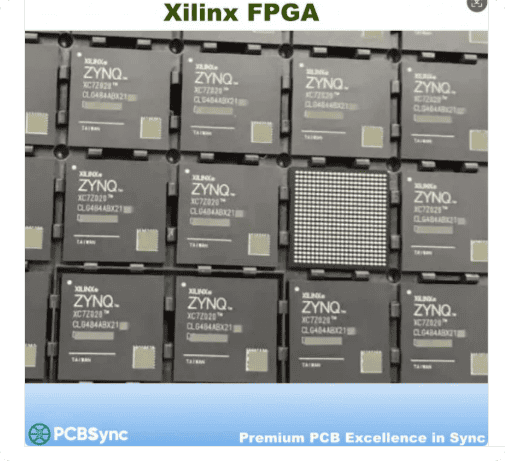
The XC2S200-6FGG895C is a powerful field-programmable gate array (FPGA) from Xilinx’s renowned Spartan-II family, designed to deliver exceptional performance and flexibility for demanding digital design applications. This industrial-grade programmable logic device combines 200,000 system gates with advanced features, making it an ideal solution for telecommunications, automotive systems, industrial automation, and embedded computing applications.
Built on proven 0.18µm CMOS technology, the XC2S200-6FGG895C FPGA offers designers a cost-effective alternative to traditional ASICs while providing the flexibility to implement design changes in the field without hardware replacement.
Key Technical Specifications
Core Architecture and Logic Resources
| Specification |
Value |
| Logic Cells |
5,292 |
| System Gates |
200,000 |
| CLB Array Configuration |
28 x 42 (1,176 total CLBs) |
| Distributed RAM |
75,264 bits |
| Block RAM |
56K bits |
| Maximum User I/O |
284 pins |
| Technology Node |
0.18µm CMOS |
Performance and Speed Characteristics
| Parameter |
Specification |
| Speed Grade |
-6 (fastest commercial grade) |
| Maximum System Performance |
Up to 200 MHz |
| Operating Voltage |
2.5V core logic |
| Temperature Range |
Commercial (0°C to +85°C) |
Package Details
| Package Feature |
Description |
| Package Type |
Fine-Pitch Ball Grid Array (FBGA) |
| Total Pin Count |
895 pins |
| Package Designation |
FGG895C |
| Lead-Free Status |
RoHS Compliant (indicated by ‘G’ in part number) |
Advanced Features and Capabilities
Configurable Logic Blocks (CLBs)
The XC2S200-6FGG895C incorporates 1,176 Configurable Logic Blocks arranged in a 28×42 array, providing substantial resources for complex digital designs. Each CLB contains multiple logic cells with Look-Up Tables (LUTs), flip-flops, and dedicated carry logic for efficient arithmetic operations.
Memory Architecture
This Spartan-II FPGA features a dual-tier memory system:
- Distributed RAM: 75,264 bits spread throughout the CLB array for fast, localized storage
- Block RAM: 56K bits organized in dedicated memory blocks for larger data structures
- Flexible memory configuration supporting various depth and width combinations
Input/Output Capabilities
With 284 maximum user I/O pins, the XC2S200-6FGG895C supports:
- Multiple I/O standards (LVTTL, LVCMOS, PCI, GTL+)
- Programmable drive strength and slew rate control
- Input/output buffer configurations for diverse system requirements
- Four dedicated global clock inputs for robust timing distribution
Delay-Locked Loops (DLLs)
Four on-chip DLLs provide advanced clock management features:
- Clock multiplication and division
- Phase shifting capabilities
- Reduced clock distribution skew
- Enhanced system timing performance
Application Areas
Telecommunications and Networking
The XC2S200-6FGG895C FPGA excels in telecommunications applications requiring:
- Protocol processing and packet handling
- Digital signal processing (DSP) functions
- Interface bridging between different standards
- High-speed data routing and switching
Industrial Automation and Control
Industrial designers leverage this FPGA for:
- Motor control and servo systems
- Process monitoring and control
- Industrial communication protocols
- Sensor interface and data acquisition
Automotive Electronics
Automotive applications benefit from:
- Engine control unit (ECU) support functions
- Advanced driver assistance systems (ADAS)
- In-vehicle networking interfaces
- Diagnostic and testing equipment
Consumer Electronics and Embedded Systems
The device supports:
- Digital video processing and display control
- Audio processing and codec implementation
- Peripheral interface controllers
- System-on-chip (SoC) integration
Design Tools and Development Support
Xilinx ISE Design Suite
The XC2S200-6FGG895C is supported by Xilinx’s comprehensive ISE Design Suite, offering:
- Synthesis: XST (Xilinx Synthesis Technology) for RTL-to-gate conversion
- Implementation: Place-and-route tools optimized for Spartan-II architecture
- Simulation: ModelSim integration for functional and timing verification
- Programming: iMPACT tool for device configuration
Hardware Description Language Support
Engineers can develop designs using industry-standard HDLs:
- VHDL: Full IEEE 1076 standard compliance
- Verilog: IEEE 1364 standard support
- Schematic Entry: Graphical design capture for legacy support
IP Core Library
Access to Xilinx FPGA IP cores accelerates development with pre-verified functions including:
- Microprocessor cores (PicoBlaze soft processor)
- Communication interfaces (UART, SPI, I2C)
- Memory controllers
- Mathematical functions and DSP building blocks
Configuration and Programming Options
Configuration Modes
The XC2S200-6FGG895C supports multiple configuration methods:
| Mode |
Description |
Use Case |
| JTAG |
Boundary-scan configuration |
Development and debugging |
| Master Serial |
FPGA controls configuration PROM |
Stand-alone operation |
| Slave Serial |
External controller manages configuration |
System integration |
| SelectMAP |
Parallel configuration interface |
Fast reconfiguration |
Configuration Memory
Compatible with Xilinx configuration PROMs and third-party flash devices for:
- Power-up automatic configuration
- Multi-boot capability
- Secure bitstream storage
Comparison with Other Spartan-II Family Members
| Device |
Logic Cells |
System Gates |
Block RAM |
Max I/O |
| XC2S50 |
1,728 |
50,000 |
32K |
176 |
| XC2S100 |
2,700 |
100,000 |
40K |
176 |
| XC2S150 |
3,888 |
150,000 |
48K |
260 |
| XC2S200 |
5,292 |
200,000 |
56K |
284 |
The XC2S200 represents the flagship device in the Spartan-II family, offering maximum logic resources and I/O capability for the most demanding applications.
Advantages Over Traditional ASICs
Flexibility and Reconfigurability
Unlike mask-programmed ASICs, the XC2S200-6FGG895C offers:
- Field Upgradability: Update designs remotely without hardware changes
- Risk Mitigation: Eliminate NRE costs and lengthy ASIC development cycles
- Rapid Prototyping: Implement and test designs in hours instead of months
- Design Iteration: Refine functionality based on real-world testing
Cost-Effectiveness
For production volumes under 100,000 units, FPGAs typically provide:
- Lower initial investment (no mask costs)
- Faster time-to-market
- Reduced inventory risk through design flexibility
- Multiple product variants from single hardware platform
Development Time Advantages
FPGA-based designs compress schedules through:
- Immediate hardware availability
- Parallel hardware/software development
- In-system debugging capabilities
- Incremental design refinement
Power Management and Thermal Considerations
Power Consumption Characteristics
The XC2S200-6FGG895C features multiple power domains:
- VCCINT: 2.5V core logic supply
- VCCO: Configurable I/O voltage (1.5V to 3.3V per bank)
- Power consumption varies with design complexity, clock frequency, and I/O activity
Power Optimization Techniques
Designers can minimize power consumption through:
- Clock gating for unused logic
- Selective use of high-speed I/O standards
- Dynamic reconfiguration for multi-mode operation
- Careful resource allocation during synthesis
Thermal Management
The 895-pin FBGA package provides:
- Efficient heat dissipation through large thermal pad
- Multiple ground pins for thermal spreading
- Compatibility with standard heatsink solutions
- Thermal monitoring through on-chip temperature sensors (when implemented)
PCB Design Guidelines
Layout Considerations
Successfully implementing the XC2S200-6FGG895C requires attention to:
- Signal Integrity: Controlled impedance traces for high-speed signals
- Power Distribution: Adequate decoupling capacitors near power pins
- Ground Planes: Continuous ground reference for noise immunity
- Via Management: Strategic via placement for signal routing
Recommended Decoupling Strategy
| Capacitor Value |
Quantity |
Location |
| 0.1µF |
10-15 |
Distributed near VCCINT pins |
| 0.01µF |
5-10 |
High-frequency decoupling |
| 10µF |
2-4 |
Bulk capacitance near device |
Signal Routing Best Practices
- Minimize stub lengths on high-speed signals
- Match trace lengths for synchronous bus interfaces
- Separate analog and digital ground regions when mixing signal types
- Provide adequate spacing for differential pairs
Quality and Reliability
Manufacturing Standards
The XC2S200-6FGG895C meets stringent quality requirements:
- RoHS Compliance: Lead-free construction meeting EU directives
- Moisture Sensitivity Level: MSL 3 classification
- ESD Protection: Human Body Model (HBM) up to 2000V
- Latch-up Immunity: Greater than 200mA per JESD78 standards
Reliability Testing
Xilinx subjects devices to comprehensive qualification:
- Temperature cycling (-65°C to +150°C)
- High temperature operating life (HTOL) testing
- Autoclave and highly accelerated stress testing (HAST)
- Electromigration and time-dependent dielectric breakdown (TDDB) analysis
Long-Term Availability
As part of Xilinx’s commitment to embedded markets:
- Extended product lifecycle support
- Migration paths to newer families documented
- Legacy design support through ISE tools
Pricing and Availability
Cost Structure
The XC2S200-6FGG895C pricing varies based on:
- Order quantity (volume discounts available)
- Lead time requirements (stock vs. custom order)
- Distributor vs. direct purchase
- Regional market conditions
Typical Pricing Tiers
| Quantity |
Price Range (USD) |
| 1-10 units |
$180-220 |
| 11-100 units |
$150-180 |
| 101-1000 units |
$120-150 |
| 1000+ units |
Contact for quote |
Note: Prices are approximate and subject to market conditions
Where to Purchase
Authorized distributors include:
- Digi-Key Electronics
- Mouser Electronics
- Arrow Electronics
- Avnet
- Direct from Xilinx/AMD
Technical Documentation and Resources
Essential Datasheets
- DS001: Spartan-II Family Data Sheet (complete specifications)
- UG002: Spartan-II User Guide (architecture and features)
- UG003: Spartan-II Configuration Guide
- Package Specifications: Mechanical drawings and land patterns
Application Notes
Key application notes for designers:
- XAPP151: Virtex and Spartan-II FPGA Families: Functional Description
- XAPP138: Using Programmable LVDS I/O
- XAPP174: High-Speed Board Design Considerations
Development Boards
Evaluation platforms featuring Spartan-II devices:
- Xilinx Spartan-II Development Kit
- Third-party prototyping boards with XC2S200
- Custom carrier boards for specific applications
Environmental Compliance
RoHS and REACH Compliance
The “G” designation in XC2S200-6FGG895C indicates:
- RoHS 2 Directive: Compliant with 2011/65/EU restrictions
- Lead-Free: Uses SAC305 or equivalent solder balls
- REACH: Registered substances per EU regulation
- Halogen-Free: Available upon request for environmentally sensitive applications
Conflict Minerals
Xilinx maintains conflict minerals policies addressing:
- Tin, tantalum, tungsten, and gold (3TG) sourcing
- Supply chain transparency
- Dodd-Frank Act compliance
Migration and Upgrade Paths
Within Spartan-II Family
Pin-compatible migration options (same package):
- Downgrade to XC2S150 for cost optimization
- Same footprint enables design scalability
To Newer FPGA Families
Evolution paths for enhanced performance:
- Spartan-3: 90nm technology, higher speed grades
- Spartan-6: Advanced DSP blocks, improved power efficiency
- Spartan-7: Latest generation with enhanced features
Design Portability
ISE project migration supported to:
- Newer tool versions (ISE 14.7 final release)
- Vivado Design Suite (with IP upgrade)
Frequently Asked Questions
What makes the -6 speed grade significant?
The -6 speed grade represents the fastest commercially available variant of the XC2S200, offering maximum performance of approximately 200 MHz system frequency. This makes it ideal for timing-critical applications requiring the highest throughput.
Is the XC2S200-6FGG895C suitable for new designs?
While the Spartan-II family is considered mature technology, it remains viable for:
- Cost-sensitive applications
- Proven design reuse
- Long-term availability requirements
- Applications not requiring cutting-edge density or performance
For new projects, evaluate newer families (Spartan-7, Artix-7) for enhanced capabilities.
What development software is required?
The XC2S200-6FGG895C requires Xilinx ISE Design Suite (final version 14.7). This software is available as a free WebPACK edition for educational and limited commercial use, or as a licensed version for full device support.
How does block RAM differ from distributed RAM?
Block RAM consists of dedicated memory blocks optimized for larger data structures, offering synchronous operation and higher density. Distributed RAM uses CLB logic resources for smaller, randomly distributed memory needs with potentially faster access in some configurations.
Can I use this FPGA for high-speed serial communication?
The Spartan-II family does not include dedicated high-speed serial transceivers. For applications requiring multi-gigabit serial links (such as PCI Express, SATA, or 10G Ethernet), consider newer families like Spartan-6 or 7-Series devices with integrated transceivers.
Summary and Recommendations
The XC2S200-6FGG895C represents a mature, reliable FPGA solution offering substantial logic resources in a high pin-count package. Its 200,000 system gates, 284 I/O pins, and -6 speed grade make it suitable for complex digital designs requiring extensive interconnectivity.
Best Suited For:
- Industrial control systems requiring long-term availability
- Telecommunications equipment with moderate bandwidth needs
- Automotive applications demanding proven technology
- Cost-optimized designs leveraging existing IP
Consider Alternatives When:
- Requiring cutting-edge power efficiency
- Needing integrated high-speed serial transceivers
- Demanding maximum logic density per dollar
- Starting greenfield projects with 10+ year lifecycles
For designers familiar with Spartan-II architecture or maintaining legacy systems, the XC2S200-6FGG895C continues to provide excellent value. However, new projects should evaluate whether modern FPGA families better align with current and future requirements.