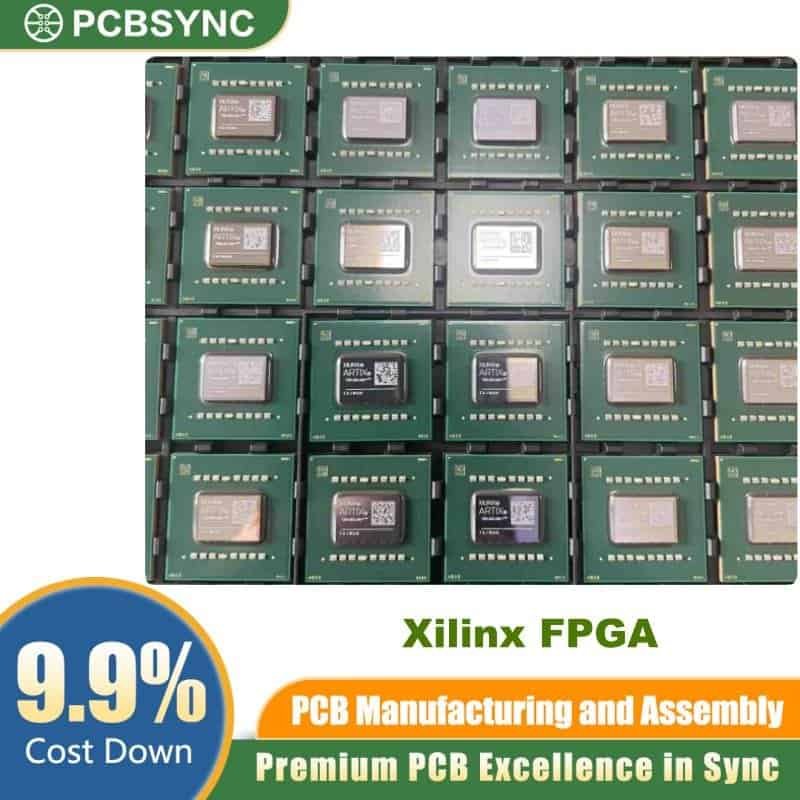
The XC2S200-6FGG882C is a powerful field-programmable gate array (FPGA) from the renowned Xilinx Spartan-II family, designed to deliver exceptional performance and flexibility for complex digital design applications. This cost-effective FPGA solution combines high-density logic resources with advanced architectural features, making it an ideal choice for engineers and designers seeking reliable programmable logic solutions.
As part of the Spartan-II family, the XC2S200-6FGG882C represents a superior alternative to traditional mask-programmed ASICs, eliminating lengthy development cycles, high initial costs, and inherent design risks. The device’s programmability enables field upgrades without hardware replacement, providing unprecedented flexibility for evolving project requirements.
Technical Specifications of XC2S200-6FGG882C
Core Performance Parameters
| Specification |
Value |
| System Gates |
200,000 gates |
| Logic Cells |
5,292 cells |
| CLB Array Configuration |
28 x 42 (1,176 total CLBs) |
| Maximum Frequency |
263 MHz |
| Speed Grade |
-6 (fastest commercial grade) |
| Process Technology |
0.18µm (180nm) CMOS |
| Core Voltage (VCCINT) |
2.5V |
| I/O Voltage (VCCO) |
1.5V, 2.5V, or 3.3V |
| Package Type |
FGG882 (882-ball Fine-Pitch BGA) |
| Operating Temperature |
Commercial (0°C to +85°C) |
Memory Architecture
| Memory Type |
Capacity |
| Total Distributed RAM |
75,264 bits |
| Block RAM |
56 Kbits (56,336 bits) |
| Distributed RAM per LUT |
16 bits |
| Block RAM Configuration |
Dual-port and single-port synchronous RAM |
I/O and Interface Capabilities
| Feature |
Specification |
| Maximum User I/Os |
284 pins |
| Supported I/O Standards |
16 different standards |
| Global Clock Inputs |
4 dedicated clock pins |
| Delay-Locked Loops (DLLs) |
4 (one at each corner) |
| 5V Tolerance |
Yes (with series resistor) |
| Hot Swap Support |
Compact PCI friendly |
Key Features of XC2S200-6FGG882C FPGA
Advanced Configurable Logic Architecture
The XC2S200-6FGG882C features a highly flexible architecture built around Configurable Logic Blocks (CLBs). Each CLB contains four Logic Cells (LCs), with each LC comprising a 4-input function generator, storage element, and carry logic. This modular design enables efficient implementation of complex combinatorial and sequential logic functions.
The device’s CLB array is organized in a 28×42 matrix, providing 1,176 total CLBs for maximum design flexibility. Function generators can be configured as look-up tables (LUTs), distributed RAM, or shift registers, offering versatile implementation options for various design requirements.
Hierarchical Memory System
The XC2S200-6FGG882C incorporates a sophisticated hierarchical memory system featuring both distributed and block RAM resources:
- Distributed RAM: Integrated within CLBs, the 75,264 bits of distributed RAM provide fast, flexible memory for small data structures, FIFO buffers, and lookup tables
- Block RAM: Two columns of synchronous block RAM totaling 56 Kbits offer high-speed storage for larger data sets, ideal for buffering, data processing, and temporary storage applications
High-Performance I/O Architecture
The programmable Input/Output Blocks (IOBs) surrounding the CLB array support 16 different I/O standards, enabling seamless interfacing with various external devices and systems. Each IOB contains three registers configurable as D-type flip-flops or level-sensitive latches, supporting both input and output operations with independent clock enable signals.
Clock Management with DLLs
Four Delay-Locked Loops (DLLs) positioned at each corner of the die provide advanced clock management capabilities, including:
- Clock deskewing and phase shifting
- Frequency multiplication and division
- Low-jitter clock distribution
- Simplified timing closure for high-speed designs
Applications of XC2S200-6FGG882C Spartan-II FPGA
Digital Signal Processing (DSP)
The XC2S200-6FGG882C excels in DSP applications requiring high-speed data processing and complex algorithmic implementations. Common uses include:
- Audio and video processing systems
- Image filtering and enhancement
- Digital communications signal processing
- Software-defined radio (SDR) implementations
Communication Systems and Networking
With its high-performance I/O capabilities and abundant logic resources, this FPGA is ideal for:
- Protocol implementation and conversion
- Network routers and switches
- Data encoding/decoding systems
- Channel coding and error correction
- High-speed serial communication interfaces
Industrial Control and Automation
The device’s reliability and reconfigurability make it perfect for industrial applications:
- Motor control systems
- Process automation controllers
- PLC (Programmable Logic Controller) replacements
- Real-time control systems
- Sensor interface and data acquisition
Medical Equipment
Healthcare applications benefit from the XC2S200-6FGG882C’s precision and flexibility:
- Medical imaging systems
- Diagnostic equipment
- Patient monitoring devices
- Laboratory instrumentation
- Portable medical devices
Embedded Systems
The FPGA serves as an excellent platform for embedded system development:
- System-on-Chip (SoC) prototyping
- Custom peripheral interfaces
- Hardware acceleration for embedded processors
- Real-time data processing
- Automotive electronics
Design Advantages Over Traditional ASICs
Rapid Development and Time-to-Market
Unlike ASICs that require months of fabrication time, the XC2S200-6FGG882C enables immediate implementation and testing. Design iterations can be completed in hours rather than weeks, significantly reducing development cycles and accelerating time-to-market for new products.
Cost-Effective Solutions
The FPGA eliminates the high NRE (Non-Recurring Engineering) costs associated with ASIC development, making it economically viable for low to medium volume production. No mask charges or minimum order quantities are required, providing flexibility for various production scales.
Field Upgradability
One of the most significant advantages is the ability to upgrade designs in the field without hardware replacement. Bug fixes, feature enhancements, and performance optimizations can be deployed through simple configuration updates, impossible with traditional ASICs.
Risk Mitigation
By eliminating the “one-shot” nature of ASIC design, FPGAs significantly reduce project risk. Design errors can be corrected without expensive silicon respins, and changing requirements can be accommodated throughout the product lifecycle.
Development Tools and Support
Xilinx ISE Design Suite
The XC2S200-6FGG882C is fully supported by the powerful Xilinx ISE (Integrated Software Environment) development system, providing:
- Automatic mapping, placement, and routing
- Comprehensive simulation capabilities
- Timing analysis and optimization tools
- Power analysis and estimation
- Configuration file generation
Design Entry Options
Multiple design entry methods are supported:
- Hardware Description Languages: Verilog HDL and VHDL
- Schematic Capture: Graphical design entry
- IP Cores: Pre-verified functional blocks
- System-level Design: High-level synthesis tools
Programming and Configuration
The FPGA supports multiple configuration modes:
- Master Serial mode (internal oscillator)
- Slave Serial mode (external clock)
- JTAG boundary-scan configuration
- SelectMAP parallel configuration
Package Information: FGG882 Ball Grid Array
Physical Characteristics
The FGG882 package utilizes Fine-Pitch Ball Grid Array (FBGA) technology with 882 solder balls, providing:
- High pin density for maximum I/O availability
- Excellent thermal performance
- Low package inductance
- Superior electrical characteristics
- Compact footprint for space-constrained designs
Lead-Free and RoHS Compliance
The “G” designation in FGG882C indicates lead-free (Pb-free) packaging compliance with environmental regulations. This makes the device suitable for applications requiring RoHS (Restriction of Hazardous Substances) compliance and environmentally conscious manufacturing.
Power Considerations and Management
Operating Voltage Requirements
| Voltage Rail |
Specification |
Purpose |
| VCCINT |
2.5V ±5% |
Core logic power supply |
| VCCO |
1.5V, 2.5V, or 3.3V |
I/O power supply (bank-specific) |
| VCCAUX |
2.5V ±5% |
Auxiliary power (DLLs and other circuits) |
Power Optimization Strategies
The XC2S200-6FGG882C supports various power-saving techniques:
- Clock gating for unused logic blocks
- Selective I/O standard usage
- Dynamic voltage scaling on I/O banks
- Low-power configuration options
Speed Grade -6: Performance Implications
The -6 speed grade designation indicates the fastest commercial-temperature performance variant available for the XC2S200. Key performance characteristics include:
- Maximum toggle frequency up to 263 MHz
- Optimized for high-speed applications
- Minimum propagation delays
- Enhanced setup and hold time margins
- Exclusively available in commercial temperature range
This speed grade is ideal for applications demanding maximum performance, such as high-speed communications, real-time video processing, and demanding control systems.
Quality and Reliability Standards
Manufacturing Excellence
As a product from Xilinx FPGA (now part of AMD), the XC2S200-6FGG882C benefits from decades of semiconductor manufacturing expertise and rigorous quality control processes ensuring consistent performance and reliability.
Temperature and Environmental Ratings
| Parameter |
Specification |
| Operating Temperature |
0°C to +85°C (Commercial) |
| Storage Temperature |
-65°C to +150°C |
| Moisture Sensitivity Level |
MSL 3 |
| MTBF |
>1,000,000 hours (at 25°C) |
Competitive Advantages
Versus Discrete Logic
Replacing hundreds of discrete logic ICs, the XC2S200-6FGG882C offers:
- Reduced board space and component count
- Lower overall system cost
- Improved reliability (fewer interconnections)
- Simplified inventory management
- Enhanced design security
Versus CPLDs
Compared to Complex Programmable Logic Devices:
- Significantly higher logic density
- More flexible architecture
- Greater memory resources
- Advanced clock management
- Better price-per-gate ratio at higher densities
Versus Newer FPGA Families
While newer FPGA families offer increased density and features, the Spartan-II XC2S200-6FGG882C remains attractive for:
- Cost-sensitive applications
- Legacy design support and maintenance
- Proven, mature technology
- Established supply chains
- Lower power requirements for many applications
Ordering and Part Number Breakdown
Understanding the XC2S200-6FGG882C part number:
| Code Segment |
Meaning |
| XC |
Xilinx Commercial product |
| 2S |
Spartan-II family |
| 200 |
Device size (200K system gates) |
| -6 |
Speed grade (fastest commercial) |
| FGG |
Fine-pitch BGA package with lead-free |
| 882 |
882-ball count |
| C |
Commercial temperature range (0°C to +85°C) |
Design Resources and Documentation
Essential Documentation
Engineers working with the XC2S200-6FGG882C should reference:
- Spartan-II FPGA Family Datasheet (DS001)
- Spartan-II Complete Data Sheet (all four modules)
- Package specifications and pinout diagrams
- Application notes for specific use cases
- PCB design guidelines for BGA packages
Training and Support
Xilinx (AMD) provides comprehensive support resources:
- Online documentation and tutorials
- Community forums and knowledge base
- Technical support channels
- Design consultation services
- Reference designs and IP cores
Best Practices for XC2S200-6FGG882C Implementation
PCB Design Considerations
For optimal performance and reliability:
- Follow Xilinx PCB design guidelines for BGA packages
- Implement proper power supply decoupling (multiple capacitors near each power pin)
- Use controlled impedance traces for high-speed signals
- Ensure adequate thermal management with proper copper pours
- Plan for JTAG programming access during prototyping
Configuration and Boot
- Select appropriate configuration mode based on system requirements
- Implement configuration memory with sufficient capacity
- Include configuration error detection and recovery mechanisms
- Provide JTAG access for debugging and in-system programming
Clock Distribution
- Utilize global clock networks for high-fanout signals
- Leverage DLLs for clock deskewing and phase alignment
- Minimize clock skew through proper placement
- Consider clock domain crossing carefully
Conclusion: Why Choose XC2S200-6FGG882C
The XC2S200-6FGG882C Xilinx Spartan-II FPGA represents an excellent balance of performance, features, and cost-effectiveness for a wide range of digital design applications. With 200,000 system gates, 5,292 logic cells, and comprehensive I/O capabilities, this device provides the resources needed for complex designs while maintaining competitive pricing.
Its proven architecture, supported by mature development tools and extensive documentation, makes it a reliable choice for both new designs and legacy system maintenance. Whether you’re developing communication systems, industrial controllers, medical equipment, or embedded solutions, the XC2S200-6FGG882C delivers the flexibility and performance required for successful implementation.
The combination of rapid development cycles, field upgradability, and freedom from ASIC-related risks makes this FPGA an intelligent choice for projects requiring programmable logic solutions. With comprehensive support from the Xilinx ecosystem and established supply chains, designers can confidently build robust, high-performance systems around the XC2S200-6FGG882C.
For engineers seeking to leverage advanced FPGA technology in their next project, the XC2S200-6FGG882C Spartan-II FPGA offers proven performance, extensive resources, and long-term reliability at an attractive price point.