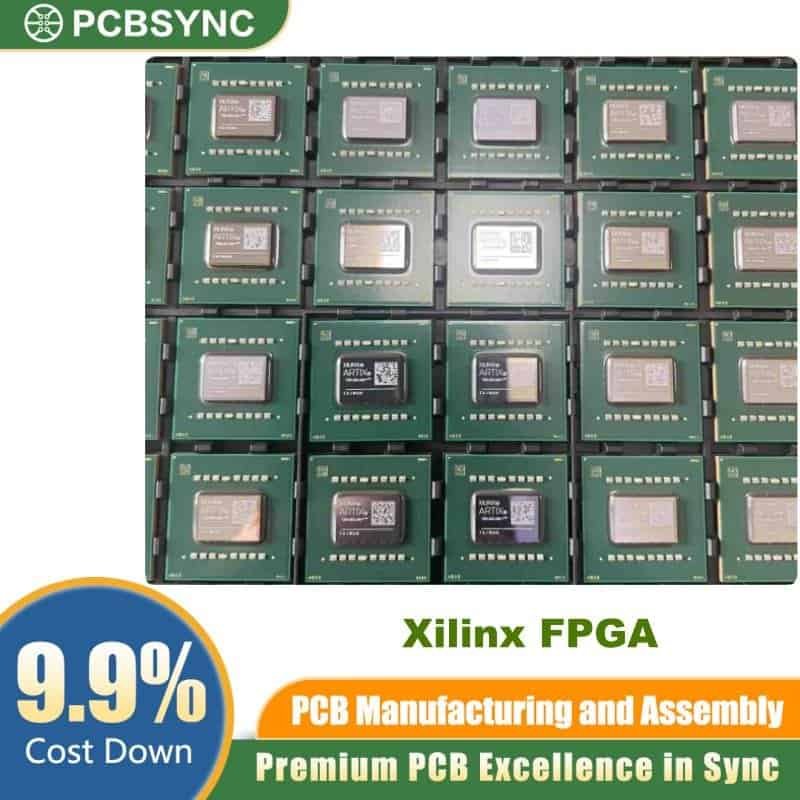
The XC2S200-6FGG843C represents a specialized variant of the renowned Spartan-II FPGA family from Xilinx (now AMD), delivering exceptional performance with 200,000 system gates and comprehensive programmable logic resources. This high-performance field-programmable gate array features 5,292 logic cells configured in an advanced 843-ball Fine-Pitch Ball Grid Array (FBGA) package, offering maximum I/O density and flexibility for complex digital systems. Engineered for demanding applications in telecommunications infrastructure, industrial automation, medical instrumentation, and embedded computing, the XC2S200-6FGG843C combines proven reliability with cost-effective implementation.
As part of the trusted Xilinx FPGA product portfolio, this device provides engineers with a robust platform for implementing sophisticated digital designs while eliminating the high costs and lengthy development cycles associated with traditional ASICs.
Technical Specifications and Core Features
Primary Device Characteristics
| Specification |
Details |
| Part Number |
XC2S200-6FGG843C |
| Device Family |
Spartan-II FPGA |
| System Gates |
200,000 gates |
| Logic Cells |
5,292 configurable cells |
| CLB Configuration |
28 × 42 (Rows × Columns) |
| Total CLBs |
1,176 configurable logic blocks |
| Speed Grade |
-6 (High-performance) |
| Temperature Grade |
Commercial (0°C to +85°C) |
| Package Type |
843-ball Fine-Pitch BGA |
| Process Technology |
0.18μm 8-layer metal CMOS |
Memory Architecture and Resources
| Memory Type |
Capacity |
Configuration |
| Distributed RAM |
75,264 bits |
Integrated within CLBs |
| Block RAM |
56 Kbits |
Dedicated dual-port RAM blocks |
| Block RAM Blocks |
14 blocks |
4K bits each |
| RAM Flexibility |
Single/Dual Port |
Configurable width and depth |
| Maximum User I/O |
Up to 284 pins |
Package dependent |
| Dedicated Clock Inputs |
4 pins |
Global low-skew distribution |
Advanced Architecture and Design Capabilities
High-Performance Logic Resources
The XC2S200-6FGG843C FPGA delivers outstanding computational performance through its sophisticated architecture. With 5,292 logic cells organized in a 28×42 configurable logic block (CLB) array, designers gain access to extensive resources for implementing complex algorithms, state machines, arithmetic functions, and custom logic circuits.
Each configurable logic block contains:
- Four logic slices with lookup tables (LUTs)
- Eight flip-flops for sequential logic
- Dedicated carry logic for high-speed arithmetic
- Multiplexers for efficient data routing
- Distributed RAM capability for localized storage
Superior Speed Grade Performance
The -6 speed grade designation indicates this device is optimized for maximum performance applications. Key performance characteristics include:
- System-Level Operation: Up to 200 MHz clock frequency
- Internal Performance: Select paths exceeding 250 MHz
- Reduced Propagation Delays: Optimized for time-critical applications
- Fast Clock-to-Output: Minimized latency for responsive systems
- High-Speed I/O: Support for rapid data transfer protocols
Comprehensive I/O Capabilities
The 843-ball FBGA package provides exceptional connectivity with extensive I/O resources:
- Maximum User I/O: 284 configurable I/O pins
- Voltage Compatibility: Support for multiple I/O standards
- LVTTL/LVCMOS: 3.3V, 2.5V, and 1.8V operation
- Differential Standards: LVDS, LVPECL for high-speed signaling
- Programmable Drive Strength: Customizable output current
- Individual I/O Configuration: Per-pin direction and standard selection
- Input Delay Elements: Programmable input timing control
Dual-Memory Architecture Benefits
| Feature |
Distributed RAM |
Block RAM |
| Total Capacity |
75,264 bits |
56 Kbits |
| Location |
Within CLBs |
Dedicated blocks |
| Access Speed |
Very fast (local) |
Fast (dedicated) |
| Best Used For |
Small buffers, FIFOs |
Large data storage |
| Port Configuration |
Single port |
Single or dual port |
| Granularity |
16 bits per CLB |
4096 bits per block |
Package Specifications: 843-Ball Fine-Pitch BGA
Physical Package Attributes
| Package Parameter |
Specification |
| Package Type |
Fine-Pitch Ball Grid Array (FBGA) |
| Total Ball Count |
843 balls |
| Ball Pitch |
1.0 mm nominal |
| Package Dimensions |
Approximately 29mm × 29mm |
| Package Height |
~2.5 mm maximum |
| Ball Material |
Lead-free (RoHS compliant) |
| Moisture Sensitivity |
MSL 3 (168 hours at ≤30°C/60% RH) |
| Body Material |
BT (Bismaleimide Triazine) substrate |
Advanced Packaging Technology
The 843-ball configuration offers several critical advantages:
- Maximum I/O Density: Dense ball arrangement maximizes available user I/O
- Excellent Signal Integrity: Short internal connections reduce inductance
- Superior Thermal Performance: Large package area enhances heat dissipation
- Robust Mechanical Structure: Ball grid provides structural stability
- Manufacturing Compatibility: Standard SMT assembly processes
- RoHS Compliance: Lead-free construction for environmental compliance
PCB Design Requirements
| Design Aspect |
Recommendation |
| PCB Layer Count |
Minimum 8 layers (10-12 preferred) |
| Via Technology |
Via-in-pad or micro-vias recommended |
| Power Planes |
Dedicated VCC and GND planes required |
| Trace Width |
50-ohm controlled impedance for critical signals |
| Thermal Management |
Thermal vias under package for heat transfer |
| BGA Landing Pad |
NSMD (Non-Solder Mask Defined) recommended |
| Decoupling |
Multiple bypass capacitors per power domain |
Application Domains and Use Cases
Telecommunications and Network Infrastructure
The XC2S200-6FGG843C excels in telecommunications applications requiring high-speed processing:
- Protocol Processing: Ethernet, TCP/IP, and custom protocol handlers
- Software-Defined Radio: Baseband processing and modulation/demodulation
- Network Switching: Packet processing and routing engines
- Telecommunications Interfaces: T1/E1, SONET/SDH line cards
- Base Station Equipment: Signal processing for wireless infrastructure
- Voice Processing: Echo cancellation and voice compression
- Data Encryption: Hardware-accelerated cryptographic operations
Industrial Automation and Control
Industrial environments benefit from the FPGA’s reliability and real-time capabilities:
- Programmable Logic Controllers: High-speed control algorithms
- Motor Drive Systems: PWM generation and feedback processing
- Machine Vision: Real-time image processing and pattern recognition
- Process Automation: Multi-channel sensor data acquisition
- Robotic Control: Precise motion control and trajectory planning
- Factory Networks: Industrial protocol conversion (Profibus, DeviceNet)
- Safety Systems: Redundant control logic implementation
Medical and Healthcare Equipment
Healthcare applications leverage the FPGA’s precision and configurability:
- Medical Imaging: Ultrasound beamforming and image reconstruction
- Patient Monitoring: Multi-parameter vital sign processing
- Laboratory Instruments: Spectroscopy and chromatography systems
- Diagnostic Equipment: Signal conditioning and data acquisition
- Portable Medical Devices: Battery-powered monitoring solutions
- Surgical Equipment: Real-time control and feedback systems
- Telemedicine: Medical data compression and transmission
Consumer Electronics and Multimedia
Consumer product designers utilize the device for multimedia processing:
- Video Processing: Format conversion, scaling, and enhancement
- Display Controllers: Multi-format video output and timing generation
- Audio DSP: Digital audio effects and equalization
- Gaming Systems: Graphics acceleration and game logic
- Set-Top Boxes: Video decoding and content management
- Digital Cameras: Image sensor interface and processing pipeline
- Home Automation: Smart home controllers and IoT gateways
Competitive Advantages Over Alternative Solutions
XC2S200-6FGG843C vs. Traditional ASICs
| Aspect |
XC2S200-6FGG843C FPGA |
ASIC Implementation |
| Development Cost |
Low (no NRE) |
Very High ($100K-$1M+) |
| Time to Market |
Weeks |
6-18 months |
| Design Flexibility |
Unlimited reprogramming |
Fixed function |
| Prototyping |
Immediate |
Requires simulation only |
| Field Updates |
In-system upgradable |
Impossible |
| Volume Break-Even |
1-50K units |
100K+ units |
| Risk Level |
Low |
High |
| Bug Fixes |
Quick firmware updates |
Hardware revision required |
Performance Comparison: FPGA Solutions
| Feature |
XC2S200-6FGG843C |
Equivalent CPLDs |
Lower-End FPGAs |
| Logic Resources |
200K gates |
Typically <10K gates |
50-100K gates |
| Memory Resources |
131K bits total |
Limited or none |
Moderate |
| I/O Count |
Up to 284 |
100-200 typical |
100-200 typical |
| Performance |
200+ MHz |
100-150 MHz |
100-175 MHz |
| Package Options |
843-ball high-density |
Limited options |
Standard packages |
| Cost Efficiency |
Excellent |
Good for simple designs |
Good |
Development Tools and Design Flow
Supported Development Software
| Tool Category |
Software Solution |
| Primary IDE |
Xilinx ISE Design Suite (recommended) |
| Synthesis |
XST (Xilinx Synthesis Technology) |
| Simulation |
ISim (integrated), ModelSim, Active-HDL |
| Place & Route |
ISE Implementation tools |
| Timing Analysis |
Static Timing Analyzer |
| Programming |
iMPACT configuration utility |
| IP Libraries |
Xilinx CORE Generator System |
| Debug Tools |
ChipScope Pro analyzer |
Hardware Description Languages
The XC2S200-6FGG843C supports industry-standard HDL development:
- VHDL: IEEE 1076-1993 and later standards
- Verilog: IEEE 1364-2001 specification
- SystemVerilog: Supported for testbenches and verification
- Schematic Entry: Legacy design capture (limited support)
- IP Integration: Pre-verified IP cores and megafunctions
Configuration and Programming Methods
| Configuration Mode |
Description |
Use Case |
| Master Serial |
FPGA controls configuration |
Stand-alone systems with SPI flash |
| Slave Serial |
External controller manages config |
Microprocessor-based systems |
| Slave Parallel |
8-bit parallel configuration |
Fast reconfiguration requirement |
| JTAG Boundary Scan |
IEEE 1149.1 standard |
Development and debugging |
| SelectMAP |
High-speed parallel interface |
Production programming |
Part Number Decoding and Ordering Guide
Understanding XC2S200-6FGG843C Nomenclature
XC2S200-6FGG843C decodes as follows:
- XC: Xilinx Commercial temperature range FPGA
- 2S: Spartan-II architecture family
- 200: 200,000 system gates density
- -6: Speed grade (-6 = fastest commercial grade available)
- FGG: Fine-pitch BGA, lead-free/RoHS-compliant package
- 843: 843-ball package configuration
- C: Commercial temperature range (0°C to +85°C)
Temperature Range Options
| Grade |
Temperature Range |
Typical Applications |
| C (Commercial) |
0°C to +85°C |
Office equipment, consumer electronics |
| I (Industrial) |
-40°C to +100°C |
Industrial control, outdoor installations |
| M (Military) |
-55°C to +125°C |
Aerospace, defense (special order) |
Speed Grade Selection Guide
| Speed Grade |
Performance Level |
Recommended For |
| -4 |
Standard |
Cost-sensitive, moderate-speed designs |
| -5 |
Enhanced |
Balanced performance and cost |
| -6 |
Premium |
Maximum performance requirements |
Note: The -6 speed grade is exclusively available in Commercial (C) temperature range.
Design Implementation Best Practices
Optimizing FPGA Performance
To achieve maximum performance from the XC2S200-6FGG843C:
- Pipeline Critical Paths: Insert register stages in long combinational paths
- Use Block RAM Efficiently: Store large data sets in dedicated block RAM
- Minimize Clock Domains: Reduce complexity of clock domain crossing
- Utilize Dedicated Resources: Leverage carry chains for arithmetic operations
- Proper Timing Constraints: Apply accurate clock and I/O timing constraints
- Power Optimization: Enable unused block power-down features
- I/O Standards: Select appropriate I/O standards for signal integrity
Resource Utilization Guidelines
| Resource Type |
Recommended Usage |
Reason |
| Logic Cells |
<80% capacity |
Maintain routing flexibility |
| Block RAM |
<90% capacity |
Allow headroom for modifications |
| User I/O |
<75% of available |
Reserve pins for debugging |
| Global Clocks |
<3 of 4 available |
Preserve clock resources |
Quality, Reliability, and Compliance
Manufacturing Quality Standards
| Standard |
Compliance Level |
| ISO 9001 |
Certified manufacturing facilities |
| RoHS Directive |
Compliant (lead-free package) |
| REACH Regulation |
Compliant substance declaration |
| Conflict Minerals |
DRC conflict-free sourcing |
| IPC-A-610 |
Class 2/3 assembly standards accepted |
| JEDEC Standards |
J-STD-020 MSL rating compliance |
Reliability Metrics and Testing
| Reliability Parameter |
Specification |
| MTBF |
>1 million hours at 55°C junction temp |
| Lifetime |
20+ years typical operational life |
| ESD Protection (HBM) |
>2000V per JEDEC JESD22-A114 |
| ESD Protection (CDM) |
>500V per JEDEC JESD22-C101 |
| Latch-up Immunity |
>200 mA per JEDEC JESD78 |
| Total Ionizing Dose |
Radiation tolerance data available |
Power Consumption and Thermal Management
Power Supply Requirements
| Power Rail |
Voltage |
Tolerance |
Typical Current |
Purpose |
| VCCINT |
2.5V |
±5% |
600-1200 mA |
Core logic power |
| VCCIO |
1.5-3.3V |
±5% |
Design dependent |
I/O bank power |
| VCCO |
1.5-3.3V |
±5% |
Per I/O bank |
Output drivers |
| AUX |
2.5V |
±5% |
<50 mA |
Auxiliary functions |
Power Consumption Estimates
| Operating Condition |
Typical Power |
Maximum Power |
| Static (Idle) |
300-500 mW |
800 mW |
| Dynamic (50% toggle) |
1.2-1.8W |
2.5W |
| Peak Operation |
2.0W |
3.0W |
| Configuration Mode |
<100 mW |
150 mW |
Note: Actual power consumption depends heavily on design implementation, clock frequency, I/O loading, and switching activity.
Thermal Design Considerations
| Thermal Parameter |
Value |
Notes |
| Junction Temperature (Tj) |
0°C to +85°C (C grade) |
Maximum operating |
| Case Temperature (Tc) |
Monitor point for thermal design |
|
| Theta-JA |
~15-25°C/W |
Package to ambient (with airflow) |
| Theta-JC |
~5-8°C/W |
Junction to case |
| Recommended Heatsink |
Per thermal calculations |
For >1.5W designs |
Getting Started with XC2S200-6FGG843C
Initial Design Workflow
- Requirements Definition: Specify functionality, performance, I/O needs
- Architecture Design: Create high-level block diagrams and data flow
- HDL Implementation: Write VHDL or Verilog design modules
- Functional Simulation: Verify logic correctness using testbenches
- Synthesis: Convert HDL to gate-level netlist
- Constraint Entry: Define timing, pinout, and area constraints
- Implementation: Place and route design onto FPGA fabric
- Static Timing Analysis: Verify all timing requirements met
- Bitstream Generation: Create configuration file
- Device Programming: Load design into FPGA via JTAG or configuration mode
Recommended Development Resources
- Xilinx ISE WebPACK: Free development suite (supports Spartan-II)
- Development Boards: Third-party evaluation platforms available
- IP Core Libraries: Pre-verified functional blocks (memory controllers, DSP functions)
- Application Notes: Xilinx documentation for design techniques
- Community Forums: Active user community for support
- Reference Designs: Example projects for common applications
Frequently Asked Questions
Q: What makes the XC2S200-6FGG843C suitable for high-reliability applications?
The device features extensive built-in reliability mechanisms including ESD protection exceeding 2000V, robust latch-up immunity, and proven long-term reliability with MTBF ratings exceeding 1 million hours. The Spartan-II family has accumulated billions of device-hours in field deployment across industrial, medical, and telecommunications applications.
Q: Can I use the XC2S200-6FGG843C in automotive applications?
The commercial-grade C variant operates reliably from 0°C to 85°C, suitable for many automotive cabin applications. For under-hood or extreme temperature automotive requirements, consider the industrial I-grade version (-40°C to +100°C). For safety-critical automotive systems, consult Xilinx for AEC-Q100 qualified devices.
Q: How does the 843-ball package differ from standard Spartan-II packages?
The 843-ball FBGA provides maximum I/O density and connectivity options. Compared to smaller packages like PQ208 (140 I/O) or FG256 (176 I/O), the FGG843 package enables access to up to 284 user I/O pins, making it ideal for applications requiring extensive external connectivity such as memory interfaces, multiple communication channels, or sensor arrays.
Q: What development tools are required for the XC2S200-6FGG843C?
The primary development environment is Xilinx ISE Design Suite, available in both commercial and free WebPACK editions (WebPACK supports Spartan-II family). The software includes synthesis, simulation, implementation, and programming tools. Third-party simulation tools like ModelSim can also be integrated into the design flow.
Q: Is the XC2S200-6FGG843C still in active production?
The Spartan-II family is a mature product line with established manufacturing. While Xilinx has introduced newer FPGA families, Spartan-II devices remain available through authorized distributors and channels. For new designs requiring long-term availability guarantees (10+ years), consult with Xilinx/AMD regarding product longevity programs and recommended alternatives.
Q: How do I estimate power consumption for my specific design?
Xilinx provides XPower Analyzer software that estimates power consumption based on your specific design characteristics including resource utilization, clock frequencies, I/O loading, and switching activity. For preliminary estimates, assume 300-500 mW static power plus approximately 1-2 mW per MHz of system clock frequency, adjusted for design complexity.
Q: What PCB design capabilities are needed for the 843-ball package?
The fine-pitch BGA requires advanced PCB manufacturing capabilities including high layer count (8+ layers), controlled impedance routing, potentially via-in-pad technology, and precise registration alignment. Partner with experienced PCB fabricators who have demonstrated BGA assembly capabilities with 1.0mm ball pitch or finer.
Q: Can I migrate designs between different Spartan-II packages?
While the logic resources remain identical across XC2S200 packages, pin assignments differ between packages, requiring PCB redesign for package changes. However, the HDL source code and IP cores are fully portable. The design can be re-implemented with new pinout constraints for a different package without changing the functional logic.
Q: What configuration memory size is required?
The XC2S200 requires a 1,335,840-bit configuration bitstream. For Master Serial mode using SPI flash memory, a 2-megabit (256KB) or larger serial flash device like the Xilinx XCF02S is recommended to accommodate the bitstream plus any design metadata.
Q: Does the device support partial reconfiguration?
The Spartan-II family does not support dynamic partial reconfiguration. Complete device reconfiguration is required for design updates. For partial reconfiguration capabilities, consider newer Xilinx FPGA families like Virtex or later-generation devices.
Migration Path and Future-Proofing
Upgrade Options Within Spartan Family
| Requirement |
Recommended Migration Target |
| More Logic Resources |
Spartan-3 family (higher gate counts) |
| Lower Power |
Spartan-3E or Spartan-6 families |
| Higher Performance |
Spartan-6 or Artix-7 families |
| Advanced Features |
Artix-7 (DSP slices, modern IP) |
| Lowest Cost |
Spartan-3A family or Spartan-7 |
Design Longevity Considerations
For ensuring long-term product viability:
- Document Pin Assignments: Maintain detailed pinout documentation
- Modular Design: Separate device-specific and portable code
- Standard Protocols: Use industry-standard interfaces for easier migration
- Conservative Resource Usage: Leave margin for future enhancements
- Thorough Testing: Validate across temperature and voltage ranges
- Maintain Source Code: Version control all design files and constraints
Conclusion: Why Choose XC2S200-6FGG843C
The XC2S200-6FGG843C stands as a proven, high-performance FPGA solution offering substantial logic resources, extensive I/O capabilities, and professional-grade reliability in a high-density 843-ball package. With 200,000 system gates, 284 I/O pins, and -6 speed grade performance, this device excels in telecommunications, industrial control, medical equipment, and demanding embedded applications.
Key Selection Criteria
Choose the XC2S200-6FGG843C when your application requires:
✓ Substantial Logic Resources: Complex algorithms and state machines
✓ Extensive I/O Connectivity: Multi-interface systems and sensor arrays
✓ High Performance: Clock frequencies up to 200 MHz
✓ Proven Reliability: Field-tested technology with decades of deployment
✓ Cost Efficiency: Elimination of ASIC NRE costs
✓ Design Flexibility: In-system reprogrammability and rapid iteration
✓ Professional Support: Comprehensive development tools and documentation
Long-Term Value Proposition
The XC2S200-6FGG843C delivers exceptional value through:
- Zero NRE Investment: No mask charges or initial tooling costs
- Rapid Time-to-Market: Weeks instead of months for ASIC development
- Field Upgradeability: Fix bugs and add features post-deployment
- Risk Mitigation: Prototype and validate before high-volume commitment
- Scalable Production: From prototypes to moderate production volumes
- Proven Track Record: Billions of device-hours in global deployments
For engineers and product managers seeking a balance between performance, I/O density, cost-effectiveness, and proven reliability, the XC2S200-6FGG843C represents an excellent foundation for successful FPGA-based system implementation. Backed by comprehensive development tools, extensive documentation, and a strong user community, this device continues to serve as a reliable choice for sophisticated digital design projects.