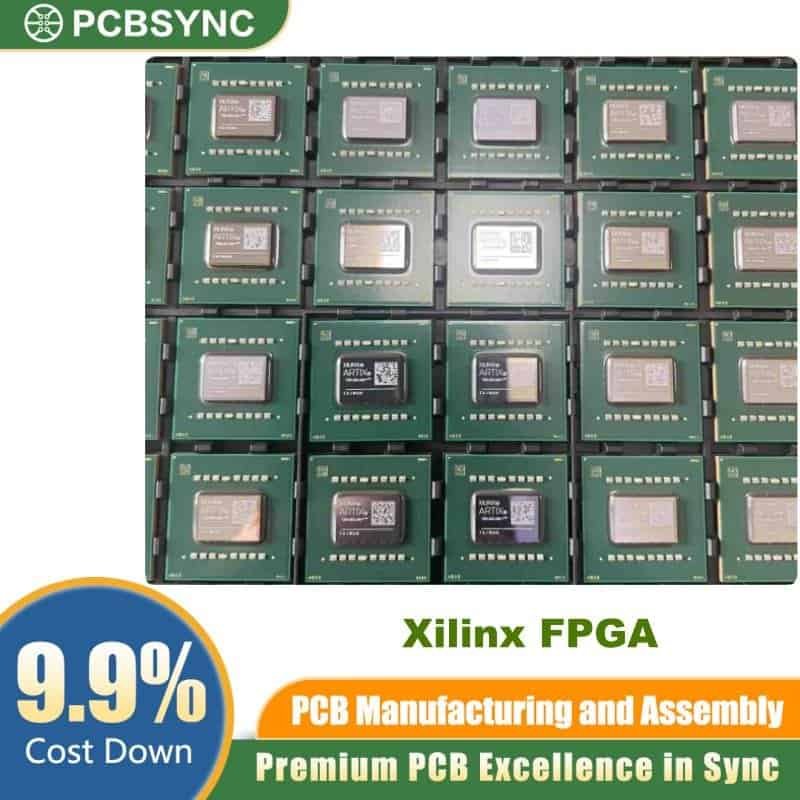
The XC2S200-6FGG838C represents a powerful member of the Xilinx Spartan-II FPGA family, delivering exceptional performance and versatility for demanding digital design applications. This 838-ball Fine-pitch Ball Grid Array (FGG838) packaged device combines 200,000 system gates with 5,292 logic cells, making it an ideal solution for complex embedded systems, telecommunications infrastructure, industrial automation, and advanced control applications.
Built on proven 0.18um CMOS technology with a 2.5V core voltage, the XC2S200-6FGG838C offers designers a cost-effective alternative to traditional ASICs while maintaining the flexibility and reconfigurability that modern applications demand. The -6 speed grade designation ensures optimal performance for high-speed digital processing tasks, supporting system frequencies up to 200 MHz.
Technical Specifications and Key Features
Core Architecture and Logic Resources
| Specification |
Value |
| Logic Cells |
5,292 |
| System Gates |
200,000 |
| CLB Array Configuration |
28 x 42 (1,176 total CLBs) |
| Maximum User I/O |
284 pins |
| Distributed RAM |
75,264 bits |
| Block RAM |
56 Kbits |
| Speed Grade |
-6 (commercial) |
| Core Voltage |
2.5V |
| Process Technology |
0.18μm CMOS |
Package and Environmental Specifications
| Parameter |
Specification |
| Package Type |
FGG838 (Fine-pitch Ball Grid Array) |
| Total Ball Count |
838 balls |
| Operating Temperature |
Commercial (0°C to +85°C) |
| RoHS Compliance |
Lead-free with “G” designation |
| Configuration Options |
Master/Slave Serial, JTAG, Boundary Scan |
XC2S200-6FGG838C Performance Advantages
High-Density Logic Implementation
The XC2S200-6FGG838C provides substantial logic resources through its 1,176 Configurable Logic Blocks arranged in an optimized 28×42 array. Each CLB contains multiple Look-Up Tables (LUTs), flip-flops, and multiplexers, enabling efficient implementation of complex combinatorial and sequential logic functions. This architecture supports sophisticated digital signal processing algorithms, state machines, and custom processing pipelines.
Flexible Memory Architecture
With 75,264 bits of distributed RAM integrated throughout the CLB array and an additional 56 Kbits of dedicated block RAM, the XC2S200-6FGG838C offers versatile memory options for buffering, data storage, and FIFO implementations. The dual-port block RAM structures support simultaneous read/write operations, enhancing data throughput in high-performance applications.
Superior I/O Capabilities
The 838-ball package provides access to 284 user-programmable I/O pins, offering exceptional connectivity options for interfacing with external components, memory devices, communication protocols, and peripheral systems. These I/O blocks support multiple voltage standards and can be configured for various electrical characteristics to match system requirements.
Application Areas for XC2S200-6FGG838C
Industrial Control and Automation
The XC2S200-6FGG838C excels in industrial environments where reliable, deterministic control is essential. Applications include programmable logic controllers (PLCs), motor control systems, robotic controllers, and process automation equipment. The device’s robust architecture and commercial temperature range ensure consistent performance in factory automation scenarios.
Telecommunications and Networking
Network infrastructure benefits from the XC2S200-6FGG838C’s high-speed processing capabilities and abundant I/O resources. Typical applications include protocol converters, network switches, digital cross-connect systems, and telecommunications interface cards. The FPGA’s reconfigurability allows for protocol updates and feature enhancements without hardware modifications.
Embedded System Design
System-on-Chip (SoC) implementations leverage the XC2S200-6FGG838C as a versatile processing platform. The device can implement custom processors, peripheral controllers, memory interfaces, and application-specific accelerators within a single chip. This integration reduces board space, power consumption, and system complexity.
Digital Signal Processing Applications
Signal processing tasks such as filtering, modulation, data compression, and image processing benefit from the XC2S200-6FGG838C’s parallel processing architecture. The combination of distributed RAM, block memory, and configurable logic enables efficient implementation of DSP algorithms with minimal latency.
Design and Development Resources
Software Tools and Development Environment
The XC2S200-6FGG838C is fully supported by Xilinx ISE Design Suite, providing comprehensive tools for design entry, synthesis, implementation, timing analysis, and verification. Designers can work with VHDL, Verilog HDL, or schematic entry methods. The software includes:
- Synthesis tools for optimizing logic utilization
- Place and route algorithms for achieving timing closure
- Static timing analysis for performance verification
- Power analysis and optimization capabilities
- In-system debugging through ChipScope Pro
Configuration and Programming Options
| Configuration Mode |
Description |
Typical Use Case |
| Master Serial |
FPGA controls configuration sequence |
Standalone systems |
| Slave Serial |
External device controls configuration |
Daisy-chain configurations |
| JTAG |
Boundary-scan based programming |
Development and testing |
| SelectMAP |
Parallel configuration interface |
Fast configuration requirements |
IP Cores and Reference Designs
Accelerate development with pre-verified IP cores available for the XC2S200-6FGG838C:
- Communication protocols (UART, SPI, I2C, CAN)
- Memory controllers (SDRAM, DDR, SRAM)
- Video interfaces (VGA, DVI)
- Mathematical functions (FFT, FIR filters)
- Standard peripherals (timers, counters, PWM)
Ordering Information and Part Number Breakdown
Understanding XC2S200-6FGG838C Part Number
| Code |
Meaning |
| XC2S |
Spartan-II FPGA family |
| 200 |
200,000 system gates |
| -6 |
Speed grade (commercial temperature) |
| FGG |
Fine-pitch Ball Grid Array package |
| 838 |
838-ball package |
| C |
Commercial temperature range (0°C to +85°C) |
The “G” designation in the ordering code (XC2S200-6FGGG838C) indicates RoHS-compliant lead-free packaging, meeting modern environmental regulations.
Comparison with Alternative Package Options
| Package Type |
Ball/Pin Count |
PCB Area |
I/O Count |
Best Application |
| FGG838 |
838 |
Large |
284 |
Maximum I/O density |
| PQ208 |
208 |
Medium |
140 |
Moderate I/O needs |
| FG256 |
256 |
Small |
176 |
Space-constrained designs |
The FGG838 package variant offers the highest I/O count in the XC2S200 family, making it optimal for applications requiring extensive connectivity or interfacing with multiple subsystems.
Power Consumption and Thermal Management
Power Supply Requirements
The XC2S200-6FGG838C requires careful power supply design to ensure reliable operation:
- VCCINT (Core Logic): 2.5V ±5%
- VCCO (I/O Banks): 1.5V to 3.3V (depending on I/O standards)
- VCCAUX (Auxiliary): 2.5V ±5%
Total power consumption varies based on design complexity, toggle rates, and I/O activity. Typical static power consumption ranges from 50-150mW, while dynamic power depends heavily on the implemented design.
Thermal Considerations
The 838-ball package provides enhanced thermal performance through its large footprint and numerous ground balls. Proper PCB design with adequate ground planes and thermal vias ensures effective heat dissipation. For high-utilization designs, consider:
- Copper ground planes for heat spreading
- Thermal vias connecting to internal layers
- Adequate airflow in the system enclosure
- Heat sinks for extreme conditions
Quality and Reliability Standards
Manufacturing and Testing
Every XC2S200-6FGG838C undergoes rigorous testing to ensure quality and reliability:
- 100% functional testing at speed
- Thermal cycling for temperature stability
- Static discharge protection verification
- Long-term reliability qualification
Industry Compliance
The device meets or exceeds multiple industry standards:
- RoHS compliant (lead-free manufacturing)
- REACH regulation compliance
- Standard export classifications (ECCN)
- Quality management system: ISO 9001
Getting Started with XC2S200-6FGG838C
Recommended Development Flow
- Requirements Analysis: Define system specifications, I/O requirements, and performance targets
- Architecture Design: Partition functionality, identify IP cores, plan memory usage
- RTL Coding: Implement design using VHDL or Verilog
- Simulation: Verify functional correctness using testbenches
- Synthesis: Convert RTL to gate-level netlist
- Implementation: Place and route design onto FPGA fabric
- Timing Analysis: Verify timing constraints are met
- Configuration: Program device and validate operation
Evaluation and Prototyping
While dedicated evaluation boards for the FGG838 package may be limited due to its specialized nature, designers can leverage similar Spartan-II devices for initial prototyping and concept validation. Custom carrier boards can be designed for production applications using standard PCB design tools and the comprehensive package specifications provided in Xilinx documentation.
Why Choose XC2S200-6FGG838C for Your Design?
Cost-Effective ASIC Alternative
The XC2S200-6FGG838C eliminates the high non-recurring engineering (NRE) costs, lengthy development cycles, and financial risks associated with custom ASIC development. Field programmability allows design refinements and feature updates throughout the product lifecycle.
Design Security and IP Protection
Built-in security features protect intellectual property:
- Bitstream encryption prevents unauthorized copying
- Readback protection secures proprietary designs
- Unique device identifiers for authentication
Long-Term Availability
As part of the established Spartan-II family, the XC2S200-6FGG838C benefits from Xilinx’s commitment to long product lifecycles, typically extending 15+ years from introduction. This longevity supports products in industrial, medical, and aerospace applications where extended availability is critical.
Comprehensive Ecosystem
The XC2S200-6FGG838C is supported by an extensive ecosystem including:
- Active user community and forums
- Third-party IP vendors
- Design service partners
- Application notes and reference designs
- Training materials and webinars
Where to Buy XC2S200-6FGG838C
The XC2S200-6FGG838C is available through authorized distributors worldwide, offering various purchasing options from single-unit prototyping quantities to volume production orders. When sourcing components, verify:
- Authorized distributor status
- Date code and lot traceability
- RoHS compliance documentation
- Warranty and return policies
For comprehensive information about Xilinx FPGA products, technical documentation, and design resources, consult authorized distributors and the official AMD-Xilinx documentation repository.
Technical Support and Documentation
Available Resources
- Complete device datasheet (DS001)
- Packaging and pinout specifications (UG175)
- Configuration guide
- Power estimation spreadsheets
- Thermal design guidelines
- PCB design recommendations
Design Assistance
Technical support is available through:
- Authorized distributor FAE teams
- Online knowledge base
- Community forums
- Application engineering support
Conclusion: XC2S200-6FGG838C for Next-Generation Designs
The XC2S200-6FGG838C delivers an exceptional balance of logic resources, I/O capability, and cost-effectiveness for demanding FPGA applications. With 200,000 system gates, 284 user I/Os, and comprehensive development tool support, this device empowers engineers to create sophisticated digital systems across industrial, telecommunications, and embedded computing domains.
The 838-ball FGG package provides maximum connectivity density, making the XC2S200-6FGG838C ideal for complex systems requiring extensive interfacing capabilities. Combined with the proven Spartan-II architecture, robust development tools, and long-term product availability, this FPGA represents a strategic choice for both new designs and ongoing production requirements.
Whether implementing high-speed data processing, complex control algorithms, or custom communication protocols, the XC2S200-6FGG838C offers the performance, flexibility, and reliability needed to succeed in today’s competitive electronics market.