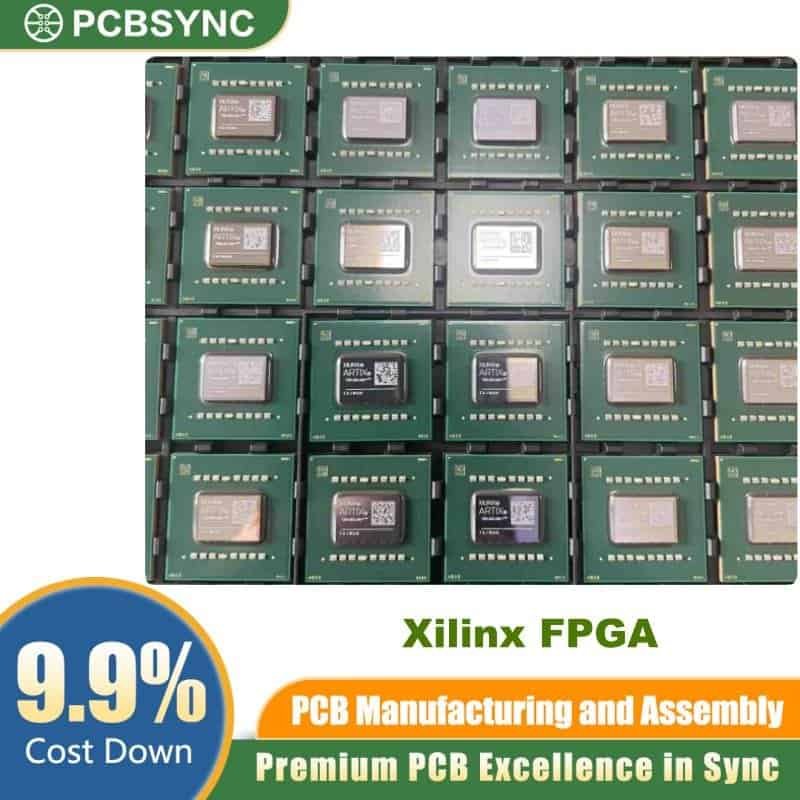
The XC2S200-6FGG691C is a high-density Field Programmable Gate Array (FPGA) from the renowned Xilinx Spartan-II family. This advanced programmable logic device delivers exceptional performance with 200,000 system gates, making it an ideal solution for complex digital design applications requiring robust processing capabilities and extensive I/O resources.
XC2S200-6FGG691C Key Features and Specifications
The XC2S200-6FGG691C combines cutting-edge 0.18-micron CMOS technology with a versatile architecture designed for demanding embedded systems, telecommunications equipment, industrial automation, and consumer electronics applications.
Core Logic Specifications
| Parameter |
Value |
| Device Family |
Spartan-II |
| System Gates |
200,000 |
| Logic Cells |
5,292 |
| CLB Array |
28 × 42 (1,176 CLBs) |
| Maximum User I/O |
284+ |
| Speed Grade |
-6 (High Performance) |
| Package Type |
FGG691 (Fine Pitch BGA) |
| Pin Count |
691 |
| Operating Voltage |
2.5V Core |
Memory Architecture of the XC2S200-6FGG691C
This Xilinx FPGA features a comprehensive SelectRAM hierarchical memory system that provides designers with flexible storage options for various application requirements.
Block RAM Configuration
The XC2S200-6FGG691C incorporates 14 dedicated block RAM modules totaling 56 Kbits of synchronous dual-port memory. Each 4,096-bit block RAM cell offers independent control signals for both ports, enabling simultaneous read and write operations with configurable data widths.
| Aspect Ratio |
Address Bus |
Data Bus |
| 4096 × 1 |
ADDR[11:0] |
DATA[0] |
| 2048 × 2 |
ADDR[10:0] |
DATA[1:0] |
| 1024 × 4 |
ADDR[9:0] |
DATA[3:0] |
| 512 × 8 |
ADDR[8:0] |
DATA[7:0] |
| 256 × 16 |
ADDR[7:0] |
DATA[15:0] |
Distributed RAM Capabilities
Beyond block RAM, the XC2S200-6FGG691C provides 75,264 bits of distributed RAM implemented within Look-Up Tables (LUTs). This distributed memory architecture enables 16-bit shift registers and flexible RAM configurations ideal for high-speed data capture and digital signal processing applications.
XC2S200-6FGG691C Programmable I/O Standards
The XC2S200-6FGG691C supports 16 high-performance I/O standards, ensuring compatibility with modern interface requirements across diverse applications.
Supported Interface Standards
| I/O Standard |
VREF (V) |
VCCO (V) |
VTT (V) |
| LVTTL (2-24mA) |
N/A |
3.3 |
N/A |
| LVCMOS2 |
N/A |
2.5 |
N/A |
| PCI 3.3V/5V |
N/A |
3.3 |
N/A |
| GTL |
0.8 |
N/A |
1.2 |
| GTL+ |
1.0 |
N/A |
1.5 |
| HSTL Class I |
0.75 |
1.5 |
0.75 |
| HSTL Class III/IV |
0.9 |
1.5 |
1.5 |
| SSTL3 Class I/II |
1.5 |
3.3 |
1.5 |
| SSTL2 Class I/II |
1.25 |
2.5 |
1.25 |
| CTT |
1.5 |
3.3 |
1.5 |
| AGP-2X |
1.32 |
3.3 |
N/A |
Clock Management Features
Delay-Locked Loop (DLL) Technology
The XC2S200-6FGG691C integrates four fully digital Delay-Locked Loops positioned at each corner of the die. These DLLs provide zero-propagation delay clock distribution with minimal skew across the entire device.
DLL Capabilities
- System clock rates up to 200 MHz
- Clock multiplication (2×)
- Clock division (1.5, 2, 2.5, 3, 4, 5, 8, or 16)
- Quadrature phase generation (0°, 90°, 180°, 270°)
- Board-level clock deskewing
- Automatic delay compensation
Global Clock Distribution Network
Four dedicated primary global clock nets ensure high-fanout clock signals reach all CLB, IOB, and block RAM clock pins with minimal skew. The secondary global routing provides 24 backbone lines for additional clock domain management flexibility.
XC2S200-6FGG691C Configuration Options
The XC2S200-6FGG691C supports multiple configuration modes for maximum design flexibility during system development and field deployment.
Configuration Modes
| Mode |
CCLK Direction |
Data Width |
Description |
| Master Serial |
Output |
1-bit |
FPGA drives configuration PROM |
| Slave Serial |
Input |
1-bit |
External controller provides data |
| Slave Parallel |
Input |
8-bit |
Fastest configuration option |
| Boundary Scan |
N/A |
1-bit |
JTAG-based configuration |
Configuration Storage Requirements
The XC2S200-6FGG691C requires 1,335,840 bits of configuration data, enabling storage in standard serial PROMs, parallel flash memory, or system processors for flexible deployment scenarios.
IEEE 1149.1 Boundary Scan Compliance
Full JTAG boundary scan support facilitates board-level testing and in-system debugging. The Test Access Port (TAP) implements all mandatory IEEE 1149.1 instructions including EXTEST, SAMPLE/PRELOAD, and BYPASS, plus additional instructions for configuration and readback operations.
FGG691 Package Specifications
The 691-pin Fine Pitch Ball Grid Array package provides excellent signal integrity and thermal performance for high-density applications.
Package Characteristics
| Parameter |
Specification |
| Package Type |
Fine Pitch BGA (FGG691) |
| Total Pins |
691 |
| Ball Pitch |
1.0mm |
| Temperature Range |
Commercial (0°C to +85°C) |
| Pb-Free Option |
Available (designated by “G” suffix) |
| RoHS Compliance |
Available |
XC2S200-6FGG691C Ordering Information
Part Number Breakdown
XC2S200-6FGG691C
- XC2S200: Device type (Spartan-II, 200K gates)
- -6: Speed grade (higher performance)
- FG: Fine pitch BGA package
- G: Pb-free packaging option
- 691: Pin count
- C: Commercial temperature range
Target Applications for XC2S200-6FGG691C
The XC2S200-6FGG691C excels in applications requiring high logic density, flexible memory architecture, and robust I/O capabilities.
Industrial and Commercial Applications
- Telecommunications infrastructure equipment
- Networking routers and switches
- Industrial automation and control systems
- Medical imaging equipment
- Video processing and display systems
- Automotive infotainment systems
- Test and measurement instrumentation
- Aerospace and defense systems
Design Tool Support
The XC2S200-6FGG691C is fully supported by the Xilinx ISE Development System, providing comprehensive design entry, implementation, and verification capabilities.
Development Features
- Automatic mapping, placement, and routing
- Timing-driven implementation
- HDL synthesis support
- Comprehensive simulation tools
- In-circuit debugging with readback capability
- Over 400 library primitives and macros
XC2S200-6FGG691C vs ASIC Alternative
The XC2S200-6FGG691C offers significant advantages over mask-programmed ASICs for high-volume applications.
FPGA Advantages
| Benefit |
Description |
| Zero NRE Costs |
No initial tooling or mask charges |
| Rapid Prototyping |
Immediate design verification |
| Field Upgradability |
In-system reprogrammability |
| Risk Mitigation |
Avoid lengthy ASIC development cycles |
| Time-to-Market |
Shortened product development |
Technical Documentation and Support
Comprehensive technical resources are available for the XC2S200-6FGG691C including detailed datasheets, application notes, reference designs, and development board documentation to accelerate your design process.