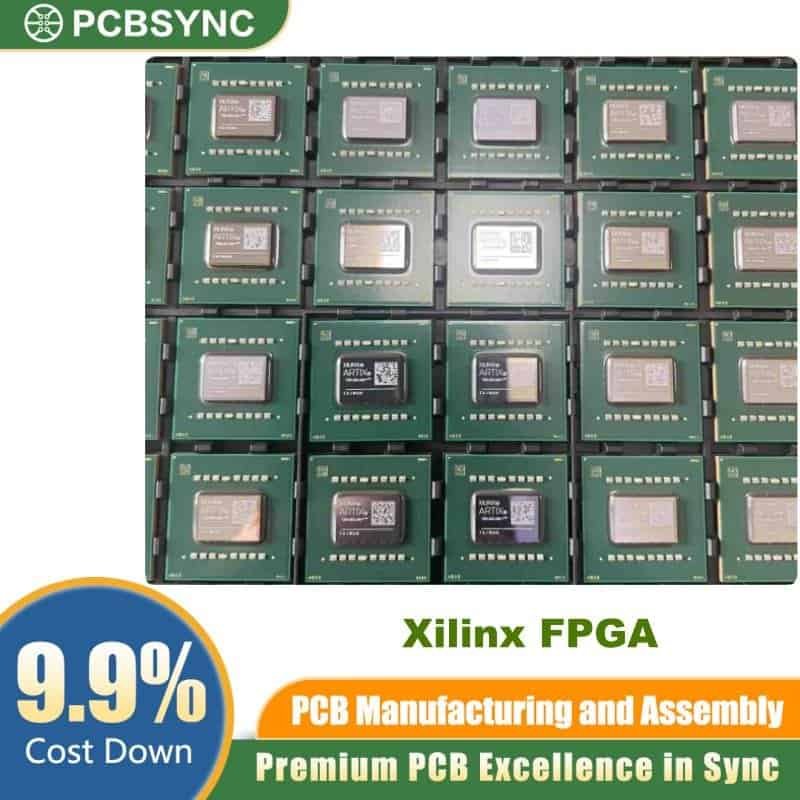
The XC2S200-6FGG1388C belongs to the renowned Spartan-II series, which revolutionized the industry by offering a high-performance FPGA architecture at an affordable price point. This specific model is engineered to provide a bridge between complex PLDs and high-end FPGAs, offering 200,000 system gates and a robust logic fabric.
Whether you are working on legacy system maintenance or specific industrial control interfaces, understanding the capabilities of the XC2S200-6FGG1388C is essential for optimal hardware design.
Key Features of the XC2S200-6FGG1388C
The Spartan-II architecture is built on a 0.22µm/0.18µm CMOS process, delivering high density and low power consumption. Below are the primary features of the XC2S200-6FGG1388C:
-
High Logic Capacity: With 5,292 logic cells and 200,000 system gates, it handles complex digital logic with ease.
-
Flexible I/O Standards: Supports multiple I/O signaling standards including LVTTL, LVCMOS, PCI, and more.
-
Integrated RAM: Features dedicated block RAM (56,320 bits) and distributed RAM (75,264 bits) for efficient data buffering.
-
Advanced Clock Management: Includes four dedicated Delay-Locked Loops (DLLs) for precise clock mirroring and skew elimination.
-
Versatile Packaging: The FGG1388 package provides an extensive number of user I/Os for complex connectivity requirements.
XC2S200-6FGG1388C Technical Specifications
To assist engineers in the selection process, the following table outlines the core electrical and physical parameters of the XC2S200-6FGG1388C.
Table 1: Core Performance Parameters
| Parameter |
Specification |
| Logic Cells |
5,292 |
| System Gates |
200,000 |
| CLB Array (Rows x Cols) |
28 x 42 |
| Distributed RAM Bits |
75,264 |
| Block RAM Bits |
56,320 (14 Blocks) |
| Max User I/O |
Up to 284 (Package Dependent) |
| Core Voltage ($V_{CCINT}$) |
2.5V |
| Speed Grade |
-6 |
| Operating Temperature |
$0^\circ\text{C}$ to $+85^\circ\text{C}$ (Commercial) |
Table 2: Supported I/O Standards
| I/O Standard |
Description |
| LVTTL / LVCMOS2 |
General purpose 3.3V/2.5V logic |
| PCI 33MHz / 66MHz |
Standard Peripheral Component Interconnect |
| GTL / GTLP |
Gunning Transceiver Logic |
| SSTL3 / SSTL2 |
Stub Series Terminated Logic |
| HSTL |
High-Speed Transceiver Logic |
Architectural Deep Dive: Logic and Memory
The XC2S200-6FGG1388C utilizes a Configurable Logic Block (CLB) structure that allows for high-speed arithmetic and versatile logic functions. Each CLB contains two slices, providing four 4-input Look-Up Tables (LUTs) and four flip-flops.
Furthermore, the inclusion of dedicated Block RAM makes this FPGA ideal for implementing FIFOs, dual-port buffers, and small ROM/RAM structures without consuming valuable logic resources. If you are looking for more options in this category, check out the Xilinx FPGA product list.
Why Choose the Spartan-II Family?
-
Cost Efficiency: Specifically designed to lower the barrier of entry for FPGA technology in consumer electronics.
-
Ease of Use: Fully supported by Xilinx ISE design tools, allowing for streamlined VHDL or Verilog implementation.
-
Reliability: Long-term availability makes it a stable choice for industrial and telecommunications infrastructure.
Typical Applications for XC2S200-6FGG1388C
Due to its balanced gate count and high I/O flexibility, the XC2S200-6FGG1388C is frequently used in the following sectors:
-
Industrial Automation: Handling motor control logic, sensor fusion, and PLC communication interfaces.
-
Telecommunications: Implementing protocol converters, data framing, and high-speed switching logic.
-
Consumer Electronics: Providing the processing power for digital video interfaces and audio processing units.
-
Legacy System Upgrades: Serving as a reliable replacement for older ASIC or CPLD designs in existing hardware stacks.
Conclusion
The XC2S200-6FGG1388C remains a vital component for developers needing a reliable, 2.5V FPGA solution with a proven track record. Its combination of 200K system gates, versatile I/O, and robust clock management ensures it can meet the demands of modern digital design while maintaining cost-effectiveness.
For developers seeking precise timing and high-speed logic within the Spartan-II ecosystem, this part provides the necessary performance overhead to ensure project success.