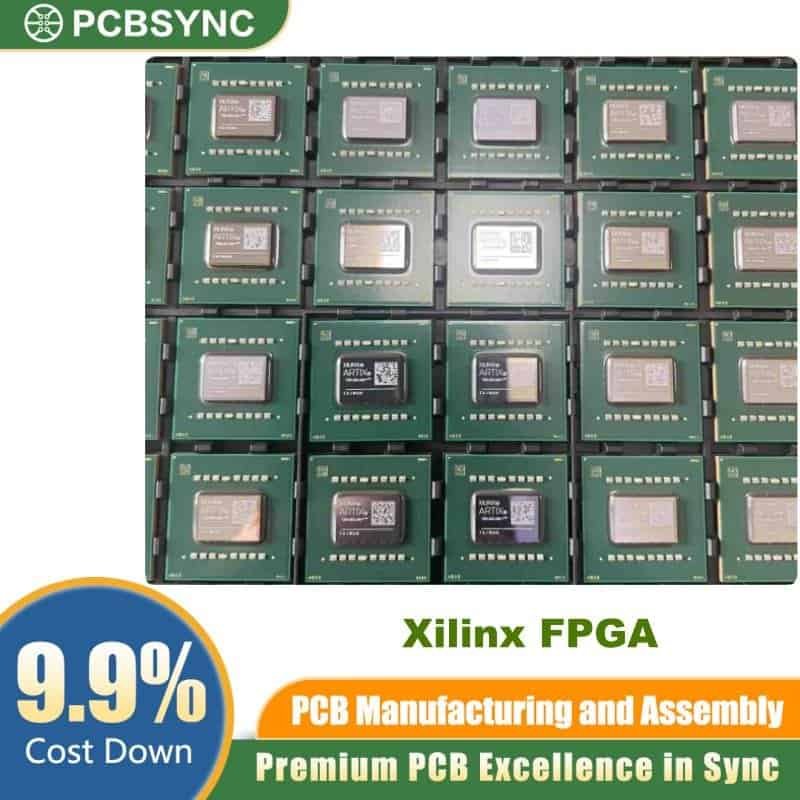
The XC2S200-6FGG1315C is a high-performance Field-Programmable Gate Array (FPGA) from the Xilinx Spartan-II family, engineered for demanding digital design applications that require abundant logic resources, flexible I/O, and cost-effective programmability. With 200,000 system gates, 5,292 logic cells, and the large-format 1315-ball Fine-Pitch BGA (FBGA) package, this component is a go-to choice for engineers in telecommunications, industrial automation, embedded systems, and digital signal processing.
This guide covers everything you need to know about the XC2S200-6FGG1315C — from core technical specifications and key features to application use cases, ordering information, and frequently asked questions.
What Is the XC2S200-6FGG1315C? – Spartan-II FPGA Overview
The XC2S200-6FGG1315C belongs to Xilinx’s Spartan-II FPGA family, a product line designed to deliver high system performance at an exceptionally low price point. The Spartan-II series was built as a cost-optimized alternative to mask-programmed ASICs, offering the critical advantage of in-field reprogrammability — something traditional ASICs cannot provide.
The part number breaks down as follows:
| Part Number Segment |
Meaning |
| XC2S200 |
Spartan-II device with 200K system gates |
| -6 |
Speed grade (-6 is the fastest available, commercial range only) |
| FGG |
Fine-Pitch Ball Grid Array package (Pb-free “G” variant) |
| 1315 |
1315-ball package pin count |
| C |
Commercial temperature range (0°C to +85°C) |
As a Pb-free (lead-free) component, the FGG designation (with the extra “G”) confirms compliance with RoHS-conscious manufacturing, making it suitable for environmentally regulated markets and modern supply chain requirements.
XC2S200-6FGG1315C Key Technical Specifications
Core Logic & Memory Resources
| Parameter |
XC2S200 Value |
| System Gates |
200,000 |
| Logic Cells |
5,292 |
| CLB Array |
28 × 42 |
| Total CLBs |
1,176 |
| Distributed RAM (bits) |
75,264 |
| Block RAM (bits) |
56K (56,000 bits) |
| Maximum User I/O |
284 |
Device & Package Details
| Parameter |
Specification |
| Manufacturer |
Xilinx (AMD) |
| Device Family |
Spartan-II |
| Part Number |
XC2S200-6FGG1315C |
| Package Type |
Fine-Pitch BGA (FBGA) |
| Pin Count |
1315 balls |
| Speed Grade |
-6 (fastest commercial grade) |
| Operating Voltage (VCCINT) |
2.5V |
| Technology Node |
0.18 µm |
| Maximum System Clock |
Up to 200 MHz |
| Temperature Range |
Commercial: 0°C to +85°C |
| RoHS Compliance |
Yes (Pb-free “G” package) |
Configuration Modes
| Configuration Mode |
M0 |
M1 |
M2 |
CCLK Direction |
Data Width |
| Master Serial |
0 |
0 |
0 |
Output |
1-bit |
| Slave Parallel |
0 |
1 |
0 |
Input |
8-bit |
| Boundary-Scan |
1 |
0 |
0 |
N/A |
1-bit |
| Slave Serial |
1 |
1 |
0 |
Input |
1-bit |
XC2S200-6FGG1315C Key Features & Advantages
#### High-Density Programmable Logic Architecture
The XC2S200-6FGG1315C uses Xilinx’s proven Configurable Logic Block (CLB) architecture. Each CLB contains four slices, with each slice holding two 4-input Look-Up Tables (LUTs) and two flip-flops. This structure delivers highly efficient logic packing for complex combinatorial and sequential circuits.
#### Delay-Locked Loop (DLL) Clock Management
The device integrates four Delay-Locked Loops (DLLs) — one at each corner of the die — enabling precise clock distribution, phase alignment, and frequency synthesis. DLLs are essential for high-speed synchronous designs, eliminating clock skew across the device fabric.
#### Dual Block RAM Columns
Two columns of dedicated Block RAM are embedded on opposite sides of the die, offering 56Kb of true dual-port synchronous memory. This on-chip memory is ideal for FIFOs, look-up tables, and data buffering without consuming CLB resources.
#### Flexible, Multi-Standard I/O
The 1315-ball package provides up to 284 user-configurable I/O pins, supporting multiple I/O standards including LVTTL, LVCMOS, PCI, GTL, HSTL, SSTL, and AGP. Each I/O bank can be independently powered, enabling mixed-voltage board designs.
#### Speed Grade -6: Maximum Commercial Performance
The -6 speed grade is the highest available for the Spartan-II family and is exclusively offered in the Commercial temperature range. It delivers the lowest propagation delays and highest system clock speeds — up to 200 MHz — making the XC2S200-6FGG1315C the optimal choice when performance is the top priority.
#### In-System Reprogrammability
Unlike ASICs, the XC2S200-6FGG1315C can be reconfigured as many times as needed, enabling post-deployment design updates, bug fixes, and feature enhancements without any hardware replacement.
XC2S200-6FGG1315C vs. Other XC2S200 Package Variants
Engineers selecting the XC2S200 often need to choose between package options. The table below compares the most common variants:
| Part Number |
Package |
Pin Count |
Pb-Free |
Speed Grade |
Temp Range |
| XC2S200-6FGG1315C |
Fine-Pitch BGA |
1315 |
Yes |
-6 |
Commercial |
| XC2S200-6FG256C |
Fine-Pitch BGA |
256 |
No |
-6 |
Commercial |
| XC2S200-5FGG256C |
Fine-Pitch BGA |
256 |
Yes |
-5 |
Commercial |
| XC2S200-5FG456C |
Fine-Pitch BGA |
456 |
No |
-5 |
Commercial |
| XC2S200-6PQ208C |
PQFP |
208 |
No |
-6 |
Commercial |
The FGG1315 package offers the highest pin count in the XC2S200 lineup, making it the preferred option for designs requiring the maximum number of I/O connections in a fine-pitch BGA footprint.
Spartan-II Family Comparison: Where Does XC2S200 Stand?
| Device |
Logic Cells |
System Gates |
CLB Array |
Max User I/O |
Distributed RAM |
Block RAM |
| XC2S15 |
432 |
15,000 |
8×12 |
86 |
6,144 bits |
16K |
| XC2S30 |
972 |
30,000 |
12×18 |
92 |
13,824 bits |
24K |
| XC2S50 |
1,728 |
50,000 |
16×24 |
176 |
24,576 bits |
32K |
| XC2S100 |
2,700 |
100,000 |
20×30 |
176 |
38,400 bits |
40K |
| XC2S150 |
3,888 |
150,000 |
24×36 |
260 |
55,296 bits |
48K |
| XC2S200 |
5,292 |
200,000 |
28×42 |
284 |
75,264 bits |
56K |
The XC2S200 is the largest and most capable device in the Spartan-II family, offering the highest logic density, most I/O, and maximum embedded memory, making it the flagship choice for the most complex designs within this product generation.
Common Applications of the XC2S200-6FGG1315C FPGA
The XC2S200-6FGG1315C’s combination of logic density, memory, and high pin count makes it suitable for a broad spectrum of industries and applications:
#### Telecommunications & Networking
Protocol bridging, packet processing, line-card control, and interface conversion between standards such as PCI, LVDS, and SSTL all benefit from the device’s flexible I/O banks and high-speed clock management.
#### Industrial Automation & Control
Motor control, sensor fusion, real-time control loops, and machine vision preprocessing leverage the deterministic timing and reconfigurability of FPGA-based designs.
#### Digital Signal Processing (DSP)
Audio, video, and communications signal chains that require custom FIR filters, FFT engines, or encoding/decoding pipelines can be efficiently mapped onto the XC2S200’s CLB and Block RAM architecture.
#### Embedded Systems & SoC Prototyping
The device is well-suited for prototyping custom processor peripherals, memory controllers, and bus interfaces ahead of ASIC tape-out, reducing development risk and iteration time.
#### Test & Measurement Equipment
Its reconfigurability makes the XC2S200-6FGG1315C ideal for logic analyzers, protocol analyzers, and custom stimulus generation hardware where frequent design updates are needed.
Design & Development Tools for XC2S200-6FGG1315C
The XC2S200-6FGG1315C is supported by Xilinx’s ISE Design Suite (the primary tool for Spartan-II devices). Key tools in the design flow include:
| Tool |
Purpose |
| ISE Project Navigator |
Top-level design entry and synthesis management |
| XST (Xilinx Synthesis Technology) |
RTL synthesis from VHDL/Verilog |
| Place & Route (PAR) |
Physical implementation and timing optimization |
| iMPACT |
Device programming and configuration via JTAG |
| ChipScope Pro |
On-chip debugging and signal probing |
| ModelSim / ISIM |
Behavioral and post-synthesis simulation |
Note: While Xilinx’s newer Vivado Design Suite is available, it does not support the legacy Spartan-II architecture. ISE Design Suite remains the correct tool chain for XC2S200 devices.
Ordering Information & Part Marking Guide
When sourcing the XC2S200-6FGG1315C, verify the following markings on the physical component to ensure authenticity:
| Marking Field |
Example |
| Device Type |
XC2S200 |
| Package |
FGG1315 |
| Speed Grade |
-6 |
| Temperature Range |
C (Commercial) |
| Lot Code |
Printed on package |
| Date Code |
YYWW format (Year/Week) |
The “G” in “FGG” confirms the Pb-free package option. Always verify that the complete part number — XC2S200-6FGG1315C — matches exactly when ordering to avoid receiving non-Pb-free or different speed grade variants.
Why Choose the XC2S200-6FGG1315C Over an ASIC?
| Comparison Point |
XC2S200-6FGG1315C FPGA |
Custom ASIC |
| NRE (Non-Recurring Engineering) Cost |
None |
Very high ($500K–$5M+) |
| Time to First Silicon |
Immediate (off-the-shelf) |
6–18 months |
| Design Update After Deployment |
Yes – fully reconfigurable |
No – hardware replacement required |
| Volume Price Sensitivity |
Higher per-unit cost at scale |
Lower per-unit cost at high volume |
| Risk of Design Error |
Low – correctable in field |
High – costly re-spin |
| I/O Flexibility |
High – multi-standard support |
Fixed at tape-out |
For low-to-medium volume production and any application requiring post-deployment flexibility, the XC2S200-6FGG1315C consistently outperforms the ASIC route on total program cost and schedule risk.
Frequently Asked Questions (FAQ)
What is the maximum operating frequency of the XC2S200-6FGG1315C?
System performance is supported up to 200 MHz with the -6 speed grade, which is the fastest commercially available speed grade for the Spartan-II XC2S200 device.
Is the XC2S200-6FGG1315C RoHS compliant?
Yes. The “G” suffix in the FGG package designation confirms it is a Pb-free (lead-free) package, compliant with RoHS environmental directives.
What temperature range does the XC2S200-6FGG1315C support?
The “C” suffix designates the Commercial temperature range: 0°C to +85°C. For industrial temperature range requirements (–40°C to +85°C), look for the “I” suffix variant. Note that the -6 speed grade is only available in the commercial range.
Can the XC2S200-6FGG1315C be programmed in-system?
Yes. The device supports JTAG Boundary-Scan (IEEE 1149.1) configuration, enabling in-system programming (ISP) and debugging without removing the component from the board.
What is the supply voltage for the XC2S200-6FGG1315C?
The internal core voltage (VCCINT) is 2.5V. I/O bank voltages (VCCO) are configurable independently to support multiple I/O standards.
What configuration memory is required?
The XC2S200 is SRAM-based and must be configured on every power-up. External configuration PROMs (such as Xilinx XC18V series) or a microcontroller/processor can be used to store and load the bitstream.
Where to Buy the XC2S200-6FGG1315C
The XC2S200-6FGG1315C is available through authorized distributors and specialty electronic component suppliers. When purchasing, confirm the full part number, lot traceability, and authenticity documentation.
For a comprehensive selection of Xilinx programmable logic solutions, visit Xilinx FPGA to explore product options, cross-reference alternatives, and request quotes.
Summary: Is the XC2S200-6FGG1315C Right for Your Design?
The XC2S200-6FGG1315C is an excellent choice if your design requires:
- Maximum I/O density in a fine-pitch BGA footprint (1315 balls, up to 284 user I/Os)
- Top-tier commercial performance with the -6 speed grade and up to 200 MHz system clock
- Generous on-chip memory — 75,264 bits of distributed RAM and 56K of Block RAM
- Pb-free, RoHS-compliant packaging for regulated markets
- Full Spartan-II logic capacity at 200,000 system gates and 5,292 logic cells
Its programmability, field-upgradability, and rich feature set make the XC2S200-6FGG1315C a proven, dependable component for engineers who need performance and design flexibility without the cost and risk of ASIC development.