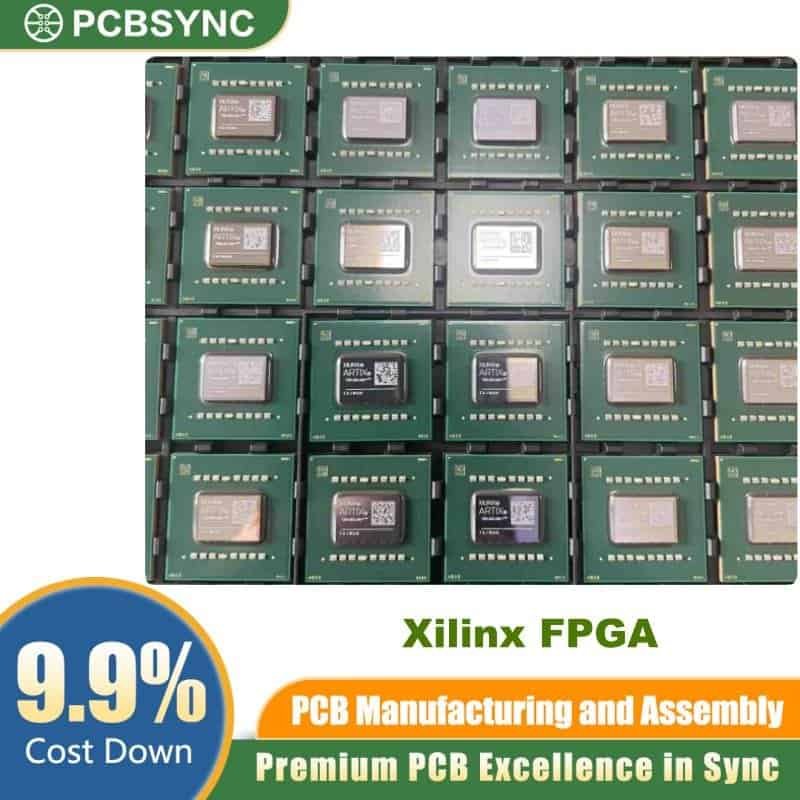
The XC2S200-6FGG1311C is a high-performance Field-Programmable Gate Array (FPGA) from Xilinx’s Spartan-II family. Designed for commercial-grade applications that demand programmable logic flexibility, this device delivers 200,000 system gates, 5,292 logic cells, and a generous 1,311-pin Fine-Pitch Ball Grid Array (FBGA) package — making it one of the most I/O-rich variants of the XC2S200 silicon. Whether you are designing embedded systems, digital signal processing (DSP) pipelines, or custom communication interfaces, the XC2S200-6FGG1311C provides the scalable, reconfigurable platform you need.
For a broader look at the Spartan-II product line and compatible Xilinx parts, visit Xilinx FPGA.
What Is the XC2S200-6FGG1311C? Key Part Number Breakdown
Understanding the part number is the first step to confirming you have the right component for your design. The XC2S200-6FGG1311C encodes a full set of device attributes:
| Field |
Value |
Meaning |
| XC2S |
XC2S |
Xilinx Spartan-II Family |
| 200 |
200 |
200,000 System Gates |
| -6 |
Speed Grade 6 |
Fastest available speed grade |
| FGG |
FGG |
Fine-Pitch Ball Grid Array (Pb-Free) |
| 1311 |
1311 |
1,311-Pin Package |
| C |
C |
Commercial Temperature Range (0°C to +85°C) |
Note: The “-6” speed grade is exclusively available in the Commercial temperature range for the Spartan-II family. The “G” in “FGG” indicates Pb-free (RoHS-compliant) packaging.
XC2S200-6FGG1311C Core Specifications
Logic and Memory Resources
The XC2S200 is the flagship device of the Spartan-II family. It offers the largest logic footprint in the series, with the following programmable resources:
| Parameter |
XC2S200 Value |
| System Gates |
200,000 |
| Logic Cells |
5,292 |
| CLB Array |
28 × 42 |
| Total CLBs |
1,176 |
| Distributed RAM |
75,264 bits |
| Block RAM |
56K bits (56,000 bits) |
| Delay-Locked Loops (DLLs) |
4 |
I/O and Package Details
| Parameter |
Value |
| Package Type |
Fine-Pitch Ball Grid Array (FBGA) |
| Package Code |
FGG |
| Total Package Pins |
1,311 |
| Maximum User I/O |
Up to 284 (device limit) |
| Supply Voltage (VCCINT) |
2.5V |
| Technology Node |
0.18µm CMOS |
Timing and Performance
| Parameter |
Value |
| Speed Grade |
-6 (fastest for XC2S200) |
| System Clock Performance |
Up to 200 MHz |
| Maximum Internal Clock |
263 MHz |
| Temperature Range |
Commercial: 0°C to +85°C |
XC2S200-6FGG1311C Architecture Overview
Configurable Logic Blocks (CLBs)
The Spartan-II architecture is built around a regular, flexible array of Configurable Logic Blocks (CLBs). The XC2S200 arranges these in a 28 × 42 grid for a total of 1,176 CLBs. Each CLB contains:
- Two slices, each with two Look-Up Tables (LUTs) and two flip-flops
- Support for logic functions, arithmetic operations, and distributed RAM
- Fast carry and borrow logic for efficient arithmetic design
Input/Output Blocks (IOBs)
Surrounding the CLB array is a perimeter of programmable Input/Output Blocks (IOBs). These support a wide range of I/O standards and offer:
- Programmable drive strength and slew rate control
- Input delay elements for setup time management
- Support for LVTTL, LVCMOS, PCI, GTL, HSTL, and SSTL interfaces
- 5V-tolerant capability with external series resistors
Block RAM
The XC2S200 integrates 56K bits of block RAM organized in two columns on opposite sides of the die. This dedicated memory supports true dual-port operation, making it highly efficient for FIFO buffers, look-up tables, and local data storage in embedded designs.
Delay-Locked Loops (DLLs)
Four Delay-Locked Loops, one at each corner of the die, provide:
- Clock deskewing across the device
- Clock frequency multiplication and division
- Phase shifting for interface timing alignment
- Reduced clock-to-output propagation delays
Spartan-II Family Comparison: Where Does the XC2S200 Stand?
The XC2S200 is the largest and most capable device in the Spartan-II family. The table below compares all family members to help you evaluate whether the XC2S200-6FGG1311C is the right fit — or if a smaller device would suffice.
| Device |
Logic Cells |
System Gates |
CLB Array |
Total CLBs |
Max User I/O |
Distributed RAM |
Block RAM |
| XC2S15 |
432 |
15,000 |
8 × 12 |
96 |
86 |
6,144 bits |
16K |
| XC2S30 |
972 |
30,000 |
12 × 18 |
216 |
92 |
13,824 bits |
24K |
| XC2S50 |
1,728 |
50,000 |
16 × 24 |
384 |
176 |
24,576 bits |
32K |
| XC2S100 |
2,700 |
100,000 |
20 × 30 |
600 |
176 |
38,400 bits |
40K |
| XC2S150 |
3,888 |
150,000 |
24 × 36 |
864 |
260 |
55,296 bits |
48K |
| XC2S200 |
5,292 |
200,000 |
28 × 42 |
1,176 |
284 |
75,264 bits |
56K |
The XC2S200 offers the largest logic resources, the most distributed RAM, and the highest block RAM of any Spartan-II device — making it the natural choice for demanding applications.
Key Features of the XC2S200-6FGG1311C
#### High-Density Programmable Logic
With 5,292 logic cells and 200,000 equivalent system gates, the XC2S200-6FGG1311C handles complex digital designs including multi-stage pipelines, state machines, bus interface controllers, and signal processing algorithms — all within a single reconfigurable device.
#### -6 Speed Grade: Maximum Performance
The “-6” designation is the fastest speed grade offered in the XC2S200 commercial range. It delivers maximum internal clock speeds up to 263 MHz and system performance of up to 200 MHz, ensuring your timing-critical applications meet their performance targets.
#### Pb-Free FGG Package
The “FGG” package designation confirms this device uses a Pb-free Fine-Pitch Ball Grid Array, meaning it is RoHS-compliant and suitable for modern production environments with strict environmental requirements.
#### 1,311-Pin High I/O Density
The FGG1311 package provides an exceptionally high pin count, offering maximum flexibility for high-channel-count interfaces, multi-bus designs, and applications requiring extensive I/O connectivity.
#### Dual-Port Block RAM
All 56K bits of on-chip block RAM support true dual-port access, allowing simultaneous read and write operations from two independent ports — ideal for data buffering between different clock domains.
#### In-System Reconfigurability
Like all FPGAs, the XC2S200-6FGG1311C can be reprogrammed in the field without hardware replacement. This eliminates costly board respins and allows firmware updates throughout the product lifecycle — a major advantage over mask-programmed ASICs.
#### JTAG Boundary Scan Support
The device supports IEEE 1149.1 JTAG boundary scan for board-level testing, simplifying production test and debug workflows.
Typical Applications for the XC2S200-6FGG1311C
The XC2S200-6FGG1311C is engineered for applications that require high logic density, substantial I/O, and reliable commercial-grade operation. Common use cases include:
| Application Area |
Use Case Examples |
| Telecommunications |
Line card logic, protocol bridging, framing controllers |
| Digital Signal Processing |
FIR/IIR filters, FFT engines, digital demodulators |
| Embedded Systems |
Custom processor peripherals, memory controllers |
| Industrial Automation |
Motor control logic, sensor data acquisition |
| Consumer Electronics |
Video processing, image scaling, display interfaces |
| Networking |
Packet inspection, switching fabric control |
| ASIC Prototyping |
Pre-silicon verification of ASIC designs |
| Military & Aerospace |
Signal processing (with appropriate derating) |
Ordering Information and Part Number Variants
The XC2S200 is available in multiple package and speed grade configurations. The table below shows related variants to help you identify the correct part for your design:
| Part Number |
Speed Grade |
Package |
Pins |
Temperature |
Pb-Free |
| XC2S200-5FG456C |
-5 |
FBGA |
456 |
Commercial |
No |
| XC2S200-5FG456I |
-5 |
FBGA |
456 |
Industrial |
No |
| XC2S200-6FG256C |
-6 |
FBGA |
256 |
Commercial |
No |
| XC2S200-6FGG256C |
-6 |
FBGA (Pb-Free) |
256 |
Commercial |
Yes |
| XC2S200-6FGG1311C |
-6 |
FBGA (Pb-Free) |
1311 |
Commercial |
Yes |
The “-6” speed grade is only available in the Commercial (C) temperature range. Industrial temperature range variants use speed grades -4 or -5.
Design Tool Support
The XC2S200-6FGG1311C is supported by Xilinx (now AMD) design tools. For legacy Spartan-II designs, the recommended toolchain is:
- Xilinx ISE Design Suite – The primary tool for Spartan-II synthesis, place-and-route, and bitstream generation
- iMPACT – For programming and configuration via JTAG
- ChipScope Pro – For in-system logic analysis and debug
- ModelSim / Questa – For HDL simulation (VHDL and Verilog supported)
Note that Spartan-II devices are not supported in the newer Vivado Design Suite, which targets 7-Series and newer architectures.
Configuration Modes
The XC2S200-6FGG1311C supports multiple configuration modes to suit various system architectures:
| Mode |
Description |
| Master Serial |
Device loads configuration from an external serial PROM |
| Slave Serial |
Configuration driven by an external controller |
| Master Parallel (Byte-Wide) |
Fast parallel configuration from a byte-wide PROM |
| Slave Parallel |
Parallel configuration from a microprocessor |
| JTAG (Boundary Scan) |
In-circuit programming and debug via JTAG interface |
Why Choose the XC2S200-6FGG1311C Over an ASIC?
For high-volume applications that might traditionally use a custom ASIC, the XC2S200-6FGG1311C offers compelling advantages:
- No NRE Costs – Avoids the non-recurring engineering costs of ASIC tape-out, which can reach millions of dollars
- Shorter Time-to-Market – Design and prototype in days or weeks, not months or years
- Field Upgradability – Reprogram the device in the field to fix bugs or add features — impossible with ASICs
- Lower Risk – Validate your design before committing to silicon
- Design Flexibility – Adapt to changing standards or customer requirements without hardware changes
Frequently Asked Questions (FAQ)
What does the “G” in FGG mean on the XC2S200-6FGG1311C?
The extra “G” in the package code indicates a Pb-free (lead-free) package, making this part RoHS-compliant for use in modern electronic products sold in the EU and other regulated markets.
Is the XC2S200-6FGG1311C still in production?
The Spartan-II family has been discontinued by AMD/Xilinx. However, the XC2S200-6FGG1311C may still be available through authorized distributors, excess inventory brokers, and component search platforms. Always source from reputable suppliers to ensure authenticity.
What is the difference between speed grade -5 and -6?
Speed grade -6 offers faster propagation delays and higher maximum clock frequencies than -5. The -6 grade is the best choice for performance-critical designs. Note that -6 is only available in the Commercial temperature range.
Can I use Vivado to program the XC2S200-6FGG1311C?
No. The Spartan-II family is supported by the Xilinx ISE Design Suite only. Vivado supports 7-Series and later devices.
What VCCINT voltage does the XC2S200-6FGG1311C require?
The device operates with a 2.5V internal core supply (VCCINT). I/O bank voltages (VCCO) are configurable per bank to support various I/O standards.
Summary: XC2S200-6FGG1311C at a Glance
| Attribute |
Value |
| Manufacturer |
Xilinx (now AMD) |
| Family |
Spartan-II |
| System Gates |
200,000 |
| Logic Cells |
5,292 |
| Block RAM |
56K bits |
| Distributed RAM |
75,264 bits |
| DLLs |
4 |
| Max User I/O |
284 |
| Package |
FGG1311 (1,311-pin FBGA, Pb-Free) |
| Speed Grade |
-6 (Commercial only) |
| Core Voltage |
2.5V |
| Temperature Range |
0°C to +85°C (Commercial) |
| Technology |
0.18µm CMOS |
| Configuration Modes |
Serial, Parallel, JTAG |
| Design Tools |
Xilinx ISE Design Suite |
The XC2S200-6FGG1311C is the top-of-the-line Spartan-II device, combining the largest available logic resources in the family with the fastest commercial speed grade and a high-density Pb-free BGA package. It is an ideal solution for engineers who need a reliable, reconfigurable programmable logic platform for demanding commercial applications.