Meta Description: Buy XC2S200-6FGG1264C – Xilinx Spartan-II FPGA with 200K gates, 5,292 logic cells, -6 speed grade, 1264-ball FGG BGA package, 2.5V, commercial temp. Full specs, features & applications.
The XC2S200-6FGG1264C is a high-performance Field Programmable Gate Array (FPGA) from Xilinx’s Spartan-II family. Combining 200,000 system gates, 5,292 logic cells, and a 1,264-ball Fine-Pitch Ball Grid Array (FGG BGA) package, this device delivers the reconfigurability and cost-efficiency that engineers need for complex digital designs. Whether you are developing telecommunications equipment, industrial automation systems, or embedded processing applications, the XC2S200-6FGG1264C provides a robust, proven platform backed by Xilinx’s industry-leading toolchain.
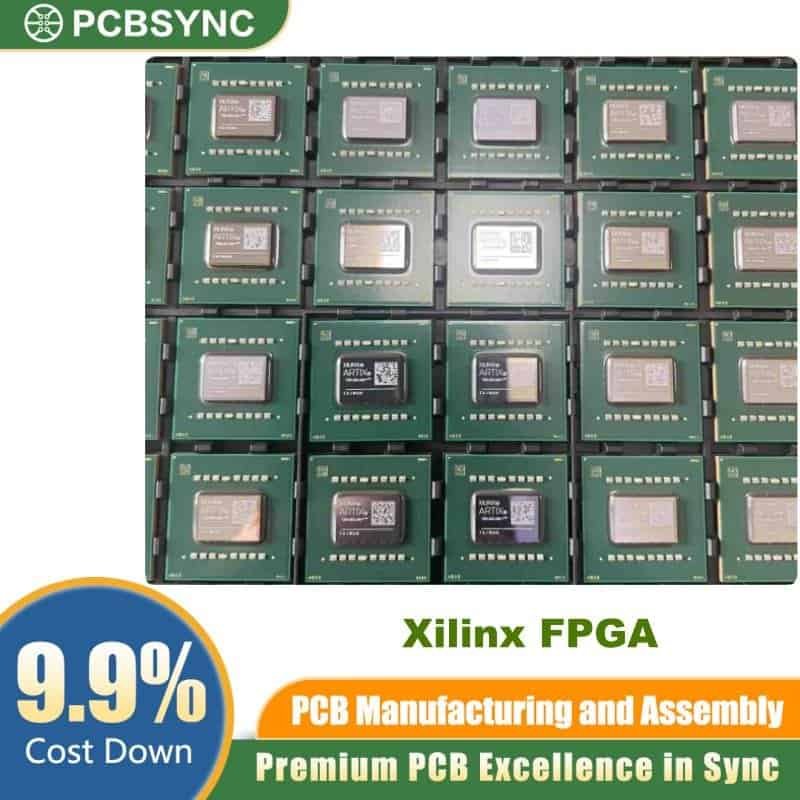
For a broader selection of compatible programmable logic devices, explore our full range of Xilinx FPGA solutions.
What Is the XC2S200-6FGG1264C? – Overview & Part Number Breakdown
The part number XC2S200-6FGG1264C encodes the device’s complete specification at a glance:
| Code Segment |
Meaning |
| XC2S200 |
Xilinx Spartan-II device with 200,000 system gates |
| -6 |
Speed grade –6 (fastest in the Spartan-II lineup) |
| FGG |
Fine-Pitch Ball Grid Array, Pb-free (Green) package |
| 1264 |
1,264 total package pins/balls |
| C |
Commercial temperature range (0°C to +85°C) |
The “G” character in “FGG” denotes RoHS-compliant, lead-free (Pb-free) packaging, distinguishing it from the standard “FG” variant. This makes the XC2S200-6FGG1264C suitable for modern designs that must meet environmental and export regulations.
XC2S200-6FGG1264C Key Specifications
Core Logic & Memory Resources
| Parameter |
XC2S200 Value |
| System Gates (Logic + RAM) |
200,000 |
| Logic Cells |
5,292 |
| CLB Array |
28 × 42 |
| Total CLBs |
1,176 |
| Distributed RAM (bits) |
75,264 |
| Block RAM (bits) |
56K (57,344) |
| Block RAM Columns |
2 |
I/O & Package Details
| Parameter |
XC2S200-6FGG1264C Value |
| Package Type |
FGG BGA (Pb-free Fine-Pitch BGA) |
| Total Package Balls |
1,264 |
| Maximum User I/O Pins |
284 |
| Global Clock / User Input Pins |
4 (not included in I/O count) |
| I/O Standards Supported |
LVTTL, LVCMOS, PCI, GTL, SSTL, HSTL, CTT, AGP |
Electrical & Timing Characteristics
| Parameter |
Value |
| Core Supply Voltage (VCCINT) |
2.5V |
| I/O Supply Voltage (VCCO) |
1.5V – 3.3V |
| Speed Grade |
–6 (Commercial only) |
| Process Technology |
0.18 µm CMOS |
| Maximum System Clock |
Up to 200+ MHz (design-dependent) |
| Temperature Range |
0°C to +85°C (Commercial) |
Configuration Modes
| Configuration Mode |
CCLK Direction |
Data Width |
Serial DOUT |
| Master Serial |
Output |
1-bit |
Yes |
| Slave Serial |
Input |
1-bit |
Yes |
| Slave Parallel |
Input |
8-bit |
No |
| Boundary-Scan (JTAG) |
N/A |
1-bit |
No |
XC2S200-6FGG1264C Architecture – How It Works
Configurable Logic Blocks (CLBs)
The heart of the XC2S200-6FGG1264C is its 1,176 Configurable Logic Blocks arranged in a 28 × 42 grid. Each CLB contains:
- Look-Up Tables (LUTs) for implementing arbitrary combinational logic
- Flip-Flops for synchronous storage and pipelining
- Fast carry logic for efficient arithmetic operations
- Multiplexers for flexible signal routing
This architecture enables the implementation of complex state machines, arithmetic units, and custom digital logic in a single reconfigurable chip.
Block RAM Architecture
The XC2S200-6FGG1264C includes 56K bits (57,344 bits) of dedicated Block RAM organized in two columns flanking the CLB core. Block RAM supports:
- True dual-port operation
- Configurable aspect ratios (16K×1 up to 512×36)
- Synchronous read/write for high-speed data buffering
- On-chip FIFO and memory controller implementations
Input/Output Blocks (IOBs) & I/O Standards
With 284 maximum user I/O pins, the XC2S200-6FGG1264C supports a wide range of interface standards, including single-ended and differential I/O. Each IOB includes:
- Programmable input delay
- Optional output slew rate control
- 3-state output enable
- Selectable pull-up or pull-down resistors
Delay-Locked Loops (DLLs)
Four Delay-Locked Loops (DLLs) – one at each corner of the die – provide:
- Zero-delay clock distribution
- Clock frequency multiplication and division
- Phase shifting for precise timing alignment
- Elimination of clock skew across the device
Spartan-II Family Comparison – Where XC2S200 Fits
The table below places the XC2S200 in context with the full Spartan-II device lineup:
| Device |
Logic Cells |
System Gates |
CLB Array |
Max User I/O |
Dist. RAM (bits) |
Block RAM |
| XC2S15 |
432 |
15,000 |
8×12 |
86 |
6,144 |
16K |
| XC2S30 |
972 |
30,000 |
12×18 |
92 |
13,824 |
24K |
| XC2S50 |
1,728 |
50,000 |
16×24 |
176 |
24,576 |
32K |
| XC2S100 |
2,700 |
100,000 |
20×30 |
176 |
38,400 |
40K |
| XC2S150 |
3,888 |
150,000 |
24×36 |
260 |
55,296 |
48K |
| XC2S200 |
5,292 |
200,000 |
28×42 |
284 |
75,264 |
56K |
The XC2S200 is the largest and most capable device in the Spartan-II family, offering the highest gate count, logic cell count, I/O count, and on-chip memory of any Spartan-II part. The FGG1264 package variant provides maximum pin accessibility for designs requiring high I/O density.
Speed Grade –6: What It Means for Your Design
The -6 speed grade is the fastest speed grade available in the Spartan-II family and is exclusively offered in the Commercial temperature range (0°C to +85°C). Key performance benefits include:
- Lower propagation delays through CLBs and routing resources
- Higher achievable clock frequencies compared to –5 and –4 grade devices
- Tighter setup and hold times for reliable high-speed synchronous designs
- Ideal for applications requiring maximum throughput within the Spartan-II architecture
Note: If your application requires industrial temperature operation (–40°C to +100°C), the –5 or –4 speed grades are available in the XC2S200 family.
XC2S200-6FGG1264C vs. Similar Part Numbers
Engineers often encounter multiple variants of the XC2S200. The table below clarifies the differences:
| Part Number |
Speed Grade |
Package |
Pins |
Pb-Free |
Temp Range |
| XC2S200-6FG456C |
–6 |
FG BGA |
456 |
No |
Commercial |
| XC2S200-6FGG456C |
–6 |
FGG BGA |
456 |
Yes |
Commercial |
| XC2S200-6FG256C |
–6 |
FG BGA |
256 |
No |
Commercial |
| XC2S200-6FGG256C |
–6 |
FGG BGA |
256 |
Yes |
Commercial |
| XC2S200-6FGG1264C |
–6 |
FGG BGA |
1264 |
Yes |
Commercial |
| XC2S200-5FGG456I |
–5 |
FGG BGA |
456 |
Yes |
Industrial |
The XC2S200-6FGG1264C stands out with its larger 1,264-ball package, which provides more I/O breakout flexibility and improved PCB routing options for high-density board designs.
Applications of the XC2S200-6FGG1264C FPGA
Telecommunications & Networking
The XC2S200-6FGG1264C excels in telecom applications due to its high-speed serial and parallel I/O support. Common uses include:
- Line card processing and framing logic
- Protocol bridge implementations (SONET, ATM, Ethernet)
- Signal routing and switching fabric control
- Packet inspection and classification engines
Industrial Automation & Motor Control
In industrial environments, this FPGA enables real-time control with deterministic latency:
- Servo and stepper motor control loops
- Field bus interfaces (CAN, Profibus, Modbus)
- PLC replacement and custom I/O expansion
- Sensor fusion and signal conditioning
Embedded Processing & Data Acquisition
With its large on-chip memory and flexible CLB architecture, the XC2S200-6FGG1264C supports:
- Soft-core processor implementations (e.g., PicoBlaze)
- High-speed ADC/DAC interfacing
- DMA controller and bus arbitration logic
- Custom co-processor acceleration
Military, Aerospace & Defense (Legacy Systems)
The Spartan-II family has an extensive installed base in defense and aerospace programs. The XC2S200-6FGG1264C is frequently used for:
- Radar signal processing
- Avionics data bus bridging (MIL-STD-1553, ARINC 429)
- Ruggedized communication equipment
- Legacy system maintenance and board re-spin
Consumer Electronics & Multimedia
- Video signal processing and format conversion
- Display timing controller implementations
- Set-top box and digital TV glue logic
- Image sensor interface and preprocessing
Programming & Development Tools
Xilinx ISE Design Suite
The XC2S200-6FGG1264C is supported by the Xilinx ISE (Integrated Synthesis Environment) design suite, which provides:
- RTL synthesis (VHDL / Verilog)
- Place-and-route (PAR) implementation
- Timing analysis and constraint management
- FPGA Editor for floorplanning
Note: ISE is the recommended toolchain for all Spartan-II devices. Vivado does not support the Spartan-II family.
Configuration Methods
The device supports multiple configuration interfaces:
| Method |
Use Case |
| Master Serial (SPI-like) |
Standalone boot from serial PROM |
| Slave Serial |
Microcontroller-driven configuration |
| Slave Parallel (SelectMAP) |
Fast parallel download |
| JTAG Boundary Scan |
In-circuit programming and debug |
Supported HDL Languages
- VHDL (IEEE 1076-1993 and 1076-2000)
- Verilog (IEEE 1364-1995 and 1364-2001)
- Schematic entry via ISE schematic editor
PCB Design Considerations for the FGG1264 Package
Board Layout Guidelines
The 1,264-ball FGG BGA package requires careful PCB design attention:
- Minimum via diameter: Follow IPC-2221 for 1.0 mm or finer ball pitch BGA escape routing
- Decoupling capacitors: Place 100nF decoupling capacitors as close as possible to each VCCINT and VCCO power pin
- Ground planes: Use a solid ground reference plane directly under the BGA for signal integrity
- Controlled impedance: Route high-speed I/O signals on controlled-impedance traces (typically 50Ω single-ended)
Power Supply Requirements
| Supply Rail |
Voltage |
Purpose |
| VCCINT |
2.5V |
Core logic power |
| VCCO |
1.5V – 3.3V (per bank) |
I/O output drive voltage |
| VREF |
Variable |
Reference voltage for certain I/O standards |
Frequently Asked Questions (FAQ)
Is the XC2S200-6FGG1264C still in production?
The Spartan-II family, including the XC2S200, has been noted as “Not Recommended for New Designs” (NRND) by AMD/Xilinx. However, the part remains available through authorized distributors for maintenance, repair, and legacy system support.
What is the difference between FG and FGG packages?
The FGG package includes the “G” suffix indicating Pb-free (RoHS-compliant) solder balls, while the standard FG package uses traditional tin-lead solder. The silicon die and electrical performance are identical.
Can the XC2S200-6FGG1264C be reprogrammed?
Yes. Like all Xilinx FPGAs, the XC2S200-6FGG1264C uses SRAM-based configuration, meaning it can be reprogrammed an unlimited number of times in-system. Configuration is loaded from an external PROM or controller at power-up.
What replaces the XC2S200 in new designs?
For new designs, Xilinx recommends migration to more modern families such as the Spartan-6, Spartan-7, or Artix-7 series, which offer greater logic density, lower power, faster I/O, and support in the Vivado Design Suite.
Is the –6 speed grade available in industrial temperature?
No. The –6 speed grade is exclusively available in the Commercial temperature range (0°C to +85°C). For industrial temperature (–40°C to +100°C), the maximum available speed grade is –5.
Why Choose the XC2S200-6FGG1264C for Your Project?
- ✅ Highest gate density in the Spartan-II family (200K gates / 5,292 cells)
- ✅ Fastest speed grade (–6) for maximum design performance
- ✅ Pb-free / RoHS-compliant FGG1264 package
- ✅ 284 user I/O pins for complex multi-bus interface designs
- ✅ 56K bits Block RAM for on-chip data buffering
- ✅ Four DLLs for zero-skew, jitter-reduced clock distribution
- ✅ Proven technology with over two decades of deployed installations
- ✅ Supported by Xilinx ISE with a mature, stable toolchain
Ordering Information
| Field |
Detail |
| Manufacturer |
Xilinx (AMD) |
| Full Part Number |
XC2S200-6FGG1264C |
| Product Family |
Spartan-II |
| Package |
1264-Ball Fine-Pitch BGA (FGG), Pb-free |
| Speed Grade |
–6 |
| Temperature Range |
Commercial (0°C to +85°C) |
| RoHS Compliance |
Yes |
| Datasheet |
Spartan-II FPGA Family Data Sheet DS001 |
All specifications are sourced from the official Xilinx Spartan-II FPGA Family Data Sheet (DS001). Always verify against the current datasheet before finalizing your design.