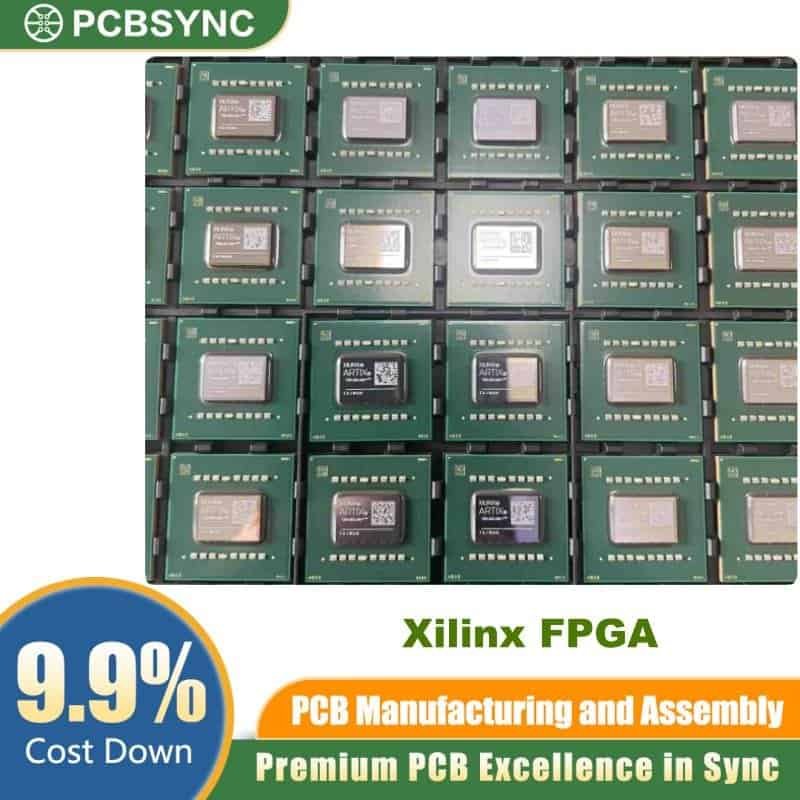
Meta Description: Buy XC2S200-6FGG1255C – Xilinx Spartan-II FPGA with 200K gates, 5,292 logic cells, -6 speed grade, 1255-pin FGG BGA package. Read full specs, pinout, applications, and ordering info.
What Is the XC2S200-6FGG1255C?
The XC2S200-6FGG1255C is a high-performance Field Programmable Gate Array (FPGA) from the Xilinx Spartan-II family, now maintained under AMD. This specific part number decodes as follows: XC2S200 (200K-gate Spartan-II device), -6 (speed grade), FGG (Fine-pitch Ball Grid Array with lead-free Pb-free packaging), 1255 (number of pins), and C (Commercial temperature range, 0°C to +85°C).
Designed as a cost-effective alternative to mask-programmed ASICs, the XC2S200-6FGG1255C combines programmable flexibility with robust on-chip resources. Its 2.5V core voltage, mature 0.18µm CMOS process, and extensive I/O capability make it a trusted choice for engineers designing communications, industrial, and embedded systems.
For a broad selection of compatible devices and accessories, visit Xilinx FPGA.
XC2S200-6FGG1255C Key Specifications at a Glance
| Parameter |
Value |
| Part Number |
XC2S200-6FGG1255C |
| Family |
Spartan-II |
| Manufacturer |
Xilinx (AMD) |
| System Gates |
200,000 |
| Logic Cells |
5,292 |
| CLB Array |
28 × 42 |
| Total CLBs |
1,176 |
| Max User I/O |
284 |
| Distributed RAM |
75,264 bits |
| Block RAM |
56K bits |
| Speed Grade |
-6 (fastest commercial grade) |
| Core Voltage (VCCINT) |
2.5V |
| Package |
FGG (Pb-free Fine-pitch BGA) |
| Pin Count |
1,255 |
| Temperature Range |
Commercial: 0°C to +85°C |
| Process Technology |
0.18µm CMOS |
| Configuration Bits |
1,335,840 |
Understanding the Part Number Breakdown
XC2S200-6FGG1255C Ordering Code Explained
| Field |
Code |
Meaning |
| Device Type |
XC2S200 |
Spartan-II, 200K system gates |
| Speed Grade |
-6 |
Fastest available; commercial range only |
| Package Type |
FGG |
Fine-pitch Ball Grid Array, Pb-free |
| Pin Count |
1255 |
1,255 solder balls |
| Temperature Range |
C |
Commercial (0°C to +85°C) |
Note: The “-6” speed grade is exclusively available in the Commercial temperature range. Industrial variants use -5 or lower speed grades.
XC2S200-6FGG1255C Architecture & Core Features
Configurable Logic Blocks (CLBs)
The XC2S200 contains 1,176 CLBs arranged in a 28-column by 42-row array. Each CLB consists of two slices, and each slice contains two look-up tables (LUTs) and two flip-flops. This architecture supports:
- Combinational logic implementation via 4-input LUTs
- Synchronous and asynchronous flip-flops with set/reset
- Fast carry and arithmetic logic chains
- Wide-function multiplexers
Block RAM
The device includes 56K bits of block RAM in two columns flanking the CLB array, providing dedicated, high-speed on-chip memory suitable for FIFOs, data buffers, and lookup tables.
Distributed RAM
An additional 75,264 bits of distributed RAM is available via the LUT resources within CLBs, enabling lightweight, low-latency data storage without consuming dedicated block RAM.
Delay-Locked Loops (DLLs)
Four Delay-Locked Loops (DLLs) — one at each corner of the die — provide clock deskewing, frequency synthesis, and phase shifting. This ensures precise clock management across large designs.
Input/Output Blocks (IOBs)
The XC2S200-6FGG1255C supports up to 284 user I/Os with programmable drive strength, slew rate control, and multiple I/O standards.
Supported I/O Standards
| I/O Standard |
Description |
| LVTTL |
Low-Voltage TTL (3.3V) |
| LVCMOS33 / LVCMOS25 / LVCMOS18 |
Low-Voltage CMOS variants |
| PCI |
3.3V PCI bus compatible |
| GTL / GTL+ |
Gunning Transceiver Logic |
| HSTL Class I / II / III / IV |
High-Speed Transceiver Logic |
| SSTL2 Class I / II |
Stub Series Terminated Logic (2.5V) |
| SSTL3 Class I / II |
Stub Series Terminated Logic (3.3V) |
| AGP |
Accelerated Graphics Port (1x/2x) |
Configuration Modes
The XC2S200-6FGG1255C supports four configuration modes, selectable via dedicated mode pins (M0, M1, M2):
| Configuration Mode |
CCLK Direction |
Data Width |
Serial DOUT |
| Master Serial |
Output |
1-bit |
Yes |
| Slave Serial |
Input |
1-bit |
Yes |
| Slave Parallel |
Input |
8-bit |
No |
| Boundary-Scan (JTAG) |
N/A |
1-bit |
No |
Spartan-II Family Comparison: Where Does XC2S200 Stand?
| Device |
Logic Cells |
System Gates |
CLB Array |
Max User I/O |
Dist. RAM (bits) |
Block RAM |
| XC2S15 |
432 |
15,000 |
8×12 |
86 |
6,144 |
16K |
| XC2S30 |
972 |
30,000 |
12×18 |
92 |
13,824 |
24K |
| XC2S50 |
1,728 |
50,000 |
16×24 |
176 |
24,576 |
32K |
| XC2S100 |
2,700 |
100,000 |
20×30 |
176 |
38,400 |
40K |
| XC2S150 |
3,888 |
150,000 |
24×36 |
260 |
55,296 |
48K |
| XC2S200 |
5,292 |
200,000 |
28×42 |
284 |
75,264 |
56K |
The XC2S200 is the largest and most capable device in the Spartan-II family, offering the highest gate count, I/O count, and memory resources.
Electrical Characteristics
Absolute Maximum Ratings
| Parameter |
Value |
| Storage Temperature |
-65°C to +150°C |
| Voltage on any pin relative to GND |
-0.5V to +4.0V |
| VCCINT |
-0.5V to +3.0V |
| VCCO |
-0.5V to +4.0V |
| Maximum DC input current |
±10 mA per pin |
Recommended Operating Conditions
| Parameter |
Min |
Typical |
Max |
| VCCINT (Core Supply) |
2.375V |
2.5V |
2.625V |
| VCCO (I/O Supply) |
1.14V |
— |
3.6V |
| Commercial Temp. (Junction) |
0°C |
— |
+85°C |
Performance & Speed Grade Details
Why Choose the -6 Speed Grade?
The -6 speed grade is the highest (fastest) performance tier available for Spartan-II commercial devices. Key highlights:
- Maximum system clock frequency achievable through DLL clock distribution
- Lowest propagation delays through CLB and routing resources
- Best suited for time-critical applications where throughput and latency matter
- Exclusively available in Commercial temperature range (0°C to +85°C)
Package Information: FGG1255 (Pb-Free Fine-Pitch BGA)
The FGG (Fine-pitch Ball Grid Array) package with 1,255 pins is the Pb-free (RoHS-compliant) variant of the standard FG package. The extra “G” in “FGG” designates the lead-free solder ball composition.
| Package Attribute |
Detail |
| Package Type |
Fine-Pitch Ball Grid Array (FBGA) |
| Lead-Free |
Yes (Pb-Free, “G” suffix) |
| Total Pins |
1,255 |
| Pitch |
Fine-pitch ball spacing |
| RoHS Compliance |
Yes |
| PCB Mounting |
Surface Mount (SMT) |
PCB Design Tip: Due to the fine-pitch BGA footprint, controlled-impedance PCB design, proper via-in-pad techniques, and X-ray inspection are strongly recommended for assembly.
Applications of the XC2S200-6FGG1255C
The XC2S200-6FGG1255C is widely deployed across multiple industries due to its flexibility and dense I/O count:
#### Communications & Networking
- Line card processing
- Protocol bridging (UART, SPI, I2C, PCI)
- Packet framing and data encoding/decoding
#### Industrial Automation
- Motor control and servo drive logic
- Sensor interface and signal conditioning
- PLC-like programmable control systems
#### Defense & Aerospace (Legacy Systems)
- Avionics bus interface (MIL-STD-1553)
- Signal processing in ruggedized environments
- FPGA-based hardware reconfiguration
#### Consumer Electronics & Prototyping
- Rapid ASIC prototyping and pre-silicon validation
- Custom coprocessor acceleration
- Digital signal processing pipelines
#### Medical Devices
- Real-time data acquisition
- Image processing front-ends
- Low-latency control logic
Design Tools & Software Support
The XC2S200-6FGG1255C is supported by Xilinx ISE Design Suite (the recommended toolchain for Spartan-II devices). Key tools include:
| Tool |
Purpose |
| ISE Project Navigator |
RTL design entry and project management |
| XST (Xilinx Synthesis Technology) |
HDL synthesis (VHDL/Verilog) |
| ISE Simulator (ISim) |
Functional and timing simulation |
| IMPACT |
Device configuration and programming |
| PlanAhead |
Floorplanning and constraint management |
Note: Vivado Design Suite does not support Spartan-II devices. Use ISE 14.7 (the final release) for full Spartan-II support.
Frequently Asked Questions (FAQ)
What does the “C” suffix mean in XC2S200-6FGG1255C?
The “C” at the end indicates the Commercial temperature range: junction temperature from 0°C to +85°C. Industrial-range devices use an “I” suffix and operate from -40°C to +100°C.
Is the XC2S200-6FGG1255C RoHS compliant?
Yes. The “G” in FGG designates a Pb-free (lead-free) package, making it RoHS compliant. Standard (non-G) packages use leaded solder balls.
What is the difference between XC2S200-6FGG1255C and XC2S200-6FG1255C?
The double “GG” in XC2S200-6FGG1255C indicates Pb-free packaging, while the single “G” version (XC2S200-6FG1255C) uses conventional leaded solder balls. Functionally and electrically they are identical.
Can I use Vivado to program the XC2S200-6FGG1255C?
No. Xilinx Vivado does not support the Spartan-II family. You must use ISE Design Suite 14.7 for synthesis, implementation, and programming.
What configuration memory is compatible?
Xilinx XCFxxS (Platform Flash) and XC18Vxx serial PROMs are compatible with Spartan-II master serial configuration mode.
Is the XC2S200-6FGG1255C still in production?
The Spartan-II family has been subject to product discontinuation notices (PDN). Buyers should verify current availability with authorized distributors and consider long-term supply planning.
Why the XC2S200-6FGG1255C Remains Relevant
Despite being part of a mature FPGA generation, the XC2S200-6FGG1255C continues to be used in:
- Legacy system maintenance where form/fit/function replacement is required
- Long-lifecycle industrial and defense programs with frozen BOM requirements
- Cost-sensitive prototyping where surplus inventory offers competitive pricing
- Educational and research environments that rely on established toolchains
Its programmable nature means that even deployed units can be updated in the field without hardware replacement — a key advantage over fixed ASICs.
Summary
The XC2S200-6FGG1255C is the flagship device of the Xilinx Spartan-II family, delivering 200,000 system gates, 5,292 logic cells, 284 user I/Os, and 56K bits of block RAM in a Pb-free 1255-pin FGG BGA package. The -6 speed grade makes it the fastest option for commercial-temperature designs. Whether you are maintaining a legacy system, building a cost-effective prototype, or designing an embedded controller, this device provides the programmable logic resources and I/O flexibility to meet demanding design requirements.