Meta Description: Buy XC2S200-6FGG1250C — Xilinx Spartan-II FPGA with 200K gates, 5,292 logic cells, -6 speed grade, 1250-ball Fine-Pitch BGA package. Full specs, pinout, applications & datasheet guide.
The XC2S200-6FGG1250C is a high-performance Field Programmable Gate Array (FPGA) from Xilinx’s Spartan-II family, engineered for engineers and designers who demand programmable logic flexibility combined with cost efficiency. Featuring 200,000 system gates, a -6 commercial speed grade, and a large 1250-ball Fine-Pitch Ball Grid Array (FGG1250) package, this device delivers robust I/O density for complex digital design applications across telecommunications, industrial automation, medical imaging, and embedded systems.
Whether you are designing a new PCB or sourcing replacement components for legacy systems, this guide covers everything you need to know about the XC2S200-6FGG1250C — from core specifications and package details to programming tools, applications, and ordering information.
What Is the XC2S200-6FGG1250C? — Xilinx Spartan-II FPGA Overview
The XC2S200-6FGG1250C is part of Xilinx’s Spartan-II FPGA family, one of the industry’s most widely adopted low-cost programmable logic platforms. Built on a 0.18 µm process technology and operating at a core voltage of 2.5V, this device bridges the gap between ASIC performance and the flexibility of a programmable gate array.
The part number breaks down as follows:
| Part Number Segment |
Meaning |
| XC2S200 |
Spartan-II family, 200K system gates |
| -6 |
Speed grade -6 (fastest commercial grade) |
| FGG |
Fine-Pitch Ball Grid Array, lead-free (Pb-free “G”) |
| 1250 |
1250-ball package |
| C |
Commercial temperature range (0°C to +85°C) |
Unlike mask-programmed ASICs, the XC2S200-6FGG1250C allows in-field reconfiguration — designers can update logic without replacing hardware, dramatically reducing development cycles and non-recurring engineering (NRE) costs.
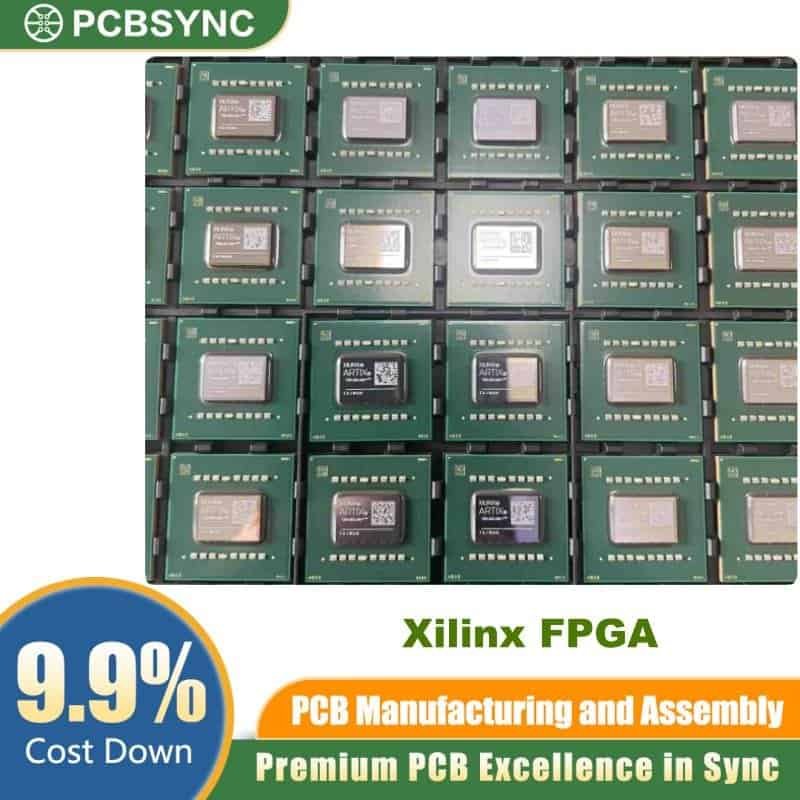
For a broader look at the full Spartan and Artix FPGA lineup, visit Xilinx FPGA.
XC2S200-6FGG1250C Key Specifications at a Glance
Core Logic Resources
| Parameter |
Value |
| Device Family |
Spartan-II |
| System Gates |
200,000 |
| Logic Cells (CLBs) |
5,292 |
| CLB Array |
28 × 42 |
| Total CLBs |
1,176 |
| Distributed RAM (bits) |
75,264 |
| Block RAM (bits) |
56K (56,000) |
| Delay-Locked Loops (DLLs) |
4 |
Electrical Characteristics
| Parameter |
Value |
| Core Supply Voltage (VCCINT) |
2.5V |
| I/O Supply Voltage (VCCO) |
1.5V – 3.3V (configurable per bank) |
| Process Technology |
0.18 µm |
| Maximum System Clock |
Up to 263 MHz |
| Speed Grade |
-6 (Commercial, fastest available) |
| Operating Temperature Range |
0°C to +85°C (Commercial) |
Package Information
| Parameter |
Value |
| Package Type |
Fine-Pitch Ball Grid Array (FBGA) |
| Package Code |
FGG1250 |
| Total Balls |
1,250 |
| Lead-Free (RoHS) |
Yes (double “G” in FGG denotes Pb-free) |
| Ball Pitch |
Fine Pitch |
Note: The -6 speed grade is exclusively available in the Commercial temperature range (suffix “C”). Industrial temperature variants use slower speed grades.
XC2S200-6FGG1250C Architecture — How It Works
Configurable Logic Blocks (CLBs)
The core of the XC2S200-6FGG1250C is its array of 1,176 Configurable Logic Blocks, organized in a 28-column × 42-row grid. Each CLB contains:
- Look-Up Tables (LUTs): 4-input LUTs for implementing any combinational logic function
- Flip-Flops: Edge-triggered D-type flip-flops for sequential logic and pipelining
- Multiplexers: Dedicated fast multiplexers for efficient logic routing
- Carry Logic: Fast carry chains enabling high-speed arithmetic operations
Block RAM
The XC2S200-6FGG1250C includes 56Kb of dedicated block RAM, organized in two columns on opposite sides of the die. Block RAM is ideal for:
- On-chip data buffering and FIFOs
- Lookup tables and coefficient storage
- Dual-port memory for multi-clock domain designs
Distributed RAM
In addition to block RAM, 75,264 bits of distributed RAM is embedded directly within the CLB array. This allows logic resources to double as lightweight, high-speed memory — reducing routing congestion and latency.
Input/Output Blocks (IOBs)
The XC2S200-6FGG1250C’s I/O architecture supports multiple standards:
| I/O Standard |
Description |
| LVTTL |
Low-voltage TTL, 3.3V |
| LVCMOS33 / LVCMOS25 |
Low-voltage CMOS at 3.3V / 2.5V |
| LVCMOS18 / LVCMOS15 |
Low-voltage CMOS at 1.8V / 1.5V |
| PCI |
33 MHz / 66 MHz PCI bus compatible |
| GTL / GTL+ |
Gunning Transceiver Logic |
| HSTL Class I / II |
High-speed transceiver logic |
| SSTL2 Class I / II |
Stub-series terminated logic |
Each IOB includes programmable output drive strength, slew rate control, and optional pull-up or pull-down resistors — giving designers fine-grained control over signal integrity.
Delay-Locked Loops (DLLs)
Four on-chip DLLs — one at each corner of the die — provide:
- Zero-propagation delay clock distribution
- Clock frequency synthesis (multiply/divide)
- Phase shifting for multi-clock domain designs
- Clock deskewing for high-speed interfaces
XC2S200-6FGG1250C vs Other Spartan-II Family Members
| Device |
Logic Cells |
System Gates |
CLB Array |
Distributed RAM (bits) |
Block RAM (bits) |
| XC2S15 |
432 |
15,000 |
8×12 |
6,144 |
16K |
| XC2S30 |
972 |
30,000 |
12×18 |
13,824 |
24K |
| XC2S50 |
1,728 |
50,000 |
16×24 |
24,576 |
32K |
| XC2S100 |
2,700 |
100,000 |
20×30 |
38,400 |
40K |
| XC2S150 |
3,888 |
150,000 |
24×36 |
55,296 |
48K |
| XC2S200 |
5,292 |
200,000 |
28×42 |
75,264 |
56K |
The XC2S200 is the largest and most capable device in the Spartan-II family, making the XC2S200-6FGG1250C the highest-performance, highest-capacity variant with the maximum available I/O count afforded by the 1250-ball package.
XC2S200 Package Comparison — Choosing the Right Package
Xilinx offers the XC2S200 core in multiple package options. The FGG1250 package provides the maximum available user I/O, making it the preferred choice for high-density system designs.
| Package |
Type |
Balls / Pins |
Max User I/O |
| PQ208 / PQG208 |
PQFP (Plastic Quad Flat Pack) |
208 |
146 |
| FG256 / FGG256 |
Fine-Pitch BGA |
256 |
176 |
| FG456 / FGG456 |
Fine-Pitch BGA |
456 |
284 |
| FGG1250 |
Fine-Pitch BGA (Pb-free) |
1,250 |
Maximum |
The FGG1250 package’s 1,250 solder balls enable the highest user I/O count among all XC2S200 variants — critical for applications requiring extensive external interfacing such as memory buses, high-speed communications, and multi-board systems.
XC2S200-6FGG1250C Applications — Where This FPGA Excels
#### Communications and Networking
The XC2S200-6FGG1250C handles high-speed data streams and implements standard communication protocols including Ethernet MAC, UART, SPI, I²C, PCIe interface bridging, and custom serializer/deserializer (SerDes) logic.
#### Industrial Automation and Motor Control
With deterministic timing, programmable I/O banks, and fast carry logic, this FPGA is widely used in servo motor control, CNC machine controllers, PLC replacement logic, and real-time sensor fusion.
#### Medical Imaging and Diagnostic Equipment
Its reconfigurability and high I/O density make the XC2S200-6FGG1250C suitable for ultrasound front-end processing, patient monitoring device interfaces, and MRI/CT image reconstruction pipelines — applications where hardware updates via reconfiguration are critical.
#### Embedded Signal Processing
Implementing FIR/IIR digital filters, FFT engines, and custom DSP pipelines in the CLB fabric enables the XC2S200-6FGG1250C to serve as a co-processor in embedded systems alongside microcontrollers and DSPs.
#### Security and Access Control Systems
High I/O availability combined with flexible logic make this FPGA a strong fit for biometric data processing, secure communication encryption hardware, and physical access control interfaces.
#### Aerospace and Defense (Legacy / Maintenance)
Many established aerospace programs originally designed around the Spartan-II family continue to rely on the XC2S200-6FGG1250C for MRO (Maintenance, Repair, and Overhaul) sourcing to maintain fielded systems.
XC2S200-6FGG1250C Programming and Design Tools
Supported Design Suites
| Tool |
Vendor |
Notes |
| ISE Design Suite |
Xilinx / AMD |
Primary legacy tool for Spartan-II; synthesis, implementation, bitstream generation |
| Vivado Design Suite |
Xilinx / AMD |
Not natively supporting Spartan-II; use ISE for this device |
| ModelSim / Questa |
Siemens EDA |
HDL simulation (VHDL, Verilog) |
| Synplify Pro |
Synopsys |
Third-party synthesis with timing optimization |
Supported HDL Languages
- VHDL — Preferred for structured, hierarchical design
- Verilog / SystemVerilog — Widely used for RTL design and testbenches
- Schematic Entry — Available in ISE for simple, block-based designs
Configuration Methods
The XC2S200-6FGG1250C supports multiple configuration modes:
| Mode |
Description |
| Master Serial |
FPGA reads bitstream from an external serial PROM |
| Slave Serial |
External controller shifts bitstream into the FPGA |
| Master Parallel (SelectMAP) |
High-speed parallel configuration up to ×8 wide |
| Slave Parallel (SelectMAP) |
External host controls parallel configuration |
| JTAG (IEEE 1149.1) |
Boundary scan; in-system programming via JTAG chain |
XC2S200-6FGG1250C Ordering and Part Number Decoder
Understanding Xilinx ordering codes helps ensure you receive exactly the right variant:
XC  2S  200  -  6  FGG  1250  C
│   │   │      │   │     │    └── Temperature: C = Commercial (0°C to +85°C)
│   │   │      │   │     └─────── Package ball count: 1250
│   │   │      │   └───────────── Package: FGG = Fine-Pitch BGA (Pb-free)
│   │   │      └───────────────── Speed grade: -6 (fastest commercial)
│   │   └──────────────────────── Gate count: 200K system gates
│   └──────────────────────────── Family: 2S = Spartan-II
└──────────────────────────────── Manufacturer: Xilinx (AMD)
Related Part Numbers (Same Core, Different Package/Speed)
| Part Number |
Package |
Speed Grade |
Temp Range |
Lead-Free |
| XC2S200-6FGG1250C |
FGG1250 BGA |
-6 |
Commercial |
Yes |
| XC2S200-5FGG456C |
FGG456 BGA |
-5 |
Commercial |
Yes |
| XC2S200-6FG456C |
FG456 BGA |
-6 |
Commercial |
No |
| XC2S200-5FGG256C |
FGG256 BGA |
-5 |
Commercial |
Yes |
| XC2S200-6FG256C |
FG256 BGA |
-6 |
Commercial |
No |
| XC2S200-5PQG208C |
PQFP 208 |
-5 |
Commercial |
Yes |
XC2S200-6FGG1250C Design Considerations and Best Practices
Power Supply Decoupling
- Place 100nF ceramic decoupling capacitors on every VCCINT and VCCO pin, as close to the package as possible.
- Use 10µF bulk capacitors at each power supply entry point to suppress low-frequency ripple.
PCB Layout Guidelines for 1250-Ball BGA
- Use a minimum 6-layer PCB for proper power plane separation with a fine-pitch BGA of this density.
- Maintain controlled impedance traces (typically 50Ω single-ended, 100Ω differential) for high-speed I/O.
- Follow Xilinx BGA escape routing guidelines using via-in-pad or dog-bone fan-out patterns based on your PCB manufacturer’s capabilities.
Configuration Time Optimization
- Pre-compute and compress bitstream files to reduce boot time in time-critical systems.
- Use SelectMAP ×8 mode for the fastest possible configuration loading.
Clock Domain Crossing (CDC)
- Always use the on-chip DLLs for clock generation and avoid asynchronous clock domain crossings.
- Implement proper synchronization FIFOs or handshaking when data must cross clock domains.
Frequently Asked Questions About the XC2S200-6FGG1250C
Q: What is the maximum operating frequency of the XC2S200-6FGG1250C? A: The Spartan-II family supports system clocks up to 263 MHz at the -6 speed grade under commercial temperature and voltage conditions. Actual achievable frequencies depend on the implemented design’s critical path timing.
Q: Is the XC2S200-6FGG1250C still in production? A: The Spartan-II family has reached end-of-life status and is not recommended for new designs. However, significant inventory remains available through authorized distributors and specialty component suppliers for legacy system maintenance and repair.
Q: What is the difference between FGG1250 and FG1250 packages? A: The extra “G” in FGG indicates the package uses lead-free (Pb-free) solder balls, complying with RoHS environmental directives. The “FG” variant uses conventional tin-lead solder. Always verify compliance requirements before ordering.
Q: Can I use Vivado to program the XC2S200-6FGG1250C? A: No. Vivado does not support the Spartan-II family. Use Xilinx ISE Design Suite (version 14.7 is the final and recommended release) for all Spartan-II device programming, synthesis, and implementation.
Q: What is the recommended replacement for new designs? A: Xilinx recommends migrating to the Spartan-6, Spartan-7, or Artix-7 families for new designs, which offer significantly greater logic density, lower power consumption, and modern interface support.
XC2S200-6FGG1250C Summary Specification Table
| Attribute |
Specification |
| Manufacturer |
Xilinx (now AMD) |
| Part Number |
XC2S200-6FGG1250C |
| Family |
Spartan-II |
| System Gates |
200,000 |
| Logic Cells |
5,292 |
| CLB Array |
28 × 42 (1,176 CLBs) |
| Block RAM |
56Kb |
| Distributed RAM |
75,264 bits |
| DLLs |
4 |
| Max Clock |
263 MHz |
| Speed Grade |
-6 (Commercial, fastest) |
| Core Voltage |
2.5V |
| I/O Voltage |
1.5V – 3.3V |
| Package |
FGG1250 Fine-Pitch BGA |
| Total Balls |
1,250 |
| Lead-Free |
Yes (RoHS compliant) |
| Temperature Range |
0°C to +85°C |
| Process Node |
0.18 µm |
| Configuration |
JTAG, Master/Slave Serial, SelectMAP |
| Design Tool |
Xilinx ISE Design Suite 14.7 |
| Status |
Not Recommended for New Designs (NRND) |
For additional Xilinx FPGA products, family comparisons, and sourcing support, visit Xilinx FPGA.