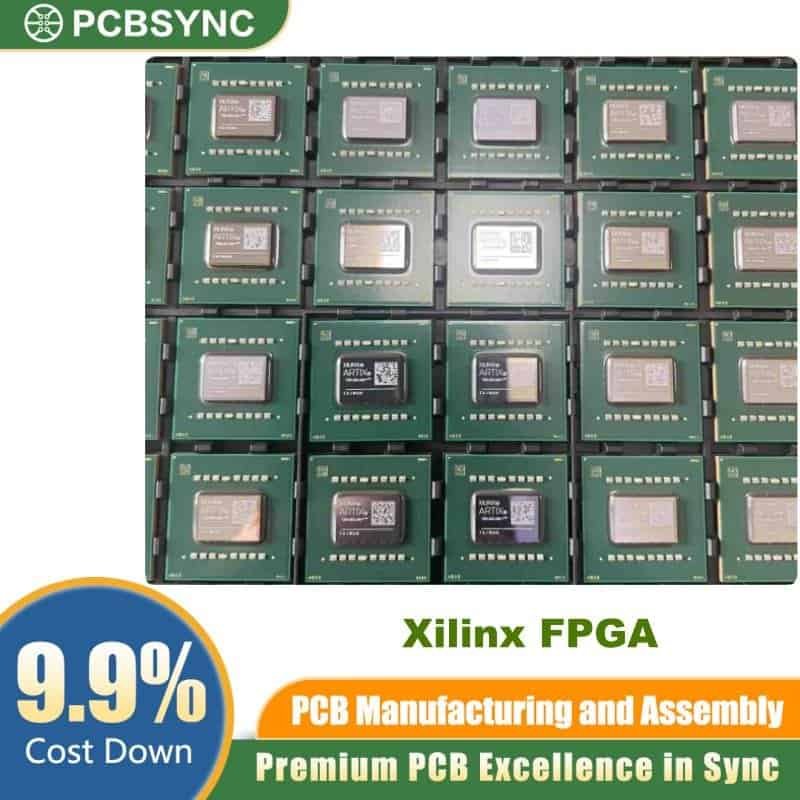
The XC2S200-6FGG1247C is a high-performance, cost-optimized Field Programmable Gate Array (FPGA) manufactured by Xilinx (now AMD), belonging to the Spartan-II family. Featuring 200,000 system gates, 5,292 logic cells, and housed in a 1,247-pin Fine-Pitch Ball Grid Array (FBGA) package, this device is engineered for high-density, high-volume digital design applications. Whether you are designing communication systems, embedded processors, or digital signal processing pipelines, the XC2S200-6FGG1247C delivers exceptional logic density and flexible I/O capabilities. For a broader overview of the Spartan device lineup and related products, visit our guide on Xilinx FPGA.
XC2S200-6FGG1247C Product Overview
The XC2S200-6FGG1247C is the largest device in the Spartan-II 2.5V FPGA family. It combines a rich fabric of Configurable Logic Blocks (CLBs), dedicated Block RAM, and four Delay-Locked Loops (DLLs) to provide robust, reconfigurable logic for both prototyping and production environments. Operating at a core voltage of 2.5V and available in the commercial temperature range (0°C to +85°C), it is positioned as a proven alternative to mask-programmed ASICs — offering in-field programmability without hardware replacement.
Key Specifications at a Glance
| Parameter |
Value |
| Part Number |
XC2S200-6FGG1247C |
| Manufacturer |
Xilinx (AMD) |
| Family |
Spartan-II |
| System Gates |
200,000 |
| Logic Cells |
5,292 |
| CLB Array |
28 x 42 (1,176 CLBs) |
| Max User I/O |
284 pins |
| Distributed RAM |
75,264 bits |
| Block RAM |
56K bits (7 x 8K) |
| Speed Grade |
-6 (263 MHz) |
| Core Voltage (VCCINT) |
2.5V |
| Technology Node |
0.18 µm CMOS |
| Package Type |
FGG1247 (Fine-Pitch BGA) |
| Pin Count |
1,247 pins |
| Temperature Range |
Commercial: 0°C to +85°C |
| RoHS Compliance |
Pb-Free (G suffix in ordering code) |
| DLLs (Delay-Locked Loops) |
4 (one at each die corner) |
| Configuration Modes |
Master Serial, Slave Serial, Slave Parallel, Boundary Scan |
Spartan-II FPGA Architecture: Inside the XC2S200-6FGG1247C
The Spartan-II architecture is built around a regular array of programmable logic resources. Understanding the internal structure helps engineers maximize device utilization and design efficiency.
Configurable Logic Blocks (CLBs)
The XC2S200-6FGG1247C contains 1,176 CLBs arranged in a 28-column by 42-row matrix. Each CLB includes two slices, and each slice contains two 4-input Look-Up Tables (LUTs), two storage elements (flip-flops or latches), and dedicated carry and arithmetic logic. This architecture enables compact, high-speed implementation of combinational and sequential logic.
Block RAM
Seven independent 8K-bit Block RAM modules provide 56K bits of dedicated on-chip memory. These dual-port synchronous RAMs support various aspect ratios and can be used for FIFOs, lookup tables, data buffers, and shift registers — fully independent of the distributed RAM in the CLB fabric.
Delay-Locked Loops (DLLs)
Four fully digital DLLs — located at each corner of the die — enable precise clock management. They eliminate clock distribution delays, multiply or divide clock frequencies, and allow phase shifting. This makes the XC2S200-6FGG1247C ideal for high-speed synchronous designs requiring tight timing margins.
Input/Output Blocks (IOBs)
Each IOB supports multiple I/O standards, ensuring compatibility with a broad range of interfacing requirements. The device supports 284 maximum user I/O pins (excluding the four dedicated global clock inputs). I/O banks operate at programmable VCCO voltages, enabling mixed-voltage system integration.
Supported I/O Standards
| I/O Standard |
Type |
Voltage |
| LVTTL |
Single-Ended |
3.3V |
| LVCMOS 3.3 / 2.5 / 1.8 |
Single-Ended |
3.3V / 2.5V / 1.8V |
| PCI |
Single-Ended |
3.3V |
| GTL / GTL+ |
Open-Drain |
Ref-Based |
| HSTL Class I / II |
Differential-Capable |
1.5V VREF |
| SSTL 3 / 2 |
Differential-Capable |
3.3V / 2.5V |
| CTT |
Single-Ended |
3.3V VREF |
How to Decode the XC2S200-6FGG1247C Part Number
The Xilinx part number follows a structured format. Breaking down XC2S200-6FGG1247C:
| Code Segment |
Value |
Meaning |
| Device Type |
XC2S200 |
Spartan-II, 200K system gates |
| Speed Grade |
-6 |
Fastest commercial grade; exclusive to commercial temp range |
| Package |
FGG |
Fine-Pitch Ball Grid Array, Pb-Free (the extra ‘G’ = RoHS compliant) |
| Pin Count |
1247 |
1,247-pin package footprint |
| Temperature |
C |
Commercial temperature range (0°C to +85°C) |
Spartan-II FPGA Family Comparison: Where XC2S200 Fits
The XC2S200 is the top-tier device in the Spartan-II family. The table below compares all family members to help engineers select the right density for their design requirements.
| Device |
Logic Cells |
System Gates |
CLBs |
Max User I/O |
Block RAM |
Dist. RAM |
| XC2S15 |
432 |
15,000 |
96 |
86 |
16K bits |
6,144 b |
| XC2S30 |
972 |
30,000 |
216 |
92 |
24K bits |
13,824 b |
| XC2S50 |
1,728 |
50,000 |
384 |
176 |
32K bits |
24,576 b |
| XC2S100 |
2,700 |
100,000 |
600 |
176 |
40K bits |
38,400 b |
| XC2S150 |
3,888 |
150,000 |
864 |
260 |
48K bits |
55,296 b |
| XC2S200 ★ |
5,292 |
200,000 |
1,176 |
284 |
56K bits |
75,264 b |
Configuration Modes of the XC2S200-6FGG1247C
The XC2S200-6FGG1247C supports four distinct configuration modes, giving system designers maximum flexibility in how the device is programmed at startup:
| Configuration Mode |
M[2:0] Pins |
CCLK Direction |
Data Width |
Typical Use |
| Master Serial |
000 |
Output |
1-bit |
PROM / serial flash |
| Slave Serial |
110 |
Input |
1-bit |
Daisy-chain multi-device |
| Slave Parallel (SelectMAP) |
010 |
Input |
8-bit |
Fast processor-based config |
| Boundary Scan (JTAG) |
100 |
N/A |
1-bit |
In-system programming / debug |
Typical Applications for the XC2S200-6FGG1247C FPGA
Thanks to its high I/O count, generous logic density, and flexible memory resources, the XC2S200-6FGG1247C is deployed across a wide range of industry applications:
Telecommunications & Networking
The device excels at protocol bridging, line-card control, framing logic, and packet processing in telecom infrastructure equipment. Its DLLs facilitate precise clock recovery, while the large I/O count supports multiple parallel buses.
Digital Signal Processing (DSP)
High-volume DSP functions — including FIR filters, FFT pipelines, and channel equalizers — benefit from the combination of distributed RAM for coefficient storage and Block RAM for data buffering. The 263 MHz maximum frequency enables real-time signal processing.
Embedded Control & Industrial Automation
Engineers frequently implement soft-core processors (such as Xilinx PicoBlaze) within the XC2S200-6FGG1247C for embedded control tasks, motor drive sequencing, and state-machine-based automation logic.
High-Speed Interface Bridging
The broad range of supported I/O standards — including HSTL, SSTL, and GTL+ — makes the XC2S200-6FGG1247C an ideal interface bridge between different bus voltages and protocols on complex PCBs.
ASIC Prototyping & Hardware Emulation
Development teams use the XC2S200-6FGG1247C to prototype ASIC designs before tape-out, avoiding the risk and cost of silicon re-spins. The ability to reconfigure in-field makes design iteration rapid and cost-effective.
Design Tools & Software Support for XC2S200-6FGG1247C
Xilinx ISE Design Suite
The primary design environment for Spartan-II devices is Xilinx ISE (Integrated Synthesis Environment). ISE provides synthesis, implementation, and bitstream generation for the XC2S200-6FGG1247C. Engineers write RTL designs in VHDL or Verilog, constrain timing, and generate a .bit or .mcs configuration file.
CORE Generator
Xilinx CORE Generator (included with ISE) provides pre-built, optimized IP cores for functions such as FIFOs, memory controllers, DSP filters, and communication protocols — all pre-tuned for Spartan-II devices.
ChipScope Pro
For in-system debug, ChipScope Pro inserts logic analyzers and virtual I/O cores into the FPGA fabric, allowing engineers to capture internal signals in real time via JTAG — without additional external test equipment.
| Tool |
Purpose |
Notes |
| Xilinx ISE Design Suite |
Synthesis, Place & Route, Bitstream |
Primary tool for Spartan-II |
| ModelSim / ISim |
RTL & Gate-Level Simulation |
Supports VHDL & Verilog |
| CORE Generator |
Optimized IP Core generation |
FIFOs, RAMs, DSP cores |
| ChipScope Pro |
In-system logic analysis |
JTAG-based internal probe |
| iMPACT |
Device programming |
JTAG & serial configuration |
Frequently Asked Questions (FAQ) About XC2S200-6FGG1247C
Q: What does the -6 speed grade mean on the XC2S200?
The -6 speed grade denotes the fastest available performance tier for the XC2S200 device, supporting a maximum system clock frequency of 263 MHz. Importantly, the -6 speed grade is exclusively available in the commercial temperature range (0°C to +85°C) and is not offered in the industrial temperature range.
Q: What is the FGG1247 package?
The FGG1247 designates a Fine-Pitch Ball Grid Array package with 1,247 solder balls. The double ‘G’ in the ordering code indicates the Pb-Free (lead-free, RoHS-compliant) version of the package. This large package accommodates the full 284-pin user I/O count of the XC2S200 alongside power, ground, and configuration pins.
Q: Is the XC2S200-6FGG1247C still in production?
The Spartan-II family, including the XC2S200, has been designated Not Recommended for New Design (NRND) by AMD/Xilinx. Engineers starting new designs are encouraged to migrate to newer Spartan families (Spartan-6, Spartan-7) for improved performance and long-term supply. However, the XC2S200-6FGG1247C remains available through authorized distributors for legacy support and spare inventory procurement.
Q: What is the difference between FGG1247 and FG456 packages for the XC2S200?
Both packages house the same XC2S200 die, but differ in ball count and PCB footprint. The FGG1247 offers a larger 1,247-pin BGA for maximum I/O access, while the FG456 is a smaller 456-ball BGA more commonly seen in space-constrained applications. The choice depends on required I/O utilization and board area constraints.
Q: Can the XC2S200-6FGG1247C be reprogrammed in-system?
Yes. Using the Boundary Scan (JTAG) configuration mode or the Slave Serial/SelectMAP modes, the XC2S200-6FGG1247C can be reconfigured in-system without physical removal from the board. This supports in-field firmware updates and design iteration during hardware bring-up.
Why Choose the XC2S200-6FGG1247C for Your FPGA Design?
The XC2S200-6FGG1247C stands out in the legacy FPGA market for several compelling reasons:
- Highest logic density in the Spartan-II family — ideal for complex, feature-rich designs
- Maximum 284 user I/O pins enabling rich peripheral connectivity
- Fast -6 speed grade supporting up to 263 MHz system clocks
- Four on-chip DLLs for zero-skew clock distribution and frequency synthesis
- Proven 0.18 µm CMOS process technology with demonstrated field reliability
- Broad I/O standard support (LVTTL, LVCMOS, PCI, HSTL, SSTL, GTL+)
- Multiple configuration modes for flexible system integration
- Cost-effective ASIC alternative with in-field reconfigurability
- Pb-Free (RoHS-compliant) packaging with FGG suffix
Summary
The XC2S200-6FGG1247C is a feature-rich, high-density Xilinx Spartan-II FPGA that continues to serve engineers in legacy maintenance, industrial control, signal processing, and communications applications. With 200,000 system gates, 5,292 logic cells, 284 user I/O pins, 56K bits of Block RAM, and four Delay-Locked Loops packed into a commercial-grade 1,247-pin FBGA package, it represents the pinnacle of the Spartan-II family. While newer Xilinx FPGA families offer greater performance, the XC2S200-6FGG1247C remains a dependable choice for engineers sustaining existing designs or evaluating high-I/O BGA form-factor solutions.