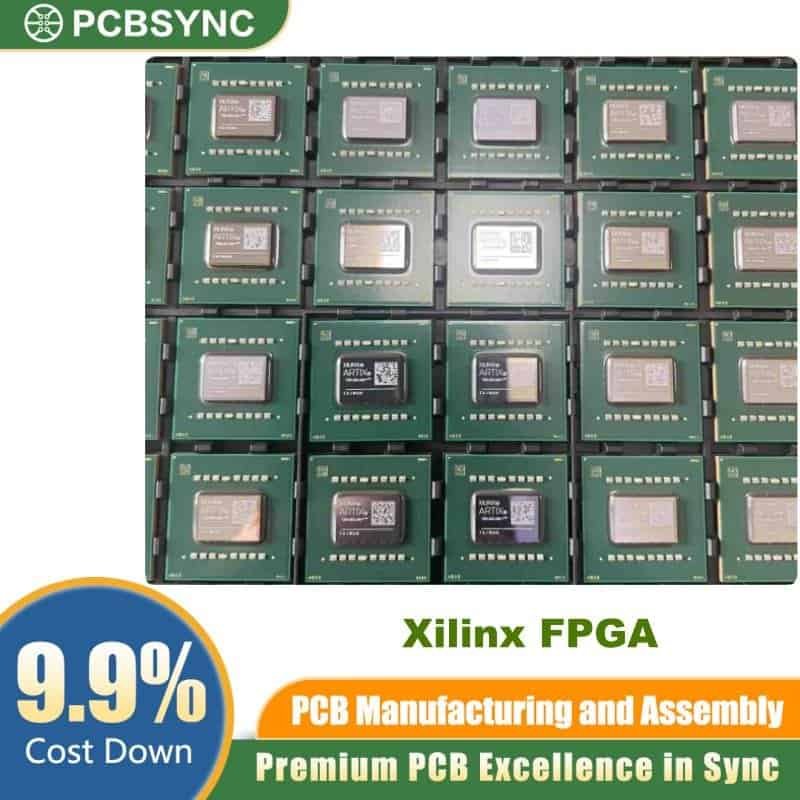
The XC2S200-6FGG1239C is a high-performance, 2.5V field-programmable gate array (FPGA) from the Xilinx Spartan-II family. Engineered for cost-sensitive, high-volume applications, this device delivers 200,000 system gates in a robust 1239-ball Fine-Pitch Ball Grid Array (FBGA) Pb-free package. Whether you are designing communication systems, industrial automation equipment, or embedded processing platforms, the XC2S200-6FGG1239C offers the programmable logic density, speed, and I/O flexibility needed to accelerate your product development cycle.
What Is the XC2S200-6FGG1239C?
The XC2S200-6FGG1239C is a member of Xilinx’s Spartan-II FPGA product line — a family specifically architected to combine low cost with competitive logic density. The part number breaks down as follows:
| Field |
Value |
Meaning |
| XC2S200 |
Device |
Spartan-II, 200K system gates |
| -6 |
Speed Grade |
Fastest commercial speed grade |
| FGG |
Package Type |
Fine-Pitch BGA, Pb-Free (G = RoHS-compliant) |
| 1239 |
Pin Count |
1239-ball BGA package |
| C |
Temperature |
Commercial range (0°C to +85°C) |
As a Xilinx FPGA in the Spartan-II series, the XC2S200-6FGG1239C is built on an advanced 0.18 µm, six-layer metal CMOS process, enabling high integration with a small power footprint. It is an excellent choice for engineers seeking a proven, reprogrammable alternative to mask-programmed ASICs — without the high NRE costs or long lead times typically associated with custom silicon.
XC2S200-6FGG1239C Key Technical Specifications
Understanding the core specifications of the XC2S200-6FGG1239C is essential for selecting the right device for your design. The table below summarizes the most important electrical and logic characteristics.
Core Logic and Memory Specifications
| Parameter |
XC2S200 Value |
| System Gates |
200,000 |
| Logic Cells |
5,292 |
| CLB Array |
28 × 42 |
| Total CLBs |
1,176 |
| Maximum User I/O |
284 |
| Distributed RAM |
75,264 bits |
| Block RAM |
56K bits (56,000 bits) |
| Block RAM Columns |
2 |
Electrical and Packaging Specifications
| Parameter |
Value |
| Core Supply Voltage |
2.5V |
| I/O Standard Support |
3.3V, 2.5V, 1.8V, 1.5V (MultiVolt I/O) |
| Process Technology |
0.18 µm, 6-layer metal CMOS |
| Speed Grade |
-6 (fastest commercial) |
| Max System Clock Frequency |
263 MHz |
| Package |
FGG1239 (1239-ball Fine-Pitch BGA, Pb-Free) |
| Operating Temperature |
0°C to +85°C (Commercial) |
| RoHS Compliance |
Yes (Pb-Free, “G” suffix) |
XC2S200-6FGG1239C Architecture Overview
Configurable Logic Blocks (CLBs)
The heart of the XC2S200-6FGG1239C is its array of 1,176 Configurable Logic Blocks (CLBs), organized in a 28-column by 42-row matrix. Each CLB contains four logic cells, where each logic cell includes:
- A 4-input Look-Up Table (LUT) for implementing arbitrary combinational logic
- A D-type flip-flop for sequential logic
- Dedicated carry logic for fast arithmetic operations
- Multiplexers for flexible routing
This architecture supports the implementation of complex state machines, DSP pipelines, data path processors, and custom logic functions — all within a single reprogrammable device.
Block RAM and Distributed RAM
The XC2S200-6FGG1239C provides two distinct types of on-chip memory:
| Memory Type |
Total Capacity |
Configuration Options |
| Distributed RAM |
75,264 bits |
16×1, 32×1, 16×2, 16×4 (single/dual port) |
| Block RAM |
56,000 bits (7 × 8K) |
True dual-port, 1K×4 to 256×16 |
Block RAM modules support synchronous, dual-port access, making them ideal for FIFO buffers, lookup tables, and small embedded memories. Distributed RAM, formed from the LUTs within CLBs, is suited for smaller, performance-critical storage tasks.
Input/Output Blocks (IOBs) and MultiVolt I/O
The XC2S200-6FGG1239C supports up to 284 user I/O pins, each served by a fully configurable Input/Output Block (IOB). Key I/O features include:
- MultiVolt I/O: Each I/O bank can be independently powered, supporting 3.3V, 2.5V, 1.8V, and 1.5V logic levels simultaneously
- Programmable drive strength: 2 mA to 24 mA per pin
- Slew rate control: Fast or slow (reduces EMI)
- Optional pull-up, pull-down, and keeper circuits
- Input delay element: For setup/hold time management
This flexibility allows the XC2S200-6FGG1239C to interface directly with virtually any modern logic family, reducing the need for external level translators.
Delay-Locked Loops (DLLs)
Four Delay-Locked Loops (DLLs) — one at each corner of the die — provide precision clock management. The DLLs enable:
- Clock deskew to eliminate board-level distribution delays
- Clock multiplication and division for flexible frequency synthesis
- Phase shifting for timing-critical data capture
XC2S200-6FGG1239C Speed Grade and Timing Performance
The -6 speed grade is the fastest available for the Spartan-II family in the commercial temperature range. This designation guarantees the best worst-case timing performance, making it the preferred choice for timing-critical applications.
| Timing Parameter |
-6 Speed Grade |
| Maximum System Clock |
263 MHz |
| Minimum Clock-to-Out (Tco) |
~3.5 ns (typical) |
| Minimum Setup Time (Tsu) |
~1.0 ns (typical) |
| Logic Propagation Delay |
Sub-5 ns pin-to-pin (typical) |
Note: The -6 speed grade is exclusively available for commercial temperature range (C-grade) devices. Industrial temperature range devices are available in -5 and -4 speed grades.
XC2S200-6FGG1239C Package: The FGG1239 FBGA
The FGG1239 package is a 1239-ball Fine-Pitch Ball Grid Array (FBGA) with a Pb-free solder ball composition (indicated by the double “GG” suffix). This large-pitch BGA offers significant PCB routing and integration advantages:
| Package Feature |
Detail |
| Package Type |
Fine-Pitch Ball Grid Array (FBGA) |
| Total Balls |
1,239 |
| Pb-Free |
Yes (RoHS compliant) |
| PCB Mount |
Surface Mount (SMD) |
| Ball Pitch |
Fine Pitch |
The large pin count of the FGG1239 package provides generous I/O expansion room beyond the 284 user I/O pins, allowing for additional power and ground balls that improve power delivery and signal integrity — a critical consideration in high-speed FPGA designs.
Comparing XC2S200-6FGG1239C with Other Spartan-II Variants
The Spartan-II family spans six density grades. The table below positions the XC2S200 at the top of the family, showing how it compares to smaller sibling devices.
| Device |
System Gates |
Logic Cells |
CLB Array |
Max User I/O |
Block RAM |
| XC2S15 |
15,000 |
432 |
8×12 |
86 |
16K |
| XC2S30 |
30,000 |
972 |
12×18 |
92 |
24K |
| XC2S50 |
50,000 |
1,728 |
16×24 |
176 |
32K |
| XC2S100 |
100,000 |
2,700 |
20×30 |
176 |
40K |
| XC2S150 |
150,000 |
3,888 |
24×36 |
260 |
48K |
| XC2S200 |
200,000 |
5,292 |
28×42 |
284 |
56K |
The XC2S200-6FGG1239C is the highest-density device in the Spartan-II family, offering the most logic cells, the most block RAM, and the most user I/O — making it the right choice when design complexity demands maximum resources at minimum cost.
Top Applications for the XC2S200-6FGG1239C
The XC2S200-6FGG1239C is widely deployed across multiple industries where programmable logic, fast time-to-market, and field upgradability are priorities.
Communications and Networking
- Protocol bridges (SPI, I2C, UART, PCI)
- Network packet processing and routing logic
- Serial/parallel data conversion
- Line card controllers in telecom equipment
Industrial Automation and Control
- Motor drive control (PWM generation, encoder interfaces)
- PLC co-processor and I/O expansion
- Machine vision preprocessing
- Safety-critical interlocking logic
Embedded Processing and DSP
- Custom DSP pipelines (FIR/IIR filters, FFT blocks)
- Hardware accelerators for embedded processors
- Co-processing alongside microcontrollers and DSPs
Test and Measurement Equipment
- High-speed data acquisition front ends
- Logic analyzer and signal generator cores
- Automated test equipment (ATE) logic
- Sensor fusion and conditioning
Medical Devices
- Patient monitoring signal processing
- Imaging system front-end logic
- Diagnostic equipment data interfaces
- Reconfigurable algorithm platforms for regulatory flexibility
Advantages of Choosing the XC2S200-6FGG1239C Over ASICs
One of the defining strengths of the XC2S200-6FGG1239C — and of FPGAs in general — is how it compares to traditional mask-programmed ASICs:
| Comparison Factor |
XC2S200-6FGG1239C (FPGA) |
Mask-Programmed ASIC |
| NRE Cost |
None |
$100K–$5M+ |
| Time to First Silicon |
Hours (in-system) |
3–18 months |
| Design Changes |
Reprogrammable at any time |
Requires full tape-out |
| Risk |
Low (fully testable before production) |
High (expensive re-spins) |
| Volume Economics |
Cost-effective at low-to-mid volumes |
Optimal only at very high volumes |
| Field Upgradability |
Yes (firmware updates) |
No |
For designs that require flexibility, fast iterations, or medium production volumes, the XC2S200-6FGG1239C delivers ASIC-class logic integration without ASIC-class risk.
Design Tools and Development Environment
The XC2S200-6FGG1239C is supported by Xilinx (now AMD) design software. For legacy Spartan-II devices, the recommended tool chain includes:
| Tool |
Purpose |
| Xilinx ISE Design Suite |
RTL synthesis, place-and-route, bitstream generation |
| VHDL / Verilog / SystemVerilog |
HDL design entry |
| ChipScope Pro |
In-system logic debugging |
| iMPACT |
Device programming via JTAG |
| Xilinx Constraints Editor |
Timing constraints (UCF format) |
The device supports JTAG boundary scan (IEEE 1149.1) for board-level test and in-system programming, simplifying both production test and field firmware updates.
Configuration Modes for XC2S200-6FGG1239C
Spartan-II FPGAs, including the XC2S200-6FGG1239C, support multiple configuration modes to suit different system architectures:
| Configuration Mode |
Description |
| Master Serial |
FPGA drives clock; reads bitstream from external serial PROM |
| Slave Serial |
External controller drives configuration data |
| Master Parallel (SelectMAP) |
Fast parallel configuration from an 8-bit bus |
| Slave Parallel (SelectMAP) |
Processor-driven parallel configuration |
| JTAG / Boundary Scan |
In-system programming via standard JTAG interface |
Configuration data is stored in an external non-volatile memory (e.g., Xilinx Platform Flash PROM). On power-up, the XC2S200-6FGG1239C automatically loads its configuration from the connected memory device.
XC2S200-6FGG1239C Ordering Information and Availability
When specifying the XC2S200-6FGG1239C, it is important to verify the full part number to ensure the correct package, speed grade, and temperature range are ordered.
| Part Number Field |
Decoded Value |
| XC2S200 |
Spartan-II, 200,000 system gates |
| -6 |
Speed Grade 6 (fastest, commercial only) |
| FGG |
Fine-Pitch BGA, Pb-Free |
| 1239 |
1239-pin package |
| C |
Commercial temperature range (0°C to +85°C) |
Full Part Number: XC2S200-6FGG1239C
This part is typically available through authorized distributors of AMD/Xilinx components, including component brokers specializing in legacy Xilinx FPGAs. Because the Spartan-II family is a mature product line, buyers should verify current availability and lead times with their preferred supplier.
Frequently Asked Questions (FAQ)
What does the “-6” speed grade mean on the XC2S200-6FGG1239C?
The -6 speed grade indicates the fastest timing performance available for the Spartan-II family in the commercial temperature range. A higher number means faster logic propagation, lower clock-to-output delay, and support for higher system clock frequencies — up to 263 MHz for the XC2S200.
Is the XC2S200-6FGG1239C RoHS compliant?
Yes. The double “GG” in the part number (FGG1239) indicates a Pb-free, RoHS-compliant package with lead-free solder balls. This makes it suitable for designs that must meet European RoHS directives and similar international environmental regulations.
What is the difference between FGG1239 and FGG456 packages for the XC2S200?
Both are Fine-Pitch BGA packages. The FGG1239 has a higher ball count (1,239 vs. 456), providing more power and ground connections for improved power integrity and signal routing flexibility on high-layer-count PCBs.
Can the XC2S200-6FGG1239C be used for new designs?
While the Spartan-II family is a mature and proven platform, Xilinx/AMD has introduced newer families (Spartan-6, Spartan-7, Artix-7) with more advanced features. The XC2S200-6FGG1239C remains an excellent choice for maintaining existing designs, replenishment orders, and applications where legacy compatibility is required.
What design software supports the XC2S200-6FGG1239C?
The primary design tool is Xilinx ISE Design Suite, which supports all Spartan-II devices. The Vivado Design Suite does not support Spartan-II; ISE is required for synthesis, implementation, and bitstream generation.
Conclusion
The XC2S200-6FGG1239C is a fully featured, high-density Spartan-II FPGA that delivers 200,000 system gates, 5,292 logic cells, 284 user I/O pins, and 56K bits of block RAM — all in a Pb-free 1239-ball FBGA package. With its -6 speed grade, MultiVolt I/O support, four on-chip DLLs, and broad development tool support, it is a versatile choice for communication, industrial, medical, and embedded processing applications.
Its reprogrammability and zero NRE cost make it a compelling alternative to ASICs for low-to-medium volume production, while its mature architecture ensures proven reliability across years of deployment. Engineers sourcing this component for legacy support or new designs requiring high I/O density will find the XC2S200-6FGG1239C to be a dependable, well-documented platform backed by extensive Xilinx ecosystem resources.