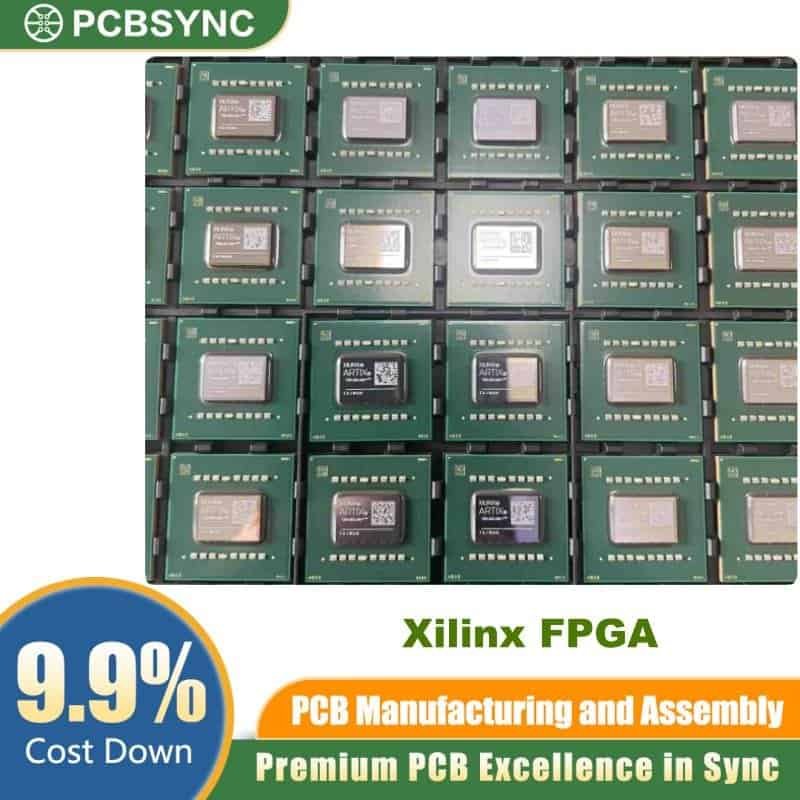
The XC2S200-6FGG1236C is a high-pin-count, commercial-grade Field Programmable Gate Array from Xilinx’s Spartan-II family. Housed in a 1236-ball Fine Pitch Ball Grid Array (FBGA) package and running at the fastest available -6 speed grade, this FPGA delivers 200,000 system gates, 5,292 logic cells, and up to 284 user I/O pins — making it one of the most capable variants in the entire XC2S200 lineup. Whether you are designing industrial control systems, telecommunications equipment, or high-density prototyping boards, the XC2S200-6FGG1236C offers the logic density and I/O flexibility your project demands.
For a broader overview of the full Xilinx Spartan device portfolio, visit Xilinx FPGA.
What Is the XC2S200-6FGG1236C? Part Number Decoded
Understanding the part number helps engineers quickly identify the exact variant they need. The XC2S200-6FGG1236C follows the standard Xilinx Spartan-II ordering convention:
| Code Segment |
Meaning |
| XC2S200 |
Spartan-II family, 200K system gate density |
| -6 |
Speed grade 6 (fastest available for Spartan-II) |
| FGG |
Fine Pitch Ball Grid Array, Pb-Free (lead-free) package |
| 1236 |
1236 total package pins/balls |
| C |
Commercial temperature range (0°C to +85°C) |
The “G” in FGG is critical: it denotes the Pb-free (RoHS-compliant) version of the package, distinguishing it from the standard FG variant. The -6 speed grade is exclusively available in the commercial temperature range, making the XC2S200-6FGG1236C a uniquely positioned part for high-speed, cost-sensitive commercial applications.
XC2S200-6FGG1236C Key Specifications at a Glance
| Parameter |
Value |
| Manufacturer |
Xilinx (AMD) |
| Product Family |
Spartan-II |
| Device |
XC2S200 |
| Speed Grade |
-6 (Fastest) |
| System Gates |
200,000 |
| Logic Cells |
5,292 |
| CLB Array |
28 × 42 |
| Total CLBs |
1,176 |
| Max User I/O |
284 |
| Distributed RAM |
75,264 bits |
| Block RAM |
56K bits |
| Core Voltage (VCCINT) |
2.5V |
| Technology Node |
0.18 µm |
| Max Clock Frequency |
263 MHz |
| Package Type |
FGG (Fine Pitch BGA, Pb-Free) |
| Pin Count |
1236 |
| Temperature Range |
Commercial (0°C to +85°C) |
| RoHS Compliance |
Yes (Pb-Free “G” package) |
Spartan-II Family Comparison: Where Does XC2S200 Stand?
The XC2S200 is the largest device in the Spartan-II family. The table below shows how it compares to other family members, helping engineers select the right gate density for their design:
| Device |
Logic Cells |
System Gates |
CLB Array |
Total CLBs |
Max User I/O |
Dist. RAM (bits) |
Block RAM |
| XC2S15 |
432 |
15,000 |
8×12 |
96 |
86 |
6,144 |
16K |
| XC2S30 |
972 |
30,000 |
12×18 |
216 |
92 |
13,824 |
24K |
| XC2S50 |
1,728 |
50,000 |
16×24 |
384 |
176 |
24,576 |
32K |
| XC2S100 |
2,700 |
100,000 |
20×30 |
600 |
176 |
38,400 |
40K |
| XC2S150 |
3,888 |
150,000 |
24×36 |
864 |
260 |
55,296 |
48K |
| XC2S200 |
5,292 |
200,000 |
28×42 |
1,176 |
284 |
75,264 |
56K |
The XC2S200 tops every metric in the Spartan-II family — the highest logic cell count, the largest CLB array, the most user I/O, and the greatest memory capacity.
XC2S200-6FGG1236C Package Options vs. Other XC2S200 Variants
The XC2S200 die is available in multiple package options. The FGG1236 is the largest footprint, providing access to the full 284 user I/O pins. Below is a comparison of available package variants:
| Part Number |
Package |
Pin Count |
Max User I/O |
Pb-Free |
| XC2S200-6PQ208C |
PQFP |
208 |
140 |
No |
| XC2S200-6PQG208C |
PQFP |
208 |
140 |
Yes |
| XC2S200-6FG256C |
FBGA |
256 |
176 |
No |
| XC2S200-6FGG256C |
FBGA |
256 |
176 |
Yes |
| XC2S200-6FG456C |
FBGA |
456 |
284 |
No |
| XC2S200-6FGG456C |
FBGA |
456 |
284 |
Yes |
| XC2S200-6FGG1236C |
FBGA |
1236 |
284 |
Yes |
Note: All package variants share the same XC2S200 die with identical logic resources. The primary differences are pin count, board footprint, and I/O accessibility.
Architecture Deep Dive: What’s Inside the XC2S200-6FGG1236C?
Configurable Logic Blocks (CLBs)
The Spartan-II architecture organizes logic in a regular array of Configurable Logic Blocks. Each CLB in the XC2S200 contains two slices, and each slice includes two 4-input look-up tables (LUTs), two storage elements (flip-flops or latches), fast carry logic, and wide-function multiplexers. With a 28×42 CLB array totaling 1,176 CLBs, the XC2S200 provides substantial logic density for complex finite state machines, data paths, and control logic.
Input/Output Blocks (IOBs)
Each IOB in the Spartan-II family supports multiple I/O standards, including LVTTL, LVCMOS, PCI, GTL, GTLP, HSTL, SSTL, and AGP. Programmable slew rates, output drive strength, and optional pull-up/pull-down resistors make the IOBs highly flexible for interfacing with a broad range of external devices.
Delay-Locked Loops (DLLs)
The XC2S200-6FGG1236C includes four Delay-Locked Loops, one positioned at each corner of the die. The DLLs eliminate clock distribution delays, support clock multiplication and division, and enable precise phase shifting — critical capabilities for high-speed synchronous designs.
Block RAM
Two columns of dedicated block RAM run along opposite sides of the die, between the CLB array and the IOB perimeter. Each XC2S200 device provides 56K bits of block RAM, configurable as dual-port memory for high-bandwidth internal data storage.
Routing Architecture
A hierarchical interconnect scheme — including local, long, and global routing resources — ensures that logic signals can be routed efficiently across the die without compromising timing closure on complex designs.
Configuration Modes for the XC2S200-6FGG1236C
The XC2S200-6FGG1236C supports four configuration modes, selectable via the M0, M1, and M2 mode pins:
| Configuration Mode |
M2–M1–M0 |
CCLK Direction |
Data Width |
Serial DOUT |
| Master Serial |
000 |
Output |
1-bit |
Yes |
| Slave Parallel |
010 |
Input |
8-bit |
No |
| Boundary-Scan (JTAG) |
100 |
N/A |
1-bit |
No |
| Slave Serial |
110 |
Input |
1-bit |
Yes |
The Boundary-Scan (JTAG) configuration mode is particularly useful for in-system programming and board-level testing, making the XC2S200-6FGG1236C well suited for production environments requiring automated test equipment (ATE) integration.
Typical Applications for the XC2S200-6FGG1236C
The XC2S200-6FGG1236C excels in applications that demand high I/O density, deterministic logic operation, and moderate gate count:
Industrial Automation & Control
Custom motor control algorithms, real-time sensor fusion, and multi-axis servo controllers benefit from the device’s deterministic timing and abundant I/O resources.
Telecommunications & Networking Equipment
Line cards, protocol bridges, and framing logic in legacy telecom infrastructure frequently rely on Spartan-II devices for their proven reliability and stable supply chain.
Prototyping & ASIC Emulation
The XC2S200’s 200K gate capacity makes it a practical platform for emulating mid-complexity ASIC designs prior to tape-out, reducing development risk and iteration time.
Digital Signal Processing (DSP)
With fast CLBs, DLLs for clock management, and dedicated block RAM, the XC2S200-6FGG1236C can implement FIR filters, FFT stages, and other DSP algorithms efficiently.
Embedded Systems & Soft-Core Processors
The gate density supports implementation of soft-core processor designs alongside peripheral logic, enabling custom SoC-like solutions in a single programmable device.
Design Tools & Software Support
The XC2S200-6FGG1236C is supported by Xilinx ISE Design Suite (ISE Foundation/WebPACK). Because the Spartan-II family predates Vivado, engineers must use ISE for synthesis, implementation, and bitstream generation targeting this device. ISE supports VHDL, Verilog, and schematic-based design entry.
For device programming and configuration, the Xilinx iMPACT tool supports all four configuration modes, including JTAG boundary-scan programming via the FGG1236 package’s dedicated JTAG pins.
Frequently Asked Questions About the XC2S200-6FGG1236C
Q: What is the maximum operating frequency of the XC2S200-6FGG1236C? A: The device is rated at up to 263 MHz system clock frequency at the -6 speed grade under commercial temperature and voltage conditions.
Q: Is the XC2S200-6FGG1236C RoHS compliant? A: Yes. The “G” in FGG denotes the Pb-free (lead-free) package variant, making it RoHS compliant.
Q: What temperature range does the XC2S200-6FGG1236C support? A: The “C” suffix indicates the Commercial temperature range: 0°C to +85°C. Industrial variants exist for other speed grades but not for the -6 grade.
Q: Can the XC2S200-6FGG1236C be reconfigured in-system? A: Yes. Using Slave Serial or Slave Parallel configuration modes, the device can be reconfigured in-system at runtime without hardware replacement — a key advantage over mask-programmed ASICs.
Q: What is the difference between FG1236 and FGG1236 packages? A: The “G” suffix in FGG designates the Pb-free (RoHS-compliant) version of the package. Both provide identical electrical performance and pinout.
Q: Is this part still recommended for new designs? A: The Spartan-II family is considered a mature/legacy product. Xilinx recommends evaluating newer Spartan-7 or Artix-7 devices for new designs. However, the XC2S200-6FGG1236C remains in demand for maintenance and repair of existing systems.
Summary: Why Choose the XC2S200-6FGG1236C?
The XC2S200-6FGG1236C stands out within the Spartan-II lineup for three reasons. First, the -6 speed grade delivers the fastest switching performance available in the family at 263 MHz, meeting demanding timing budgets. Second, the 1236-ball BGA package provides mechanical advantages in high-density PCB designs while offering access to all 284 available user I/O. Third, the Pb-free “G” package ensures compliance with modern environmental regulations without any compromise in electrical performance.
For engineers sourcing Xilinx FPGAs for both legacy support and new development, understanding the full range of available Xilinx FPGA products is essential to making the right design choice.