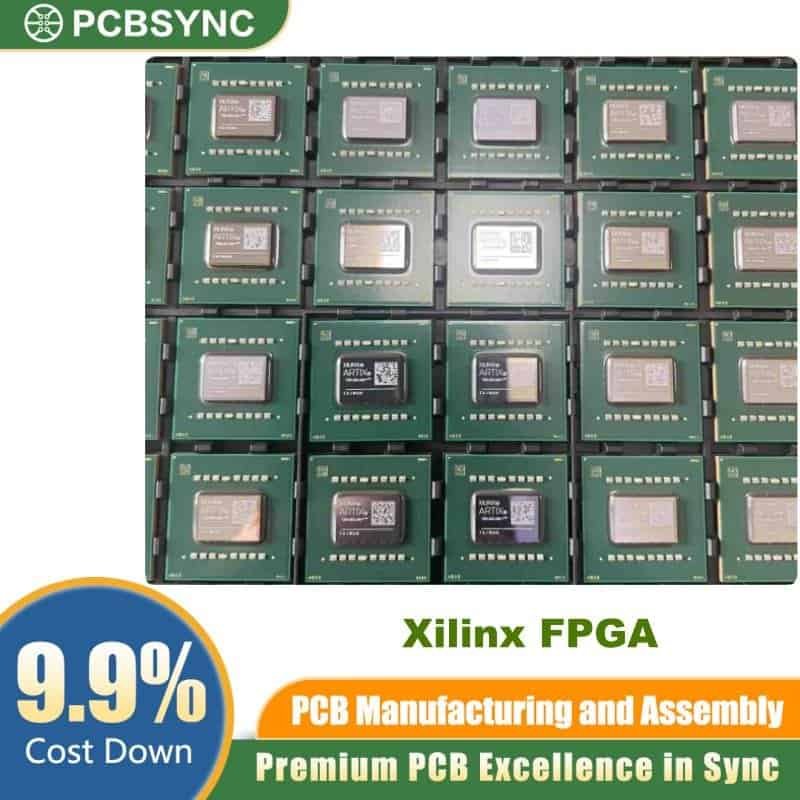
Meta Description: The XC2S200-6FGG1225C is a Xilinx Spartan-II FPGA featuring 200K system gates, 5,292 logic cells, -6 speed grade, and a Pb-free FGG1225 BGA package. Read the full specs, tables, and applications guide here.
What Is the XC2S200-6FGG1225C?
The XC2S200-6FGG1225C is a Field-Programmable Gate Array (FPGA) from Xilinx’s Spartan-II family — one of the most widely deployed programmable logic families in electronics history. This specific variant combines 200,000 system gates and 5,292 logic cells with the “-6” speed grade, the fastest commercially available speed grade for the Spartan-II series, housed in a high-density FGG1225 Ball Grid Array (BGA) package.
The “G” in the package code confirms Pb-free, RoHS-compliant construction, while the “C” suffix specifies a commercial operating temperature range of 0°C to +85°C. These two attributes together make the XC2S200-6FGG1225C a strong fit for modern production environments where both performance and environmental compliance are non-negotiable.
Built on a proven 0.18 µm CMOS process and operating from a 2.5V core supply, the XC2S200-6FGG1225C delivers high-speed digital logic capability across applications in communications, industrial automation, embedded systems, and signal processing.
XC2S200-6FGG1225C Complete Specifications Table
| Parameter |
Value |
| Part Number |
XC2S200-6FGG1225C |
| FPGA Family |
Spartan-II |
| Manufacturer |
Xilinx (AMD) |
| System Gates |
200,000 |
| Logic Cells |
5,292 |
| CLB Array |
28 × 42 |
| Total CLBs |
1,176 |
| Max User I/O Pins |
284 |
| Distributed RAM |
75,264 bits |
| Block RAM |
57,344 bits (56K) |
| DLLs (Clock Management) |
4 |
| Speed Grade |
-6 (Fastest Commercial) |
| Max Frequency |
Up to 263 MHz |
| Core Supply Voltage (VCCINT) |
2.5V |
| I/O Supply Voltage (VCCO) |
2.5V / 3.3V |
| Technology Node |
0.18 µm CMOS |
| Package |
FGG1225 (Fine-Pitch Ball Grid Array) |
| Lead-Free / RoHS |
Yes (Pb-free) |
| Temperature Range |
Commercial: 0°C to +85°C |
| Configuration Interface |
JTAG / Master Serial / Slave Serial |
Decoding the XC2S200-6FGG1225C Part Number
Every character in a Xilinx part number carries specific meaning. Understanding the ordering code helps you verify that you have selected the correct device for your design requirements.
| Segment |
Value |
Meaning |
| XC |
XC |
Xilinx Commercial product |
| 2S |
2S |
Spartan-II family |
| 200 |
200 |
200,000 system gates |
| -6 |
-6 |
Speed grade -6 (fastest commercial) |
| F |
F |
Fine-Pitch Ball Grid Array package |
| GG |
GG |
Pb-free (lead-free) variant |
| 1225 |
1225 |
1225-ball package |
| C |
C |
Commercial temperature (0°C to +85°C) |
Key distinction: The “GG” (double-G) in FGG1225 indicates a Pb-free package. A single “G” suffix (FG) indicates standard tin-lead solder. Always confirm the correct suffix when procuring for RoHS-regulated markets.
XC2S200-6FGG1225C Architecture Deep Dive
Configurable Logic Blocks (CLBs)
At the core of the XC2S200-6FGG1225C is a 28×42 array of 1,176 Configurable Logic Blocks. Each CLB consists of two logic cell slices, and each slice contains:
- Two 4-input Look-Up Tables (LUTs) for combinational logic
- Two storage elements (flip-flops or latches)
- Fast carry and arithmetic logic
- Wide-function multiplexers
This architecture supports efficient implementation of everything from simple glue logic to complex state machines and pipelined arithmetic units.
Distributed RAM
The LUT-based distributed RAM provides 75,264 bits of fast, flexible on-chip storage. It integrates directly into the CLB fabric and is ideal for FIFOs, shift registers, and small lookup tables embedded within your logic design.
Block RAM
The XC2S200-6FGG1225C includes two dedicated columns of block RAM totalling 57,344 bits (56K). Block RAM supports true dual-port access with independent read and write widths, enabling efficient data buffering and memory-intensive design patterns.
| Memory Resource |
Capacity |
Best Use |
| Distributed RAM |
75,264 bits |
FIFOs, shift registers, small LUTs |
| Block RAM |
57,344 bits (56K) |
Buffers, packet FIFOs, lookup tables |
| Total On-Chip Memory |
132,608 bits |
— |
Delay-Locked Loops (DLLs)
Four Delay-Locked Loops, one in each corner of the die, provide advanced clock management:
- Zero clock-skew distribution across the device
- Clock phase shifting (0°, 90°, 180°, 270°)
- Clock frequency multiplication and division
- Elimination of clock-insertion delay
DLLs are essential for designs operating at the device’s maximum -6 speed grade performance level.
Input/Output Blocks (IOBs)
The XC2S200-6FGG1225C supports up to 284 user I/O pins, arranged around the perimeter of the die. Each IOB supports:
- Programmable slew rate control
- Optional pull-up, pull-down, or keeper circuits
- Input delay elements for setup-time management
- Multiple I/O standards (LVTTL, LVCMOS, PCI, GTL, SSTL, HSTL, CTT, AGP)
XC2S200-6FGG1225C vs. Other XC2S200 Package Variants
The same XC2S200 silicon core is available across multiple package options. Here is how the FGG1225 variant compares to other orderable configurations:
| Part Number |
Package |
Ball/Pin Count |
Pb-Free |
Max I/O |
Temp Range |
Speed Grade |
| XC2S200-6FGG1225C |
FGG BGA |
1225 |
Yes |
284 |
Commercial |
-6 |
| XC2S200-6FGG456C |
FGG BGA |
456 |
Yes |
284 |
Commercial |
-6 |
| XC2S200-6FGG256C |
FGG BGA |
256 |
Yes |
176 |
Commercial |
-6 |
| XC2S200-6PQG208C |
PQFP |
208 |
Yes |
140 |
Commercial |
-6 |
| XC2S200-5FGG456I |
FGG BGA |
456 |
Yes |
284 |
Industrial |
-5 |
| XC2S200-4FGG456I |
FGG BGA |
456 |
Yes |
284 |
Industrial |
-4 |
The FGG1225 package offers the highest pin count in the XC2S200 lineup, providing maximum routing flexibility for complex, pin-intensive board designs.
Full Spartan-II Family Comparison
The XC2S200 is the largest member of the Spartan-II family. The table below shows how it benchmarks against all other family members:
| Device |
Logic Cells |
System Gates |
CLB Array |
Max I/O |
Dist. RAM |
Block RAM |
| XC2S15 |
432 |
15,000 |
8×12 |
86 |
6,144 bits |
16K |
| XC2S30 |
972 |
30,000 |
12×18 |
92 |
13,824 bits |
24K |
| XC2S50 |
1,728 |
50,000 |
16×24 |
176 |
24,576 bits |
32K |
| XC2S100 |
2,700 |
100,000 |
20×30 |
176 |
38,400 bits |
40K |
| XC2S150 |
3,888 |
150,000 |
24×36 |
260 |
55,296 bits |
48K |
| XC2S200 |
5,292 |
200,000 |
28×42 |
284 |
75,264 bits |
56K |
As the flagship device, the XC2S200-6FGG1225C delivers the maximum gate count, logic cell density, I/O capacity, and memory resources available within the Spartan-II portfolio.
Top Applications for the XC2S200-6FGG1225C
#### Digital Signal Processing (DSP)
The XC2S200-6FGG1225C handles high-throughput DSP workloads efficiently. Its abundant logic cells and on-chip memory support FIR/IIR filters, Fast Fourier Transform (FFT) engines, digital up/down converters, and custom signal chains operating up to 263 MHz.
#### High-Speed Communications and Networking
With 284 I/O pins and the fastest commercial speed grade, this FPGA is well-suited for implementing SONET framers, Ethernet MACs, serial-to-parallel converters, and custom communication protocol engines in telecom and datacom infrastructure.
#### Industrial Automation and Motion Control
The XC2S200-6FGG1225C handles PLC replacement logic, motor drive control, encoder interface decoding, and real-time process monitoring. Its field reprogrammability simplifies software updates without hardware replacement.
#### Embedded Processor Interfaces
In embedded system designs, this FPGA bridges processors, memory, and peripheral ICs. It implements custom bus bridges, DMA controllers, and hardware accelerators that offload work from the main CPU.
#### Medical Imaging and Diagnostics
Medical device engineers use Spartan-II FPGAs in ultrasound front-end logic, X-ray image processing pipelines, and patient monitoring equipment. The device’s deterministic timing behavior is valuable in safety-critical medical designs.
#### Video and Image Processing
Real-time video processing applications benefit from the XC2S200-6FGG1225C’s high I/O count and distributed RAM. Typical uses include image scaling, color space conversion, line buffering, and frame synchronization.
#### Aerospace and Defense
The Spartan-II architecture’s stability and long production history make the XC2S200-6FGG1225C appropriate for aerospace and defense designs that demand proven, reliable logic across extended operational lifetimes.
XC2S200-6FGG1225C vs. ASIC: Why Choose This FPGA?
The XC2S200-6FGG1225C is a compelling alternative to custom ASICs at low-to-medium production volumes. The table below summarizes the key trade-offs:
| Factor |
XC2S200-6FGG1225C (FPGA) |
Custom ASIC |
| Non-Recurring Engineering Cost |
None |
Very high ($500K–$5M+) |
| Time to First Silicon |
Days (bitstream) |
6–18 months |
| Design Error Recovery |
Reprogram bitstream |
Full respin required |
| Field Upgrade Capability |
Yes |
No |
| Performance |
Up to 263 MHz |
Can exceed GHz |
| Power Efficiency |
Moderate |
High (optimized) |
| Best Volume Range |
Low to medium |
High volume |
For engineers building prototypes, low-volume production hardware, or systems requiring periodic field updates, the XC2S200-6FGG1225C delivers faster time-to-market with far less financial risk.
For more information on selecting the right programmable logic solution for your project, visit Xilinx FPGA for in-depth product guidance and selection resources.
Power Supply Design for the XC2S200-6FGG1225C
| Supply Rail |
Voltage |
Description |
| VCCINT |
2.5V |
Core logic power supply |
| VCCO (Bank-specific) |
2.5V or 3.3V |
I/O bank power supply |
| VCCJ |
2.5V |
JTAG interface supply |
PCB design recommendations:
- Place 100 nF decoupling capacitors on every VCCINT pin, as close to the package as possible
- Place 10 µF bulk capacitors on both VCCINT and VCCO planes
- Use separate power planes for VCCINT and VCCO to minimize noise coupling
- Refer to Xilinx DS001 and XAPP176 for full power delivery network guidelines
Design Tool Support for the XC2S200-6FGG1225C
The XC2S200-6FGG1225C is supported by the Xilinx ISE Design Suite, the legacy toolchain for pre-Series-7 Xilinx devices. Vivado does not support Spartan-II, so ISE remains the correct implementation environment.
| Tool |
Purpose |
| ISE Design Suite |
Synthesis, Place & Route, Timing Analysis |
| IMPACT |
Bitstream download via JTAG |
| ChipScope Pro |
On-chip debug and signal capture |
| PlanAhead (early version) |
Floorplanning |
| ModelSim / ISIM |
RTL simulation and verification |
Supported HDL languages: VHDL, Verilog, and ABEL. The ISE XST synthesizer handles both VHDL and Verilog natively. Third-party synthesizers such as Synopsys Synplify Pro are also supported for the XC2S200-6FGG1225C.
Configuration Modes for the XC2S200-6FGG1225C
The Spartan-II FPGA supports multiple configuration modes, selectable via the M0, M1, and M2 mode pins:
| Mode |
Description |
Typical Use |
| Master Serial |
FPGA reads bitstream from an SPI PROM |
Standard production configuration |
| Slave Serial |
External host clocks bitstream into FPGA |
Processor-driven configuration |
| Slave Parallel (SelectMAP) |
8-bit parallel byte-wide configuration |
Faster configuration time |
| JTAG |
IEEE 1149.1 boundary-scan programming |
Development and debug |
Frequently Asked Questions About the XC2S200-6FGG1225C
What does the speed grade “-6” mean for the XC2S200-6FGG1225C?
The “-6” speed grade is the fastest available commercial speed grade for the Spartan-II family. It specifies the minimum propagation delay and maximum operating frequency of the device. Higher numbers in the Spartan-II speed grade system indicate faster devices. The -6 grade is only offered for commercial temperature range parts.
Is the XC2S200-6FGG1225C Pb-free and RoHS compliant?
Yes. The double-G “GG” in the FGG1225 package code confirms that this part uses a Pb-free (lead-free) ball grid array. It meets the requirements of the EU’s RoHS Directive and is appropriate for use in modern electronics manufacturing.
How many I/O pins does the XC2S200-6FGG1225C support?
The XC2S200 core supports up to 284 user I/O pins. The FGG1225 package provides sufficient ball count to expose the full user I/O capacity of this device. This is the maximum I/O count available in the Spartan-II family.
Can the XC2S200-6FGG1225C be reconfigured in the field?
Yes. Like all Spartan-II FPGAs, the XC2S200-6FGG1225C is SRAM-based and fully reconfigurable. A new bitstream can be loaded via JTAG or an external configuration PROM after the device is deployed in the field, with no hardware changes required.
What is the difference between XC2S200-6FGG1225C and XC2S200-6FGG456C?
Both devices share the same Spartan-II XC2S200 silicon core with identical logic resources, memory, and -6 speed grade. The key difference is the package: the FGG1225 provides more physical balls (1225 vs. 456), which typically offers better power distribution, improved thermal performance, and more routing flexibility on the PCB.
What software do I use to program the XC2S200-6FGG1225C?
Use the Xilinx ISE Design Suite for design implementation and the IMPACT tool for JTAG-based bitstream programming. The device does not support Vivado, which is intended for Series-7 and newer Xilinx devices.
Summary: Why the XC2S200-6FGG1225C Stands Out
The XC2S200-6FGG1225C brings together the peak logic density of the Spartan-II family — 200,000 system gates, 5,292 logic cells, 284 user I/O, and 132K bits of on-chip memory — in a high-density, Pb-free FGG1225 BGA package with the fastest commercial speed grade. Its 2.5V core voltage, 0.18 µm process technology, and proven ISE toolchain support make it a reliable, cost-effective choice for communications, industrial, embedded, medical, and DSP applications. For designs where pin density, field reprogrammability, and time-to-market efficiency matter most, the XC2S200-6FGG1225C remains a powerful and well-understood solution.