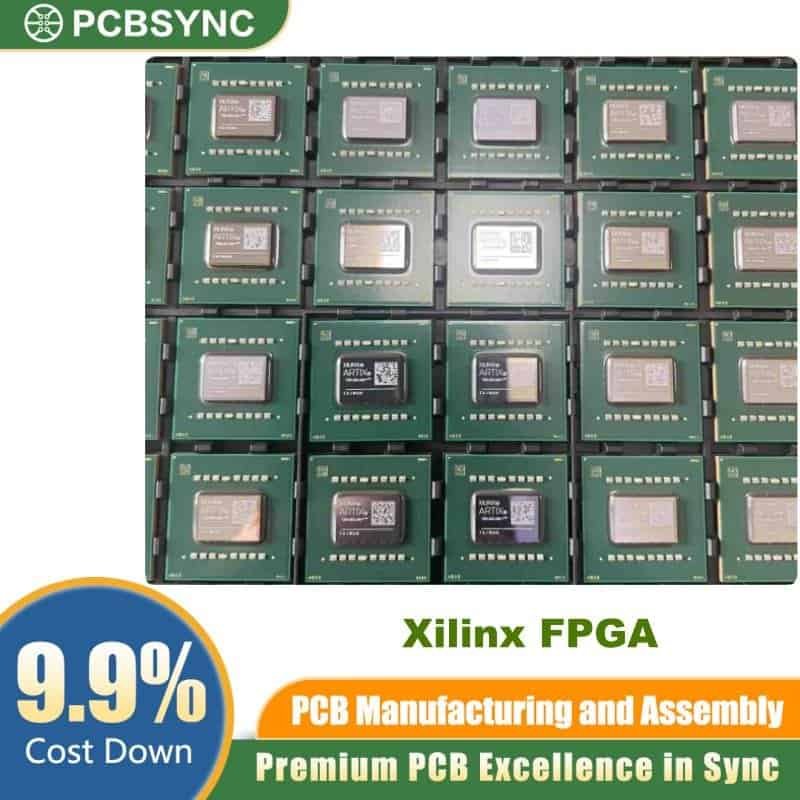
Meta Description: The XC2S200-6FGG1214C is a high-performance Xilinx Spartan-II FPGA with 200,000 system gates, 5,292 logic cells, and a 1,214-ball Pb-free FBGA package. Get full specs, pinout, and pricing here.
The XC2S200-6FGG1214C is a field-programmable gate array (FPGA) from Xilinx’s (now AMD) Spartan-II family. It delivers 200,000 system gates, 5,292 configurable logic cells, and comes in a robust 1,214-ball Fine-Pitch Ball Grid Array (FBGA) Pb-free package — making it one of the most capable members of the Spartan-II series. Whether you are designing for telecommunications, industrial automation, or consumer electronics, the XC2S200-6FGG1214C provides exceptional performance at a competitive price point.
Looking for compatible Xilinx FPGA components and PCB solutions? Visit PCBSync for expert resources.
What Is the XC2S200-6FGG1214C?
The XC2S200-6FGG1214C is a member of the Xilinx Spartan-II FPGA family, manufactured using advanced 0.18 µm process technology. It operates on a 2.5V core voltage and is rated for commercial temperature range (0°C to +85°C). The “-6” speed grade denotes the fastest available speed grade in the Spartan-II commercial lineup, while the “FGG1214” suffix identifies the 1,214-ball Fine-Pitch BGA package with the double “G” confirming it is RoHS-compliant (Pb-free).
This device is ideal for engineers who need dense I/O capability, embedded memory, and high-speed clock management in a single, cost-effective FPGA.
XC2S200-6FGG1214C Key Specifications at a Glance
| Parameter |
Value |
| Part Number |
XC2S200-6FGG1214C |
| Manufacturer |
Xilinx (AMD) |
| Family |
Spartan-II |
| System Gates |
200,000 |
| Logic Cells |
5,292 |
| CLB Array |
28 × 42 |
| Total CLBs |
1,176 |
| Max User I/O |
284 |
| Distributed RAM |
75,264 bits |
| Block RAM |
56K bits (57,344 bits) |
| Process Technology |
0.18 µm |
| Core Voltage |
2.5V |
| Speed Grade |
-6 (Fastest Commercial) |
| Max Clock Frequency |
263 MHz |
| Package |
FGG1214 (1,214-ball Pb-free FBGA) |
| Temperature Range |
Commercial (0°C to +85°C) |
| RoHS Compliance |
Yes (Pb-free) |
XC2S200-6FGG1214C: Detailed Technical Overview
Logic Architecture and CLB Structure
The XC2S200-6FGG1214C features a 28 × 42 Configurable Logic Block (CLB) array, totalling 1,176 CLBs. Each CLB contains four logic cells, which include Look-Up Tables (LUTs), flip-flops, and carry logic. This architecture gives designers the flexibility to implement both combinatorial and registered logic efficiently.
The 5,292 logic cells allow complex designs — including DSP pipelines, state machines, and multi-channel serial interfaces — to be fully realized on a single chip. This is a key advantage over smaller Spartan-II variants and makes the XC2S200-6FGG1214C the largest device in the Spartan-II family.
On-Chip Memory Resources
The XC2S200-6FGG1214C provides two distinct types of embedded memory:
| Memory Type |
Capacity |
| Distributed RAM |
75,264 bits |
| Block RAM (total) |
57,344 bits (56K) |
| Configuration Bits |
1,335,840 bits |
Block RAM is organized into independent, synchronous dual-port modules positioned on opposite sides of the die. These are ideal for FIFO buffers, look-up tables, and data-path memory in high-speed designs.
I/O Capabilities and Supported Standards
The XC2S200-6FGG1214C supports up to 284 user I/O pins (excluding the four global clock/user input pins). Its I/O blocks (IOBs) support a wide range of single-ended and differential I/O standards, including:
| I/O Standard |
Type |
| LVTTL |
Single-ended |
| LVCMOS 3.3V / 2.5V |
Single-ended |
| PCI (3.3V, 33/66 MHz) |
Single-ended |
| GTL / GTL+ |
Single-ended |
| SSTL2 / SSTL3 |
Single-ended |
| AGP |
Single-ended |
| LVDS |
Differential |
| LVPECL |
Differential |
This broad I/O compatibility makes the XC2S200-6FGG1214C an excellent interface bridge between mixed-voltage systems.
Clock Management: Delay-Locked Loops (DLLs)
The XC2S200-6FGG1214C integrates four Delay-Locked Loops (DLLs), one at each corner of the die. These DLLs offer:
- Zero-delay clock buffering for board-level clock distribution
- Clock frequency synthesis (multiply/divide)
- Phase shifting for timing margin optimization
- Duty-cycle correction
This robust clock management system is critical for designs that require tight timing closure, such as DDR interfaces, high-speed serial links, and synchronous multi-board systems.
Configuration Modes
The XC2S200-6FGG1214C supports multiple industry-standard configuration modes, allowing flexible deployment options:
| Configuration Mode |
Data Width |
CCLK Direction |
Serial DOUT |
| Master Serial |
1-bit |
Output |
Yes |
| Slave Serial |
1-bit |
Input |
Yes |
| Slave Parallel |
8-bit |
Input |
No |
| Boundary-Scan (JTAG) |
1-bit |
N/A |
No |
Configuration can be performed using standard Xilinx Platform Flash PROMs, SPI Flash memories, or via JTAG for in-system programming — a key advantage for field upgrades.
FGG1214 Package Details: Why It Matters
The FGG1214 package suffix in XC2S200-6FGG1214C breaks down as follows:
| Code |
Meaning |
| F |
Fine-Pitch Ball Grid Array (FBGA) |
| GG |
Pb-free (RoHS-compliant) packaging |
| 1214 |
1,214 total solder balls |
| C |
Commercial temperature grade (0°C to +85°C) |
The large 1,214-ball package provides the highest pin count available for the XC2S200 device, enabling access to the full complement of 284 user I/O pins plus power, ground, and configuration pins. This makes it the preferred package choice for high pin-count system designs that demand maximum connectivity.
The Pb-free (RoHS) construction also ensures compliance with European Union WEEE/RoHS directives and is suitable for modern PCB assembly processes using lead-free solder alloys.
XC2S200-6FGG1214C vs. Other XC2S200 Package Variants
| Part Number |
Package |
Balls / Pins |
Pb-Free |
Temp Grade |
| XC2S200-6FGG1214C |
1214-ball FBGA |
1,214 |
✅ Yes |
Commercial |
| XC2S200-6FGG456C |
456-ball FBGA |
456 |
✅ Yes |
Commercial |
| XC2S200-6FG456C |
456-ball FBGA |
456 |
❌ No |
Commercial |
| XC2S200-6FG256C |
256-ball FBGA |
256 |
❌ No |
Commercial |
| XC2S200-6PQ208C |
208-pin PQFP |
208 |
❌ No |
Commercial |
The XC2S200-6FGG1214C clearly stands out with the largest ball count, maximizing I/O availability for complex, high-density board designs.
Spartan-II Family Comparison: Where the XC2S200 Sits
| Device |
Logic Cells |
System Gates |
CLB Array |
Max I/O |
Dist. RAM (bits) |
Block RAM |
| XC2S15 |
432 |
15,000 |
8 × 12 |
86 |
6,144 |
16K |
| XC2S30 |
972 |
30,000 |
12 × 18 |
92 |
13,824 |
24K |
| XC2S50 |
1,728 |
50,000 |
16 × 24 |
176 |
24,576 |
32K |
| XC2S100 |
2,700 |
100,000 |
20 × 30 |
176 |
38,400 |
40K |
| XC2S150 |
3,888 |
150,000 |
24 × 36 |
260 |
55,296 |
48K |
| XC2S200 |
5,292 |
200,000 |
28 × 42 |
284 |
75,264 |
56K |
As the table shows, the XC2S200 is the top-tier device in the Spartan-II family, offering the most logic resources, the highest I/O count, and the greatest memory capacity across the entire lineup.
Typical Applications of the XC2S200-6FGG1214C
The XC2S200-6FGG1214C excels in a broad range of application domains. Its combination of dense logic, embedded memory, DLLs, and extensive I/O support makes it a natural fit for the following use cases:
Telecommunications & Networking
- Packet processing and protocol bridging
- Multi-channel serial interfaces (UART, SPI, I2C)
- Line card and switching fabric implementations
Industrial Automation
- Motor control and PID feedback loops
- PLC replacement with custom logic
- Sensor data aggregation and processing
Digital Signal Processing (DSP)
- FIR/IIR filter implementations
- FFT pipelines
- Image and video pre-processing
Embedded Systems & SoC Design
- Custom processor pipelines (e.g., MicroBlaze soft-core implementations)
- Co-processing with host CPUs
- Interface bridging (PCI, DDR)
Test & Measurement Equipment
- Pattern generation and logic analysis
- High-speed data capture
- Protocol emulation
Why Choose the XC2S200-6FGG1214C Over an ASIC?
The XC2S200-6FGG1214C offers compelling advantages over fixed-function ASICs:
| Criterion |
XC2S200-6FGG1214C (FPGA) |
Custom ASIC |
| NRE Cost |
None |
$500K–$5M+ |
| Time to Market |
Days (reprogram in-field) |
12–18 months |
| Design Risk |
Low (re-programmable) |
High (mask-fixed) |
| Volume Flexibility |
Any volume |
High-volume only |
| Field Upgrades |
Yes (JTAG / serial) |
No |
| Logic Density |
200K system gates |
Custom |
For low-to-medium volume production and designs requiring iterative updates, the XC2S200-6FGG1214C is clearly the superior choice.
Design Tools & Software Support
The XC2S200-6FGG1214C is supported by the following Xilinx/AMD design tools:
Xilinx ISE Design Suite
The ISE (Integrated Software Environment) is the primary toolchain for Spartan-II devices. It provides:
- HDL synthesis (VHDL, Verilog)
- Implementation (map, place, and route)
- Timing analysis and simulation
- Bitstream generation and JTAG programming
Third-Party EDA Tools
The XC2S200-6FGG1214C is also compatible with major third-party synthesis tools, including Synopsys Synplify and Mentor Graphics Precision RTL.
Note: The XC2S200-6FGG1214C is not supported in Xilinx Vivado, which targets newer 7-Series and beyond devices. Always use ISE 14.7 for Spartan-II development.
Ordering Information: Decoding the XC2S200-6FGG1214C Part Number
| Code |
Description |
| XC |
Xilinx commercial product |
| 2S |
Spartan-II family |
| 200 |
200,000 system gates |
| -6 |
Speed grade (-6 = fastest commercial) |
| F |
Fine-Pitch BGA package type |
| GG |
Pb-free / RoHS-compliant |
| 1214 |
1,214 total ball count |
| C |
Commercial temperature range (0°C to +85°C) |
Absolute Maximum Ratings
| Parameter |
Value |
| Storage Temperature |
−65°C to +150°C |
| Junction Temperature |
+125°C |
| Supply Voltage (VCCINT) |
−0.5V to +3.0V |
| I/O Voltage (VCCO) |
−0.5V to +4.6V |
| Input Voltage |
−0.5V to VCCO + 0.5V |
⚠️ Operating beyond these limits may cause permanent damage to the device.
Frequently Asked Questions (FAQ)
What is the XC2S200-6FGG1214C used for?
The XC2S200-6FGG1214C is used in telecommunications, industrial automation, digital signal processing, and embedded systems design. Its large I/O count and dense logic make it suitable for complex, high-bandwidth applications.
Is the XC2S200-6FGG1214C RoHS compliant?
Yes. The double “GG” in the part number confirms that the XC2S200-6FGG1214C is packaged in a Pb-free (lead-free), RoHS-compliant FBGA package.
What is the maximum operating frequency of the XC2S200-6FGG1214C?
The XC2S200-6FGG1214C supports system performance up to 263 MHz with the -6 speed grade, which is the fastest commercial speed grade in the Spartan-II series.
Can I program the XC2S200-6FGG1214C in the field?
Yes. The device supports JTAG in-system programming and can be reconfigured via Master Serial, Slave Serial, or Slave Parallel modes — enabling field updates without hardware replacement.
What design software should I use for the XC2S200-6FGG1214C?
Use Xilinx ISE Design Suite (version 14.7) for Spartan-II device support. Vivado does not support the Spartan-II family.
What is the difference between FGG1214C and FGG456C?
The main difference is the package size and ball count. The FGG1214C has 1,214 solder balls, providing more routing and power/ground connections. Both are Pb-free and commercial temperature grade. The FGG1214C is preferred for designs requiring maximum I/O density.
Summary: Is the XC2S200-6FGG1214C Right for Your Design?
The XC2S200-6FGG1214C represents the pinnacle of the Xilinx Spartan-II family. With 200,000 system gates, 5,292 logic cells, 284 user I/O pins, embedded block RAM, and four on-chip DLLs — all in a Pb-free 1,214-ball FBGA package — it delivers a compelling combination of performance, density, and compliance for a wide range of applications.
Its -6 speed grade guarantees operation up to 263 MHz, making it one of the fastest options in the Spartan-II lineup. Furthermore, its RoHS-compliant packaging ensures it meets modern environmental standards for global markets.
If you are sourcing the XC2S200-6FGG1214C or exploring compatible Xilinx FPGA solutions, ensure you verify the full part number — including the “GG” Pb-free suffix — to guarantee compliance with your BOM and manufacturing requirements.