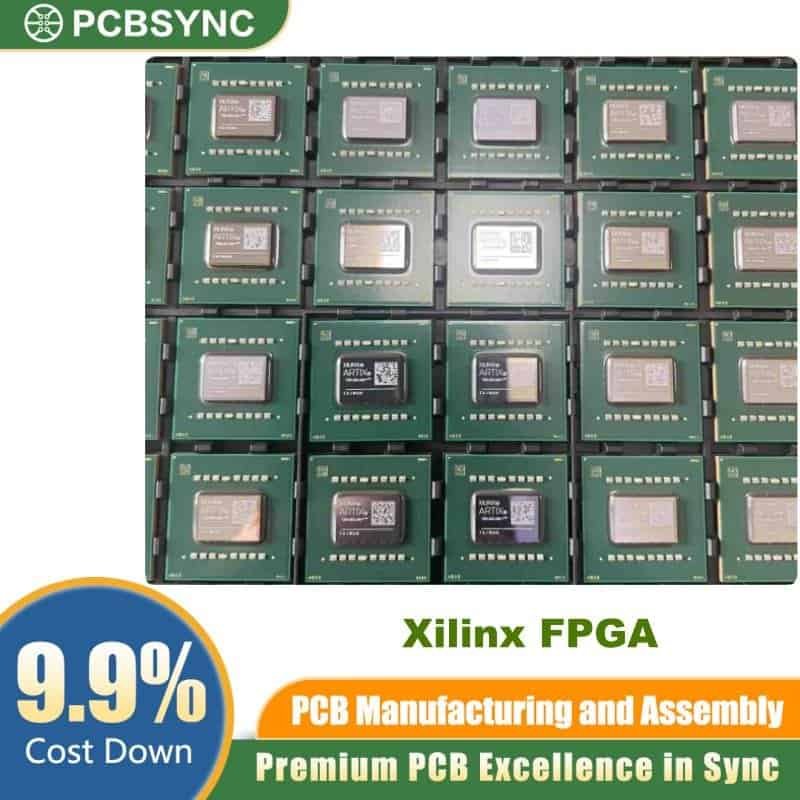
The XC2S200-6FGG1199C is a high-performance Field Programmable Gate Array (FPGA) from the Xilinx Spartan-II family, manufactured on an advanced 0.18µm process technology. Designed for engineers and developers who need a cost-effective, flexible, and reprogrammable logic solution, this device delivers 200,000 system gates, 5,292 logic cells, and a robust I/O architecture — all in a compact Ball Grid Array (BGA) package. Whether you are building embedded systems, telecommunications hardware, or industrial automation controllers, the XC2S200-6FGG1199C offers the reliability and performance that demanding applications require.
What Is the XC2S200-6FGG1199C? – Xilinx Spartan-II FPGA Overview
The XC2S200-6FGG1199C belongs to the Xilinx Spartan-II FPGA series, one of the industry’s most recognized families of programmable logic devices. The Spartan-II line was engineered as a cost-optimized alternative to mask-programmed ASICs, eliminating the high NRE (Non-Recurring Engineering) costs, long lead times, and inflexibility of traditional ASIC development.
Part Number Breakdown
Understanding the part number helps you verify compatibility and ordering:
| Field |
Code |
Meaning |
| Family |
XC2S |
Spartan-II Series |
| Gate Count |
200 |
200,000 System Gates |
| Speed Grade |
-6 |
Fastest commercial speed grade |
| Package |
FGG |
Fine-Pitch Ball Grid Array (FBGA) |
| Pin Count / Variant |
1199C |
Package/commercial variant designation |
Note: The -6 speed grade is exclusively available in the Commercial temperature range (0°C to +85°C), making the XC2S200-6FGG1199C ideal for commercial and industrial product development environments.
XC2S200-6FGG1199C Key Specifications
Core Logic Resources
| Parameter |
Value |
| System Gates |
200,000 |
| Logic Cells |
5,292 |
| CLB Array Size |
28 × 42 |
| CLB Count |
1,176 |
| Maximum Flip-Flops |
5,292 |
| Distributed RAM Bits |
75,264 bits |
Memory Resources
| Memory Type |
Capacity |
| Block RAM (embedded) |
57,344 bits (56 Kbits) |
| Block RAM Cells |
14 dual-port blocks |
| Distributed RAM |
75,264 bits |
| Total On-Chip RAM |
~132 Kbits |
Each block RAM is a fully synchronous, dual-ported 4,096-bit RAM with independent control signals per port, enabling high-bandwidth internal data buffering without external memory.
Clock and Timing
| Parameter |
Value |
| Max System Frequency |
263 MHz |
| Delay-Locked Loops (DLLs) |
4 (one per corner of die) |
| Global Clock Nets |
4 primary + 4 secondary |
| DLL Functions |
Deskew, frequency synthesis, clock mirroring |
I/O Characteristics
| Parameter |
Value |
| Maximum User I/O Pins |
284 |
| Selectable I/O Standards |
16+ |
| Input/Output Blocks (IOBs) |
Full LVCMOS, LVTTL, GTL, PCI, SSTL, HSTL support |
| ESD Protection |
On all I/O pins |
Power and Process Technology
| Parameter |
Value |
| Core Supply Voltage |
2.5V |
| I/O Voltage Range |
1.5V – 3.3V (depending on standard) |
| Process Node |
0.18µm CMOS |
| Operating Temperature |
0°C to +85°C (Commercial) |
XC2S200-6FGG1199C Architecture Deep Dive
Configurable Logic Blocks (CLBs)
The heart of the XC2S200 is its array of 1,176 Configurable Logic Blocks (CLBs) arranged in a 28×42 matrix. Each CLB contains four logic cells (slices), and each slice includes:
- Two 4-input Look-Up Tables (LUTs)
- Two storage elements (flip-flops or latches)
- Fast carry and arithmetic logic
- Wide function multiplexers
This architecture allows the XC2S200-6FGG1199C to implement a wide variety of digital functions — from simple glue logic to complex state machines and DSP pipelines.
Block RAM Architecture
The 14 embedded Block RAM modules are positioned along the vertical edges of the die, between CLB columns and IOB columns. Key features include:
- True dual-port access (two independent read/write ports)
- Independently configurable data widths per port
- Synchronous read and write operation
- Suitable for FIFOs, shift registers, ROM tables, and data buffers
Delay-Locked Loops (DLLs)
Four Delay-Locked Loops positioned at each corner of the die provide:
- Zero-skew clock distribution across the entire chip
- Input clock frequency multiplication and division
- Phase adjustment for high-speed interfaces
- Board-level clock deskewing (clock mirroring off-chip and back)
Interconnect Hierarchy
The XC2S200-6FGG1199C features a hierarchical routing architecture with multiple interconnect layers:
- Local routing between adjacent CLBs
- Long lines for global signal distribution
- Direct connections between neighboring CLBs for minimal delay
- Primary and secondary global clock networks for skew-free clock distribution
I/O Standards Supported by XC2S200-6FGG1199C
The device’s Input/Output Blocks (IOBs) support a broad range of industry-standard signaling levels, making it highly compatible with modern digital systems:
| I/O Standard |
Description |
| LVTTL |
Low-Voltage TTL (3.3V) |
| LVCMOS33 |
Low-Voltage CMOS 3.3V |
| LVCMOS25 |
Low-Voltage CMOS 2.5V |
| LVCMOS18 |
Low-Voltage CMOS 1.8V |
| LVCMOS15 |
Low-Voltage CMOS 1.5V |
| PCI |
3.3V PCI Bus |
| GTL |
Gunning Transceiver Logic |
| GTL+ |
GTL with termination |
| HSTL Class I/II |
High-Speed Transceiver Logic |
| SSTL2 Class I/II |
Stub Series Terminated Logic 2.5V |
| SSTL3 Class I/II |
Stub Series Terminated Logic 3.3V |
Each IOB also includes programmable pull-up, pull-down, and keeper circuits, along with adjustable output slew rate control.
Configuration Modes
The XC2S200-6FGG1199C supports multiple configuration methods to accommodate different system architectures:
| Configuration Mode |
CCLK Direction |
Data Width |
Serial DOUT |
| Master Serial |
Output |
1-bit |
Yes |
| Slave Serial |
Input |
1-bit |
Yes |
| Slave Parallel |
Input |
8-bit |
No |
| Boundary-Scan (JTAG) |
N/A |
1-bit |
No |
Configuration data can be loaded from external serial PROMs, parallel NOR Flash, microcontrollers, or directly via JTAG — offering maximum flexibility for production and field updates.
Applications of the XC2S200-6FGG1199C
#### Telecommunications & Networking
The device’s 200,000 system gates and 263 MHz maximum frequency make it ideal for line cards, protocol bridges, and baseband processing in wireline and wireless communications equipment.
#### Industrial Automation
With 284 I/O pins and support for multiple voltage standards, the XC2S200-6FGG1199C integrates seamlessly with PLCs, servo controllers, motion control systems, and industrial fieldbus interfaces.
#### High-Speed Data Acquisition
The combination of large embedded block RAM and fast DLL-enabled clocking supports real-time ADC/DAC interfacing, radar signal conditioning, and test and measurement instruments.
#### Embedded Vision & Image Processing
The 75,264-bit distributed RAM and 56 Kbit block RAM allow efficient implementation of pixel pipelines, convolution engines, and frame buffer management for machine vision and surveillance systems.
#### Wireless Communication Baseband Processing
The XC2S200-6FGG1199C’s logic density and reprogrammability make it suitable for prototyping and deploying 4G/5G baseband algorithms, spread-spectrum processing, and OFDM modulation schemes.
#### Medical Imaging & Diagnostics
Reliable 2.5V operation and commercial-grade stability enable its use in ultrasound front ends, CT scan controllers, and other precision medical imaging platforms.
Why Choose the XC2S200-6FGG1199C Over a Custom ASIC?
| Factor |
XC2S200-6FGG1199C FPGA |
Mask-Programmed ASIC |
| NRE Cost |
None |
$250,000 – $5,000,000+ |
| Time to Market |
Days to weeks |
6–18 months |
| Reprogrammability |
Yes (unlimited) |
No |
| Field Upgradability |
Yes (via JTAG or external PROM) |
No |
| Design Risk |
Low (iterate freely) |
High (costly re-spins) |
| Ideal Volume |
Low to medium |
High volume only |
For Xilinx FPGA solutions used in low-to-medium production volumes, or projects still in active development, the XC2S200-6FGG1199C offers a compelling total cost of ownership advantage over traditional ASIC approaches.
Design Tools & Software Support
The XC2S200-6FGG1199C is supported by Xilinx ISE (Integrated Software Environment), the legacy design suite for Spartan-II devices. Key toolchain components include:
- ISE Design Suite – RTL synthesis, place-and-route, timing analysis
- ModelSim / ISim – Functional and timing simulation
- iMPACT / JTAG – Device configuration and boundary-scan testing
- ChipScope Pro – Embedded logic analysis for real-time debug
Note: The newer Vivado Design Suite does not support Spartan-II devices. For new design starts, Xilinx recommends evaluating the Artix-7 or Spartan-7 families for continued software support.
Ordering Information & Available Variants
The XC2S200 is offered in multiple packages and speed grades. The table below summarizes the most common variants:
| Part Number |
Speed Grade |
Package |
User I/Os |
Temp Range |
| XC2S200-6PQ208C |
-6 (Fastest) |
208-pin PQFP |
140 |
Commercial |
| XC2S200-6FG256C |
-6 (Fastest) |
256-pin FBGA |
176 |
Commercial |
| XC2S200-6FGG456C |
-6 (Fastest) |
456-pin FBGA |
284 |
Commercial |
| XC2S200-5FGG456C |
-5 |
456-pin FBGA |
284 |
Commercial |
| XC2S200-5FG256I |
-5 |
256-pin FBGA |
176 |
Industrial |
| XC2S200-6FGG1199C |
-6 (Fastest) |
FGG BGA |
284 |
Commercial |
The -6 speed grade delivers the highest performance within the Spartan-II family and is only available for commercial temperature range applications (0°C to +85°C).
Frequently Asked Questions (FAQ)
What does the “6” in XC2S200-6FGG1199C mean?
The -6 denotes the speed grade. In the Spartan-II family, -6 is the fastest available speed grade, supporting maximum clock frequencies up to 263 MHz. It is only available in the commercial temperature range.
Is the XC2S200-6FGG1199C RoHS compliant?
Standard variants of the XC2S200 series are not RoHS compliant by default. Lead-free (Pb-free) variants include a “G” character in the ordering code. Verify with your distributor for the exact RoHS status of the XC2S200-6FGG1199C.
Can I reprogram the XC2S200-6FGG1199C in the field?
Yes. The device supports JTAG-based in-system programming (ISP) and can be reconfigured from external NOR Flash or serial PROM without physical hardware changes.
What design software do I need?
Use Xilinx ISE Design Suite for synthesis, simulation, and device programming. Vivado does not support Spartan-II devices.
What are the alternatives to the XC2S200-6FGG1199C?
If you need a modern alternative with extended software support, consider the Xilinx Spartan-6, Spartan-7, or Artix-7 families, which offer higher logic density, lower power, and full Vivado toolchain compatibility.
Summary: XC2S200-6FGG1199C at a Glance
| Specification |
Value |
| Manufacturer |
Xilinx (AMD) |
| Family |
Spartan-II |
| System Gates |
200,000 |
| Logic Cells |
5,292 |
| Block RAM |
57,344 bits |
| Distributed RAM |
75,264 bits |
| Max User I/Os |
284 |
| Max Frequency |
263 MHz |
| DLLs |
4 |
| Core Voltage |
2.5V |
| Process Node |
0.18µm |
| Speed Grade |
-6 (Commercial) |
| Operating Temp |
0°C to +85°C |
The XC2S200-6FGG1199C is a proven, production-grade FPGA that delivers substantial logic resources, high-speed clocking, and versatile I/O in a flexible Ball Grid Array package. Its ASIC-like performance with the full reprogrammability of an FPGA makes it a reliable choice for engineers across telecommunications, industrial, embedded, and data acquisition markets.