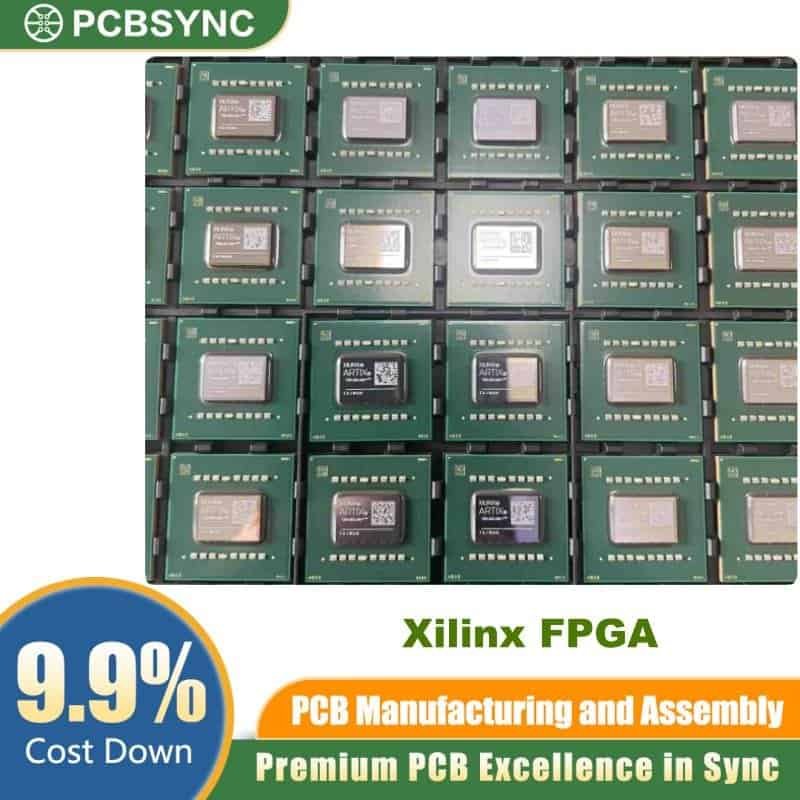
The XC2S200-6FGG1194C is a high-performance Field Programmable Gate Array (FPGA) from Xilinx’s Spartan-II family. Engineered for demanding digital design applications, this device delivers 200,000 system gates, 5,292 logic cells, and operates at up to 263 MHz — all within a robust 1194-pin Fine Pitch Ball Grid Array (FBGA) package. Whether you are designing telecommunications equipment, embedded systems, or industrial controllers, the XC2S200-6FGG1194C offers the logic density, I/O flexibility, and reprogrammability needed for modern hardware development.
For engineers and procurement professionals seeking a broad selection of compatible devices, explore the full range of Xilinx FPGA solutions available today.
What Is the XC2S200-6FGG1194C? Part Number Decoded
Understanding the part number helps engineers quickly identify the device’s key characteristics:
| Code Segment |
Meaning |
| XC2S200 |
Spartan-II family, 200,000 system gates |
| -6 |
Speed grade -6 (fastest available for Spartan-II Commercial) |
| FGG |
Fine Pitch Ball Grid Array, Pb-free (RoHS-compliant) package |
| 1194 |
1,194 total package pins |
| C |
Commercial temperature range (0°C to +85°C) |
The “-6” speed grade is exclusively available in the Commercial temperature range and represents the highest-performance option within the Spartan-II family. The “G” in “FGG” designates Pb-free, RoHS-compliant packaging, making this part suitable for modern environmentally regulated manufacturing environments.
XC2S200-6FGG1194C Key Specifications
Core Logic and Memory Resources
| Parameter |
Specification |
| Logic Cells |
5,292 |
| System Gates |
200,000 |
| CLB Array |
28 × 42 |
| Total CLBs |
1,176 |
| Distributed RAM |
75,264 bits |
| Block RAM |
56K bits (56,000 bits) |
| Maximum User I/O |
284 pins |
| Delay-Locked Loops (DLLs) |
4 (one at each die corner) |
Electrical and Timing Characteristics
| Parameter |
Specification |
| Core Supply Voltage |
2.5V |
| Process Technology |
0.18 µm CMOS |
| Maximum Clock Frequency |
Up to 263 MHz |
| Speed Grade |
-6 (Commercial only) |
| I/O Standards Supported |
16 selectable I/O standards |
| Operating Temperature |
0°C to +85°C (Commercial) |
Package Information
| Parameter |
Specification |
| Package Type |
Fine Pitch Ball Grid Array (FBGA) |
| Package Code |
FGG |
| Total Pin Count |
1,194 |
| RoHS Compliance |
Yes (Pb-free, “G” designation) |
| Mounting Type |
Surface Mount |
XC2S200-6FGG1194C Architecture Overview
Configurable Logic Blocks (CLBs)
The XC2S200 organizes its logic resources into 1,176 Configurable Logic Blocks arranged in a 28-column by 42-row array. Each CLB contains Look-Up Tables (LUTs) capable of implementing any 4-input Boolean function, along with flip-flops and carry logic for arithmetic operations. This structure enables the implementation of highly complex digital circuits including state machines, arithmetic units, and custom processors.
SelectRAM Hierarchical Memory
The Spartan-II architecture features a two-tier memory hierarchy branded as SelectRAM:
- Distributed RAM: Each LUT within a CLB can be configured as 16-bit synchronous RAM, totaling 75,264 bits of distributed RAM across the XC2S200. This memory is ideal for small FIFOs, register files, and look-up tables that require fast, single-cycle access.
- Block RAM: Four dedicated 4K-bit block RAM modules provide 56K bits of synchronous dual-port memory. Block RAM supports independent read and write ports with configurable width/depth ratios, making it suitable for larger buffers, packet memories, and frame stores.
Input/Output Blocks (IOBs) and I/O Standards
With up to 284 user-configurable I/O pins and support for 16 selectable I/O standards, the XC2S200-6FGG1194C integrates cleanly with a wide variety of external devices and buses. Supported I/O standards include LVTTL, LVCMOS, PCI, GTL, SSTL, and more — giving designers the freedom to interface with legacy and modern peripherals without external level-shifting.
Delay-Locked Loops (DLLs)
Four on-chip Delay-Locked Loops, positioned at each corner of the die, provide precise clock management. DLLs eliminate clock distribution skew, multiply or divide the input clock frequency, and phase-shift clock signals — critical capabilities for high-speed synchronous designs operating at or near the device’s 263 MHz maximum clock rate.
XC2S200 Family Comparison Table
The XC2S200 sits at the top of the Spartan-II product family. The table below shows how it compares to other members:
| Device |
Logic Cells |
System Gates |
CLB Array |
Total CLBs |
Max User I/O |
Distributed RAM |
Block RAM |
| XC2S15 |
432 |
15,000 |
8 × 12 |
96 |
86 |
6,144 bits |
16K |
| XC2S30 |
972 |
30,000 |
12 × 18 |
216 |
92 |
13,824 bits |
24K |
| XC2S50 |
1,728 |
50,000 |
16 × 24 |
384 |
176 |
24,576 bits |
32K |
| XC2S100 |
2,700 |
100,000 |
20 × 30 |
600 |
176 |
38,400 bits |
40K |
| XC2S150 |
3,888 |
150,000 |
24 × 36 |
864 |
260 |
55,296 bits |
48K |
| XC2S200 |
5,292 |
200,000 |
28 × 42 |
1,176 |
284 |
75,264 bits |
56K |
The XC2S200 provides the greatest logic density in the Spartan-II series, making the XC2S200-6FGG1194C the optimal choice for projects that have outgrown smaller Spartan-II members.
XC2S200-6 Speed Grade Comparison
Speed grade significantly affects maximum operating frequency and propagation delays. The table below outlines the general performance tiers within the Spartan-II XC2S200 family:
| Speed Grade |
Max Clock Frequency |
Temperature Range |
Availability |
| -6 |
Up to 263 MHz |
Commercial only (0°C to +85°C) |
Standard |
| -5 |
~200 MHz |
Commercial & Industrial |
Standard |
The -6 speed grade is the highest-performance option and is exclusively available for the Commercial temperature range. Engineers requiring industrial temperature range (-40°C to +85°C) must select a -5 speed grade variant.
Key Features of the XC2S200-6FGG1194C
#### Second-Generation ASIC Replacement Technology
The Spartan-II family was designed as a cost-effective alternative to mask-programmed ASICs. The XC2S200-6FGG1194C eliminates the high NRE (non-recurring engineering) costs of ASIC development, removes lengthy manufacturing lead times, and enables in-field design updates — a fundamental advantage impossible with fixed-function ASICs.
#### Unlimited Reprogrammability
As an SRAM-based FPGA, the XC2S200-6FGG1194C supports unlimited reprogramming cycles. Design changes, bug fixes, and feature additions can be deployed without hardware replacement. Configuration is loaded at power-up via an external PROM or through the JTAG boundary scan interface.
#### Virtex-Derived Architecture
The Spartan-II architecture is a streamlined derivative of Xilinx’s high-end Virtex FPGA architecture. This lineage provides engineers with a proven, high-performance fabric featuring advanced routing resources, dedicated carry logic, and a mature development ecosystem.
#### JTAG Boundary Scan Support
Full IEEE 1149.1 JTAG boundary scan support enables in-system programming, device configuration, and board-level debug without removing the component. This feature significantly reduces test and bring-up time during hardware development.
#### RoHS-Compliant Pb-Free Packaging
The “G” designation in “FGG” confirms this is the Pb-free, RoHS-compliant version of the standard FG package. This compliance is required for products sold into the European Union and increasingly mandated across global markets.
Typical Applications for the XC2S200-6FGG1194C
The XC2S200-6FGG1194C’s combination of high gate count, rich I/O, and fast clock speeds makes it suitable across a broad range of application domains:
#### Telecommunications and Networking
The device’s 263 MHz maximum clock rate and support for multiple I/O standards make it well-suited for line cards, packet processors, framer logic, and protocol bridging in telecom and networking infrastructure.
#### Industrial Automation and Control
With 284 user I/O pins and robust 2.5V operation, the XC2S200-6FGG1194C can interface with numerous sensors, actuators, and field bus interfaces simultaneously. Its reprogrammability supports iterative control algorithm development without board re-spins.
#### Embedded Vision and Image Processing
The device’s 5,292 logic cells and 56K bits of block RAM support efficient implementation of image filtering, edge detection, and video frame buffering for machine vision and surveillance systems.
#### High-Speed Data Acquisition
Real-time parallel data capture from ADCs and sensors benefits from the device’s fast clock, distributed RAM, and configurable I/O standards. The XC2S200-6FGG1194C can pre-process and buffer captured data streams before forwarding to a host processor.
#### Wireless Communication Baseband Processing
The 200,000-gate capacity supports complex modulation/demodulation algorithms for 4G/5G infrastructure, satellite terminals, and IoT concentrators operating at high symbol rates.
#### Rapid ASIC Prototyping
Hardware verification teams use the XC2S200-6FGG1194C to prototype ASIC designs before tape-out, catching functional bugs early and reducing the risk of costly silicon re-spins.
Development Tools and Software Support
#### Xilinx ISE Design Suite
The XC2S200-6FGG1194C is supported by the Xilinx ISE (Integrated Software Environment) design suite. ISE provides a complete RTL-to-bitstream flow including synthesis, place-and-route, timing analysis, and simulation. Note that newer Xilinx tools such as Vivado do not support Spartan-II devices — ISE remains the required toolchain for this family.
#### Supported Design Entry Methods
| Design Entry Method |
Supported |
| VHDL |
Yes |
| Verilog |
Yes |
| Schematic Entry |
Yes |
| EDIF Netlist |
Yes |
| NGC Netlist |
Yes |
#### Configuration Methods
| Configuration Method |
Description |
| Master Serial |
External serial PROM drives configuration at power-up |
| Slave Serial |
Downstream device in a daisy-chain configuration |
| SelectMAP (Parallel) |
High-speed parallel configuration via processor or logic |
| JTAG (Boundary Scan) |
In-system programming via IEEE 1149.1 interface |
| Master SPI (via JTAG) |
SPI flash-based configuration |
Ordering Information and Part Number Structure
Xilinx Spartan-II devices follow a structured ordering code. Understanding this code enables procurement teams to select the correct variant for their application:
XC2S200 - 6 - FGG - 1194 - C
   |      |    |      |    |
   |      |    |      |    Temperature: C = Commercial (0°C to +85°C)
   |      |    |      |                I = Industrial (-40°C to +85°C)
   |      |    |      Pin Count: 1194
   |      |    Package: FGG = Fine Pitch BGA, Pb-free
   |      Speed Grade: -6 (fastest, Commercial only)
   Device: XC2S200 (200K gates)
Common XC2S200 Variants
| Part Number |
Speed Grade |
Package |
Pins |
Temp Range |
Pb-Free |
| XC2S200-6FGG1194C |
-6 |
FBGA |
1194 |
Commercial |
Yes |
| XC2S200-6FGG456C |
-6 |
FBGA |
456 |
Commercial |
Yes |
| XC2S200-6FG456C |
-6 |
FBGA |
456 |
Commercial |
No |
| XC2S200-5FGG456C |
-5 |
FBGA |
456 |
Commercial |
Yes |
| XC2S200-5FGG456I |
-5 |
FBGA |
456 |
Industrial |
Yes |
| XC2S200-6PQG208C |
-6 |
PQFP |
208 |
Commercial |
Yes |
Frequently Asked Questions (FAQ)
Q: What is the maximum operating frequency of the XC2S200-6FGG1194C? The device supports system clock rates up to 263 MHz, making it suitable for high-speed digital processing tasks in telecommunications, data acquisition, and signal processing applications.
Q: Is the XC2S200-6FGG1194C RoHS compliant? Yes. The “G” in the package code “FGG” indicates a Pb-free, RoHS-compliant package. This makes the device suitable for products sold into the European Union and other markets with environmental restrictions on hazardous substances.
Q: What software do I need to design with the XC2S200-6FGG1194C? You must use the Xilinx ISE Design Suite. The newer Xilinx Vivado tool does not support Spartan-II FPGAs. ISE supports VHDL, Verilog, schematic entry, and EDIF netlists.
Q: Can the XC2S200-6FGG1194C operate at industrial temperatures? No. The -6 speed grade is exclusively available in the Commercial temperature range (0°C to +85°C). For industrial temperature operation (-40°C to +85°C), you must select a -5 speed grade variant such as the XC2S200-5FGG456I.
Q: How is the XC2S200-6FGG1194C configured after power-up? The device loads its configuration from an external source at power-up. Supported configuration modes include Master Serial (via external PROM), SelectMAP parallel configuration, and JTAG-based in-system programming.
Q: What is the difference between XC2S200-6FGG1194C and XC2S200-6FGG456C? Both devices contain the same XC2S200 silicon with the same 200,000 gates, 5,292 logic cells, and -6 speed grade. The primary difference is the package: the FGG1194C has 1,194 pins while the FGG456C has 456 pins. The higher pin count package provides more accessible I/O routing for dense board designs.
Summary: Why Choose the XC2S200-6FGG1194C?
The XC2S200-6FGG1194C delivers the highest logic density in the Spartan-II family combined with the highest available speed grade, all within a large-format FBGA package that maximizes PCB routing flexibility. Key strengths include:
- 200,000 system gates — top-of-family logic capacity for complex designs
- 263 MHz maximum clock — fastest speed grade in the Spartan-II lineup
- 284 user I/O pins — extensive connectivity with 16 selectable standards
- 75,264 bits distributed RAM + 56K block RAM — a rich two-tier memory hierarchy
- RoHS-compliant Pb-free packaging — ready for global regulatory compliance
- Unlimited reprogrammability — lower risk and faster iteration versus ASICs
For engineers seeking a mature, proven FPGA solution backed by a comprehensive design ecosystem, the XC2S200-6FGG1194C remains a compelling choice for legacy design support, prototyping, and cost-sensitive production applications.