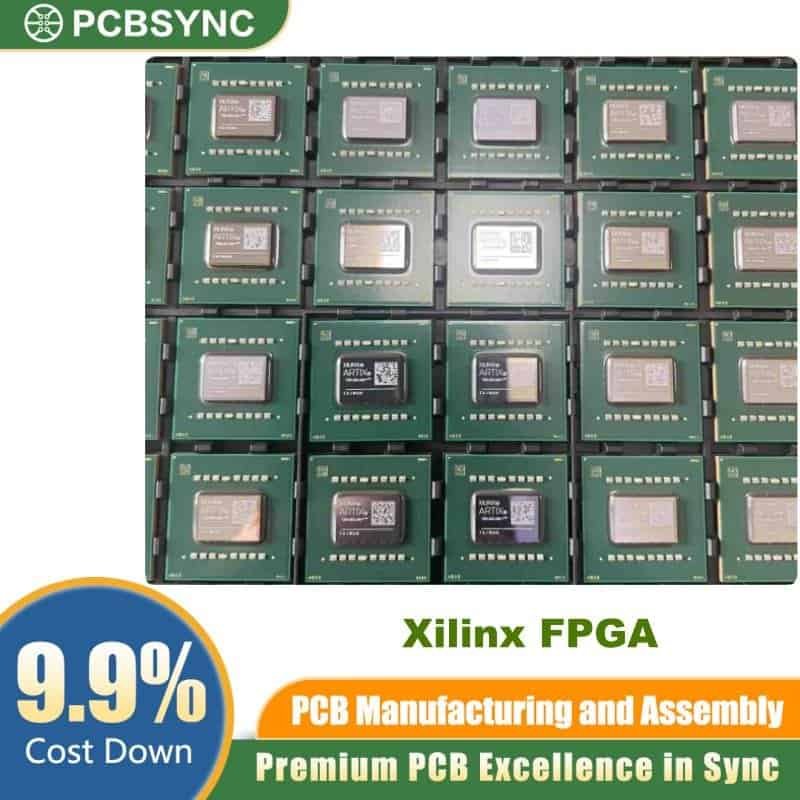
XC2S200-6FGG1177C: Complete Guide to Xilinx Spartan-II FPGA
The XC2S200-6FGG1177C is a high-performance Field Programmable Gate Array (FPGA) from Xilinx’s Spartan-II family. Designed for cost-sensitive, high-volume applications, this device delivers 200,000 system gates, 5,292 logic cells, and a -6 speed grade — making it one of the most capable parts in the Spartan-II lineup. Whether you’re designing embedded systems, telecommunications hardware, or industrial controllers, the XC2S200-6FGG1177C offers the flexibility, performance, and reliability engineers demand.
For a broader selection of compatible devices, explore our full range of Xilinx FPGA solutions.
What Is the XC2S200-6FGG1177C?
Part Number Breakdown
Understanding the XC2S200-6FGG1177C part number is essential for procurement and design planning. Each segment of the part number carries specific information:
| Segment |
Meaning |
| XC2S200 |
Xilinx Spartan-II family, 200K system gates |
| -6 |
Speed grade (fastest in the Spartan-II family) |
| FGG |
Fine-Pitch Ball Grid Array (FBGA), Pb-free package |
| 1177 |
1177-pin package |
| C |
Commercial temperature range (0°C to +85°C) |
Device Family Overview
The XC2S200-6FGG1177C belongs to the Xilinx Spartan-II family, a 2.5V FPGA series built on 0.18µm CMOS process technology. The Spartan-II family was designed as a direct, lower-cost alternative to mask-programmed ASICs, offering full reprogrammability without the NRE costs or development risk of traditional ASICs.
XC2S200-6FGG1177C Key Specifications
Core Logic and Memory Resources
| Parameter |
Value |
| Logic Cells |
5,292 |
| System Gates (Logic + RAM) |
200,000 |
| CLB Array |
28 × 42 |
| Total CLBs |
1,176 |
| Distributed RAM (bits) |
75,264 |
| Block RAM (bits) |
56K (57,344) |
| Block RAM Blocks |
14 |
Electrical and Physical Characteristics
| Parameter |
Value |
| Core Supply Voltage |
2.5V |
| Process Technology |
0.18µm CMOS |
| Speed Grade |
-6 (fastest available) |
| Max Clock Frequency |
263 MHz |
| Package Type |
FBGA (Fine-Pitch BGA), Pb-free |
| Pin Count |
1177 |
| Temperature Range |
Commercial (0°C to +85°C) |
| Maximum User I/O |
284 |
Configuration and Interface Features
| Feature |
Details |
| Configuration Modes |
Master Serial, Slave Serial, Slave Parallel, Boundary Scan |
| Delay-Locked Loops (DLLs) |
4 (one per corner of the die) |
| JTAG Boundary Scan |
IEEE 1149.1 compliant |
| I/O Standards Supported |
LVTTL, LVCMOS2, PCI, GTL, HSTL, SSTL |
XC2S200-6FGG1177C Architecture Deep Dive
Configurable Logic Blocks (CLBs)
The heart of the XC2S200-6FGG1177C is its array of 1,176 Configurable Logic Blocks (CLBs). Each CLB contains two slices, and each slice includes two 4-input Look-Up Tables (LUTs), two storage elements (flip-flops or latches), and fast carry logic. This architecture enables efficient implementation of arithmetic functions, state machines, and complex combinatorial logic.
Input/Output Blocks (IOBs)
The IOBs surrounding the CLB array support a wide range of single-ended and differential I/O standards. Key IOB features include:
- Programmable input delay for setup time optimization
- Optional pull-up, pull-down, and keeper circuits
- Slew rate control for EMI reduction
- Configurable drive strength
Block RAM
The XC2S200-6FGG1177C provides 56Kbits of dedicated block RAM, organized into 14 dual-port RAM blocks of 4Kbits each. This embedded memory is ideal for FIFOs, lookup tables, and temporary data buffers in high-speed designs.
Delay-Locked Loops (DLLs)
Four on-chip DLLs — positioned at each corner of the die — allow designers to eliminate clock skew, multiply or divide clock frequencies, and phase-shift clocks. This enables robust synchronous design without external clock conditioning components.
Spartan-II Family Comparison Table
The XC2S200 is the largest and most capable device in the Spartan-II family. The table below shows how it compares across the full family:
| Device |
Logic Cells |
System Gates |
Total CLBs |
Max User I/O |
Distributed RAM (bits) |
Block RAM (bits) |
| XC2S15 |
432 |
15,000 |
96 |
86 |
6,144 |
16K |
| XC2S30 |
972 |
30,000 |
216 |
92 |
13,824 |
24K |
| XC2S50 |
1,728 |
50,000 |
384 |
176 |
24,576 |
32K |
| XC2S100 |
2,700 |
100,000 |
600 |
176 |
38,400 |
40K |
| XC2S150 |
3,888 |
150,000 |
864 |
260 |
55,296 |
48K |
| XC2S200 |
5,292 |
200,000 |
1,176 |
284 |
75,264 |
56K |
Applications of the XC2S200-6FGG1177C
Telecommunications and Networking
The XC2S200-6FGG1177C is widely used in telecommunications infrastructure. Its 263 MHz maximum clock speed and 284 user I/O pins make it suitable for protocol processing, switching fabrics, and line card implementations in routers and switches.
Industrial Automation and Control
With its large I/O count and robust CLB architecture, this FPGA handles real-time motor control, process automation, and machine vision applications. The commercial temperature rating covers standard industrial environments.
Embedded Systems and SoC Prototyping
Engineers use the XC2S200-6FGG1177C for embedded processor implementations and SoC prototyping. The combination of distributed and block RAM supports soft-core processor deployments such as Xilinx’s PicoBlaze.
Signal Processing
The device’s logic density and high-speed clock capability support digital signal processing (DSP) pipelines, including FIR/IIR filters, FFT engines, and modulation/demodulation blocks for wireless baseband applications.
Medical and Security Systems
The reconfigurability of the XC2S200-6FGG1177C makes it valuable in diagnostic imaging equipment, patient monitoring systems, and security access control applications where design updates must be deployed after manufacturing.
Configuration Modes
The XC2S200-6FGG1177C supports four configuration modes to suit different system architectures:
| Configuration Mode |
CCLK Direction |
Data Width |
Description |
| Master Serial |
Output |
1-bit |
FPGA drives clock; reads from external serial PROM |
| Slave Serial |
Input |
1-bit |
External master drives clock and data |
| Slave Parallel |
Input |
8-bit |
Fast parallel configuration from microprocessor |
| Boundary Scan (JTAG) |
N/A |
1-bit |
IEEE 1149.1 JTAG-based configuration |
Ordering Information and Package Details
Decoding the Part Number
The FGG suffix indicates a Pb-free Fine-Pitch Ball Grid Array package, compliant with RoHS requirements. Pb-free variants include the “G” character in the package suffix per Xilinx ordering conventions.
Available Speed Grades
| Speed Grade |
Description |
Temperature Availability |
| -6 |
Fastest (263 MHz max) |
Commercial only (0°C to +85°C) |
| -5 |
Standard |
Commercial and Industrial |
Note: The -6 speed grade for XC2S200 devices is exclusively available in the Commercial temperature range (suffix “C”).
XC2S200-6FGG1177C vs. Competing Devices
Why Choose the Spartan-II Over an ASIC?
The XC2S200-6FGG1177C eliminates the major drawbacks of mask-programmed ASICs:
- No NRE costs — skip the multi-million-dollar mask set investment
- No minimum order quantities — order exactly what you need
- Field reprogrammability — update designs post-deployment without hardware replacement
- Faster time to market — move from design to prototype in days, not months
Spartan-II vs. Spartan-3 Considerations
Engineers migrating from Spartan-II should note that the Spartan-3 family offers lower power, higher density, and more advanced I/O standards. However, the Spartan-II remains valuable for legacy designs, long product lifecycles, and supply chain continuity in industrial and mil-aero adjacent applications.
Development Tools and Support
Xilinx ISE Design Suite
The XC2S200-6FGG1177C is fully supported by the Xilinx ISE Design Suite, which includes synthesis, implementation, timing analysis, and bitstream generation tools. ISE WebPACK provides a free entry point for smaller designs.
Simulation and Verification
Designers can use industry-standard simulators (ModelSim, Vivado Simulator) with Xilinx-provided UNISIM and SIMPRIM libraries for functional and timing simulation of Spartan-II devices.
IP Cores
Xilinx’s IP catalog includes LogiCORE IP modules compatible with the XC2S200, covering interfaces such as UART, SPI, I2C, and soft-core processors, accelerating design development significantly.
Frequently Asked Questions (FAQ)
What is the maximum frequency of the XC2S200-6FGG1177C?
The XC2S200 at the -6 speed grade achieves a maximum system clock frequency of 263 MHz, making it the highest-performance variant in the Spartan-II family.
Is the XC2S200-6FGG1177C RoHS compliant?
Yes. The “G” in the “FGG” package designation indicates a Pb-free (lead-free) package, meeting RoHS environmental compliance requirements.
What temperature range does the XC2S200-6FGG1177C support?
The “C” suffix specifies the Commercial temperature range: 0°C to +85°C. Industrial-range variants (suffix “I”, -40°C to +100°C) are available at the -5 speed grade.
Can the XC2S200-6FGG1177C replace an ASIC?
Yes. Xilinx designed the Spartan-II family specifically as a flexible, reprogrammable alternative to mask-programmed ASICs, suitable for high-volume production with the added benefit of in-field updates.
What programming software is used for the XC2S200-6FGG1177C?
Xilinx ISE Design Suite is the primary development environment. The device is programmed using the iMPACT tool via JTAG or through a configuration PROM in Master Serial mode.
Summary Specifications Card
| Attribute |
XC2S200-6FGG1177C |
| Manufacturer |
Xilinx (AMD) |
| Family |
Spartan-II |
| Logic Cells |
5,292 |
| System Gates |
200,000 |
| Max User I/O |
284 |
| Block RAM |
56 Kbits |
| Distributed RAM |
75,264 bits |
| Max Frequency |
263 MHz |
| Core Voltage |
2.5V |
| Process Node |
0.18µm CMOS |
| Speed Grade |
-6 |
| Package |
FGG (Pb-free FBGA) |
| Pin Count |
1177 |
| Temperature Range |
Commercial (0°C to +85°C) |
| Configuration Modes |
Master Serial, Slave Serial, Slave Parallel, JTAG |
| DLLs |
4 |
| RoHS Compliant |
Yes |