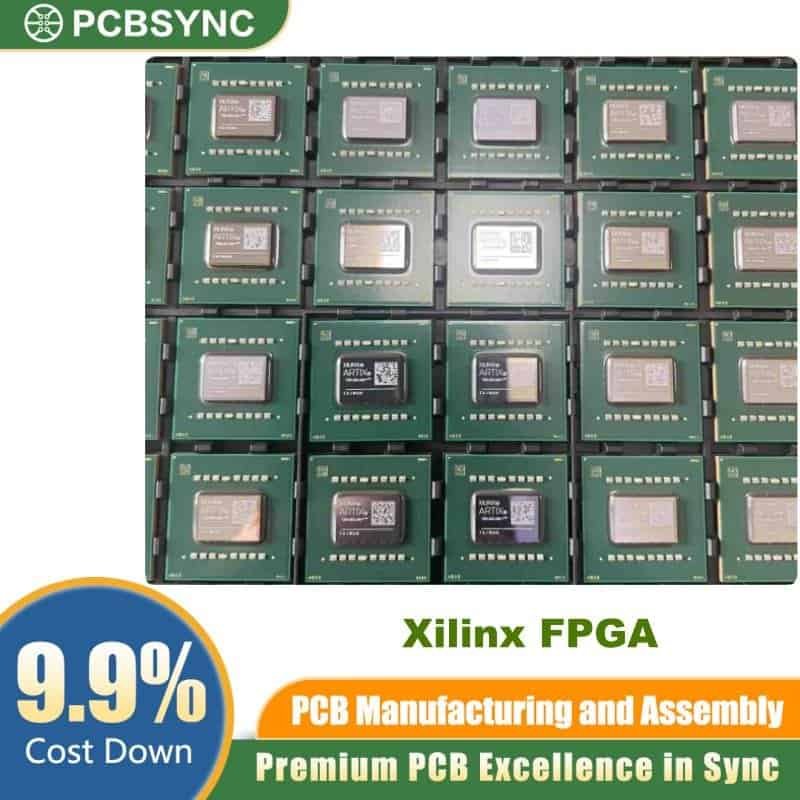
The XC2S200-6FGG1156C is a high-performance Field Programmable Gate Array (FPGA) from Xilinx’s Spartan-II family. Designed for cost-sensitive, high-volume applications, this device delivers up to 200,000 system gates in a fine-pitch ball grid array (FBGA) package with 1,156 pins. Whether you are prototyping a complex digital design or replacing a mask-programmed ASIC, the XC2S200-6FGG1156C provides the programmability, speed, and I/O density your project demands.
If you are sourcing Xilinx Spartan-II devices, explore the full selection at Xilinx FPGA for competitive pricing and availability.
What Is the XC2S200-6FGG1156C?
The XC2S200-6FGG1156C is the largest member of the Spartan-II FPGA family, manufactured by Xilinx (now AMD). It is built on a 0.18 µm, 6-layer copper CMOS process and operates at a core voltage of 2.5V. The part number breaks down as follows:
| Part Number Segment |
Meaning |
| XC2S200 |
Spartan-II device with ~200K system gates |
| -6 |
Speed grade 6 (fastest commercially available) |
| FGG |
Fine-pitch Ball Grid Array, Pb-free package |
| 1156 |
1,156 total ball count |
| C |
Commercial temperature range (0°C to +85°C) |
Key Features of the XC2S200-6FGG1156C
The XC2S200-6FGG1156C stands out among Spartan-II FPGAs due to its rich feature set optimized for high I/O count applications and complex logic designs.
Logic and Memory Architecture
- 5,292 Logic Cells organized in a 28×42 CLB array
- 1,176 Configurable Logic Blocks (CLBs), each containing two slices with look-up tables (LUTs) and flip-flops
- 75,264 bits of distributed RAM embedded within the CLB array
- 56K bits of dedicated Block RAM (four 14K-bit dual-port block RAM modules)
- Four Delay-Locked Loops (DLLs) for clock management and deskewing
I/O and Packaging
- 284 maximum user I/Os (not including four dedicated global clock inputs)
- Housed in a 1,156-ball Fine-Pitch BGA package — the highest pin-count package in the Spartan-II lineup, enabling dense board designs
- Supports multiple I/O standards including LVTTL, LVCMOS, PCI, GTL, HSTL, SSTL, and CTT
Speed and Performance
- Speed grade -6 — the fastest available for the XC2S200 in commercial temperature range
- System clock frequency up to 263 MHz
- Propagation delay as low as 2.8 ns for fast combinatorial paths
XC2S200-6FGG1156C Full Technical Specifications
| Parameter |
Specification |
| Manufacturer |
Xilinx (AMD) |
| Family |
Spartan-II |
| Part Number |
XC2S200-6FGG1156C |
| Logic Cells |
5,292 |
| System Gates |
~200,000 |
| CLB Array |
28 × 42 |
| Total CLBs |
1,176 |
| Distributed RAM |
75,264 bits |
| Block RAM |
57,344 bits (56K) |
| Max User I/Os |
284 |
| DLLs |
4 |
| Speed Grade |
-6 |
| Max Frequency |
263 MHz |
| Core Voltage |
2.5V |
| I/O Voltage |
3.3V / 2.5V (programmable) |
| Process Technology |
0.18 µm, 6-layer Cu CMOS |
| Package |
1156-ball FBGA (FGG) |
| Package Type |
Fine-Pitch Ball Grid Array (Pb-free) |
| Operating Temperature |
0°C to +85°C (Commercial) |
| Configuration Cells |
1,335,840 |
Spartan-II Family Comparison: Where Does the XC2S200 Fit?
The table below compares the XC2S200-6FGG1156C’s core device — the XC2S200 — against other members of the Spartan-II family to help you choose the right device for your application.
| Device |
Logic Cells |
System Gates |
CLB Array |
Total CLBs |
Max User I/O |
Dist. RAM (bits) |
Block RAM (bits) |
| XC2S15 |
432 |
15,000 |
8×12 |
96 |
86 |
6,144 |
16K |
| XC2S30 |
972 |
30,000 |
12×18 |
216 |
92 |
13,824 |
24K |
| XC2S50 |
1,728 |
50,000 |
16×24 |
384 |
176 |
24,576 |
32K |
| XC2S100 |
2,700 |
100,000 |
20×30 |
600 |
176 |
38,400 |
40K |
| XC2S150 |
3,888 |
150,000 |
24×36 |
864 |
260 |
55,296 |
48K |
| XC2S200 |
5,292 |
200,000 |
28×42 |
1,176 |
284 |
75,264 |
56K |
The XC2S200 is the top-of-range device in the Spartan-II family, making it ideal when maximum gate count and I/O density are required.
Configuration Modes Supported
The XC2S200-6FGG1156C supports multiple industry-standard configuration modes, giving designers flexibility in how the device is programmed on the board.
| Configuration Mode |
Pre-config Pull-ups |
CCLK Direction |
Data Width |
Serial DOUT |
| Master Serial |
No |
Output |
1 bit |
Yes |
| Slave Serial |
Yes |
Input |
1 bit |
Yes |
| Slave Parallel |
Yes |
Input |
8 bits |
No |
| Boundary-Scan (JTAG) |
Yes |
N/A |
1 bit |
No |
Supported I/O Standards
The XC2S200-6FGG1156C’s programmable I/O buffers support a wide range of single-ended and differential signaling standards:
| I/O Standard |
Type |
Voltage |
| LVTTL |
Single-ended |
3.3V |
| LVCMOS33 / LVCMOS25 |
Single-ended |
3.3V / 2.5V |
| PCI |
Single-ended |
3.3V |
| GTL / GTL+ |
Single-ended |
Ref-based |
| HSTL I / HSTL III |
Single-ended |
Ref-based |
| SSTL2 / SSTL3 |
Single-ended |
Ref-based |
| CTT |
Single-ended |
Ref-based |
XC2S200-6FGG1156C vs. Other Package Options
Xilinx offered the XC2S200 in several package variants. The FGG1156 is the largest and most I/O-capable option:
| Part Number |
Package |
Pin Count |
Max User I/Os |
Pb-Free |
| XC2S200-6PQ208C |
PQFP |
208 |
140 |
No |
| XC2S200-6PQG208C |
PQFP |
208 |
140 |
Yes |
| XC2S200-6FG256C |
FBGA |
256 |
176 |
No |
| XC2S200-6FGG256C |
FBGA |
256 |
176 |
Yes |
| XC2S200-6FG456C |
FBGA |
456 |
284 |
No |
| XC2S200-6FGG456C |
FBGA |
456 |
284 |
Yes |
| XC2S200-6FGG1156C |
FBGA |
1,156 |
284 |
Yes |
Note: The FGG1156 package offers the same 284 user I/Os as the FGG456 but in a larger physical footprint, which can be advantageous for boards requiring more generous ball pitch for ease of PCB routing and assembly.
Applications: Who Should Use the XC2S200-6FGG1156C?
The XC2S200-6FGG1156C is a proven solution across multiple industries and use cases. Its large gate count, abundant block RAM, and 284 I/Os make it especially suitable for:
### Digital Communications
- Ethernet MAC and PHY interfaces
- Serial protocol controllers (UART, SPI, I²C)
- High-speed data multiplexing
### Signal Processing
- DSP pipelines for audio and video processing
- FIR/IIR filter implementations using distributed RAM
- Image buffering leveraging block RAM
### Embedded Systems Prototyping
- Soft-core processor implementations (e.g., MicroBlaze-compatible designs)
- Rapid ASIC prototyping and emulation
- SoC (System-on-Chip) design validation
### Industrial Control
- Motor drive controllers
- PLC (Programmable Logic Controller) logic replacement
- Real-time sensor data acquisition
### Legacy System Replacement
- Drop-in FPGA replacement for obsolete ASICs or CPLDs
- Bridging legacy bus protocols to modern interfaces
Development Tools for the XC2S200-6FGG1156C
Xilinx’s ISE Design Suite is the primary development toolchain for Spartan-II devices. Because the Spartan-II is a legacy family, it is not supported in Vivado. Engineers working with this device should use:
- Xilinx ISE (version 14.7, the final release — free WebPACK edition available)
- VHDL or Verilog hardware description languages
- JTAG-based programming via Xilinx Platform Cable USB or compatible programmer
- ChipScope Pro for in-system logic analysis and debugging
Ordering and Availability
The XC2S200-6FGG1156C is a legacy/end-of-life part from Xilinx. Stock availability varies among authorized distributors and the open market. When sourcing this component, verify:
- Date code and lot traceability — essential for counterfeit avoidance
- Pb-free (RoHS) compliance — the “G” in “FGG” confirms this device is Pb-free
- Temperature grade — the “C” suffix confirms commercial range (0°C to +85°C)
- ESD and moisture sensitivity — store in dry, anti-static packaging (MSL rating applies)
Frequently Asked Questions (FAQ)
What does the -6 speed grade mean on the XC2S200-6FGG1156C?
Speed grade -6 is the fastest speed grade available for the XC2S200 in the commercial temperature range. A higher number indicates better performance with shorter propagation delays and higher achievable clock frequencies (up to 263 MHz).
Is the XC2S200-6FGG1156C RoHS compliant?
Yes. The “G” in the “FGG” package designation indicates that this is a Pb-free, RoHS-compliant package variant.
What is the difference between FGG1156 and FGG456 packages?
Both packages support the same maximum of 284 user I/Os for the XC2S200 device. The FGG1156 has a larger physical ball array (1,156 balls), which results in a coarser effective ball pitch and can simplify PCB layout and manufacturing. This makes it preferable for designs where PCB routing density or assembly yield is a concern.
Can I program this FPGA with Vivado?
No. Xilinx Vivado does not support the Spartan-II family. You must use Xilinx ISE 14.7 (the final supported release) for design, synthesis, implementation, and programming of the XC2S200-6FGG1156C.
What core voltage does the XC2S200-6FGG1156C require?
The device requires a 2.5V core supply (VCCINT). I/O banks can be powered at 3.3V or 2.5V depending on the selected I/O standard.
Summary
The XC2S200-6FGG1156C remains a reliable and capable FPGA for legacy system maintenance, ASIC prototyping, and industrial applications demanding a high I/O count in a well-understood, mature architecture. With 200,000 system gates, 5,292 logic cells, 56K bits of block RAM, 284 user I/Os, and the fastest -6 speed grade in the Spartan-II commercial lineup, this device continues to serve engineers who need a proven programmable solution.
For sourcing and pricing information on Xilinx Spartan-II and other Xilinx devices, visit Xilinx FPGA.