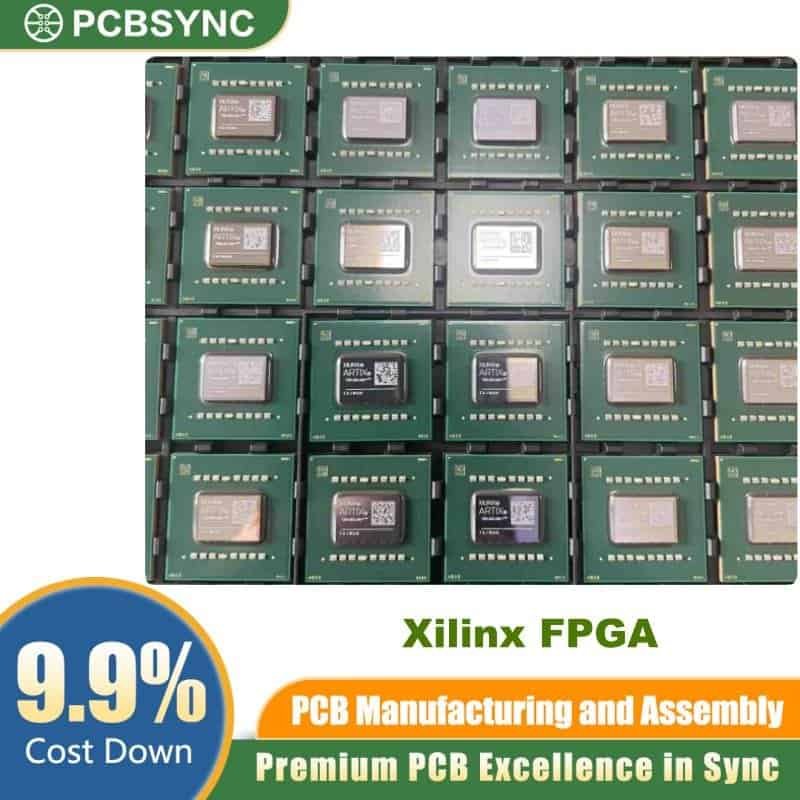
The XC2S200-6FGG1143C is a high-performance, cost-optimized Field Programmable Gate Array (FPGA) from Xilinx’s Spartan-II family. Featuring 200,000 system gates, 5,292 logic cells, and a massive 1,143-ball Fine-Pitch Ball Grid Array (FBGA) package, this device is engineered for engineers and designers who need maximum I/O density, fast clock speeds, and flexible in-field reprogrammability — all at a competitive price point.
Whether you are designing communications equipment, industrial control systems, medical devices, or high-speed data processing platforms, the XC2S200-6FGG1143C delivers the logic capacity and I/O flexibility to meet demanding requirements. For a broader overview of the Xilinx product lineup, explore our full range of Xilinx FPGA solutions.
What Is the XC2S200-6FGG1143C? A Xilinx Spartan-II FPGA Overview
The XC2S200-6FGG1143C is part of the Xilinx Spartan-II FPGA family — a 2.5V, low-cost FPGA series built on a 0.18µm process technology. The Spartan-II family was designed as a superior programmable alternative to mask-programmed ASICs, eliminating high NRE (non-recurring engineering) costs and allowing designers to update logic in the field without swapping out hardware.
Key Differentiators of the XC2S200-6FGG1143C
- Part Number Breakdown: XC2S200 (device) | -6 (speed grade) | FGG (Fine-pitch Ball Grid Array, Pb-free) | 1143 (pin count) | C (Commercial temperature range)
- Speed Grade -6: The fastest available speed grade for this device family, exclusively available in the Commercial temperature range (0°C to 85°C)
- FGG Package (Pb-free): The double “G” in “FGG” designates a RoHS-compliant, lead-free packaging option — ideal for modern, environmentally-conscious designs
- 1,143 Pins: Provides the highest I/O availability in the XC2S200 package lineup, making it suitable for designs requiring extensive external interfacing
XC2S200-6FGG1143C Full Technical Specifications
Core Logic and Memory Specifications
| Parameter |
XC2S200-6FGG1143C Value |
| Device Family |
Spartan-II |
| System Gates |
200,000 |
| Logic Cells |
5,292 |
| CLB Array (Rows × Columns) |
28 × 42 |
| Total CLBs |
1,176 |
| Distributed RAM (bits) |
75,264 |
| Block RAM (bits) |
57,344 (56K) |
| Maximum User I/O |
284 (up to package limit) |
| Speed Grade |
-6 (fastest available) |
| Core Voltage (VCCINT) |
2.5V |
| Process Technology |
0.18µm |
| Delay-Locked Loops (DLLs) |
4 (one at each corner of die) |
Package and Physical Specifications
| Parameter |
Value |
| Package Type |
FGG (Fine-Pitch Ball Grid Array, Pb-free) |
| Pin Count |
1,143 |
| Package Designator |
FBGA-1143 |
| RoHS Compliance |
Yes (Pb-free, “G” suffix) |
| Operating Temperature |
0°C to +85°C (Commercial) |
| Mounting Style |
Surface Mount (SMT) |
Electrical Characteristics
| Parameter |
Value |
| Core Supply Voltage (VCCINT) |
2.5V |
| I/O Supply Voltage (VCCO) |
1.5V – 3.3V (MultiVolt) |
| Max Operating Frequency |
Up to 263 MHz |
| Pin-to-Pin Logic Delay |
As low as ~5ns (speed grade -6) |
| I/O Standard Support |
LVTTL, LVCMOS, SSTL, GTL, HSTL, PCI, AGP |
XC2S200-6FGG1143C Architecture and Internal Features
## Configurable Logic Blocks (CLBs)
The XC2S200-6FGG1143C contains 1,176 CLBs arranged in a 28×42 grid. Each CLB consists of two slices, and each slice contains:
- Two 4-input Look-Up Tables (LUTs) for combinational logic
- Two storage elements (flip-flops or latches)
- Dedicated carry logic for fast arithmetic
- Wide function multiplexers
This architecture allows engineers to implement complex state machines, arithmetic units, data paths, and control logic efficiently within a single device.
## Block RAM (BRAM) Architecture
The XC2S200 contains 56K bits of dedicated block RAM (57,344 bits), organized in two columns of block RAM that run along opposite sides of the die — positioned between the CLB array and the IOB columns. Each block RAM can be configured as:
- 16K × 1, 8K × 2, 4K × 4, 2K × 9, 1K × 18 (true dual-port)
- Read and write operations can occur independently and simultaneously
This makes the BRAM ideal for FIFOs, data buffers, lookup tables, and embedded memories in signal processing designs.
## Input/Output Blocks (IOBs) and MultiVolt I/O
The XC2S200-6FGG1143C supports a MultiVolt I/O interface, meaning different I/O banks can be configured to operate at different voltages simultaneously (1.5V to 3.3V). Supported I/O standards include:
- LVTTL (3.3V)
- LVCMOS (1.8V, 2.5V, 3.3V)
- SSTL2, SSTL3 (for SDRAM/DDRRAM interfacing)
- GTL, GTL+
- HSTL (for high-speed bus applications)
- PCI (3.3V, 33/66 MHz)
- AGP (1×, 2×)
## Delay-Locked Loops (DLLs)
Four on-chip Delay-Locked Loops (DLLs), one at each corner of the die, provide:
- Clock deskew and alignment
- Frequency synthesis (multiply and divide)
- Phase shifting for high-speed source-synchronous interfaces
- Elimination of clock distribution delay
## Configuration Interface
The XC2S200-6FGG1143C supports multiple configuration modes:
- Master Serial (via Xilinx serial PROM)
- Slave Serial
- Master Parallel Up / Down
- Slave Parallel (SelectMAP)
- JTAG Boundary Scan (IEEE 1149.1)
Configuration data is stored in SRAM-based cells, meaning the device is reprogrammed each power-up cycle from an external storage source (flash PROM, microprocessor, etc.).
XC2S200 Spartan-II Family Comparison Table
The table below compares the XC2S200 with other members of the Spartan-II FPGA family to help you select the right device for your application:
| Device |
Logic Cells |
System Gates |
CLB Array |
Total CLBs |
Max User I/O |
Dist. RAM (bits) |
Block RAM |
| XC2S15 |
432 |
15,000 |
8×12 |
96 |
86 |
6,144 |
16K |
| XC2S30 |
972 |
30,000 |
12×18 |
216 |
92 |
13,824 |
24K |
| XC2S50 |
1,728 |
50,000 |
16×24 |
384 |
176 |
24,576 |
32K |
| XC2S100 |
2,700 |
100,000 |
20×30 |
600 |
176 |
38,400 |
40K |
| XC2S150 |
3,888 |
150,000 |
24×36 |
864 |
260 |
55,296 |
48K |
| XC2S200 |
5,292 |
200,000 |
28×42 |
1,176 |
284 |
75,264 |
56K |
The XC2S200 is the largest device in the Spartan-II family, offering the maximum gate count, logic cell density, I/O count, and memory resources — making the XC2S200-6FGG1143C the premium choice within this family.
XC2S200-6FGG1143C Package Variants Comparison
Understanding the differences between available XC2S200 packages helps you choose the right variant for your PCB layout and I/O requirements:
| Part Number |
Package |
Pin Count |
I/O Available |
Pb-Free |
Speed Grade |
Temp Range |
| XC2S200-6PQ208C |
PQFP |
208 |
140 |
No |
-6 |
Commercial |
| XC2S200-6FG256C |
FBGA |
256 |
176 |
No |
-6 |
Commercial |
| XC2S200-6FGG256C |
FBGA |
256 |
176 |
Yes |
-6 |
Commercial |
| XC2S200-6FG456C |
FBGA |
456 |
284 |
No |
-6 |
Commercial |
| XC2S200-6FGG456C |
FBGA |
456 |
284 |
Yes |
-6 |
Commercial |
| XC2S200-6FGG1143C |
FBGA |
1,143 |
284+ |
Yes |
-6 |
Commercial |
Note: The XC2S200-6FGG1143C features the largest pin-count package available for this device, maximizing available I/O routing options and PCB design flexibility. The “GG” suffix confirms this is the RoHS-compliant lead-free version.
Applications: Where Is the XC2S200-6FGG1143C Used?
The XC2S200-6FGG1143C is a versatile, high-density FPGA suited for a wide range of application domains:
Communications and Networking
- Protocol implementation (Ethernet, UART, SPI, I2C, CAN)
- Network switches, routers, and packet processors
- Line cards and interface bridging
Industrial Automation and Control
- Motor control and drive systems
- PLC (Programmable Logic Controller) replacement
- Machine vision and sensor data acquisition
- Process control and real-time monitoring
Medical Electronics
- Imaging equipment (X-ray, MRI, ultrasound signal processing)
- Patient monitoring systems
- Diagnostic instruments requiring high reliability
Military and Aerospace
- Ruggedized signal processing platforms
- Radar and sonar data acquisition systems
- Embedded computing in defense electronics
Consumer and Embedded Systems
- Set-top boxes and digital TV decoders
- Video processing and display controllers
- Embedded CPU co-processing
High-Performance Computing
- Accelerator cards for AI/ML inference
- Data center preprocessing workloads
- Custom instruction-set processors
Advantages of the XC2S200-6FGG1143C Over Traditional ASICs
| Factor |
Traditional ASIC |
XC2S200-6FGG1143C FPGA |
| Development Time |
Months to years |
Days to weeks |
| NRE Cost |
Tens of thousands of dollars |
$0 |
| Mask Cost |
Very high |
None |
| Field Updateability |
Not possible |
Yes — reprogrammable in-system |
| Design Risk |
High (hard to fix post-tape-out) |
Low (iterations are fast) |
| Volume Flexibility |
Optimized only at high volume |
Flexible at any quantity |
| Time-to-Market |
Slow |
Fast |
The Spartan-II FPGA series — and the XC2S200-6FGG1143C specifically — was designed as a direct, cost-effective alternative to mask-programmed ASICs, particularly for high-volume applications where flexibility and fast development cycles are priorities.
Design Tools and Software Support for XC2S200-6FGG1143C
Xilinx (now AMD) provides the following design and programming tools compatible with the XC2S200-6FGG1143C:
- ISE Design Suite — Legacy toolchain fully supporting the Spartan-II family. Includes synthesis, implementation, simulation, and JTAG programming
- iMPACT — Configuration and boundary-scan tool for programming via JTAG
- ChipScope Pro — On-chip logic analyzer for real-time debugging
- ModelSim / ISIM — HDL simulation environments for behavioral and post-place-and-route verification
HDL design entry is supported in both VHDL and Verilog. Schematic entry is also available through ISE.
Ordering Information and Part Number Decoder
The XC2S200-6FGG1143C follows the standard Xilinx part numbering convention:
| Field |
Value |
Meaning |
| XC |
XC |
Xilinx Commercial FPGA |
| 2S |
2S |
Spartan-II Family |
| 200 |
200 |
200,000 System Gates |
| -6 |
-6 |
Speed Grade (fastest, commercial-only) |
| FGG |
FGG |
Fine-pitch Ball Grid Array, Pb-free (lead-free) |
| 1143 |
1143 |
1,143 Package Pins |
| C |
C |
Commercial Temperature (0°C to +85°C) |
Frequently Asked Questions (FAQ) About the XC2S200-6FGG1143C
What is the maximum clock frequency of the XC2S200-6FGG1143C?
The XC2S200-6FGG1143C is rated at up to 263 MHz maximum operating frequency, with pin-to-pin data path delays as low as 5ns depending on the specific logic path and implementation.
Is the XC2S200-6FGG1143C RoHS compliant?
Yes. The double “G” in the package designator (FGG) indicates this is the Pb-free, RoHS-compliant variant of the XC2S200 in the 1143-ball FBGA package.
What temperature range does the XC2S200-6FGG1143C support?
The “C” suffix designates the Commercial temperature range: 0°C to +85°C. Industrial-range variants (–40°C to +85°C) carry an “I” suffix. Note that the -6 speed grade is exclusively available in the Commercial temperature range.
What configuration modes are supported?
The device supports Master Serial, Slave Serial, SelectMAP (Slave Parallel), Master Parallel Up/Down, and JTAG (IEEE 1149.1) boundary scan configuration modes.
Is the XC2S200-6FGG1143C still in production?
The Spartan-II family has been classified as mature/end-of-life by AMD Xilinx. Inventory may still be available through authorized distributors and component brokers. For new designs, AMD recommends migrating to the Spartan-6, Spartan-7, or Artix-7 families.
What is the difference between XC2S200-6FGG1143C and XC2S200-6FGG456C?
The primary difference is the package pin count: the FGG1143 package has 1,143 pins versus 456 pins in the FGG456, providing significantly more PCB routing flexibility and I/O access while housing the same core XC2S200 silicon.
Summary: Why Choose the XC2S200-6FGG1143C?
The XC2S200-6FGG1143C offers the perfect combination of logic density, I/O flexibility, speed, and RoHS compliance for legacy and new designs requiring the Spartan-II feature set. With 200,000 system gates, 5,292 logic cells, 56K bits of block RAM, and the highest pin count in the XC2S200 package lineup — all in a lead-free BGA package — this FPGA is a robust choice for engineers designing high-density, high-reliability digital systems.
Its support for MultiVolt I/O, on-chip DLLs, flexible configuration modes, and broad I/O standard compatibility makes it an adaptable platform across communications, industrial, medical, and defense applications.