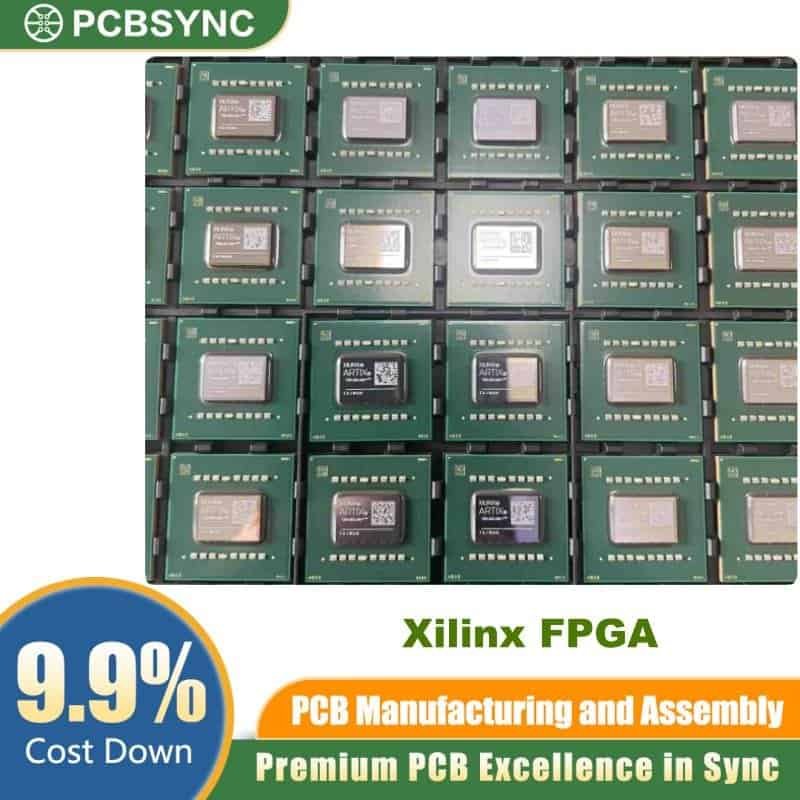
The XC2S200-6FGG1120C is a high-density, cost-optimized Field Programmable Gate Array (FPGA) manufactured by Xilinx (now AMD). Part of the proven Spartan-II family, this device delivers 200,000 system gates in a Pb-free Fine-Pitch Ball Grid Array (FGG) package with 1120 pins, making it one of the most pin-rich configurations in the XC2S200 lineup. Whether you’re replacing a legacy ASIC, building embedded systems, or maintaining existing designs, the XC2S200-6FGG1120C offers a reliable, reprogrammable solution with strong I/O density and established silicon performance.
What Is the XC2S200-6FGG1120C? — Part Number Decoded
Understanding the part number helps engineers quickly identify device characteristics before reviewing full specifications.
| Code Segment |
Value |
Meaning |
| XC |
XC |
Xilinx Commercial Device |
| 2S |
2S |
Spartan-II Family |
| 200 |
200 |
200,000 System Gates |
| -6 |
Speed Grade 6 |
Fastest commercially available speed grade |
| FGG |
FGG |
Pb-Free Fine-Pitch Ball Grid Array (BGA) |
| 1120 |
1120 |
Total number of package pins |
| C |
C |
Commercial temperature range (0°C to +85°C) |
Note: The “-6” speed grade is exclusively available in the Commercial temperature range. The “G” in “FGG” indicates a Pb-free (lead-free) package, distinguishing it from the standard “FG” package variant.
XC2S200-6FGG1120C Key Technical Specifications
The following table summarizes the core electrical and logic specifications for this device based on the Xilinx Spartan-II datasheet (DS001).
Core Logic Specifications
| Parameter |
XC2S200 Value |
| System Gates |
200,000 |
| Logic Cells |
5,292 |
| CLB Array (Rows × Columns) |
28 × 42 |
| Total CLBs |
1,176 |
| Maximum User I/O |
284 |
| Distributed RAM (bits) |
75,264 |
| Block RAM (bits) |
56K (56,000) |
| Delay-Locked Loops (DLLs) |
4 |
Package & Electrical Specifications
| Parameter |
Value |
| Package Type |
Fine-Pitch BGA (FGG) |
| Package Pins |
1,120 |
| Operating Voltage (Core) |
2.5V |
| I/O Voltage Support |
2.5V (LVTTL, LVCMOS, PCI, GTL, SSTL, HSTL) |
| Process Technology |
0.18 µm (180nm) |
| Operating Temperature |
0°C to +85°C (Commercial) |
| Max Clock Frequency |
Up to 263 MHz |
| RoHS / Pb-Free |
Yes (FGG = Pb-free package) |
Spartan-II Family Comparison — Where XC2S200 Sits
The XC2S200 is the largest device in the Spartan-II family, offering the highest gate count and most I/O pins across the lineup.
| Device |
Logic Cells |
System Gates |
CLB Array |
Max User I/O |
Block RAM |
| XC2S15 |
432 |
15,000 |
8 × 12 |
86 |
16K |
| XC2S30 |
972 |
30,000 |
12 × 18 |
92 |
24K |
| XC2S50 |
1,728 |
50,000 |
16 × 24 |
176 |
32K |
| XC2S100 |
2,700 |
100,000 |
20 × 30 |
176 |
40K |
| XC2S150 |
3,888 |
150,000 |
24 × 36 |
260 |
48K |
| XC2S200 |
5,292 |
200,000 |
28 × 42 |
284 |
56K |
The XC2S200 provides nearly 3× the logic cells of the XC2S100, making it the natural choice for applications that have outgrown mid-range Spartan-II densities.
XC2S200-6FGG1120C Architecture Overview
Configurable Logic Blocks (CLBs)
The Spartan-II architecture uses a regular, flexible grid of CLBs as its core logic resource. Each CLB contains four logic cells, each with a 4-input LUT (Look-Up Table), a flip-flop, and dedicated carry logic. The 28×42 CLB array of the XC2S200 delivers exceptional flexibility for implementing combinational logic, sequential circuits, and small on-chip memories using SelectRAM™ distributed RAM (16 bits per LUT).
Block RAM (BRAM)
The XC2S200 includes 56Kbits of configurable block RAM organized in two columns flanking the CLB array. Each block RAM can be configured as a synchronous dual-port memory with independent read and write port widths, making it ideal for FIFOs, LUT tables, and embedded data buffers.
Delay-Locked Loops (DLLs)
Four on-chip Delay-Locked Loops are placed at the corners of the die. The DLLs enable zero-delay clock distribution, clock domain crossing, frequency synthesis, and fine-grained phase shifting — critical features for high-speed digital designs.
Input/Output Blocks (IOBs)
The XC2S200 supports a rich set of I/O standards through its programmable Input/Output Blocks, including LVTTL, LVCMOS2, PCI, GTL, SSTL2, SSTL3, HSTL, and AGP. Each IOB can be individually configured for input, output, or bidirectional operation, with optional slew-rate control and output drive strength selection.
Speed Grade -6: What It Means for Your Design
The -6 speed grade is the fastest available in the Spartan-II commercial lineup. A higher speed grade number corresponds to faster propagation delays and higher performance. Key timing benefits include:
- Faster CLB-to-CLB routing delays
- Shorter setup and hold times on flip-flops
- Higher achievable system clock frequencies (up to 263 MHz)
- Better performance for time-critical signal paths
The -6 speed grade is only available in the Commercial temperature range (0°C to +85°C). For industrial applications requiring -40°C to +100°C, the -5I speed grade is typically used.
Applications: Where Is the XC2S200-6FGG1120C Used?
The XC2S200-6FGG1120C is well-suited for a wide range of embedded and digital design applications:
#### Common Use Cases
| Application Area |
Description |
| ASIC Prototyping & Replacement |
Cost-effective alternative to mask-programmed ASICs with full reprogrammability |
| Embedded Processing |
Custom logic for co-processing tasks alongside CPUs |
| Communications |
Glue logic, protocol bridging, and data path processing |
| Industrial Control |
High-speed I/O interfaces and state-machine control logic |
| Consumer Electronics |
Low-cost programmable logic for mid-range volume products |
| Test & Measurement |
Flexible, reconfigurable test logic |
| Legacy System Support |
Drop-in replacement for older Spartan-II designs |
The large I/O count of the FGG1120 package makes it especially valuable when pin density is a priority, offering designers room for high-bandwidth external interfaces.
XC2S200 Package Options Comparison
Xilinx offered the XC2S200 in several package types. The FGG1120 stands out as the highest pin-count option.
| Package |
Type |
Pin Count |
Notes |
| PQG208 |
Pb-Free PQFP |
208 |
(Discontinued – PDN2004-01) |
| FGG256 |
Pb-Free Fine-Pitch BGA |
256 |
Standard BGA option |
| FGG456 |
Pb-Free Fine-Pitch BGA |
456 |
Mid-density BGA |
| FGG1120 |
Pb-Free Fine-Pitch BGA |
1,120 |
Highest I/O availability |
The “G” in FGG across all variants indicates lead-free packaging, compliant with RoHS environmental requirements.
Programming & Development Tools
The XC2S200-6FGG1120C is supported by Xilinx ISE Design Suite, the development environment used for all Spartan-II devices. Key tools include:
- Xilinx ISE — Synthesis, implementation, and bitstream generation
- ModelSim / Vivado Simulator — Functional and timing simulation
- JTAG Boundary Scan — On-chip debugging and device configuration
- iMPACT — Device programming and configuration management
Note: For new designs, Xilinx recommends migrating to newer FPGA families such as Spartan-6 or Artix-7. The XC2S200 is best suited for maintaining or replicating existing Spartan-II designs.
Why Choose the XC2S200-6FGG1120C?
For engineers sourcing this specific part, there are several compelling reasons to select the FGG1120 variant at the -6 speed grade:
Maximum I/O Flexibility — With 1,120 package pins and up to 284 usable user I/Os, the FGG1120 package minimizes the need for I/O expanders and simplifies PCB routing for dense designs.
Top Commercial Performance — The -6 speed grade delivers the lowest propagation delays available in the Spartan-II commercial family, meeting demanding timing requirements with margin.
Lead-Free Compliance — The FGG suffix guarantees RoHS-compliant, Pb-free packaging, meeting modern environmental manufacturing standards.
Proven Architecture — The Spartan-II architecture has been deployed in millions of units across industrial, communications, and consumer products, providing well-understood design behavior and stable silicon.
For more information about the broader range of programmable logic solutions, visit Xilinx FPGA to explore compatible devices and procurement options.
XC2S200-6FGG1120C vs. Common Alternatives
| Part Number |
Gates |
Speed Grade |
Package |
Pins |
Key Difference |
| XC2S200-6FGG1120C |
200K |
-6 (fastest) |
Pb-Free BGA |
1,120 |
This product |
| XC2S200-5FGG1120C |
200K |
-5 |
Pb-Free BGA |
1,120 |
Slightly slower; for cost-sensitive designs |
| XC2S200-6FG456C |
200K |
-6 |
Standard BGA |
456 |
Fewer pins; standard (non-Pb-free) |
| XC2S150-6FGG456C |
150K |
-6 |
Pb-Free BGA |
456 |
Lower gate count alternative |
| XC2S200E-6FGG456C |
200K |
-6 |
Pb-Free BGA |
456 |
Enhanced Spartan-IIE; improved I/O standards |
Frequently Asked Questions (FAQ)
Q: Is the XC2S200-6FGG1120C still in production? The XC2S200 family has been subject to product discontinuation notices. Availability is primarily through distributor excess inventory and authorized secondary-market channels. Always verify stock before designing-in for new projects.
Q: What is the difference between FG and FGG packages? The “G” in FGG indicates a Pb-free (lead-free) package. The FG variant uses standard tin-lead solder balls, while FGG uses RoHS-compliant lead-free solder balls.
Q: Can I use Vivado to program the XC2S200-6FGG1120C? No. Vivado does not support the Spartan-II family. Use Xilinx ISE Design Suite and the iMPACT programming tool for all XC2S200 devices.
Q: What JTAG programming options does this device support? The XC2S200 supports JTAG boundary scan configuration and testing per IEEE 1149.1 standards, as well as Master/Slave Serial and SelectMAP parallel configuration modes.
Q: What I/O standards does the XC2S200 support? Supported standards include LVTTL, LVCMOS2, PCI (3.3V), GTL, GTL+, SSTL2, SSTL3, HSTL Class I & II, CTT, and AGP.
Summary
The XC2S200-6FGG1120C is the top-of-the-range device within the Xilinx Spartan-II FPGA family — combining maximum gate density (200K gates, 5,292 logic cells), the fastest commercial speed grade (-6), and the highest pin-count Pb-free BGA package (1,120 pins). It is an excellent choice for legacy system support, ASIC replacement, and any application demanding high I/O connectivity and proven FPGA performance on a 2.5V, 0.18µm process node.