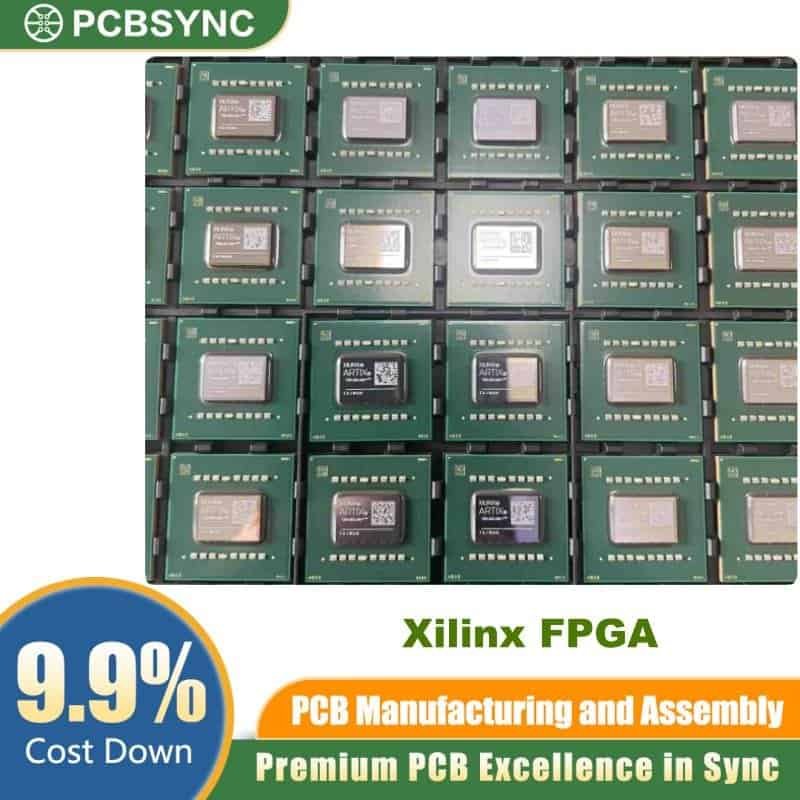
The XC2S200-6FGG1115C is a high-density, cost-effective Field Programmable Gate Array (FPGA) from Xilinx’s Spartan-II family. Designed for high-volume commercial applications, this device delivers powerful programmable logic in a compact 1115-pin Fine-pitch Ball Grid Array (FBGA) package, making it a go-to solution for engineers seeking flexible, scalable digital design. Whether you’re developing embedded systems, communications hardware, or signal processing applications, the XC2S200-6FGG1115C offers the performance and versatility your project demands.
What Is the XC2S200-6FGG1115C? – Xilinx Spartan-II FPGA Overview
The XC2S200-6FGG1115C belongs to Xilinx’s Spartan-II FPGA family, a 2.5V programmable logic device built on 0.18µm process technology. The part number decodes as follows:
| Part Number Segment |
Meaning |
| XC2S200 |
Spartan-II device, 200K system gates |
| -6 |
Speed grade 6 (fastest commercial grade) |
| FGG |
Fine-pitch Ball Grid Array (FBGA) package |
| 1115 |
1115 pins |
| C |
Commercial temperature range (0°C to +85°C) |
As a superior alternative to mask-programmed ASICs, this FPGA eliminates the high upfront NRE (non-recurring engineering) costs and long development cycles associated with custom silicon, while still delivering ASIC-like performance.
XC2S200-6FGG1115C Key Specifications at a Glance
| Parameter |
Value |
| Manufacturer |
Xilinx (now AMD) |
| Series |
Spartan-II |
| Device |
XC2S200 |
| System Gates |
200,000 |
| Logic Cells |
5,292 |
| CLB Array |
28 × 42 (1,176 CLBs) |
| Max User I/O Pins |
284 |
| Block RAM |
56 Kbits (14 × 4K blocks) |
| Distributed RAM |
75,264 bits |
| Delay-Locked Loops (DLLs) |
4 |
| Speed Grade |
-6 (Commercial Only) |
| Supply Voltage |
2.5V core |
| Package |
1115-pin FBGA (FGG1115) |
| Temperature Range |
Commercial (0°C to +85°C) |
| Process Technology |
0.18µm |
| Max System Frequency |
Up to 263 MHz |
XC2S200-6FGG1115C Architecture and Core Features
Configurable Logic Blocks (CLBs) – The Heart of the FPGA
The XC2S200 contains 1,176 Configurable Logic Blocks arranged in a 28 × 42 array. Each CLB provides flexible look-up tables (LUTs), flip-flops, and carry logic, enabling efficient implementation of combinatorial and sequential logic. The distributed RAM totals 75,264 bits, ideal for small buffers and shift registers embedded directly in the logic fabric.
Block RAM – On-Chip Memory for High-Speed Data Buffering
The XC2S200-6FGG1115C includes 14 blocks of 4,096-bit dual-port synchronous RAM, yielding a total of 56 Kbits of on-chip block RAM. Each memory block supports:
- Fully synchronous dual-port operation
- Independent control signals per port
- Configurable data widths for each port independently
- Single-cycle read and write access
This makes the device well-suited for FIFO buffers, data pipelines, and look-up table storage without consuming CLB resources.
Delay-Locked Loops (DLLs) – Precision Clock Management
Four on-chip Delay-Locked Loops, one at each corner of the die, provide:
- Zero-skew clock distribution
- Clock frequency synthesis and multiplication
- Phase shifting for timing closure
- Board-level clock deskew when driving clocks off-chip and back on
Input/Output Blocks (IOBs) – Flexible I/O Interface
The XC2S200-6FGG1115C supports up to 284 user I/O pins (excluding 4 dedicated global clock pins). The IOBs support multiple industry-standard interface standards and include programmable pull-up and pull-down resistors, slew-rate control, and output drive strength configuration.
XC2S200 Spartan-II Family Comparison Table
| Device |
System Gates |
Logic Cells |
CLB Array |
Max User I/O |
Block RAM |
| XC2S15 |
15,000 |
432 |
8 × 12 |
86 |
14K |
| XC2S30 |
30,000 |
972 |
12 × 18 |
132 |
14K |
| XC2S50 |
50,000 |
1,728 |
16 × 24 |
176 |
28K |
| XC2S100 |
100,000 |
2,700 |
20 × 30 |
196 |
40K |
| XC2S200 |
200,000 |
5,292 |
28 × 42 |
284 |
56K |
The XC2S200 is the largest device in the Spartan-II family, offering the highest gate count, I/O density, and on-chip memory capacity.
Configuration Modes Supported by the XC2S200-6FGG1115C
The XC2S200-6FGG1115C supports multiple configuration modes, providing design flexibility across different system architectures:
| Configuration Mode |
CCLK Direction |
Data Width |
Serial DOUT |
| Master Serial |
Output |
1 bit |
Yes |
| Slave Serial |
Input |
1 bit |
Yes |
| Slave Parallel |
Input |
8 bits |
No |
| Boundary-Scan (JTAG) |
N/A |
1 bit |
No |
During power-on and throughout configuration, all I/O drivers remain in a high-impedance state, ensuring safe system startup. The JTAG boundary-scan interface also allows in-system programming and functional testing.
XC2S200-6FGG1115C vs. Other XC2S200 Package Variants
Xilinx offers the XC2S200 in several package configurations. The FGG1115 is the largest, offering maximum pin accessibility for complex designs:
| Part Number |
Package |
Pins |
Max User I/O |
Speed Grade |
| XC2S200-6PQ208C |
PQFP |
208 |
140 |
-6 |
| XC2S200-6FG256C |
FBGA |
256 |
176 |
-6 |
| XC2S200-6FG456C |
FBGA |
456 |
284 |
-6 |
| XC2S200-6FGG1115C |
FBGA |
1115 |
284 |
-6 |
The FGG1115 package provides the widest ball pitch and spacing, beneficial for PCB routing in high-layer-count designs.
Top Applications for the XC2S200-6FGG1115C FPGA
The XC2S200-6FGG1115C is widely used across industries where programmable logic, high I/O density, and reliable performance are required:
#### Embedded Systems and SoC Prototyping
Its large CLB array and block RAM make it ideal for prototyping microprocessor-based systems, memory controllers, and peripheral interfaces before committing to custom silicon.
#### Telecommunications and Networking
The DLL-driven clocking architecture and multiple configuration modes allow seamless integration into SDH/SONET framing, Ethernet MAC implementations, and line-card designs.
#### Industrial Control and Automation
With commercial-grade temperature support and robust I/O options, the XC2S200-6FGG1115C excels in PLC interfaces, motor controllers, and sensor fusion platforms.
#### Digital Signal Processing (DSP)
The device’s distributed and block RAM resources support FIR filters, FFT pipelines, and data acquisition systems in audio, medical imaging, and radar processing.
#### Test and Measurement Equipment
JTAG boundary-scan support and flexible reconfigurability make this FPGA a natural fit for ATE (Automatic Test Equipment) and protocol analyzers.
Why Choose the XC2S200-6FGG1115C? – Key Advantages
- Speed Grade -6: The fastest commercial speed grade available for the XC2S200, enabling system frequencies up to 263 MHz.
- 200K Gate Density: The maximum logic capacity within the Spartan-II family for demanding designs.
- Reprogrammable In-Field: Unlike ASICs, the XC2S200 can be reconfigured after deployment, dramatically reducing product update costs.
- Cost-Effective Alternative to ASICs: Eliminates NRE costs and shortens time-to-market.
- Mature, Well-Documented Platform: Supported by Xilinx ISE Design Suite with decades of community documentation.
- JTAG Boundary Scan: Simplifies board-level testing and in-system configuration.
Design Tools and Software Support
The XC2S200-6FGG1115C is supported by the Xilinx ISE Design Suite, which provides:
- HDL synthesis (VHDL, Verilog)
- Place-and-route for Spartan-II devices
- Timing analysis and simulation support
- iMPACT programming software for device configuration
For engineers exploring Xilinx FPGA solutions, the Spartan-II family remains a well-understood and deeply documented platform with extensive reference designs and application notes.
Ordering Information and Part Number Breakdown
| Field |
Value |
| Full Part Number |
XC2S200-6FGG1115C |
| Family |
Spartan-II |
| Process Node |
0.18µm |
| Core Voltage |
2.5V |
| Speed Grade |
-6 (Commercial) |
| Package Code |
FGG (Fine-pitch Ball Grid Array, Pb-Free “G”) |
| Pin Count |
1115 |
| Temperature Grade |
C (Commercial: 0°C to +85°C) |
| RoHS Compliance |
Check with distributor for Pb-free status |
Note: The “G” in “FGG” within the Spartan-II ordering code denotes a Pb-free (lead-free) packaging option, in accordance with Xilinx’s environmental compliance program.
Frequently Asked Questions (FAQ) – XC2S200-6FGG1115C
What is the maximum operating frequency of the XC2S200-6FGG1115C?
The -6 speed grade supports system clock frequencies of up to 263 MHz, depending on the design’s logic complexity and routing.
Is the XC2S200-6FGG1115C still in production?
The Spartan-II family has been discontinued by Xilinx (PDN2004-01 and subsequent notices). However, the XC2S200-6FGG1115C remains available through authorized distributors and component brokers for legacy system support and maintenance.
What is the difference between XC2S200-6FGG1115C and XC2S200-5FGG1115C?
The -6 speed grade is faster than -5, offering lower propagation delays and higher maximum operating frequencies. The -6 grade is exclusively available in the Commercial temperature range.
What programming software is used for the XC2S200?
The XC2S200 is programmed using Xilinx ISE Design Suite with iMPACT configuration software, or via JTAG using third-party programmers supporting the Xilinx JTAG boundary-scan standard.
Can I replace the XC2S200-6FGG1115C with a Spartan-3 or newer device?
A direct pin-compatible drop-in replacement does not exist across families. Migration to Spartan-3 or Spartan-6 requires a redesign of the PCB and HDL, but Xilinx provides migration guides to assist with the transition.
Summary – XC2S200-6FGG1115C Xilinx Spartan-II FPGA
The XC2S200-6FGG1115C is a proven, high-performance FPGA from Xilinx’s Spartan-II family. With 200,000 system gates, 5,292 logic cells, 56 Kbits of dual-port block RAM, four DLLs, and up to 284 user I/O pins in an 1115-pin FBGA package, it delivers the logic density and flexibility required for demanding digital design applications. Its -6 speed grade ensures maximum system performance within the commercial temperature range, making it ideal for telecommunications, embedded systems, industrial automation, and DSP workloads.
For engineers sourcing Xilinx FPGA components or seeking technical guidance on FPGA selection and design, the XC2S200-6FGG1115C represents a reliable, well-understood platform backed by comprehensive Xilinx documentation and toolchain support.