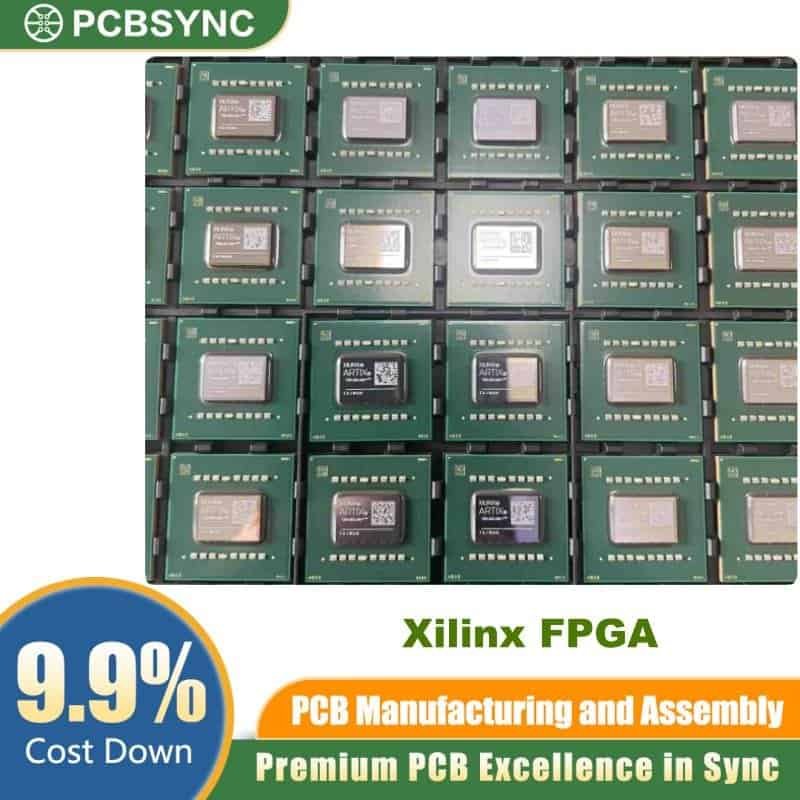
The XC2S200-6FGG1067C is a high-performance, cost-effective Field Programmable Gate Array (FPGA) from Xilinx’s legendary Spartan-II family. Designed for commercial-grade applications that demand programmable logic flexibility without the steep cost of custom ASICs, this device delivers 200,000 system gates, 5,292 logic cells, and a maximum operating frequency of up to 263 MHz — all in a robust 1067-pin Fine-Pitch Ball Grid Array (FBGA) Pb-free package. Whether you are an embedded systems engineer, PCB designer, or electronics procurement specialist, this guide covers everything you need to know about the XC2S200-6FGG1067C.
What Is the XC2S200-6FGG1067C? – Product Overview
The XC2S200-6FGG1067C is a member of the Xilinx Spartan-II FPGA family, a 2.5V programmable logic device manufactured on a proven 0.18-micron process technology. Breaking down the part number reveals exactly what you are getting:
| Part Number Segment |
Meaning |
| XC2S200 |
Spartan-II family, 200K system gates |
| -6 |
Speed Grade 6 (fastest available for Spartan-II) |
| FGG |
Fine-Pitch Ball Grid Array, Pb-free (RoHS-compatible) |
| 1067 |
1,067 total package pins |
| C |
Commercial temperature range (0°C to +85°C) |
As a Xilinx FPGA, the XC2S200-6FGG1067C sits at the top of the Spartan-II lineup in terms of logic density, making it ideal for high-pin-count designs in communications, industrial control, image processing, and embedded systems.
XC2S200-6FGG1067C Key Specifications at a Glance
Core Logic & Memory Resources
| Parameter |
XC2S200 Value |
| System Gates (Logic + RAM) |
200,000 |
| Logic Cells |
5,292 |
| CLB Array (Rows × Columns) |
28 × 42 |
| Total CLBs |
1,176 |
| Maximum User I/O Pins |
284 |
| Distributed RAM (bits) |
75,264 |
| Block RAM (bits) |
56K (56,000) |
| Delay-Locked Loops (DLLs) |
4 |
Package & Electrical Specifications
| Parameter |
Specification |
| Package Type |
Fine-Pitch BGA (FGG) – Pb-Free |
| Total Package Pins |
1,067 |
| Supply Voltage (VCCINT) |
2.5V |
| I/O Voltage (VCCO) |
3.3V / 2.5V / 1.8V / 1.5V compatible |
| Process Technology |
0.18µm |
| Maximum Frequency |
Up to 263 MHz |
| Speed Grade |
-6 (Fastest in family) |
| Temperature Range |
0°C to +85°C (Commercial) |
| RoHS / Pb-Free |
Yes (FGG = Pb-free packaging) |
XC2S200-6FGG1067C Architecture Deep Dive
Configurable Logic Blocks (CLBs)
The heart of the XC2S200-6FGG1067C is its 1,176 Configurable Logic Blocks arranged in a 28-row by 42-column matrix. Each CLB contains four logic cells, each built around a 4-input Look-Up Table (LUT), a D-type flip-flop, and dedicated carry logic. This architecture enables efficient implementation of combinatorial logic, arithmetic functions, and registered state machines. With 5,292 logic cells in total, the XC2S200 delivers ample capacity for complex control-plane and data-path designs.
Block RAM and Distributed RAM
The XC2S200-6FGG1067C provides two types of on-chip memory to serve different design needs:
- Distributed RAM — 75,264 bits of RAM embedded within the CLB fabric. These small, single-cycle-access memories are ideal for shift registers, FIFOs, and small lookup tables distributed across the device.
- Block RAM — 56K bits of dedicated synchronous block RAM organized in two columns. Block RAM supports true dual-port access, making it suitable for frame buffers, packet buffers, and high-bandwidth data storage.
Delay-Locked Loops (DLLs)
Four on-chip Delay-Locked Loops — one at each corner of the die — provide clock deskewing, duty-cycle correction, and frequency synthesis. The DLLs eliminate clock distribution skew and allow the XC2S200 to reliably operate at its rated frequencies, a critical feature for high-speed digital designs.
Input/Output Blocks (IOBs)
The XC2S200-6FGG1067C supports up to 284 user-configurable I/O pins, each implemented as a programmable Input/Output Block (IOB). The IOBs support a wide range of single-ended and differential signaling standards, including LVTTL, LVCMOS, PCI, GTL, HSTL, and SSTL, giving designers tremendous flexibility when interfacing with external memory, processors, and peripherals.
Spartan-II Family Comparison: Where Does the XC2S200 Fit?
The XC2S200 is the largest and most capable device in the Spartan-II lineup. Understanding the family hierarchy helps engineers select the right device for their application:
| Device |
Logic Cells |
System Gates |
CLB Array |
Max User I/O |
Distributed RAM |
Block RAM |
| XC2S15 |
432 |
15,000 |
8 × 12 |
86 |
6,144 bits |
16K |
| XC2S30 |
972 |
30,000 |
12 × 18 |
92 |
13,824 bits |
24K |
| XC2S50 |
1,728 |
50,000 |
16 × 24 |
176 |
24,576 bits |
32K |
| XC2S100 |
2,700 |
100,000 |
20 × 30 |
176 |
38,400 bits |
40K |
| XC2S150 |
3,888 |
150,000 |
24 × 36 |
260 |
55,296 bits |
48K |
| XC2S200 |
5,292 |
200,000 |
28 × 42 |
284 |
75,264 bits |
56K |
The XC2S200-6FGG1067C is the top-tier device in this family — chosen when designs demand the maximum logic density, the largest I/O count, and the fastest speed grade (-6) available in the Spartan-II platform.
Part Number Decoding: Speed Grade, Package & Temperature Range
Speed Grade -6 Explained
The -6 speed grade denotes the fastest timing characterization available within the Spartan-II family. A higher number equals a faster device. Importantly, the -6 speed grade is exclusively available in the Commercial temperature range (0°C to +85°C) — it is not offered in Industrial or Military temperature variants. Engineers building high-frequency designs for benign operating environments will benefit most from the -6 designation.
FGG Package: Pb-Free Fine-Pitch BGA
The FGG suffix distinguishes this part from the standard FG package. The double “G” indicates that the device uses Pb-free (lead-free) solder ball material, complying with RoHS environmental directives. The 1067-pin Fine-Pitch Ball Grid Array package provides a compact footprint with high pin density — essential for board designs that need maximum connectivity while managing PCB real estate.
Commercial Temperature (“C” Suffix)
The trailing “C” confirms operation across the commercial temperature range of 0°C to +85°C. This makes the XC2S200-6FGG1067C appropriate for use in consumer electronics, networking equipment, industrial workstations, and test & measurement instruments operating in controlled environments.
Top Applications for the XC2S200-6FGG1067C
The XC2S200-6FGG1067C excels in a broad range of applications that benefit from high logic density, abundant on-chip memory, and versatile I/O:
| Application Domain |
Use Case Example |
| Telecommunications |
Protocol bridging, line-card glue logic, framing engines |
| Embedded Systems |
Soft-core processor implementations (MicroBlaze-like), peripheral controllers |
| Image & Video Processing |
Pixel pipeline processing, video timing generation |
| Industrial Automation |
Motor control, sensor fusion, real-time signal processing |
| Test & Measurement |
Pattern generation, data capture, instrument front-ends |
| Networking & Data Comm |
Packet processing, flow control, interface bridging |
| Legacy System Maintenance |
Replacement / re-implementation of obsolete ASICs or TTL logic |
XC2S200-6FGG1067C vs. Alternative Part Numbers
The XC2S200 is available across multiple packages and speed grades. Understanding the alternatives helps procurement teams identify functionally equivalent or compatible parts:
| Part Number |
Speed Grade |
Package |
Pins |
Pb-Free |
Temp Range |
| XC2S200-6FGG1067C |
-6 |
Fine-Pitch BGA |
1067 |
Yes |
Commercial |
| XC2S200-5FG456C |
-5 |
Fine-Pitch BGA |
456 |
No |
Commercial |
| XC2S200-6FG456C |
-6 |
Fine-Pitch BGA |
456 |
No |
Commercial |
| XC2S200-5FGG456C |
-5 |
Fine-Pitch BGA |
456 |
Yes |
Commercial |
| XC2S200-6PQ208C |
-6 |
PQFP |
208 |
No |
Commercial |
The FGG1067 package variant is distinguished by its maximum pin count of 1,067 — making it the preferred choice when designs require the full complement of user I/O and superior signal routing density on multilayer PCBs.
Design Tools & Programming Support
Xilinx ISE Design Suite
The XC2S200-6FGG1067C is supported by the Xilinx ISE Design Suite, the legacy development environment for Spartan-II and other classic Xilinx FPGA families. ISE provides:
- HDL synthesis (VHDL / Verilog)
- Place-and-route with timing closure
- Static timing analysis
- JTAG-based device programming via iMPACT
Configuration Methods
The XC2S200 supports multiple configuration modes, allowing flexible system integration:
| Configuration Mode |
Description |
| Master Serial |
FPGA loads bitstream from external serial PROM |
| Slave Serial |
External processor drives bitstream serially |
| Master Parallel |
FPGA reads bitstream from parallel flash memory |
| Slave Parallel |
External microcontroller drives parallel configuration |
| JTAG |
IEEE 1149.1 boundary-scan and in-system programming |
JTAG Boundary Scan
Full IEEE 1149.1 JTAG boundary-scan support is built in, enabling in-system programming, board-level testing, and debug — critical for production environments and field updates.
Why Choose the XC2S200-6FGG1067C for Your Design?
Advantages of the Spartan-II Platform
- Lower cost than Virtex-class FPGAs while delivering solid logic density for mainstream applications
- Programmability eliminates ASIC NRE costs and enables field upgrades without hardware swaps
- Proven 0.18µm process with extensive production history and well-characterized timing data
- Broad I/O standard support simplifies interfacing to legacy and modern peripheral devices
- Four on-chip DLLs eliminate clock skew and enable multi-clock-domain designs
Considerations Before Selection
- The Spartan-II family is not recommended for new designs — Xilinx has since introduced the Spartan-3, Spartan-6, Artix-7, and newer Spartan-7 families with significantly improved density, power efficiency, and tooling support.
- The XC2S200-6FGG1067C is best suited for legacy system maintenance, end-of-life product support, or replacement of obsolete logic in existing fielded hardware.
- Designers starting new projects should evaluate Xilinx Artix-7 or Spartan-7 FPGAs for access to modern IP cores, lower power consumption, and active vendor support.
Frequently Asked Questions (FAQ)
What does the “6” speed grade mean in XC2S200-6FGG1067C?
The “-6” denotes the fastest available speed grade within the Spartan-II family. It indicates the minimum propagation delay characterization — faster than the -5 or -4 grades — allowing the device to operate reliably at higher clock frequencies, up to 263 MHz in optimal conditions.
Is the XC2S200-6FGG1067C RoHS compliant?
Yes. The double “G” in “FGG” signifies that this is the Pb-free (lead-free) packaging variant, making it compliant with the European Union’s RoHS (Restriction of Hazardous Substances) directive.
What is the operating voltage of the XC2S200-6FGG1067C?
The core logic (VCCINT) operates at 2.5V. The I/O banks (VCCO) can be powered at 3.3V, 2.5V, 1.8V, or 1.5V depending on the interface standard selected for each I/O bank.
Can the XC2S200-6FGG1067C be used in industrial temperature environments?
No. The “C” suffix designates the commercial temperature range only (0°C to +85°C). Additionally, the -6 speed grade is exclusively offered in the commercial range. For industrial temperature requirements (-40°C to +85°C), alternative speed grades and part numbers must be selected.
What programming software supports the XC2S200-6FGG1067C?
The device is supported by the Xilinx ISE Design Suite. Xilinx Vivado does not support the Spartan-II family.
How many user I/O pins does the XC2S200-6FGG1067C provide?
The XC2S200 device provides up to 284 maximum user I/O pins (not including the four dedicated global clock/user input pins).
Ordering Information Summary
| Attribute |
Detail |
| Manufacturer |
Xilinx (now AMD) |
| Part Number |
XC2S200-6FGG1067C |
| Product Family |
Spartan-II |
| Logic Cells |
5,292 |
| System Gates |
200,000 |
| Speed Grade |
-6 |
| Package |
1067-Pin Fine-Pitch BGA (Pb-Free) |
| Operating Voltage |
2.5V |
| Temperature Range |
0°C to +85°C (Commercial) |
| RoHS Compliant |
Yes |
| Configuration Interface |
JTAG, Serial, Parallel |
| Design Tool |
Xilinx ISE |
Conclusion
The XC2S200-6FGG1067C remains a sought-after component for engineers supporting legacy platforms and high-pin-count FPGA applications. Its combination of 5,292 logic cells, 200K system gates, 284 user I/O, 56K block RAM, four DLLs, and the fastest -6 speed grade in a Pb-free 1067-pin BGA package makes it a uniquely capable device for demanding commercial-grade applications. For procurement, design support, or alternative Xilinx FPGA recommendations, explore the full selection of Xilinx FPGA solutions to find the right device for your project.