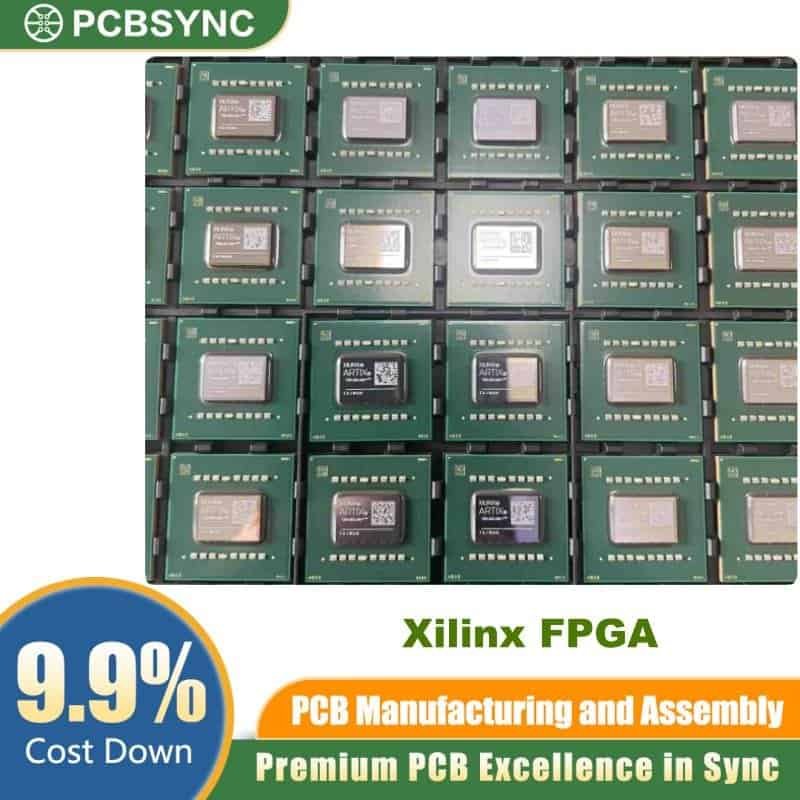
The XC2S200-6FGG1066C is a high-performance, cost-efficient Field-Programmable Gate Array (FPGA) from Xilinx’s industry-renowned Spartan-II family. Designed for high-volume commercial applications, this device delivers 200,000 system gates, 5,292 logic cells, and operates at up to 200 MHz — all in a compact 1066-ball Fine-Pitch BGA (FGG1066) package. Whether you are designing embedded systems, digital signal processing pipelines, or communication interfaces, the XC2S200-6FGG1066C is a proven, reliable solution.
For a broader selection of programmable logic devices, explore our full range of Xilinx FPGA products.
What Is the XC2S200-6FGG1066C?
The XC2S200-6FGG1066C belongs to Xilinx’s Spartan-II 2.5V FPGA family — a series engineered as a superior, lower-cost alternative to mask-programmed ASICs. The part number breaks down as follows:
| Part Number Segment |
Meaning |
| XC2S200 |
Spartan-II device with ~200,000 system gates |
| -6 |
Speed Grade 6 (fastest available; Commercial range only) |
| FGG |
Fine-Pitch Ball Grid Array (Pb-Free packaging) |
| 1066 |
1066-pin package |
| C |
Commercial temperature range (0°C to +85°C) |
XC2S200-6FGG1066C Key Specifications
General Device Specifications
| Parameter |
Value |
| Family |
Spartan-II |
| Technology |
0.18 µm |
| Core Voltage (VCCINT) |
2.5V |
| I/O Voltage (VCCO) |
1.5V – 3.3V (multi-standard) |
| System Gates |
200,000 |
| Logic Cells |
5,292 |
| CLB Array |
28 × 42 |
| Total CLBs |
1,176 |
| Maximum User I/O |
284 |
| Total Distributed RAM |
75,264 bits |
| Total Block RAM |
56K bits |
| Delay-Locked Loops (DLLs) |
4 |
| Max Frequency |
up to 200+ MHz |
| Speed Grade |
-6 (fastest Commercial grade) |
| Temperature Range |
Commercial: 0°C to +85°C |
| Package |
FGG1066 (1066-ball Fine-Pitch BGA, Pb-Free) |
| RoHS Compliance |
Yes (Pb-Free “G” suffix) |
CLB (Configurable Logic Block) Architecture
| CLB Feature |
Detail |
| Slices per CLB |
4 |
| Look-Up Tables (LUTs) |
2 per slice (4-input) |
| Flip-Flops |
2 per slice |
| CLB Array Size |
28 columns × 42 rows |
| Total CLBs |
1,176 |
| Distributed RAM Support |
Yes (16-bit per LUT) |
Each CLB in the XC2S200 contains four slices, and each slice includes two 4-input Look-Up Tables (LUTs) and two D-type flip-flops. This architecture enables efficient implementation of both combinatorial and sequential logic.
Block RAM Specifications
| Block RAM Parameter |
Value |
| Total Block RAM Bits |
56,000 bits (56K) |
| Number of Block RAM Modules |
14 |
| Organization Options |
16K × 1, 8K × 2, 4K × 4, 2K × 8, 1K × 16 |
| Synchronous Operation |
Yes |
| Dual-Port Support |
Yes |
The XC2S200’s dual-port block RAM enables simultaneous read/write operations, making it ideal for buffering, FIFOs, and lookup tables in high-throughput designs.
I/O Block (IOB) Features
| IOB Feature |
Detail |
| Maximum User I/O |
284 |
| Supported I/O Standards |
LVTTL, LVCMOS2, PCI, GTL, HSTL, SSTL2, SSTL3, AGP |
| Input Delay Element |
Programmable |
| Output Drive Strength |
2 mA to 24 mA (programmable) |
| Slew Rate Control |
Fast / Slow (selectable) |
| 3-State Output Support |
Yes |
| Pull-Up / Pull-Down |
Programmable |
| Open-Drain Output |
Supported |
Clock Management (DLL)
| DLL Feature |
Detail |
| Number of DLLs |
4 (one at each die corner) |
| Clock Multiplication |
Yes |
| Clock Division |
Yes |
| Phase Shifting |
Yes |
| Jitter Reduction |
Yes |
| Dedicated Global Clock Lines |
4 |
The four on-chip Delay-Locked Loops (DLLs) allow the XC2S200-6FGG1066C to perform clock edge alignment, frequency synthesis, and low-skew clock distribution across the device — critical for high-speed, synchronous designs.
XC2S200-6FGG1066C Package Information
| Package Attribute |
Value |
| Package Type |
Fine-Pitch Ball Grid Array (FGG) |
| Total Ball Count |
1,066 |
| Pb-Free (RoHS) |
Yes |
| Mounting Style |
Surface Mount (SMD) |
| Package Dimensions |
Refer to Xilinx DS001 Datasheet |
| Thermal Characteristics |
Refer to Xilinx Package Thermal Data |
The FGG1066 package is the Pb-free version of the FG1066, denoted by the additional “G” in the package name. This makes it fully RoHS compliant and suitable for products requiring lead-free manufacturing processes.
Spartan-II Family Comparison: Where Does XC2S200 Stand?
| Device |
Logic Cells |
System Gates |
CLB Array |
Max User I/O |
Dist. RAM (bits) |
Block RAM (bits) |
| XC2S15 |
432 |
15,000 |
8 × 12 |
86 |
6,144 |
16K |
| XC2S30 |
972 |
30,000 |
12 × 18 |
92 |
13,824 |
24K |
| XC2S50 |
1,728 |
50,000 |
16 × 24 |
176 |
24,576 |
32K |
| XC2S100 |
2,700 |
100,000 |
20 × 30 |
176 |
38,400 |
40K |
| XC2S150 |
3,888 |
150,000 |
24 × 36 |
260 |
55,296 |
48K |
| XC2S200 |
5,292 |
200,000 |
28 × 42 |
284 |
75,264 |
56K |
The XC2S200 is the largest and highest-density device in the Spartan-II family, offering the most logic cells, the most user I/O, and the largest memory capacity — making it the top choice within the series for complex, resource-intensive designs.
Key Features and Benefits of the XC2S200-6FGG1066C
Superior Alternative to Mask-Programmed ASICs
Unlike traditional ASICs, the XC2S200-6FGG1066C eliminates non-recurring engineering (NRE) costs, long development cycles, and the risk of design errors that require expensive re-spins. Its in-field reprogrammability allows design upgrades without hardware replacement — a major advantage for iterative product development.
Fastest Commercial Speed Grade
The -6 speed grade is the fastest available in the Spartan-II family and is exclusively offered in the Commercial temperature range. This makes it the optimal choice for timing-critical applications where maximum operating frequency is essential.
Versatile Multi-Standard I/O
The XC2S200-6FGG1066C supports a wide range of industry-standard I/O interfaces, including PCI, LVTTL, LVCMOS, HSTL, SSTL2/3, and AGP. This multi-standard I/O capability simplifies system integration across diverse bus architectures and voltage domains.
Four On-Chip Delay-Locked Loops (DLLs)
The four DLLs provide robust clock management capabilities including multiplication, division, phase shifting, and jitter reduction — essential for designs that demand precise timing control and low clock skew.
Pb-Free and RoHS Compliant
The “G” designation in the FGG package confirms this is a lead-free, RoHS-compliant component, aligning with global environmental regulations and supporting green manufacturing initiatives.
Typical Applications of the XC2S200-6FGG1066C
| Application Area |
Use Case Example |
| Digital Signal Processing (DSP) |
FIR/IIR filters, FFT engines, image processing |
| Communications |
UART, SPI, I²C, PCIe protocol bridging |
| Embedded Control |
Custom microcontroller peripherals, bus controllers |
| Consumer Electronics |
Display controllers, set-top box logic |
| Industrial Automation |
Motor control, sensor interfaces, PLCs |
| Prototyping & Emulation |
ASIC prototyping, hardware emulation |
| Automotive |
In-vehicle network controllers (non-safety-critical) |
Configuration and Programming
The XC2S200-6FGG1066C supports multiple configuration modes for maximum design flexibility:
| Configuration Mode |
Description |
| Master Serial |
FPGA drives configuration clock; uses serial PROM |
| Slave Serial |
External source drives configuration; daisy-chain support |
| Master Parallel (SelectMAP) |
8-bit parallel mode for fast configuration |
| JTAG (Boundary Scan) |
IEEE 1149.1 compliant; supports in-circuit test |
Configuration data is stored externally in a PROM or microprocessor and loaded into the FPGA at power-on. The device can also be reconfigured dynamically via the SelectMAP interface, enabling partial or full reconfiguration at runtime.
Development Tools for XC2S200-6FGG1066C
| Tool |
Description |
| Xilinx ISE Design Suite |
Primary synthesis, implementation, and simulation tool for Spartan-II |
| XST (Xilinx Synthesis Tool) |
HDL synthesis integrated in ISE |
| ModelSim / ISIM |
Functional and timing simulation |
| IMPACT |
Programming and configuration tool |
| Synopsys / Mentor Tools |
Third-party synthesis and verification |
Note: The XC2S200-6FGG1066C is supported by the Xilinx ISE Design Suite (legacy). While newer AMD/Xilinx tools such as Vivado do not support Spartan-II, ISE 14.7 remains the recommended toolchain for this device family.
Ordering Information and Part Number Decoder
| Field |
XC2S200-6FGG1066C |
| Device Family |
Spartan-II |
| Device |
XC2S200 |
| Speed Grade |
-6 (Commercial, fastest) |
| Package |
FGG (Fine-Pitch BGA, Pb-Free) |
| Pin Count |
1066 |
| Temperature |
C (Commercial: 0°C to +85°C) |
| RoHS Status |
Compliant (Pb-Free) |
Frequently Asked Questions (FAQ)
What is the XC2S200-6FGG1066C used for?
The XC2S200-6FGG1066C is used in applications requiring high-density programmable logic, including DSP, communication interfaces, embedded control systems, industrial automation, and ASIC prototyping.
What is the difference between XC2S200-5 and XC2S200-6?
The -6 speed grade is faster than the -5 speed grade and is exclusively available in the Commercial temperature range (0°C to +85°C). The -5 grade is also available in Industrial range, whereas -6 is limited to Commercial.
Is the XC2S200-6FGG1066C RoHS compliant?
Yes. The double-“G” (FGG) in the package designation confirms Pb-free, RoHS-compliant packaging.
What configuration interface does this FPGA support?
The XC2S200-6FGG1066C supports Master Serial, Slave Serial, SelectMAP (parallel), and JTAG boundary scan configuration modes.
What design software supports the XC2S200-6FGG1066C?
The device is fully supported by the Xilinx ISE Design Suite (version 14.7). Third-party tools from Synopsys and Mentor Graphics are also compatible.
Can the XC2S200-6FGG1066C be reprogrammed in the field?
Yes. Like all Xilinx SRAM-based FPGAs, the XC2S200-6FGG1066C is infinitely reprogrammable and supports in-field configuration updates without hardware replacement.
Summary
The XC2S200-6FGG1066C is Xilinx’s most capable Spartan-II device, combining 200,000 system gates, 5,292 logic cells, 284 user I/Os, 56K bits of block RAM, and four on-chip DLLs in a Pb-free 1066-ball BGA package. With its -6 speed grade, it delivers the fastest performance available in the Spartan-II Commercial range — making it an outstanding choice for cost-sensitive yet performance-demanding applications.
Its programmability, rich I/O standard support, and proven silicon reliability make it a dependable workhorse for engineers developing everything from industrial controllers to high-speed communication interfaces.