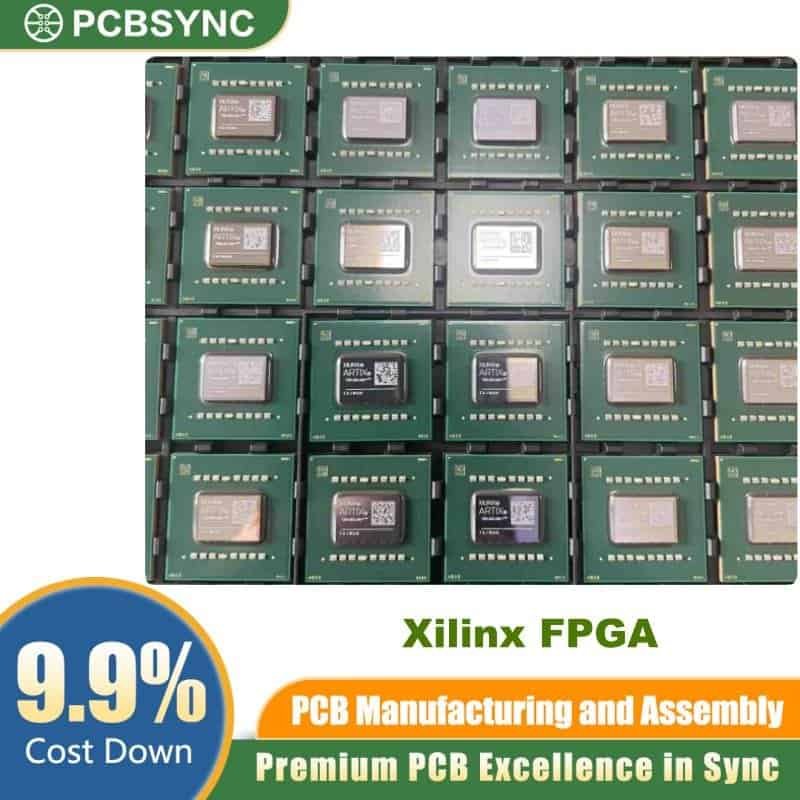
The XC2S200-6FGG1029C is a high-performance Field Programmable Gate Array (FPGA) manufactured by Xilinx (now AMD Xilinx), part of the well-established Spartan-II 2.5V FPGA family. Designed for cost-sensitive, high-volume applications, this device delivers up to 200,000 system gates, making it an ideal programmable logic solution for engineers seeking flexibility without the risk and overhead of mask-programmed ASICs. Whether you are developing telecommunications equipment, consumer electronics, or embedded control systems, the XC2S200-6FGG1029C provides a reliable, reprogrammable platform backed by decades of Xilinx innovation.
For a broader selection of programmable logic devices, explore our full range of Xilinx FPGA products.
What Is the XC2S200-6FGG1029C?
The part number XC2S200-6FGG1029C can be decoded as follows:
| Code Segment |
Meaning |
| XC2S200 |
Xilinx Spartan-II, 200K system gate device |
| -6 |
Speed Grade 6 (fastest available for Spartan-II) |
| FGG |
Fine Pitch Ball Grid Array, Pb-Free (RoHS compliant) |
| 1029 |
1029-pin package |
| C |
Commercial temperature range (0°C to +85°C) |
This device belongs to the Spartan-II product family, Xilinx’s cost-optimized FPGA line built on 0.18µm process technology and operating at a core voltage of 2.5V.
XC2S200-6FGG1029C Key Specifications
Core Logic Resources
| Parameter |
XC2S200 Value |
| System Gates (Logic + RAM) |
200,000 |
| Logic Cells |
5,292 |
| CLB Array |
28 × 42 |
| Total CLBs |
1,176 |
| Maximum User I/O |
284 |
| Distributed RAM |
75,264 bits |
| Block RAM |
56K bits |
Device & Package Details
| Parameter |
Specification |
| Part Number |
XC2S200-6FGG1029C |
| Manufacturer |
Xilinx (AMD) |
| Family |
Spartan-II |
| Package Type |
FGG (Fine Pitch BGA, Pb-Free) |
| Pin Count |
1,029 |
| Speed Grade |
-6 (fastest commercial) |
| Core Voltage |
2.5V |
| I/O Voltage |
2.5V (LVCMOS/LVTTL compatible) |
| Process Technology |
0.18µm |
| Temperature Range |
Commercial: 0°C to +85°C |
Clock and Timing Performance
| Parameter |
Value |
| Maximum System Frequency |
Up to 263 MHz |
| Delay-Locked Loops (DLLs) |
4 (one per corner) |
| Clock Distribution |
Global and regional clock networks |
XC2S200-6FGG1029C Features and Architecture
Configurable Logic Blocks (CLBs)
The XC2S200 features 1,176 Configurable Logic Blocks arranged in a 28×42 matrix. Each CLB contains four slices, and each slice includes two function generators (Look-Up Tables), two storage elements (flip-flops or latches), carry logic, and arithmetic support. This architecture enables efficient implementation of both combinatorial and sequential logic designs.
Block RAM
The device includes 56K bits of dedicated block RAM arranged in two columns. Block RAM supports true dual-port operation, allowing simultaneous read and write from two independent ports. This makes it highly suitable for FIFOs, lookup tables, and embedded memory arrays.
Distributed RAM
With 75,264 bits of distributed RAM embedded within the CLB fabric, the XC2S200-6FGG1029C supports small, fast memory structures directly in the logic array. Distributed RAM offers single-cycle read access, making it valuable for register files and small data buffers.
Delay-Locked Loops (DLLs)
Four on-chip Delay-Locked Loops — one at each corner of the die — provide clock management functions including clock deskew, frequency synthesis, and phase shifting. DLLs eliminate clock distribution delay, enabling high-speed synchronous designs.
Input/Output Blocks (IOBs)
The XC2S200 supports up to 284 user I/O pins, each with configurable drive strength, slew rate control, and optional pull-up/pull-down resistors. The IOBs are compatible with multiple I/O standards including LVCMOS2, LVTTL, GTL, SSTL, CTT, and HSTL.
XC2S200 Spartan-II Family Comparison
The table below compares the XC2S200 with other members of the Spartan-II family to help you select the right device for your application:
| Device |
Logic Cells |
System Gates |
CLB Array |
User I/O |
Distributed RAM |
Block RAM |
| XC2S15 |
432 |
15,000 |
8×12 |
86 |
6,144 bits |
16K |
| XC2S30 |
972 |
30,000 |
12×18 |
92 |
13,824 bits |
24K |
| XC2S50 |
1,728 |
50,000 |
16×24 |
176 |
24,576 bits |
32K |
| XC2S100 |
2,700 |
100,000 |
20×30 |
176 |
38,400 bits |
40K |
| XC2S150 |
3,888 |
150,000 |
24×36 |
260 |
55,296 bits |
48K |
| XC2S200 |
5,292 |
200,000 |
28×42 |
284 |
75,264 bits |
56K |
The XC2S200 is the largest and most capable device in the Spartan-II family, offering the maximum gate count, I/O count, and memory resources for the most demanding Spartan-II designs.
Speed Grade -6: Why It Matters
The -6 speed grade is the fastest available within the Spartan-II family and is exclusively offered in the Commercial temperature range. Choosing the -6 grade ensures:
- Faster propagation delays through logic paths
- Higher maximum clock frequencies for time-critical applications
- Tighter setup and hold time margins, enabling more robust timing closure
- Best-in-class performance for the Spartan-II platform at 2.5V
For applications where maximum throughput is critical — such as real-time signal processing, high-speed data acquisition, or fast control loops — the XC2S200**-6**FGG1029C is the optimal choice within the family.
Configuration Options
The XC2S200-6FGG1029C supports several industry-standard configuration modes:
| Configuration Mode |
Description |
| Master Serial |
Xilinx serial PROM (XCF series) drives configuration |
| Slave Serial |
External processor or device provides configuration bitstream |
| Master Parallel (SelectMAP) |
8-bit parallel configuration from byte-wide PROM |
| Slave Parallel (SelectMAP) |
External controller drives parallel configuration |
| JTAG (Boundary Scan) |
IEEE 1149.1 JTAG interface for programming and testing |
Configuration data is stored externally in a serial or parallel Flash/PROM device and loaded into the FPGA on power-up. The device also supports in-system reconfiguration, allowing field updates without hardware replacement.
Supported I/O Standards
| I/O Standard |
Description |
| LVCMOS2 |
Low Voltage CMOS, 2.5V |
| LVTTL |
Low Voltage TTL, 3.3V |
| GTL / GTL+ |
Gunning Transceiver Logic |
| SSTL2 / SSTL3 |
Stub Series Terminated Logic |
| CTT |
Center Tap Terminated |
| HSTL |
High Speed Transceiver Logic |
| PCI (3.3V) |
Peripheral Component Interconnect compatible |
Typical Applications of the XC2S200-6FGG1029C
The XC2S200-6FGG1029C FPGA is widely used across multiple industries due to its combination of logic density, I/O flexibility, and cost-effectiveness:
#### Telecommunications
- Line card processing and framing logic
- Protocol bridging (Ethernet, SONET, ATM)
- Multi-channel UART and SPI controllers
#### Industrial Automation
- Motor drive control and PWM generation
- Real-time sensor data acquisition
- Safety-critical PLC replacement
#### Consumer Electronics
- Digital video processing
- Set-top box interface logic
- High-speed display controllers
#### Embedded Computing
- Custom processor co-processing
- Memory controller implementation
- Hardware accelerators for DSP functions
#### Test and Measurement
- Pattern generation
- Logic analysis capture
- Protocol emulation
Design Tools and Software Support
The XC2S200-6FGG1029C is supported by the following Xilinx/AMD design tools:
| Tool |
Purpose |
| Xilinx ISE Design Suite |
Primary design entry, synthesis, implementation, and bitstream generation for Spartan-II |
| XST (Xilinx Synthesis Technology) |
HDL synthesis engine within ISE |
| ChipScope Pro |
On-chip debug and signal monitoring |
| iMPACT |
Device programming and configuration |
| ModelSim / Vivado Simulator |
RTL and gate-level simulation |
Note: Xilinx Vivado Design Suite does not support Spartan-II devices. Use ISE Design Suite 14.7, the final version supporting legacy Spartan-II devices. ISE 14.7 is available as a free download from AMD’s website.
Ordering Information and Part Number Breakdown
XC2S200-6FGG1029C vs. Similar Part Numbers
| Part Number |
Speed Grade |
Package |
Pb-Free |
Temp Range |
| XC2S200-6FGG1029C |
-6 |
1029-ball FGG BGA |
Yes |
Commercial |
| XC2S200-6FGG456C |
-6 |
456-ball FGG BGA |
Yes |
Commercial |
| XC2S200-6FG456C |
-6 |
456-ball FG BGA |
No |
Commercial |
| XC2S200-5FGG456C |
-5 |
456-ball FGG BGA |
Yes |
Commercial |
| XC2S200-5FGG456I |
-5 |
456-ball FGG BGA |
Yes |
Industrial |
The 1029-pin FGG package offers the highest pin count option for the XC2S200, providing maximum routing flexibility on PCBs where a large number of I/O connections are required.
Why Choose the XC2S200-6FGG1029C Over Mask-Programmed ASICs?
| Factor |
ASIC |
XC2S200-6FGG1029C FPGA |
| NRE Cost |
High (tooling, masks) |
None |
| Development Time |
Months to years |
Days to weeks |
| Reprogrammability |
Not possible |
Yes, unlimited |
| Design Risk |
High (tape-out risk) |
Low |
| Time to Market |
Slow |
Fast |
| Volume Flexibility |
High at large volumes |
Excellent for all volumes |
The XC2S200-6FGG1029C eliminates the need for costly ASIC development, making it the preferred choice for prototyping, low-to-medium volume production, and applications that require periodic logic updates in the field.
Frequently Asked Questions (FAQ)
Q: What is the maximum operating frequency of the XC2S200-6FGG1029C? A: The Spartan-II XC2S200 at speed grade -6 supports system clock frequencies up to approximately 263 MHz, depending on design complexity and routing.
Q: Is the XC2S200-6FGG1029C RoHS compliant? A: Yes. The “G” in “FGG” indicates a Pb-free (lead-free) package, making it RoHS compliant.
Q: What configuration PROM is compatible with this device? A: Xilinx XCF (Platform Flash) series PROMs such as the XCF01S, XCF02S, and XCF04S are recommended for serial configuration of the XC2S200.
Q: Can this device be used in industrial temperature environments? A: The “C” suffix indicates Commercial temperature range (0°C to +85°C). For industrial environments (–40°C to +85°C), choose an “I” suffix variant.
Q: What design software should I use for the XC2S200-6FGG1029C? A: Use Xilinx ISE Design Suite 14.7. Vivado does not support Spartan-II generation devices.
Summary
The XC2S200-6FGG1029C is a mature, proven, and highly capable FPGA device from the Xilinx Spartan-II family. With 200,000 system gates, 5,292 logic cells, 284 user I/O pins, 56K bits of block RAM, four on-chip DLLs, and the fastest -6 speed grade in a 1029-pin Pb-free BGA package, it delivers exceptional flexibility for commercial-grade embedded and digital logic designs. Its advantage over ASICs — zero NRE cost, full reprogrammability, and rapid time-to-market — makes it a compelling choice for engineers across telecommunications, industrial, consumer, and embedded computing markets.