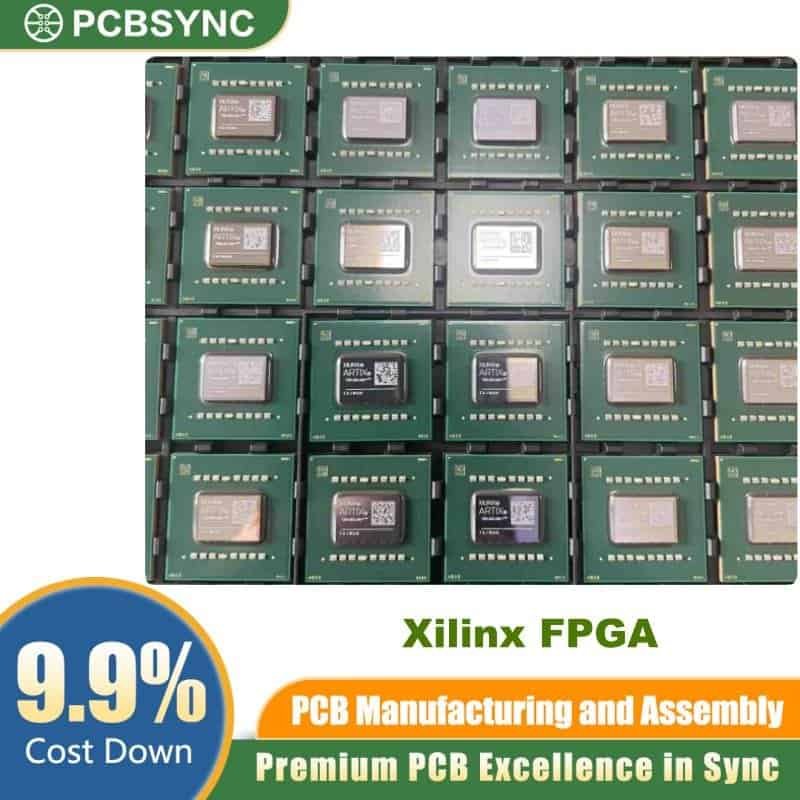
The XC2S200-6FGG1026C is a high-performance Field-Programmable Gate Array (FPGA) from Xilinx’s Spartan-II family. Designed for cost-sensitive, high-volume applications, this device delivers 200,000 system gates in a 1026-ball Fine Pitch BGA (FBGA) package with a commercial-grade speed rating of -6. Whether you are prototyping a new digital design or replacing an ASIC, the XC2S200-6FGG1026C provides a reliable, programmable, and field-upgradeable solution.
What Is the XC2S200-6FGG1026C?
The XC2S200-6FGG1026C is a member of Xilinx’s Spartan-II 2.5V FPGA family. It is manufactured on a 0.18 µm process technology and operates on a 2.5V core supply voltage. The part number breaks down as follows:
| Part Number Segment |
Meaning |
| XC2S200 |
Spartan-II device with 200K system gates |
| -6 |
Speed grade (-6 is the fastest; Commercial range only) |
| FGG |
Fine Pitch Ball Grid Array (Pb-Free / RoHS-compliant package) |
| 1026 |
1026 total package pins/balls |
| C |
Commercial temperature range (0°C to +85°C) |
This Pb-free “FGG” variant makes the XC2S200-6FGG1026C ideal for manufacturers requiring RoHS compliance.
XC2S200-6FGG1026C Key Specifications
Core Logic Resources
| Parameter |
XC2S200 Value |
| System Gates |
200,000 |
| Logic Cells |
5,292 |
| CLB Array |
28 × 42 |
| Total CLBs |
1,176 |
| Maximum User I/O |
284 |
| Distributed RAM |
75,264 bits |
| Block RAM |
56K bits |
Electrical & Packaging Specifications
| Parameter |
Value |
| Core Voltage (VCCINT) |
2.5V |
| I/O Voltage (VCCO) |
2.5V (adjustable per bank) |
| Process Technology |
0.18 µm |
| Speed Grade |
-6 (fastest commercial grade) |
| Package Type |
FGG (Fine Pitch BGA, Pb-Free) |
| Pin Count |
1026 |
| Temperature Range |
Commercial: 0°C to +85°C |
| Configuration Bits |
1,335,840 |
Clock & Timing Resources
| Feature |
Specification |
| Delay-Locked Loops (DLLs) |
4 (one per die corner) |
| Maximum Frequency |
Up to 263 MHz |
| Clock Distribution |
Dedicated global clock network |
XC2S200-6FGG1026C Architecture Overview
Configurable Logic Blocks (CLBs)
The XC2S200-6FGG1026C contains 1,176 CLBs arranged in a 28×42 array. Each CLB consists of two slices, and each slice contains two 4-input look-up tables (LUTs) and two flip-flops. This architecture enables efficient implementation of combinational logic, sequential logic, and arithmetic functions.
Block RAM
Two columns of block RAM are placed on opposite sides of the die, providing 56,000 bits (56K) of dual-port synchronous RAM. This memory can be used for FIFOs, buffers, lookup tables, and data storage within the FPGA fabric.
Distributed RAM
In addition to block RAM, the XC2S200-6FGG1026C offers 75,264 bits of distributed RAM using the CLB slice LUTs. This is ideal for small, fast memories deeply embedded in the logic.
Input/Output Blocks (IOBs)
With 284 user I/O pins, the XC2S200-6FGG1026C supports a wide range of single-ended and differential I/O standards. Each IOB includes programmable pull-up/pull-down resistors, slew rate control, and optional output delay elements.
Delay-Locked Loops (DLLs)
Four on-chip DLLs provide clock multiplication, division, phase shifting, and deskewing, enabling precise timing management across complex multi-clock designs.
Configuration Modes
The XC2S200-6FGG1026C supports multiple configuration modes for flexible system integration:
| Configuration Mode |
CCLK Direction |
Data Width |
Serial DOUT |
| Master Serial |
Output |
1-bit |
Yes |
| Slave Serial |
Input |
1-bit |
Yes |
| Slave Parallel |
Input |
8-bit |
No |
| Boundary-Scan (JTAG) |
N/A |
1-bit |
No |
Configuration data can be loaded from an external PROM, microprocessor, or via JTAG, making the XC2S200-6FGG1026C highly adaptable to different system architectures.
Spartan-II Family Comparison: Where Does XC2S200 Stand?
The XC2S200 is the largest device in the Spartan-II family. The table below compares all family members:
| Device |
Logic Cells |
System Gates |
CLB Array |
Max User I/O |
Block RAM |
| XC2S15 |
432 |
15,000 |
8×12 |
86 |
16K |
| XC2S30 |
972 |
30,000 |
12×18 |
92 |
24K |
| XC2S50 |
1,728 |
50,000 |
16×24 |
176 |
32K |
| XC2S100 |
2,700 |
100,000 |
20×30 |
176 |
40K |
| XC2S150 |
3,888 |
150,000 |
24×36 |
260 |
48K |
| XC2S200 |
5,292 |
200,000 |
28×42 |
284 |
56K |
The XC2S200-6FGG1026C, with the -6 speed grade and 1026-ball package, is the highest-density, fastest variant available in the commercial temperature range.
XC2S200-6FGG1026C Applications
The XC2S200-6FGG1026C is widely used across industries due to its flexible programmable logic and competitive price-to-performance ratio. Common applications include:
- Digital Signal Processing (DSP) — filters, FFTs, and data conversion pipelines
- Communications — protocol bridges, serializers/deserializers, and line-rate interfaces
- Industrial Control — motor controllers, PLCs, and machine vision preprocessing
- Consumer Electronics — display controllers, audio processing, and set-top box logic
- Embedded Systems — soft-core CPU implementations (e.g., PicoBlaze) and memory controllers
- ASIC Prototyping — rapid functional verification before tape-out
Why Choose the XC2S200-6FGG1026C Over a Traditional ASIC?
One of the key advantages of the XC2S200-6FGG1026C is its programmability. Unlike mask-programmed ASICs, this FPGA:
- Eliminates NRE (Non-Recurring Engineering) costs
- Reduces time-to-market by allowing immediate design iteration
- Supports field upgrades — the device can be reprogrammed without hardware replacement
- Minimizes design risk by allowing functional verification at full speed before committing to silicon
For engineers exploring the full range of programmable solutions, you can browse our selection of Xilinx FPGA devices to find the right fit for your project.
Ordering Information & Part Number Decoder
When ordering the XC2S200-6FGG1026C, verify each segment of the part number to ensure you receive the correct variant:
| Field |
Code |
Description |
| Device |
XC2S200 |
Spartan-II, 200K gates |
| Speed Grade |
-6 |
Fastest; Commercial range only |
| Package Base |
FG |
Fine Pitch Ball Grid Array |
| Pb-Free Indicator |
G (second G) |
RoHS-compliant, Pb-free package |
| Pin Count |
1026 |
1026 solder balls |
| Temperature |
C |
Commercial (0°C to +85°C) |
Note: The “FGG” (double-G) suffix confirms Pb-free packaging. The standard (leaded) equivalent would carry the “FG” suffix.
Development Tools & Software Support
The XC2S200-6FGG1026C is supported by Xilinx’s legacy ISE Design Suite, which includes:
- XST (Xilinx Synthesis Technology) for HDL synthesis
- ISE Project Navigator for design management
- ChipScope Pro for on-chip debugging
- iMPACT for device configuration and JTAG programming
HDL design entry is supported in both VHDL and Verilog, making the device accessible to a wide range of design engineers.
Frequently Asked Questions (FAQ)
What is the maximum speed of the XC2S200-6FGG1026C?
The XC2S200-6FGG1026C achieves a maximum frequency of 263 MHz with the -6 speed grade, making it the fastest option in the Spartan-II commercial family.
Is the XC2S200-6FGG1026C RoHS compliant?
Yes. The “FGG” (double-G) in the part number confirms this is a Pb-free, RoHS-compliant package variant.
Can the XC2S200-6FGG1026C be used in industrial temperature applications?
No. The “C” suffix indicates a commercial temperature range only (0°C to +85°C). For industrial temperature range (-40°C to +85°C), look for the “I” suffix variant.
What programming interface does the XC2S200-6FGG1026C support?
The device supports JTAG (Boundary-Scan), Master Serial, Slave Serial, and Slave Parallel configuration modes.
Is this device still recommended for new designs?
The Spartan-II family has been marked as Not Recommended for New Designs (NRND) by Xilinx/AMD. For new projects, consider a more current FPGA family such as Spartan-7 or Artix-7. However, the XC2S200-6FGG1026C remains widely available for maintenance, legacy system support, and replacement procurement.
Summary
The XC2S200-6FGG1026C is the flagship device of the Xilinx Spartan-II family — offering 200,000 system gates, 5,292 logic cells, 284 user I/Os, 56K bits of block RAM, and a -6 speed grade in a Pb-free 1026-ball FBGA package. It is an excellent choice for legacy system maintenance, prototyping, and cost-sensitive digital design applications requiring a proven, well-documented programmable logic solution.