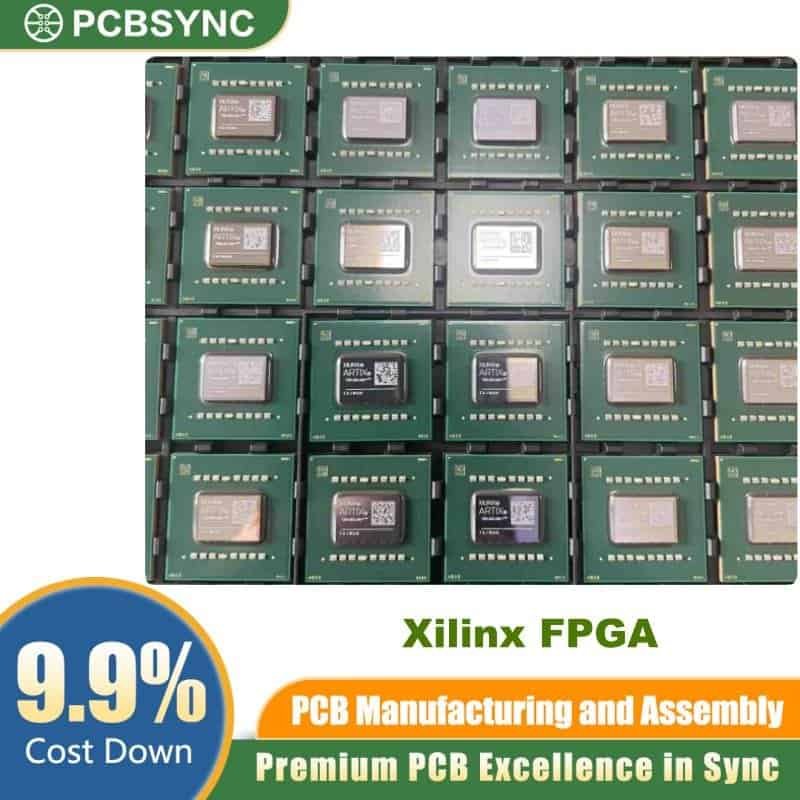
The XC2S200-6FGG1003C is a high-performance Field-Programmable Gate Array (FPGA) from Xilinx’s Spartan-II family. Designed for cost-sensitive, high-volume applications, this device delivers 200,000 system gates, 5,292 logic cells, and an impressive 1,003-pin Fine-Pitch Ball Grid Array (FBGA) package — making it one of the most pin-rich configurations in the XC2S200 lineup. Whether you are prototyping a complex digital system or replacing a mask-programmed ASIC, the XC2S200-6FGG1003C provides the flexibility, speed, and I/O density your design demands.
What Is the XC2S200-6FGG1003C?
The XC2S200-6FGG1003C is a member of the Xilinx Spartan-II FPGA family, manufactured on a proven 0.18 µm process node and powered by a 2.5V core supply. The part number breaks down as follows:
| Part Number Segment |
Meaning |
| XC2S200 |
Spartan-II device with 200K system gates |
| -6 |
Speed grade 6 (fastest in commercial range) |
| FGG |
Fine-Pitch Ball Grid Array (Pb-Free package) |
| 1003 |
1,003 total ball count |
| C |
Commercial temperature range (0°C to +85°C) |
This device is an ideal drop-in solution for engineers seeking maximum I/O expansion within the Spartan-II ecosystem. For a broader selection of Xilinx FPGA products and compatible components, you can explore dedicated FPGA supplier catalogs.
XC2S200-6FGG1003C Key Specifications
General Device Parameters
| Parameter |
Value |
| Family |
Spartan-II |
| Manufacturer |
Xilinx (AMD) |
| Part Number |
XC2S200-6FGG1003C |
| System Gates |
200,000 |
| Logic Cells |
5,292 |
| CLB Array |
28 × 42 |
| Total CLBs |
1,176 |
| Maximum User I/O |
284 |
| Speed Grade |
-6 (Fastest Commercial) |
| Operating Temperature |
0°C to +85°C (Commercial) |
| Core Voltage (VCCINT) |
2.5V |
| Process Technology |
0.18 µm |
| Package |
1003-Pin Fine-Pitch BGA (FGG1003) |
| Package Type |
Pb-Free (RoHS Compliant) |
Memory & Logic Resources
| Resource |
Specification |
| Total Distributed RAM |
75,264 bits |
| Total Block RAM |
56K bits (56,000 bits) |
| Block RAM Columns |
2 |
| Configurable Logic Blocks (CLBs) |
1,176 |
| Flip-Flops per CLB Slice |
2 |
| LUTs per CLB Slice |
2 |
| Delay-Locked Loops (DLLs) |
4 |
Performance Characteristics
| Parameter |
Value |
| Maximum System Clock |
Up to 200 MHz |
| Internal Performance |
Up to 263 MHz (logic paths) |
| Speed Grade |
-6 (Commercial Only) |
| Configuration Interface |
Master Serial, Slave Serial, SelectMAP, JTAG |
| Boundary Scan Support |
IEEE 1149.1 JTAG |
XC2S200-6FGG1003C Package Details
FGG1003 Fine-Pitch Ball Grid Array
The FGG1003 package (Fine-Pitch Ball Grid Array, 1003 balls, Pb-Free) is one of the largest package options in the Spartan-II XC2S200 series. The “G” in “FGG” designates the lead-free, RoHS-compliant version, making it suitable for modern manufacturing environments that require green, halogen-free, and Pb-free components.
| Package Attribute |
Detail |
| Package Code |
FGG1003 |
| Total Pin / Ball Count |
1,003 |
| Package Style |
Fine-Pitch Ball Grid Array (FBGA) |
| Lead-Free (Pb-Free) |
Yes (RoHS Compliant) |
| Package Shape |
Square |
| Terminal Form |
Ball (BGA) |
Spartan-II Family Comparison Table
The table below places the XC2S200-6FGG1003C in context within the full Spartan-II device family:
| Device |
Logic Cells |
System Gates |
CLB Array |
Total CLBs |
Max User I/O |
Distributed RAM |
Block RAM |
| XC2S15 |
432 |
15,000 |
8×12 |
96 |
86 |
6,144 bits |
16K |
| XC2S30 |
972 |
30,000 |
12×18 |
216 |
92 |
13,824 bits |
24K |
| XC2S50 |
1,728 |
50,000 |
16×24 |
384 |
176 |
24,576 bits |
32K |
| XC2S100 |
2,700 |
100,000 |
20×30 |
600 |
176 |
38,400 bits |
40K |
| XC2S150 |
3,888 |
150,000 |
24×36 |
864 |
260 |
55,296 bits |
48K |
| XC2S200 |
5,292 |
200,000 |
28×42 |
1,176 |
284 |
75,264 bits |
56K |
The XC2S200 is the largest and most capable device in the Spartan-II family, and the FGG1003C package maximizes available I/O routing flexibility for dense board designs.
Architecture Overview
Configurable Logic Blocks (CLBs)
The heart of the XC2S200-6FGG1003C is its array of 1,176 Configurable Logic Blocks, arranged in a 28-column by 42-row matrix. Each CLB contains four logic cells, and every logic cell includes:
- A 4-input Look-Up Table (LUT) for combinatorial logic
- A dedicated D-type flip-flop for registered logic
- Carry and control logic for efficient arithmetic operations
This structure enables engineers to implement everything from simple glue logic to complex state machines and DSP pipelines within a single device.
Block RAM
The XC2S200 integrates 56K bits of synchronous Block RAM, organized in two columns on opposite sides of the CLB array. Each Block RAM block can be independently configured as a single-port or simple dual-port memory, supporting widths from 1 to 16 bits. This makes the device well suited for buffering, FIFOs, and lookup tables in real-time applications.
Delay-Locked Loops (DLLs)
Four on-chip Delay-Locked Loops — one at each corner of the die — provide clock management, deskewing, and frequency synthesis capabilities. The DLLs allow designers to eliminate clock distribution delays and generate multiple phase-shifted or frequency-divided clocks without external components.
Input/Output Blocks (IOBs)
Surrounding the CLB array is a perimeter of programmable Input/Output Blocks. Each IOB supports:
- Programmable drive strength and slew rate control
- 3.3V and 2.5V I/O standards (LVCMOS, LVTTL, PCI, GTL, SSTL, HSTL, CTT)
- Optional pull-up, pull-down, and keeper circuits
- Input delay (optional)
- Fast-capture flip-flops
Supported I/O Standards
| I/O Standard |
Voltage |
Application |
| LVCMOS33 |
3.3V |
General-purpose logic |
| LVCMOS25 |
2.5V |
Low-voltage systems |
| LVTTL |
3.3V |
TTL-compatible designs |
| PCI |
3.3V |
PCI bus interfaces |
| GTL / GTL+ |
1.2V / 1.5V |
High-speed backplane I/O |
| SSTL2 / SSTL3 |
2.5V / 3.3V |
Memory interfaces (SDRAM) |
| HSTL |
1.5V |
High-speed transceiver logic |
| CTT |
1.5V |
Centertap-terminated logic |
Configuration Modes
The XC2S200-6FGG1003C supports multiple configuration modes, giving designers the flexibility to load the FPGA bitstream using the most appropriate method for their system architecture:
| Mode |
Description |
| Master Serial |
FPGA drives configuration clock; uses serial PROM |
| Slave Serial |
External device drives clock; daisy-chain capable |
| SelectMAP (Slave Parallel) |
8-bit parallel interface for fast configuration |
| JTAG (IEEE 1149.1) |
Boundary scan and in-circuit programming |
Configuration data can be stored in Xilinx Platform Flash PROMs or third-party serial Flash memories. The device supports in-system reconfiguration, enabling field updates without hardware replacement — a critical advantage over mask-programmed ASICs.
Typical Applications of XC2S200-6FGG1003C
The XC2S200-6FGG1003C is designed for cost-sensitive, high-volume applications where programmability offers a decisive edge:
| Application Area |
Use Case Examples |
| Digital Signal Processing (DSP) |
FIR/IIR filters, FFT engines, audio processing |
| Communication Systems |
Protocol bridges, UART/SPI/I2C controllers, MAC layers |
| Industrial Control |
Motor control, PLC logic, sensor fusion |
| Consumer Electronics |
Display controllers, image processing pipelines |
| Networking |
Packet classification, switch fabric control |
| Automotive Systems |
Gateway ECUs, diagnostic interfaces |
| Test & Measurement |
Pattern generators, logic analyzers |
| Prototyping & Emulation |
ASIC prototype replacement, pre-silicon verification |
Why Choose the XC2S200-6FGG1003C Over an ASIC?
The Spartan-II XC2S200 was specifically engineered as a cost-effective ASIC alternative. Here is a direct comparison:
| Feature |
XC2S200-6FGG1003C (FPGA) |
Mask-Programmed ASIC |
| Development Cost |
Low (no NRE fees) |
Very high (NRE costs) |
| Time to Market |
Days to weeks |
Months to years |
| Design Risk |
Low (fully reprogrammable) |
High (fixed after tape-out) |
| Field Upgradability |
Yes (in-system reprogrammable) |
No |
| Prototyping Flexibility |
Unlimited revisions |
One revision per tape-out |
| Volume Economics |
Competitive for mid-volumes |
Better only at very high volumes |
Ordering Information & Part Number Decoding
Understanding the XC2S200-6FGG1003C part number helps when sourcing alternatives or equivalent parts:
XC2S200 - 6 - FGG - 1003 - C
   |      |    |      |     |
   |      |    |      |     └── Temperature: C = Commercial (0°C to +85°C)
   |      |    |      └──────── Pin Count: 1003 balls
   |      |    └─────────────── Package: FGG = Fine-Pitch BGA, Pb-Free
   |      └──────────────────── Speed Grade: -6 (fastest commercial)
   └─────────────────────────── Device: Spartan-II, 200K gates
Available Package Options for XC2S200
| Part Number |
Package |
Pins |
Pb-Free |
Temp Range |
| XC2S200-6PQ208C |
PQFP |
208 |
No |
Commercial |
| XC2S200-6PQG208C |
PQFP |
208 |
Yes |
Commercial |
| XC2S200-6FG256C |
FBGA |
256 |
No |
Commercial |
| XC2S200-6FGG256C |
FBGA |
256 |
Yes |
Commercial |
| XC2S200-6FG456C |
FBGA |
456 |
No |
Commercial |
| XC2S200-6FGG456C |
FBGA |
456 |
Yes |
Commercial |
| XC2S200-6FGG1003C |
FBGA |
1003 |
Yes |
Commercial |
Note: The -6 speed grade is exclusively available in the Commercial temperature range. Industrial-grade variants use speed grades -4 or -5.
Development Tools & Software Support
Xilinx (now AMD) provides a complete software ecosystem for designing with the XC2S200-6FGG1003C:
| Tool |
Description |
| Xilinx ISE Design Suite |
Primary synthesis, implementation, and bitstream generation tool for Spartan-II |
| XST (Xilinx Synthesis Technology) |
HDL synthesis engine integrated in ISE |
| ChipScope Pro |
On-chip logic analysis and debug |
| iMPACT |
Configuration and programming utility |
| CORE Generator |
IP core generation for common functions |
Tip: While AMD’s Vivado Design Suite is the current flagship tool, the XC2S200 is supported by the ISE 14.x series (the final ISE release). Designers should use ISE 14.7 for full Spartan-II support.
Frequently Asked Questions (FAQ)
What does the “-6” speed grade mean for XC2S200-6FGG1003C?
Speed grade -6 is the fastest commercially available speed grade for the Spartan-II XC2S200 device. It designates tighter timing parameters and higher maximum operating frequencies compared to -4 or -5 variants. The -6 grade supports system performance up to 200 MHz.
Is the XC2S200-6FGG1003C RoHS compliant?
Yes. The “G” in the “FGG” package designation confirms that this is a Pb-free (lead-free) RoHS-compliant package, making it suitable for products sold in the EU and other regions with environmental directives on hazardous substances.
Can the XC2S200-6FGG1003C be reprogrammed in the field?
Yes. Spartan-II FPGAs are SRAM-based and fully in-system reprogrammable. Configuration data is volatile and reloaded at power-up from an external PROM or flash memory, or delivered via JTAG. This allows design updates in deployed systems without hardware replacement.
What is the maximum number of user I/O pins on the XC2S200-6FGG1003C?
The XC2S200 supports a maximum of 284 user I/O pins. Note that four additional global clock/user input pins are not included in this count.
What are the power supply requirements?
The XC2S200-6FGG1003C requires:
- VCCINT = 2.5V (core logic supply)
- VCCO = 2.5V or 3.3V (I/O bank supply, depending on I/O standard used)
Summary
The XC2S200-6FGG1003C is a powerful, flexible, and cost-effective FPGA solution for engineers who need maximum I/O density in a Pb-free 1003-pin BGA package. With 200,000 system gates, 5,292 logic cells, 75,264 bits of distributed RAM, 56K bits of block RAM, four DLLs, and support for up to 200 MHz system performance, this device strikes an excellent balance between capability and economy. Its in-system reprogrammability, wide I/O standard support, and ASIC-replacement credentials make it a go-to component for digital design teams across industries.